Section Modulus calculation and optimization
Section Modulus calculation and optimization
Section modulus
Section modulus is a geometric property for a given cross-section used in the design of beams or flexural members.
For general design, the elastic section modulus is used, applying up to the yield point for most metals and other common materials.
The elastic section modulus is defined as S = I / y, where I is the area moment of inertia and y is the distance from the neutral axis to any given fibre.
It is a direct measure of strength of any sectional area of an object about the neutral axis.
Moment of Inertia
Moment of inertia is defined as the quantity expressed by the body resisting angular acceleration which is the sum of the product of the mass of every particle with its square of a distance from the axis of rotation.
Or in more simple terms, it can be described as a quantity that decides the amount of torque needed for a specific angular acceleration in a rotational axis.
Moment of Inertia is also known as the angular mass or rotational inertia.
The SI unit of moment of inertia is kg m2.
Calculating section modulus of Hood
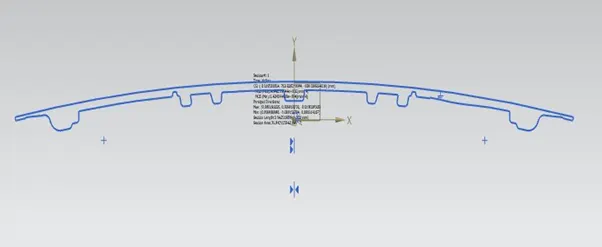
Imin =1.4221*10^4 mm4
Y=440.19
S = I/Y
S = 32.30 mm3
So in order to improve the resistance capacity of hood, we need to increase the section modulus of hood.
Here we modified the cross section of hood by offsetting the inner panel curve by 0.5mm .
Now calculating moment of inertia.
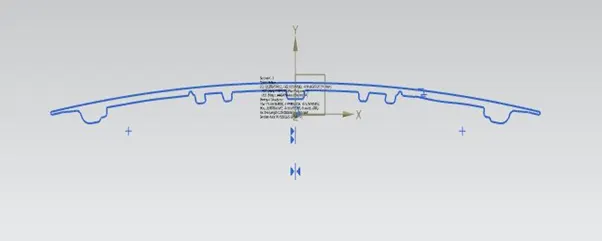
Imin = 1.445*10^4 mm4
Y = 440.19
S = I/Y
S = 32.826
CONCLUSION
So here by comparing both the design there is a change in strength value, so when I increased the cross section by 0.5 mm the section modulus value increases so that the strength.
The strength of material directly proportional to moment of inertia. Increase in sectional area there is increase in overall mass ,hence increase in strength.