Section Modulus calculation and optimization
Section Modulus is a geometric property used to calculate the bending stresses in a structural member. It is the ratio of the area moment of inertia of a section about its neutral axis to the distance of the extreme layer from the neutral axis.
It is denoted by S.
S =I/y
Where,
S = Section Modulus
I = Moment of Inertia
y = distance between the neutral axis and the extreme end of the object
The above formula depicts that the section modulus of a section is directly proportional to the area moment of inertia. To prove the same a solid model is used and enhanced to compare the section modulus of the part.
In this example a hood is subjected to calculate its original section modulus and then optimize its the design to improve the original result.
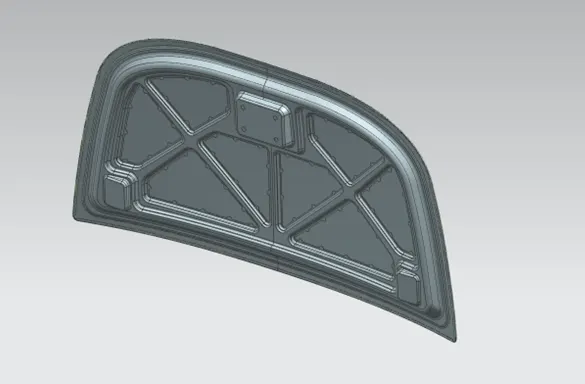
An intersection curve is created with the help of a plane over the hood body as shown below.
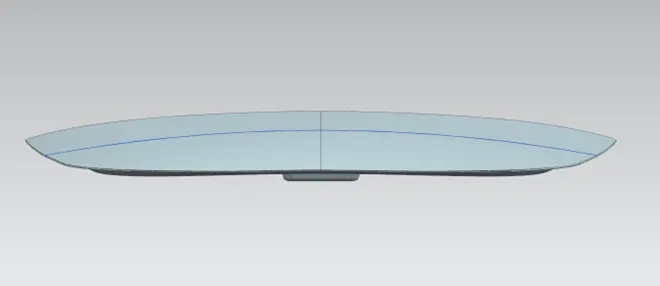
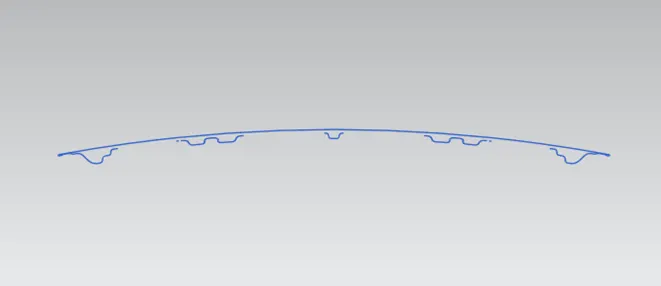
To measure the distance between the neutral axis and the extreme end of the object use simple distance tool and measure end to end distance of the section. Dividing it by 2 to gives the value of y.
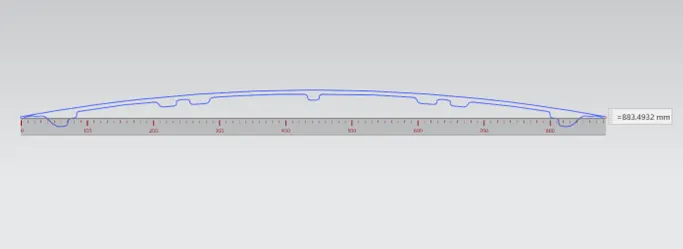
Here,
Total distance = 883.49 mm
Hence, y = 441.74 mm for both calculations.
Case 1 (Original Section):
Since the original curve is not connected properly, a sketch is created and the same curve is projected. With the help of line command all the disconnected curves are joined. Now, a sectional inertia analysis is done on the curve to get the area moment of inertia.
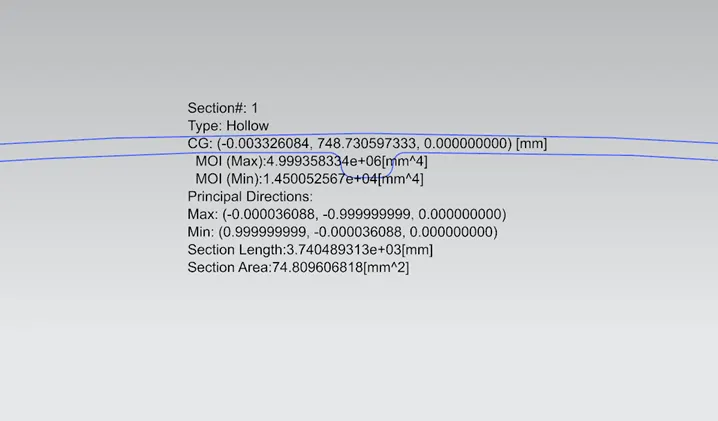
In the above image,
Maximum Moment of Inertia = I = 1.45 x (10)^4 mm^4
Hence,
Section Modulus (S) = 1.45 x (10)^4 / 441.74 = 32.82 mm^3
Case 2 (Optimized Section):
For the optimized case, I have increased the thickness of the hood by 2mm. Following is its sectional inertia analysis.
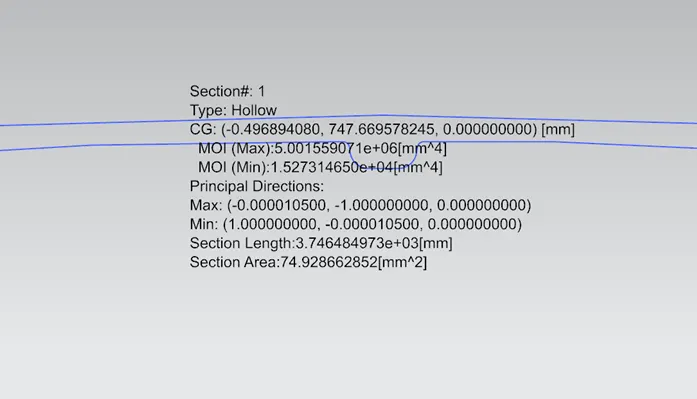
In the above image,
Maximum Moment of Inertia = I = 1.52 x (10)^4 mm^4
Hence,
Section Modulus (S) = 1.52 x (10)^4 / 441.74 = 34.4 mm^3
Conclusion:
From the solid model of hood, a cross section is analysed for the section modulus calculation. It is then optimized by increasing its thickness and again analysed for section modulus calculation. As per the results, it can be concluded that as the area moment of inertia increases the section modulus of the section also increases.