Liftgate Assembly Design
Introduction-
A car’s back door/ liftgate is a door that gives access to storage at the rear of a car. Liftgates are found on a SUV, crossover, and hatchback types of cars. It is a big door covering the rear side. This liftgate has two types. First being manual and another is power liftgate. In a manual liftgate the person manually pushes the door upwards while the power liftgate uses a motor which activates at a press of a button.
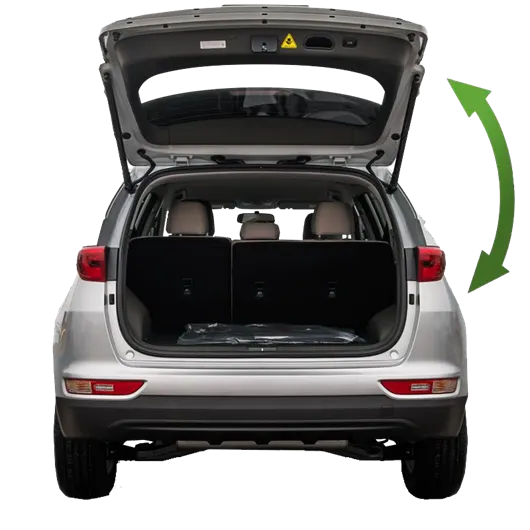
The liftgate assembly features other necessary parts such as following:
- Rear wiper – The rear wiper and its motor is attached to the inside of the liftgate panel. The motor is mounted on the inner panel and wiper on the outer panel.
- Gas stay – The gas stay is a thin tube with a piston rod. Fuelled by compressed gas, the rod moves. On each side of the liftgate, a gas stay is located. They assist in raising the liftgate during opening and provide support for it while it is open. Gast stays are incredibly robust.
- Hinges – At the upper side of the liftgate at both ends we find hinges which keeps the liftgate in contact with the car body to perform a circular shaped opening.
- Striker – A striker is a locking mechanism which is mounted at the lower side tangential to the circular trajectory of liftgate.
Project Aim-
The project aims on designing a back door assembly from provided Class-A surface. In the assembly a back door inner panel, hinge mountings & reinforcements, gas stay mountings & reinforcements, striker mounting & reinforcement, as well as wiper motor mounting and reinforcement are created. Finally, a draft analysis is done on every part.
Design methodology-
To design a car back door’s inner panel, we must be designing the sealing flange; creating mountings for hinges, gas stay, striker and wiper motor; creating embosses for increasing strength and reducing the impact forces in a n even of a collision; and designing a flange for joining the inner panel and outer panel using mastic.
Sealing Flange:
Sealing flange is a rubber portion that is wrapped around the back of the car. When the liftgate closes the rubber is pressed against the car. It seals the water and dust from entering the cabin.
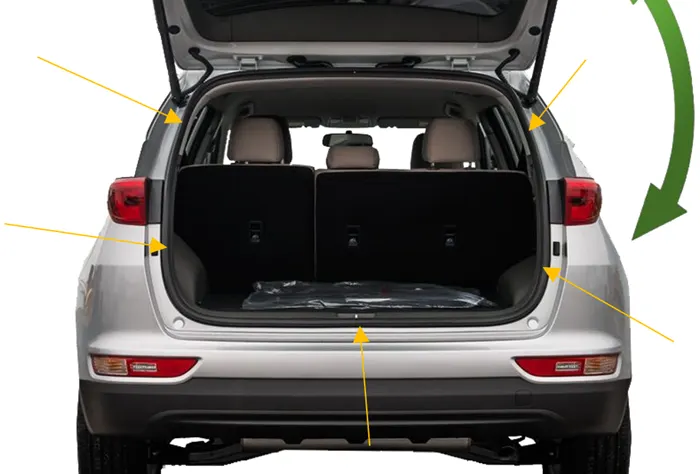
Emboss for mountings:
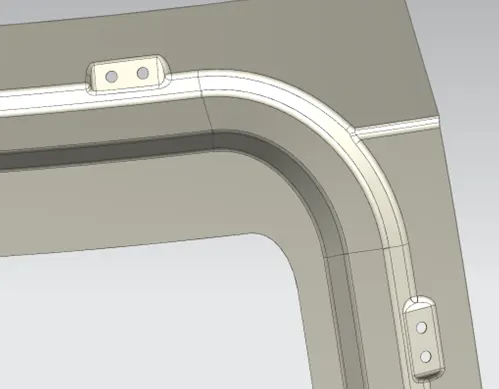
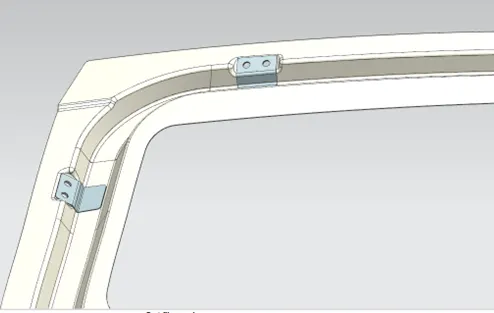
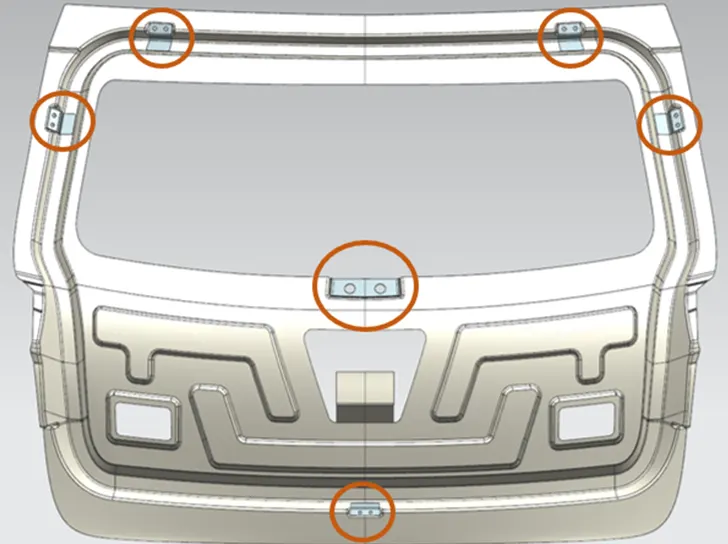
For mountings of hinges, gas stay, striker and wiper motor, embosses are created which are further reinforced for more strength.
Striker positioning:
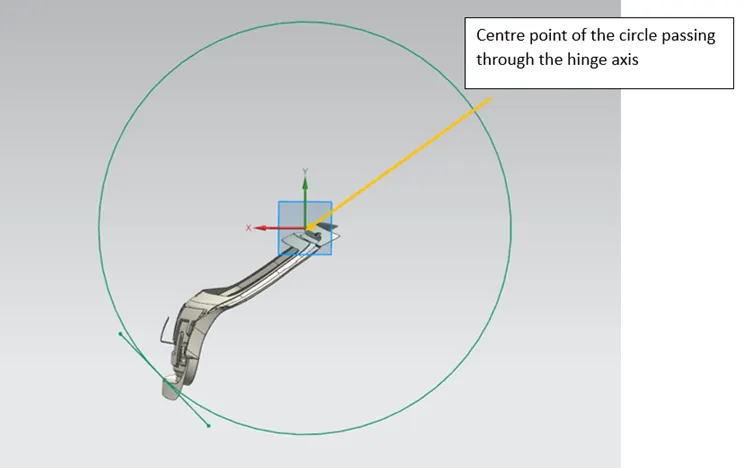
When creating a mount for striker we need to consider its position. As mentioned, the position is tangential to the door’s trajectory. Hence, a circle is drawn keeping the hinge axis as centre and extended till the mounting position of striker. Thereafter, a tangent line is drawn showing the position of the striker.
Emboss for strength:
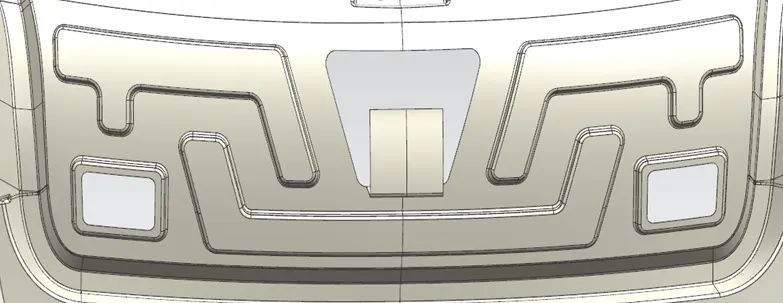
In an event of collision from the back of the car, there is low pace from the rear to the passenger cabin. Hence to strengthen the back door embosses are created on the inner panel. These embosses will provide enough strength and act as a plentiful diversion for impact force from the passenger cabin.
Hemming:
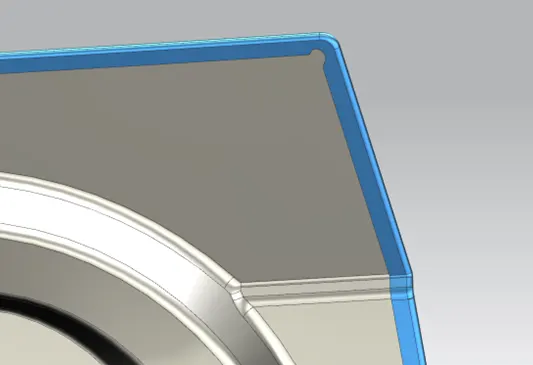
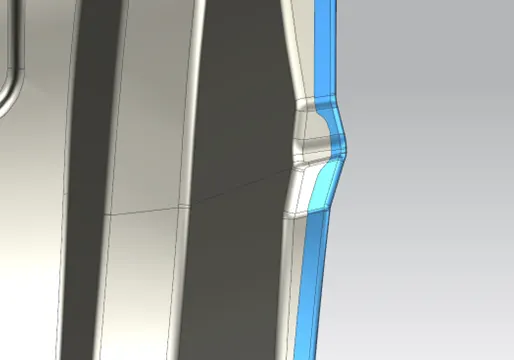
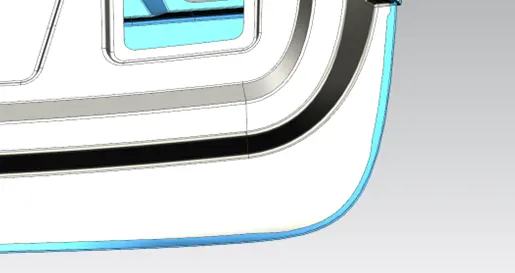
Hemming is a metal joining process wherein two sheet metal panels are joined together without the need of welding. The inner panel is placed on top of outer panel then, with the help of mechanized rollers the outer panel is folded/ closed slowly inward on the inner panel. While folding in the corners the material tends to overlap causing stress at the area. Therefore, a relief is also given at the corners of the hemming.
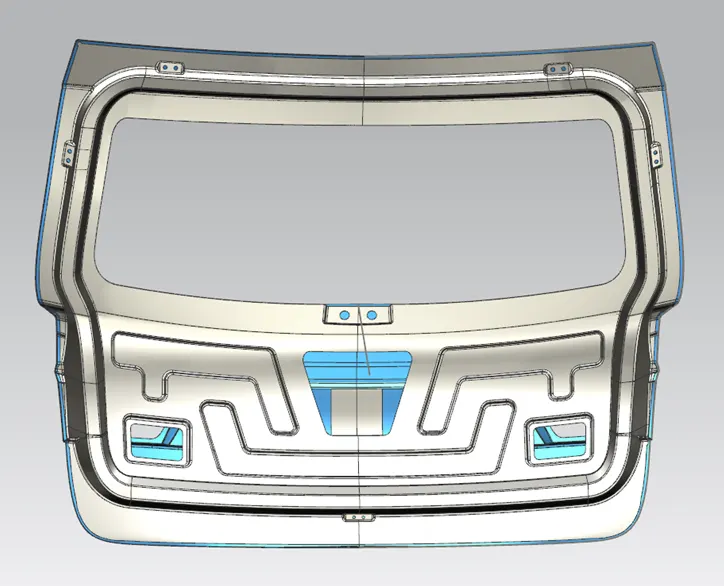
Between the panels mastic sealant is used. Since the hemming eliminates the need of welding we get a higher quality outer surface and aesthetics to the outer edge.
Draft Analysis-
Draft analysis is performed to check whether the part is manufacturable or not. When sheet metal is deep drawn it tends to stick to the surface of the cavity due to expansion. If the cavity doesn’t have a predefined draft angle then ejection of the part becomes difficult and sometimes the die is also damaged. To prevent this a minimum of 7 degrees of draft angle is provide in every area of the sheet metal component. The draft analysis shows draft in each area of the component. The draw direction is the direction in which the core and cavity moves. In this design the tooling direction is sketched as following:
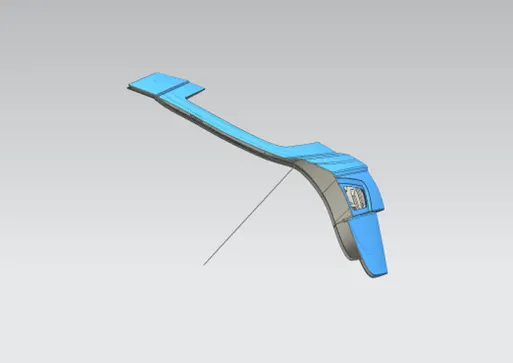
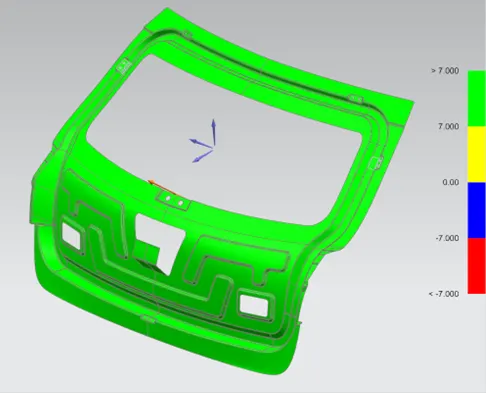
The draft analysis shows that all areas of the inner panel has a draft angle of 7 degrees and above passing the draft angle criteria.
Design parameters followed-
The distance between the inner panel and outer panel after thickening to 0.75 mm should be 0.2 mm.
The minimum distance between two features for example the holes and edge fillets for mountings should be a 5mm to avoid stress concentration.
Embosses should be designed such that the impact force is spread across.
The striker position is tangential to the door’s trajectory.
The main flange for joining the panels (under the rear glass) via mastic is designed from the inner panel material only. For mastic application 5mm space is left.
The distance between the hemming and inner panel’s outer edge is 2mm.
The hemming area should be 6 to 8 mm in length.
At the edges, relief should be provied for hemming.
Minimum draft direction at each area is 7mm.
All the faces and embosses are created considering the tooling direction.
All sharp Edges filleted.
Conclusion-
From the given surface a design of the whole back door assembly is done. Following design parameters all components are created and assembled together. The draft analysis shows that the entire inner panel is manufacturable.