Project-1: Powertrain for aircraft in runways
6. a) To calculate the force and power required to push / pull an aircraft by a towing vehicle:
Although aircrafts are quite capable of moving themselves forwards or backwards on the ground using their own engines for thrust, that is not allowed because -
- the resulting jet blast or prop wash would cause increased noise and also damage to the terminal building or equipment.
- The powerful blast can hurt airport staff due to high-speed debris.
- This debris would also be sucked into the engine, as it is in normal use, and cause excessive wear - a major cause of wear on aircraft engines is during ground use/ A pull (“tugging”) and pushback are therefore the preferred method to move ground-handling aircraft.
Towing Vehicle helps the forward movement of an aircraft, usually with engines off, using the power of a specialised ground vehicle attached to or supporting the nose landing gear.
Assuming the Towing vehicle:LEKTRO 89:
- The LEKTRO 8950SDB is designed to tow aircraft up to 180,000 lbs/81,648 kg.
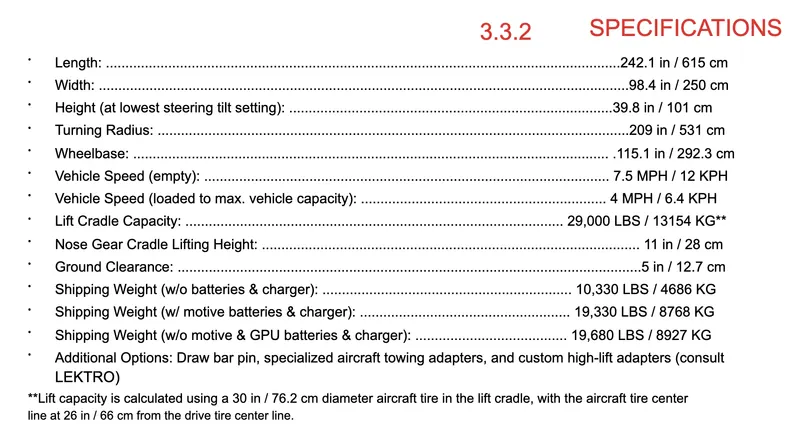
- Starting Torque should be high due to heavy vehicle.
- Towing Vehicle can't move faster because of load.
Forces required to push/pull an aircraft by towing vehicle:
Rolling Resistance Force(Frr):
- The effect of tire resistance and the road resistance on EV performance. All the frictional forces which act on the vehicle movement are clubbed under rolling resistance force.
- Frr=μR mg ;where μR is coefficient of rolling resistance, m is mass of vehicle(kg) and g is gravitational accleration(m/s^2)
- let, μR =0.01
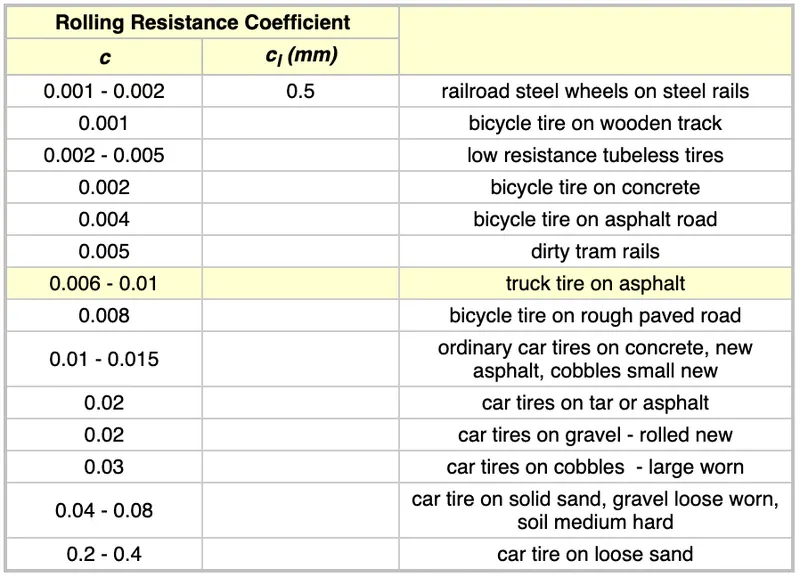
- Alternatively, Frr=μR mg/r; where r is raduis of wheel. Because of small wheels, rolling resistance will be high.
Aerodynamic Drag Force (Fag):
- The force the vehicle body encounters while vehicle is moving at certain speed through the air.
- Fad=½Cd ρAv2 ;where Cd is aerodynamic drag coefficient, ρ is density of air(kg/m^3), v is velocity of vehicle(m/sec) and A is frontal area(m^2)
- Lets consider Cd=0.82
- As speed(v) of LEKTRO 89 with load is 6.4 km/h; so, Fad is also low(negligible).
Force due to acceleration:
- This force is not considered because speed of towing vehicle is very low(6.4 Km/h) with load and aircraft engine is OFF.
- Total Force=Aerodynamic force+ Rolling resistance force
- Fte= ½Cd ρAv2 + μR mg
Assumptions:
m=81,648 kg (Aircraft)+ 8000kg(Towing Vehicle)
Cd=0.82
A=(2.5*1.01)=2.525 m^2
v=6.4 km/h=1.78 m/s
μR =0.01
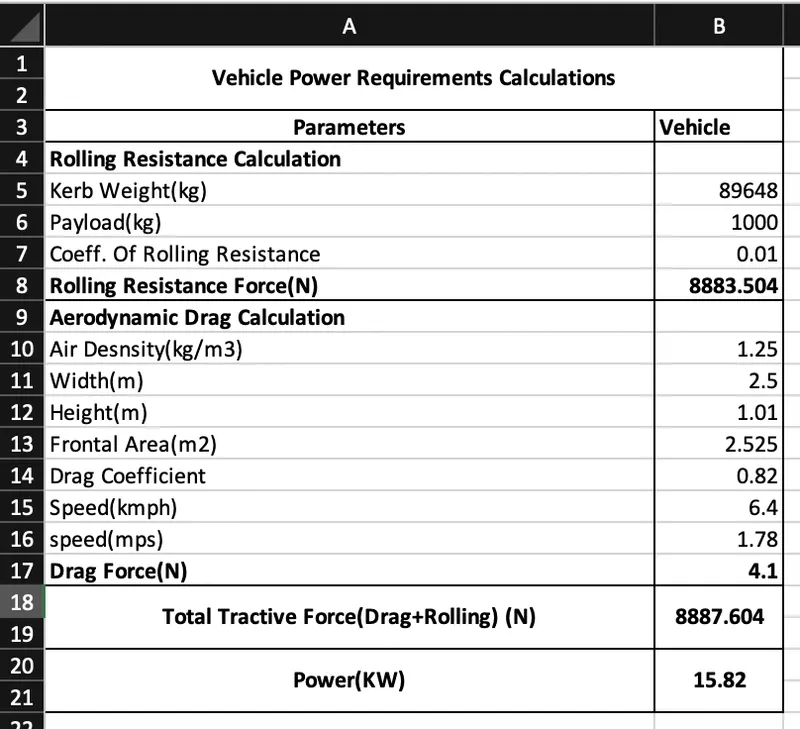
In Excel calculator:
Simulink Model:
- Model is made by using force equation.
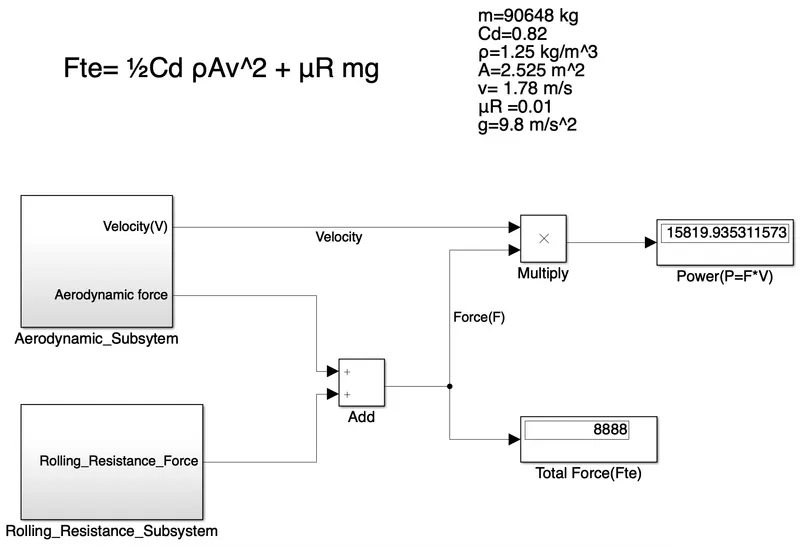
Subsytems:
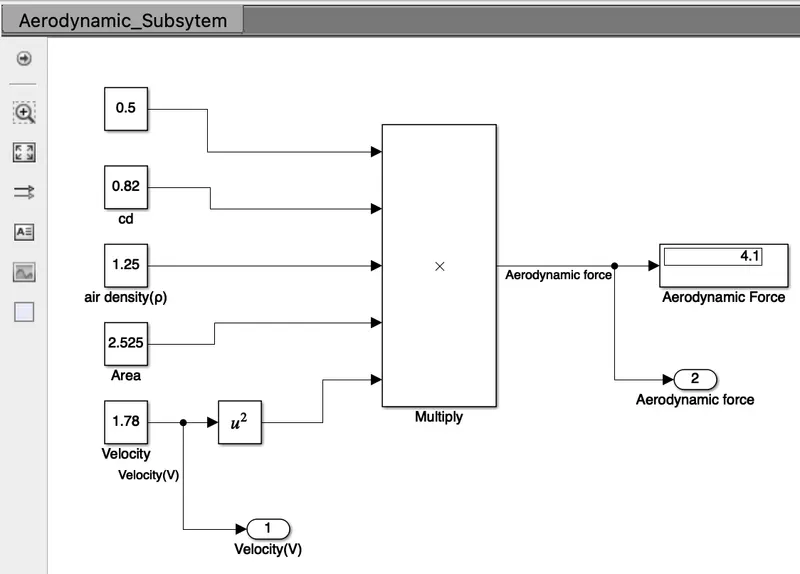
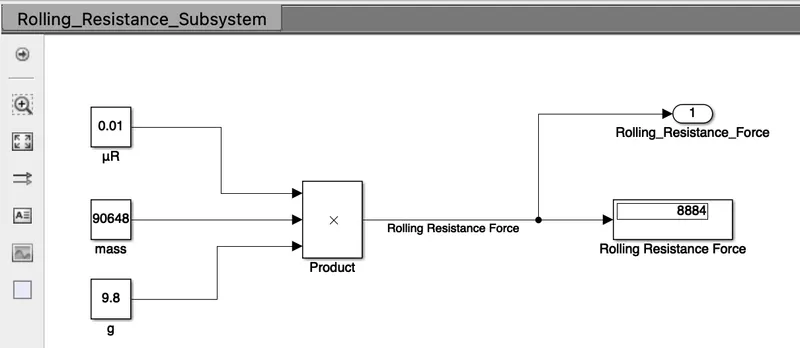
Results:
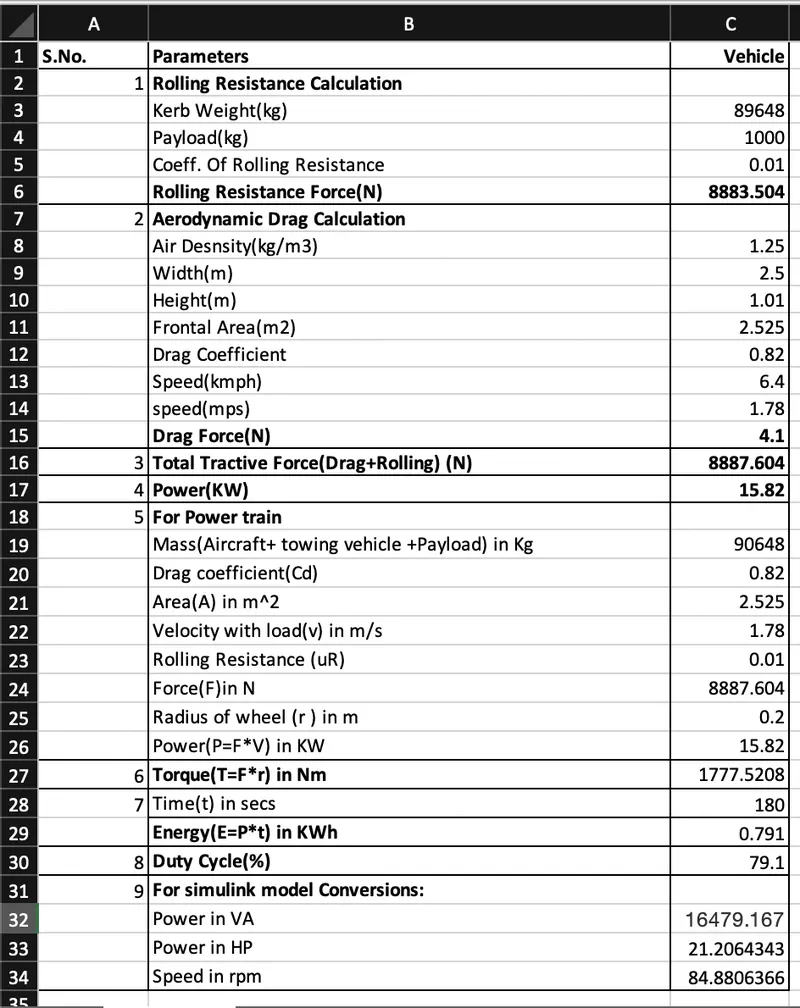
According to assumed conditions, Force is 8888 N and power is 15.82 KW.
7. To design an electric powertrain with type of motor, it’s power rating, and energy requirement to fulfill aircraft towing application:
Assumptions for Electric Power Train:
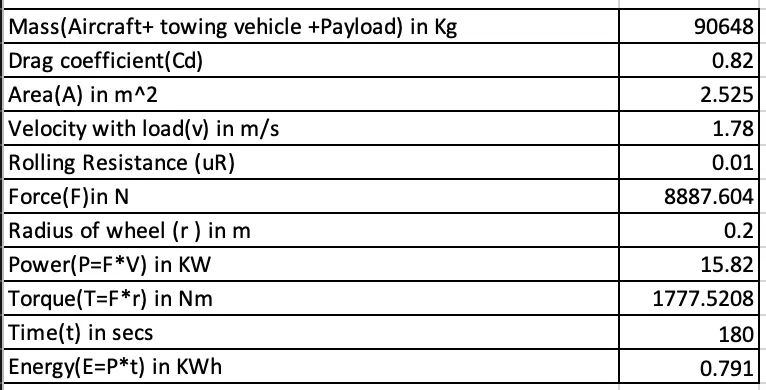
- As speed is low, Motor with high torque is required to carry heavy load.
- According to this load (Power=15.82 KW, Torque=1777.5 nm); PMSM 3-phase synchronous motor specifications are taken into consideration:
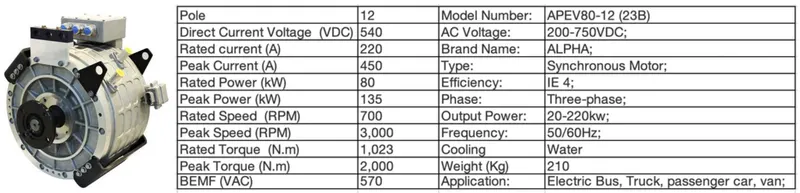
- Assume motor efficiency=89%
- Duty Cycle=Output Power/Input Power
=15.82/20
=0.791=79.1%
- Therefore, Duty cycle range is 0% to 79.1%.
- Block-diagram of Powertrain:
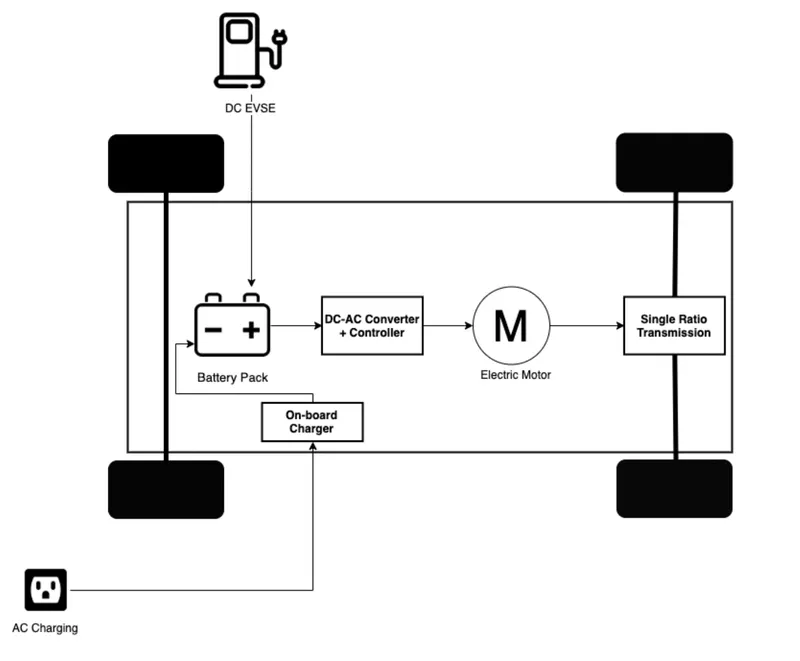
- Battery Pack:The battery pack is made up of multiple Lithium-ion cells and stores the energy needed to run the vehicle. Battery provides DC.
- DC-AC converter:The DC supply by battery pack is converted into AC and supplied to electric motor.
- Electric Motor:Converts the electrical energy into mechanical energy and delivers to wheel by single ratio transmission.
- On-board charger: Converts AC received through charge port to DC and controls the amount of current flowing into battery.
Simulink-model:
- As, Specifications are of AC synchronous motor, so taken the reference model i.e. AC4
- AC4 model is based on the three-phase induction motor.
- Changed the torque, speed, power, voltage, frequency, no of poles according to assumed conditions.
- As motor voltage rating is 200-750VDC, so here in model it is 460V.
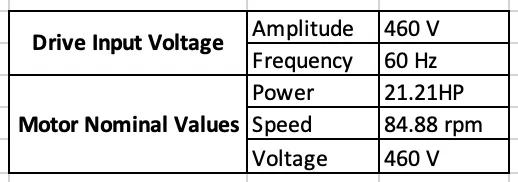
AC4 - DTC Induction 21.21 HP Motor Drive
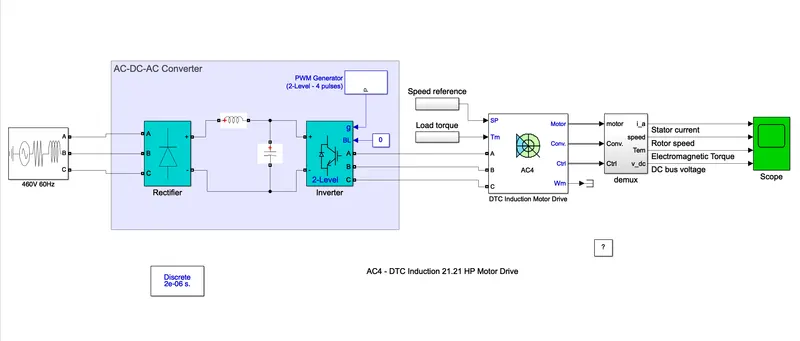
- From grid, AC power is converted into DC for lithium-ion batteries than again into AC for electric motor. Here DTC induction motor drive is used.
- First AC is rectified by a six pulse diode bridge. The filtered DC voltage is applied to an IGBT two-level inverter generating 50 Hz. The IGBT inverter uses Pulse Width Modulation (PWM) at a 2 kHz carrier frequency.
- This motor has a three-phase winding at the stator and a wound rotor or a squirrel-cage rotor. The squirrel-cage rotor consists of slots of conducting bars embedded in the rotor iron. The conducting bars are short-circuited together at each end of the rotor by conducting rings.
- The induction motor is fed by a PWM voltage source inverter which is built using a Universal Bridge Block. The speed control loop uses a proportional-integral controller to produce the flux and torque references for the DTC block. The DTC block computes the motor torque and flux estimates and compares them to their respective reference. The comparators outputs are then used by an optimal switching table which generates the inverter switching pulses.
- Motor current, speed, and torque signals are available at the output of the block.
Simulation:
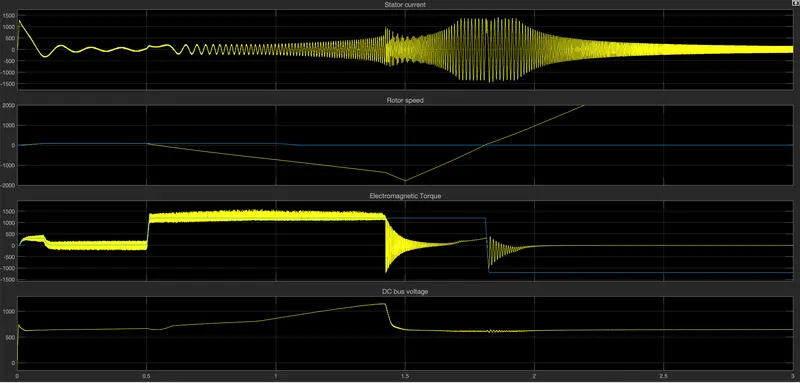
- At time t = 0 s, the speed set point is 84.88 rpm.
- At t = 0.5 s, the full load torque is applied to the motor shaft while the motor speed is still ramping to its final value.
Excel calculator for all parameters: