Week-4 Challenge WOT Condition Part-2
- What is the difference between mapped and dynamic model of engine, motor and generator? How can you change model type?
Solution:
Dynamic models describe processes that have a memory, or more formally processes for which the state at a given time depends on the states and inputs at previous times. These models are described mathematically by differential equations in continuous time or difference equations in discrete time.
Static models describe memory-less processes where the current state only depend on the current input (and not on previous inputs). Such processes are represented mathematically by algebraic equations. These model uses a set of steady-state loopup tables.

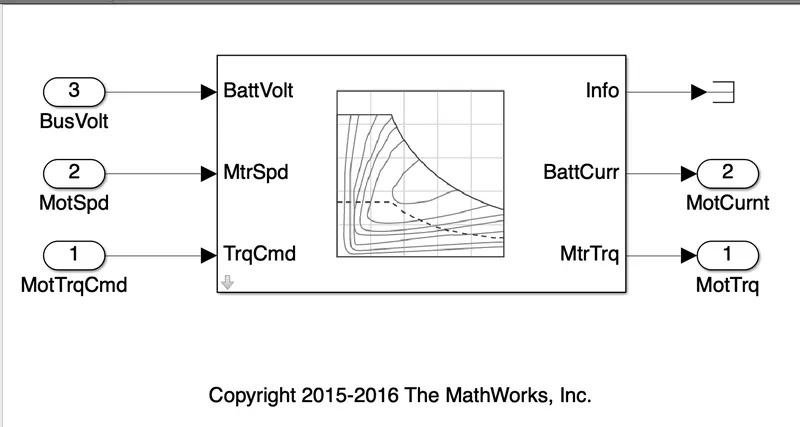
Example of Mapped Motor:
- Implements a mapped motor and drive electronics operating in torque-control mode. Specify electrical torque range with a torque-speed envelope or maximum motor power and torque. Output torque tracks a torque reference demand and includes a motor and drive response time constant. Specify electrical losses as a single operating point that estimates loss across the operating range, measured loss, or measured efficiency.
Example of Dynamic Motor:
- Interior PM controller SS Trq: Implements a torque-based, field-oriented controller for an internal permanent magnet synchronous machine (PMSM) with an optional outer-loop speed controller. The torque control implements strategies for maximizing the torque per amp (MTPA) and weakening the magnetic flux.
- Interior PMSM SS Spd: Model the dynamics of a three-phase interior permanent magnet synchronous motor (PMSM) with sinusoidal back electromotive force.
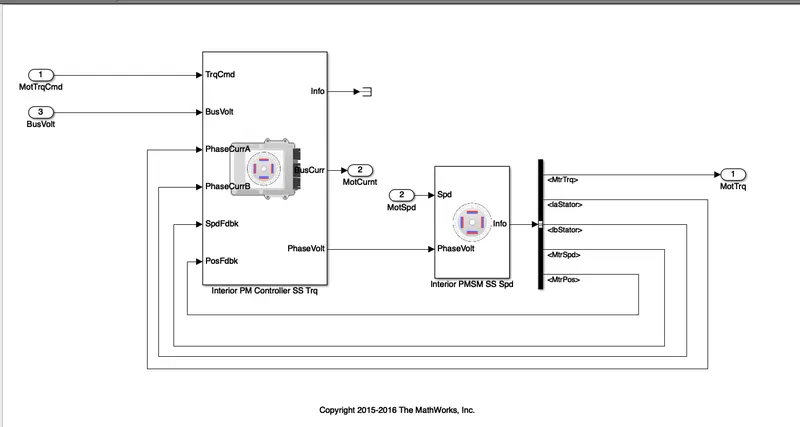
- To change model type: click on varient manager then right click on model and set as label mode active choice.
2.How does the model calculate miles per gallon? Which factors are considered to model fuel flow?
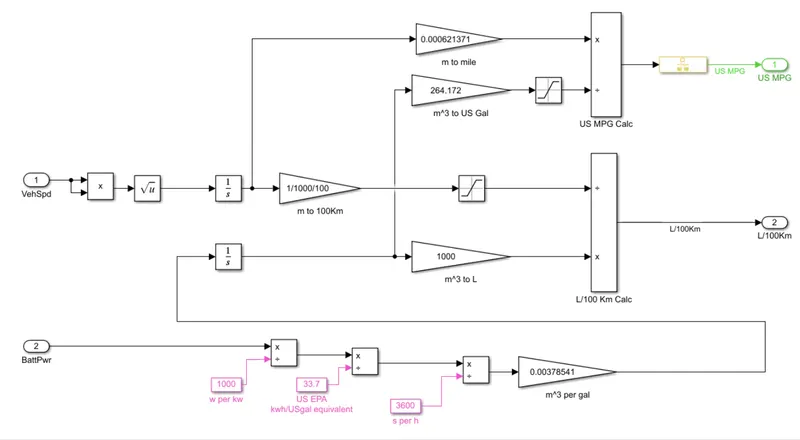
- Battery power(inport 2) is converted into KW, then to US EPA and then to (s per h). After that gain block is used to convert into m^3 per gal, this values integrates.
- This integrated value goes to gain block(m^3 to US gal), which further goes to Saturation and limit is set in saturation block.
- From inport1, Vehicle speed is given to intergrator which gives distance and this distance value goes to gain block(0.000621371).
- The output of this gain block and saturation block is divided by using US MPG calc, this gives miles per gallon value.
- For conversion, gain and product/divide blocks are used.
- To set limits, saturation blocks are used.
- Integrator block shows values are changing w.r.t time.
3. Run the HEV ReferenceApplication with WOT drive cycle. Change the grade and wind velocity in the environment block. Comment on the results.
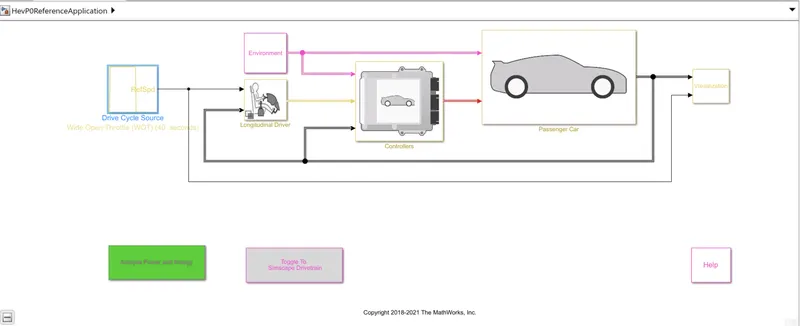
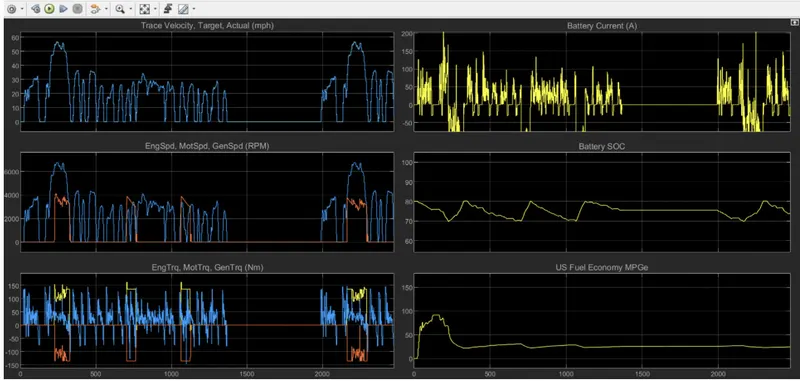
- It is Backward facing model where arrows are from Wide Open Throttle(WOT) drive cycle to Passenger car.
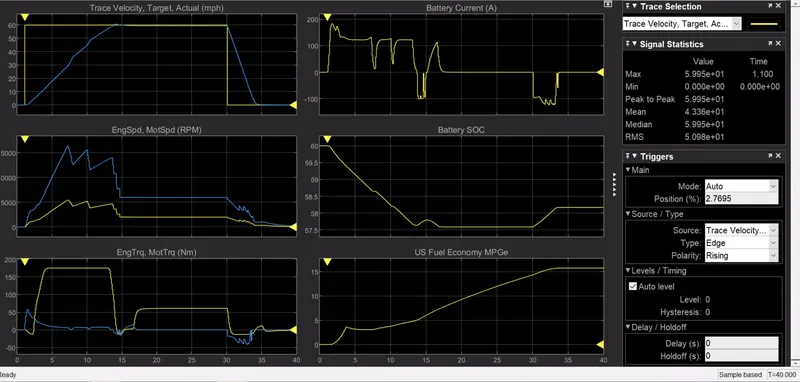
- Original signals are yellow in color and Actual signals are Blue in color.
- In First graph-Trace Velocity vs Trarget Velocity-At ideal WOT condition, velocity reaches at 60mph in no time it is maximum Torque region(around 170 Nm) where as pratically it takes some time to attain due to discharge of battery current(graph2).
- After ataining speed, Vehicle enters in Maximum Power region, where trace velocity follows the Target Actual Velocity(graph1)
- When battery current (graph2) goes negative, Vehicle starts deacclerating and vehicle operates in Regenerative Braking mode. Also, Torque(graph5) is negative in this mode and motor speed(graph3) is inversely proportional to torque as motor is acting as generator.
- Graph4 is Battery SOC (State of Charge)-Battery is draining at starting, as vehicle starts deaccelerating, Battery starts charging.
- Graph6 is US Fuel Economy in miles per gallon.
- If we increase the grade from 0, then speed of the vehicle also decreases from Trace velocity(graph1).
- In this, Wind Velocity is Zero, if we increase wind Velocity then vehicle will face more resistance and performance may decrease.
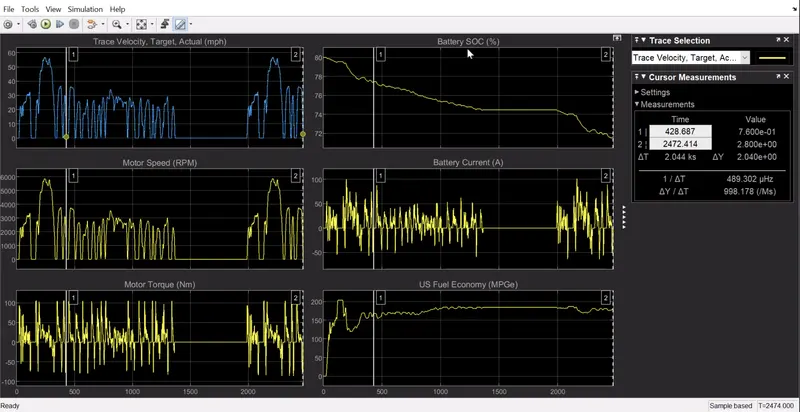
4. Keeping all other parameters same, compare the simulated results of hybrid and pure electric powertrains.
Solution:
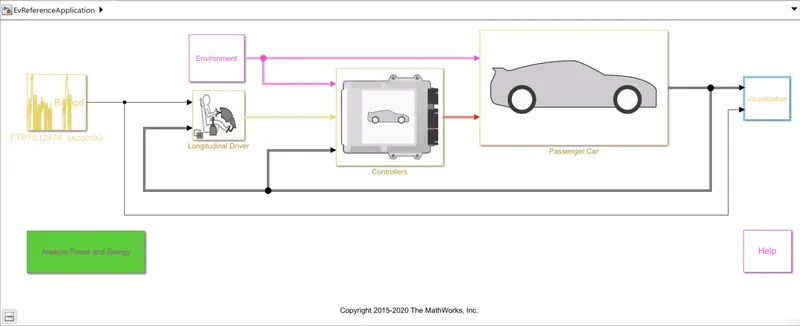
- To open EV model, type 'autoblkEvStart' in command window.
- Model:
- Simulation Results:
- To open HEV model, type 'autoblkHevStart' in command window.
- Model:
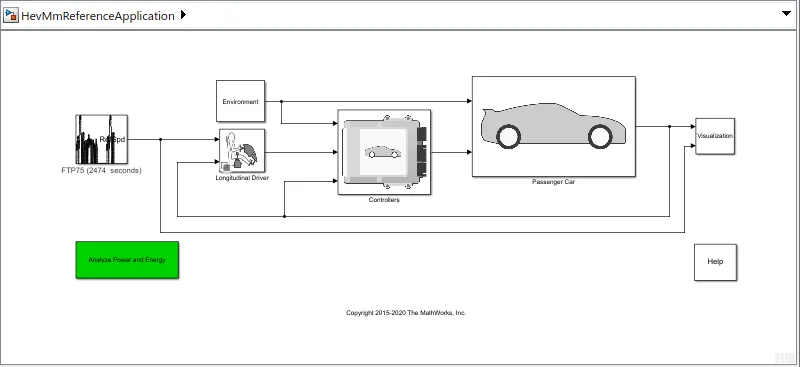
- Simultaion Results: