Week 1 Understanding Different Battery Chemistry
1.Materials & chemical reactions of lithium ion cells
- A battery is made up of several individual cells that are connected to one another.
Internal connection of battery:
- It contains five components: positive electrode (a cathode), negative electrode (an anode), liquid electrolyte, separator and current collector.
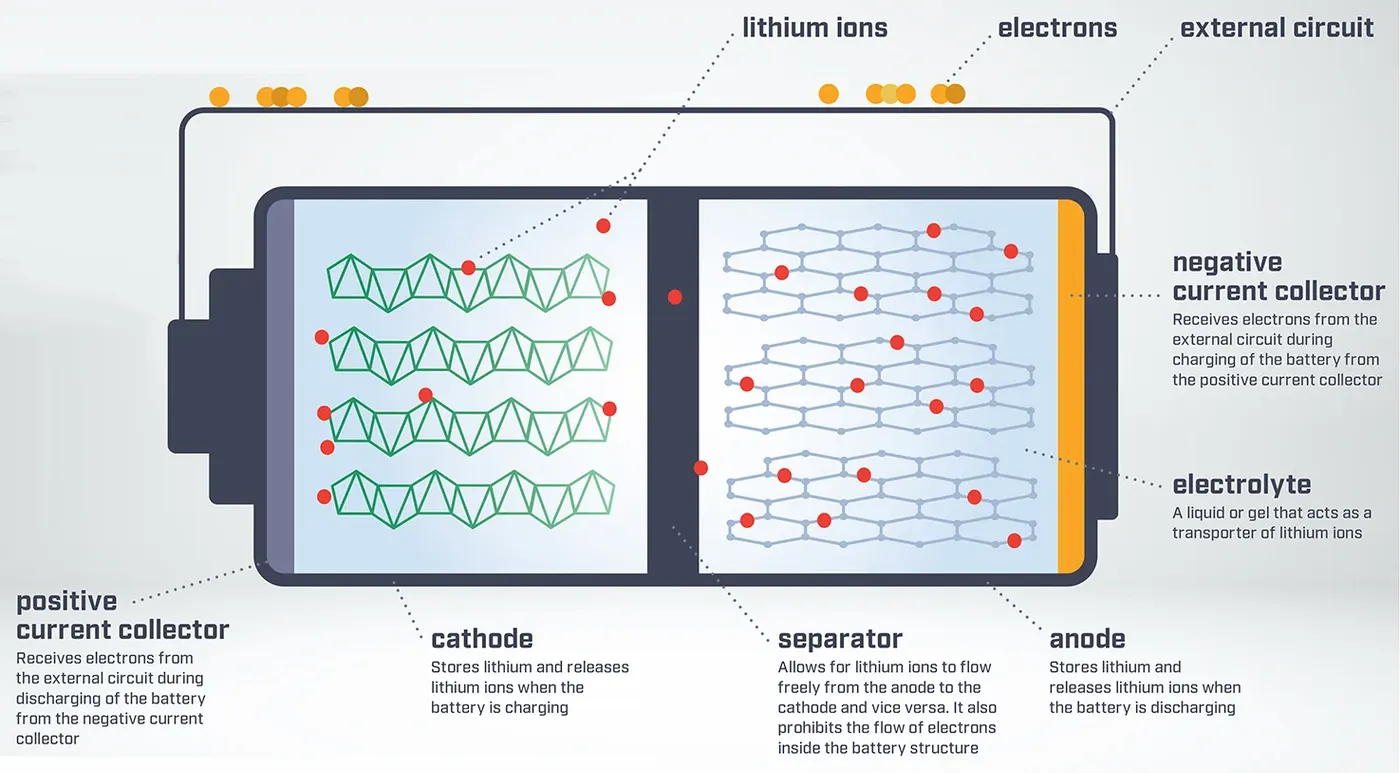
- Cathode(+ve): It is oxidizing electrode that acquires electrons from the external circuit and is reduced during the electrochemical reaction. Cathode materials: Metal oxides derived from cobalt, nickel, manganese, iron, aluminum.
- Anode(-ve): It is reducing electrode that releases electrons to the external circuit and oxidizes during and electrochemical reaction.Anode materials are Carbon based, example- Graphite.
- Electrolyte: It is the medium that provides the ion transport mechanism between the cathode and anode of a cell. It is lithium salt in an organic solvent.
- Separator: It segregates the anode from the cathode, forming an isolator for electrons but allowing ions to pass through.
- Current collector: It is used to provide conduction of electrons from inside the electrochemical reaction to the external part without any reaction within the operation window. For positive current collector-Aluminium foil is used and for negative current collector-Copper foil is used.
Working:
- During Charging: The lithium atom is separated from its metal oxide structure. The lithium ions moves to the anode through the elctrolyte and the electrons flow through the external circuit and reaches the graphite structure.
- During Discharging: The lithium ions moves back and combine with metal oxide structure. The electrons flow from graphite layer through the load back to the metal oxide.
- As long as lithium ions are making the trek from one electrode to another, there is a constant flow of electrons. This provides the energy to keep your device running. Since this cycle can be repeated hundreds of times, this type of battery is rechargeable.
- The lithium based batteries have the ability to work for many years but the capacity also decreases over time. This is due to the formation of Solid Electrolyte Interface or SEI.
Types:
- Lithium cobalt oxide (LCO)
- Lithium manganese oxide (LMO)
- Lithium nickel cobalt aluminium oxide (NCA)
- Lithium nickel manganese cobalt oxide (NMC)
- Lithium iron phosphate (LFP)
- Lithium titanate (LTO)
Lithium cobalt oxide (LCO):
Inside a lithium-ion battery, oxidation-reduction (Redox) reactions take place.
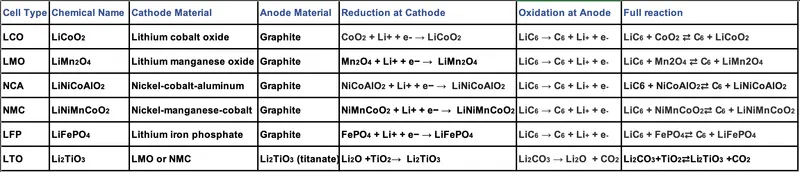
Reduction takes place at the cathode. There, cobalt oxide combines with lithium ions to form lithium-cobalt oxide (LiCoO2). The half reaction is:
CoO2 + Li+ + e- → LiCoO2
Oxidation takes place at the anode. There, the graphite intercalation compound LiC6 forms graphite (C6) and lithium ions. The half-reaction is:
LiC6 → C6 + Li+ + e-
Here is the full reaction (left to right = discharging, right to left = charging):
LiC6 + CoO2 ⇄ C6 + LiCoO2
- Table of chemical reactions:
2. Li+ion batteries characteristics:
Some used terms:
- Energy density is measured in watt-hours per kilogram (Wh/kg) and is the amount of energy the battery can store with respect to its mass. Determines the driving range/charge.
- Power density is measured in watts per kilogram (W/kg) and is the amount of power that can be generated by the battery with respect to its mass. Determines the acceleration rate possible in EVs
- SOC (state of charge) of battery, it means it can estimate the ratio of present charge to the full charge capacity.This will enable the driver to take decisions about the range of vehicle can go.
- SOH (state of health) of battery is very important for the driver to know w.r.t vehicle performance and life cycle. so when the battery is charged or discharged many times, it losses the capacity of charging to its full capacity which is designed orginally. Over many cycle of charge and discharge the battery can't be charged fully. So, if there is estimate on the present full charge capacity with the orignal full charge capacity, the health of battery is known.
- C-rate:Charge and discharge rates of a battery are governed by C-rates. The capacity of a battery is commonly rated at 1C, meaning that a fully charged battery rated at 1Ah should provide 1A for one hour. The same battery discharging at 0.5C should provide 500mA for two hours, and at 2C it delivers 2A for 30 minutes. Losses at fast discharges reduce the discharge time and these losses also affect charge times.
- Closed circuit voltgae(CCV):The potential or voltage of a battery when it is discharging or charging.
- Cycle-life:the Total number of charge/discharge cycles the cell can sustain before it’s capacity is significantly reduced.
- Open circuit voltage(OCV):The difference in potential between the terminals of a cell when the circuit is open (i.e., a no-load condition). The voltage of a battery when it is not delivering or receiving power.
- Shelf-life:The duration of storage under specified conditions at the end of which the battery still retains the ability to give a specified performance.
- Thermal-runaway:A critical condition arising during constant voltage charging in which the current and the temperature of the battery produce a cumulative mutually-reinforcing effect which further increases them and can lead to the destruction of the battery.
Battery-characteristics:
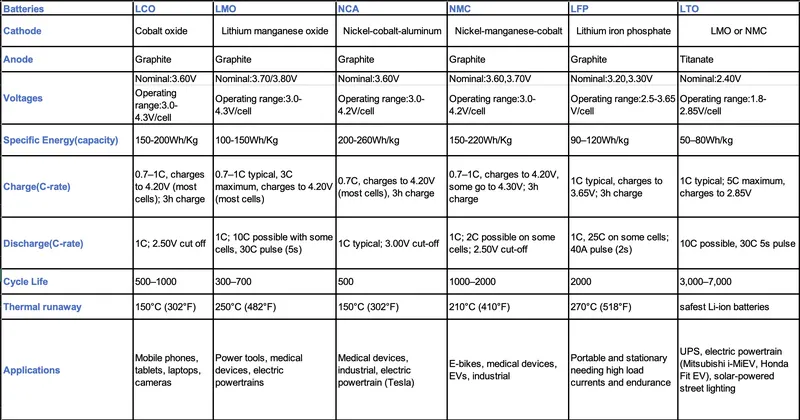
- Lithium cobalt oxide (LCO):The battery consists of a cobalt oxide cathode and a graphite carbon anode. The cathode has a layered structure and during discharge, lithium ions move from the anode to the cathode. The flow reverses on charge. The drawback of Li-cobalt is a relatively short life span, low thermal stability and limited load capabilities (specific power).The drawback of Li-cobalt is a relatively short life span, low thermal stability and limited load capabilities (specific power). Like other cobalt-blended Li-ion, Li-cobalt has a graphite anode that limits the cycle life by a changing solid electrolyte interface(SEI), thickening on the anode and lithium plating while fast charging and charging at low temperature.
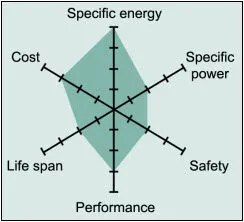
- Lithium manganese oxide (LMO): Li-ion cell with lithium manganese oxide as cathode material. The architecture forms a three-dimensional spinel structure that improves ion flow on the electrode, which results in lower internal resistance and improved current handling. A further advantage of spinel is high thermal stability and enhanced safety, but the cycle and calendar life are limited.Low internal cell resistance enables fast charging and high-current discharging.
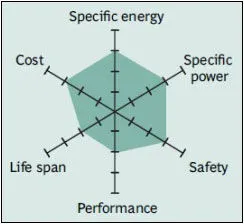
- Lithium nickel cobalt aluminum oxide (NCA):Offering high specific energy, reasonably good specific power and a long life span. Less flattering are safety and cost. NCA is a further development of lithium nickel oxide; adding aluminum gives the chemistry greater stability.
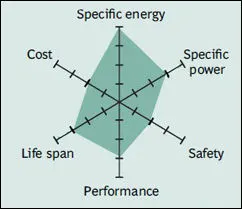
- Lithium nickel manganese cobalt oxide (NMC): One of the most successful Li-ion systems is a cathode combination of nickel-manganese-cobalt (NMC).Nickel is known for its high specific energy but poor stability; manganese has the benefit of forming a spinel structure to achieve low internal resistance but offers a low specific energy. Combining the metals enhances each other strengths.NMC is the battery of choice for power tools, e-bikes and other electric powertrains.
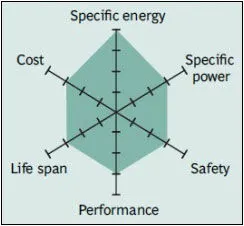
- Lithium iron phosphate (LFP):Li-phosphate offers good electrochemical performance with low resistance. This is made possible with nano-scale phosphate cathode material. The key benefits are high current rating and long cycle life, besides good thermal stability, enhanced safety and tolerance if abused.Li-phosphate has a higher self-discharge than other Li-ion batteries, which can cause balancing issues with aging.
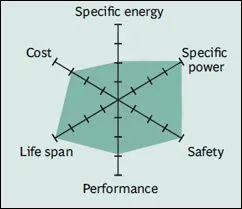
- Lithium titanate (LTO): Li-titanate replaces the graphite in the anode of a typical lithium-ion battery and the material forms into a spinel structure. The cathode can be lithium manganese oxide or NMC.No SEI film formation and no lithium plating when fast charging and charging at low temperature. Thermal stability under high temperature is also better than other Li-ion systems; however, the battery is expensive.
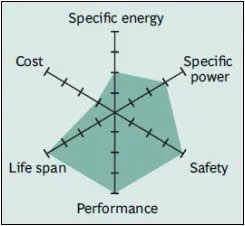
- Comparison of lithium ion cells types: