Project 1
PROJECT-1
Aim: To route the wiring harness on given V16 Engine and to create flatten view drawing in CATIA V5.
Objective: The objective of the project is to route the wiring harness on given Engine and prepare flatten view drawing in CATIA V5. All types of packaging rules have to be considered while routing the harness. Also, Industry best practices should be demonstrated in design. All the necessary details like clearance, clipping/clamping selection, harness fixing requirements, harness continuity should be provided in order to design wiring harness.
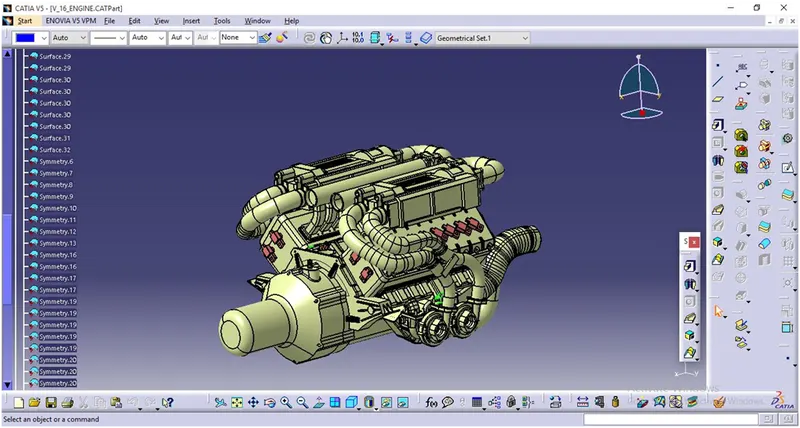
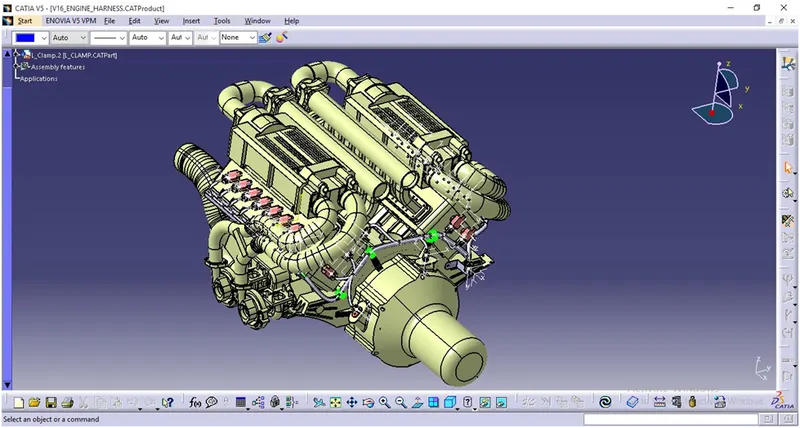
Fig. shows V16 Engine
- The above figure shows the 16 valve Bugatti Engine where 8 cylinders are placed on the right side and 8 cylinders are placed on the left side.
- There are total 16 injectors where 8 injectors are used for 8 cylinders on right side and 8 injectors are used for another 8 cylinders on left side.
- Also there are 4 cam-shaft sensors, so there are total 16 F.I sensors that we have to connected electrically.
- Generally, 4-pole connectors are used for fuel injectors of the engine.
- The engine will also have an interconnection connector which will connect the engine to other parts of the vehicle. We will be using a 12-pole electrical connector with a mounting clip feature as an interconnection connector.
- The plastic guiding channel used in this harness should be made of a material that can withstand at least 150° C.
- The bend ratio for the all bundle segments should be 1.4.
Assumptions:
- Provide clips/clamps as per requirement.
- Make sure that there is no any fauling case while designing the wire harness. Additional clips/clamps may be used to avoid fauling case.
- Give additional slack if needed. 5-10% slack is sufficient.
- Avoid routing over bolt and bolted joints to avoid harness puncture.
- Avoid routing on sharp edges or else provide protection over the harness.
- Follow the clearance distance and keep away the harness from heat generation components.
- Protection should be provided as needed according to surrounding temperature.
- Avoid direct support for harness on fuel lines routed in the engine.
- Use plastic guiding channels if needed.
- Branch length should be greater than 50mm.
- Minimum distance between two branch points should be at least 50mm.
- Minimum distance between clip and branch point.
- Avoid too many sheet metal brackets on the engine. Try to use available threaded bosses on the engine or demand for it.
- The wiring harness should be easy to assemble and easy to access.
- While using dummy connectors, ensure that whatever positions you are defining that are practical. Bundle diameters and another placements can be defined properly for the wire harness routing.
- If the packaging area is too tight and there are many packaging constraints then we can think of creating harness channel which can be used to route and protect the wire harness effectively.
Step 1: Creating Context Assembly
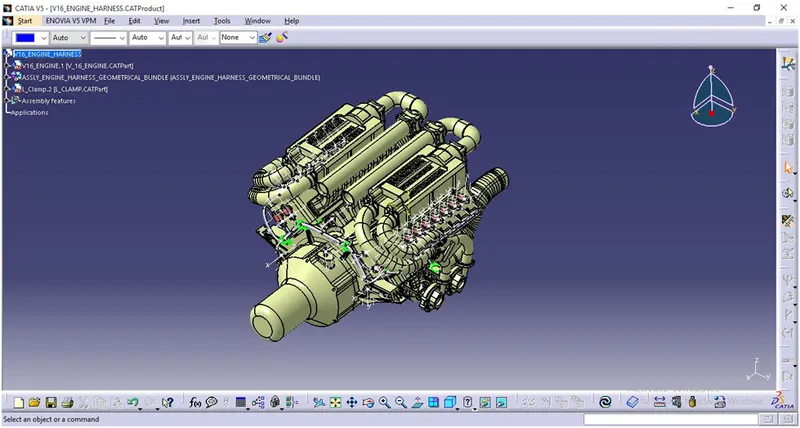
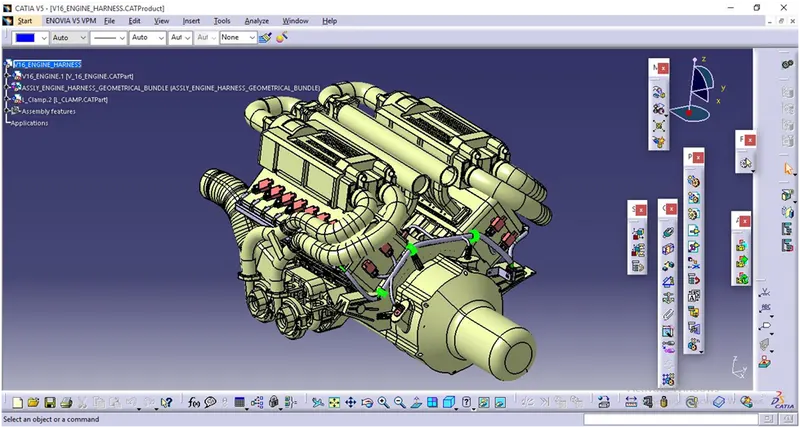
- A Context Assembly for Engine Harness has created which will work as the main assembly as shown in above figure.
- A Context Assembly will contain Engine Assembly data for V16 Engine and Engine harness Geometrical Bundle Assembly.
- If any sheet metal bracket will require then they are added in the context assembly.
Step 2: To define 4-pole connector electrically.
Here, according to the requirement we are using 'C-1563689' which is a 4-pole connector. This CAD data is downloaded from te.com. Now, to define a connector electrically we should define the geometrical parameters like bundle connection point and connector connection point in Electrical Part Design workbench for the downloaded connector.
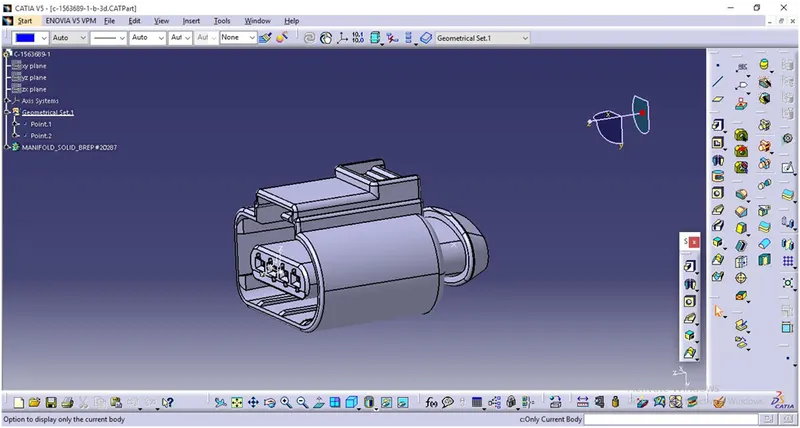
Above figure shows the connector connection point for the connector C-1563689-4P. Accordingly all other connectors are defined electrically.
Step 3: Adding connectors to the all 16 fuel injector sensors and 4 cam-shaft sensors.
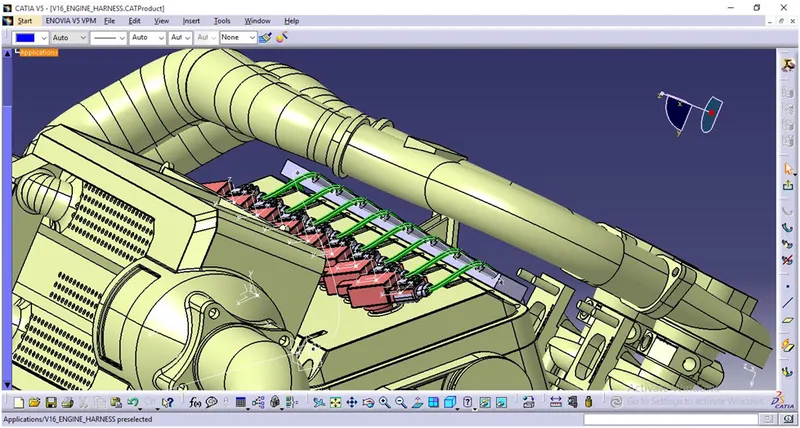
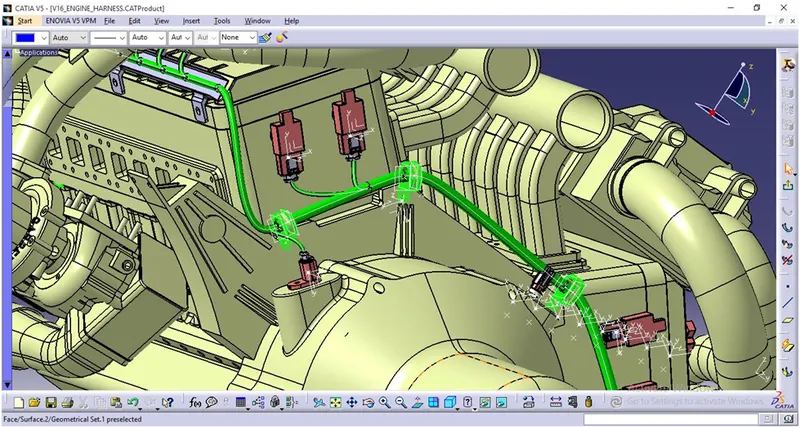
In this step, we are placing connectors to fuel injector sensors and cam-shaft sensors. So we will require total 20 connectors which have to be added in the Engine Harness geometrical Bundle Assembly. We have to use manipulation tools along with compass, snap and smart move features to locate all the connectors.
Step 4: Adding sheet metal bracket (L-Clamp).
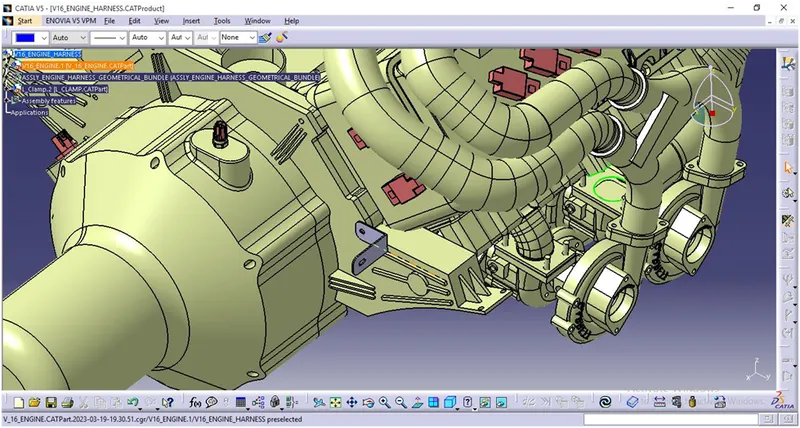
Now, we have to add sheet metal bracket in order to provide mounting for the interconnection connector. Also, we have to make sure that the bracket is placed inside the context assembly and outside of engine and geometrical bundle assembly. The bracket should be mounted on the existing bolt as shown below. This bracket should have locking system in clockwise direction so that it can't be move freely. Herein below figure, rib is performing the locking feature for the bracket. All the design ideas should be discussed with the engine designing team so that there won't be any disturbance for the smooth working of engine in real world application.
Step 5: Mounting the interconnection connector on the sheet metal bracket and mounting the p-clamps for wire harness.
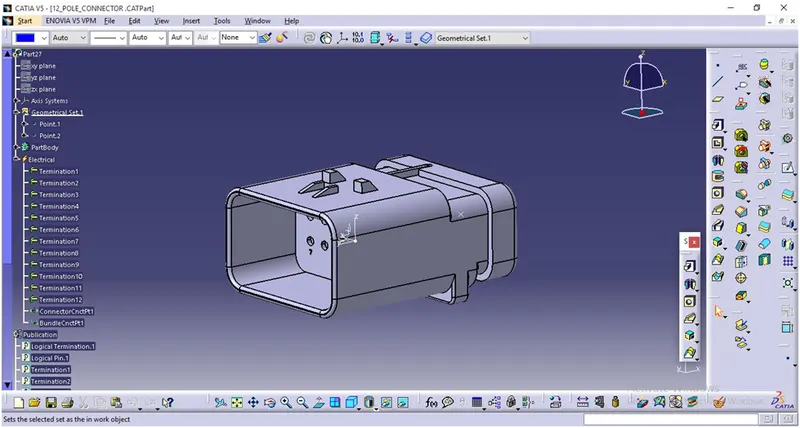
Here, a 12 pole connector "C-776438-4" and mounting cavity "C-1924487-2" is together used as interconnection connector. The required cad data is downloaded from te.com. First, we have to define 12 pole connector and mounting cavity electrically as below.
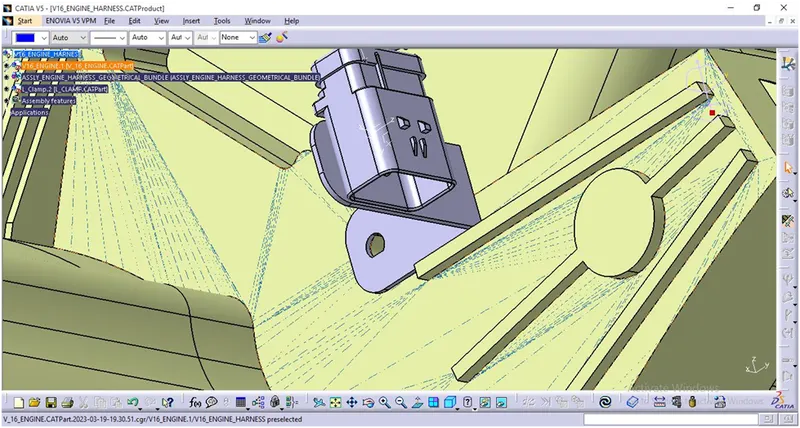
Above figure shows that, both 12 pole connector and mounting cavity are electrically connected together in electrical assembly design workbench.
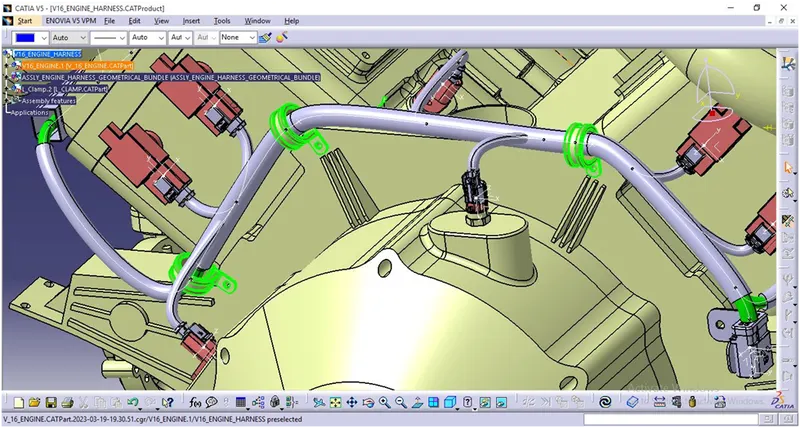
Here, we have mounted 3 P-clamps on the existing bolts of the engine for the wire harness routing as shown in above figure.
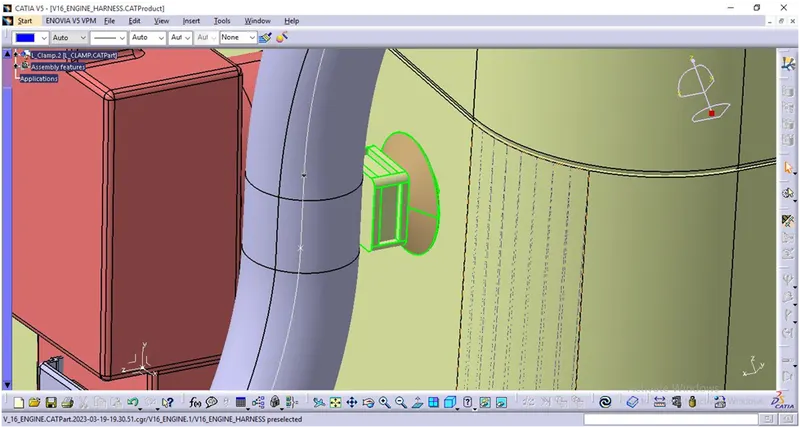
- In above figure, we have mounted furr tree clip also for the smooth path to wiring harness routing towards guiding channel on both right and left side.
Step 6: Mounting of a plastic guiding channel.
We have to add now plastic guiding channel because Bugatti V16 engine has 8 injectors on right side and 8 injectors on left side which are very close to each other. Hence plastic guiding channel is best option for proper and easy routing of the wiring harness. It will reduce the complex wiring harness routing. We will require two different guiding channel for both right and left side of the engine. Now, before placing guiding channel, we have to electrically define the part.
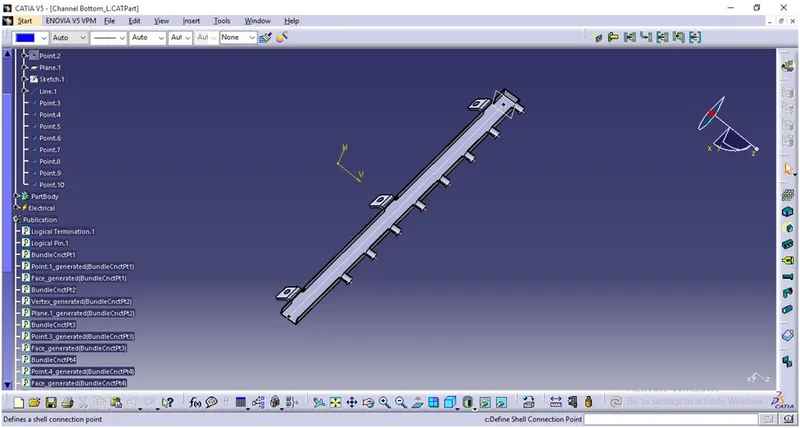
- In above figure, we have created point 1 at entry face and another point at endpoint at required distance.
- Now, join that both points and create a line which will be later used for routing the wire harness bundle inside the guiding channel.
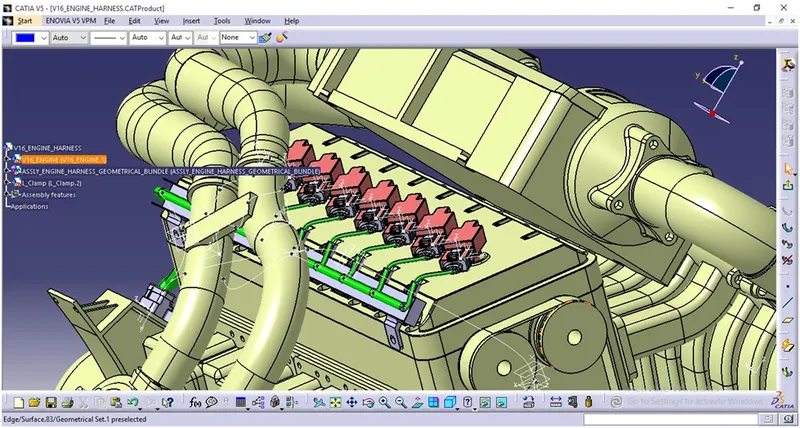
- Above figure shows for the left side guiding channel and same process will be repeated for the right side channel.
- We have created bundle entry points for the eight connectors, one bundle entry point at channel entry face and defined guiding channel electrically as equipment.
- After electrically define of guiding channel, we have located guiding channel at desired place as shown in above figure.
- Here, we have used different commands like manipulation, snap, smart move, compass etc. for placing of guiding channel.
- Now at this stage, we have just located bottom of the guiding channel.
- All 23 connectors, 3 P-clamps, 1 Interconnection connector, 1 furr tree clips and 2 plastic guiding channels are mounted.
Step 7: Bundle routing from Interconnection connector to 3 P-clamps
Here, we are routing the bundle segment from interconnection connector to 3 P-clamps.The diameter for this routing path is 15mm and bend radius ratio is assumed to be 1.4.
Step 8: Adding branch points to 4 cam-shaft sensors.
Adding branch point to the bundle segment at distance of 55mm from P-clamp as shown in below figure.
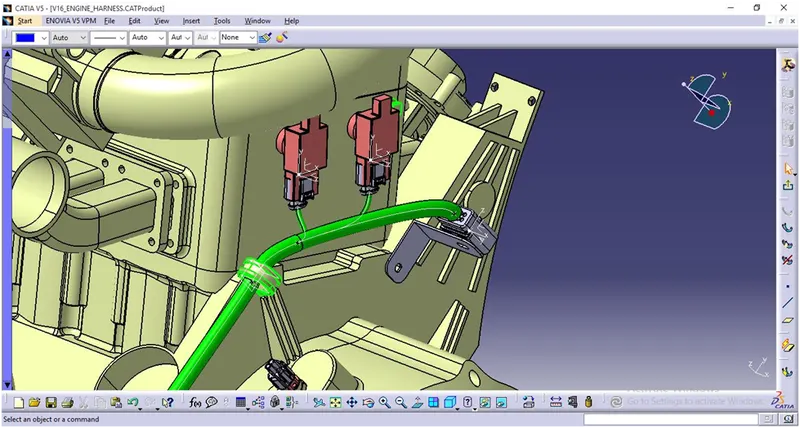
- In above figure, two branches are added from the created branch point to cam-shaft sensors.
Step 9: Routing to the plastic guiding channel.
Another branch point is added from the interconnection connector at distance of 50mm. From this branch point, the bundle is routed to the right guiding channel. We have provided furr tree clip in between branch point and guiding channel for the smooth routing.
Step 10: Adding protective coverings and guiding channels top shell to harness bundle.
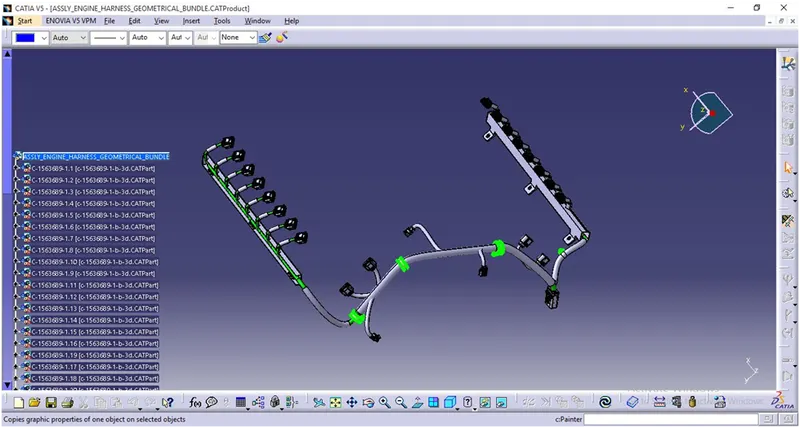
Here in below figure, we have done with whole wiring harness routing for the V16 Engine. Now, we have to add protective coverings to all bundle segments and top shell of the guiding channel.
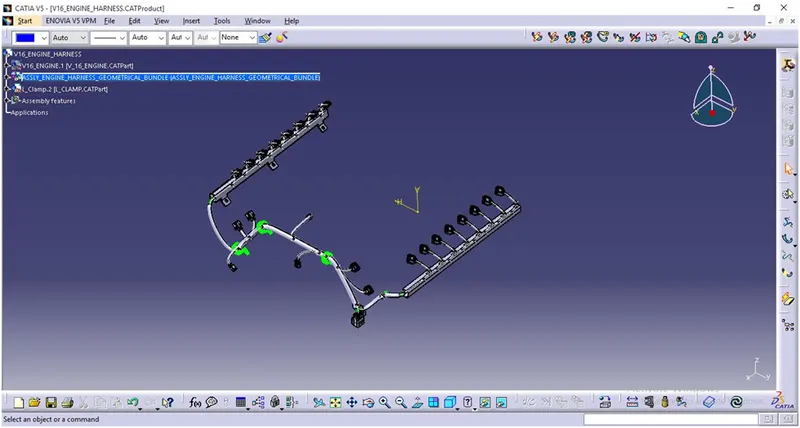
In above figure, we have added all the slit COT tubes and cotton tapes on bundle segments as a protective coverings. Also, we have added top of the both left and right side plastic guiding channel.
Step 11: Checking bundle continuity.
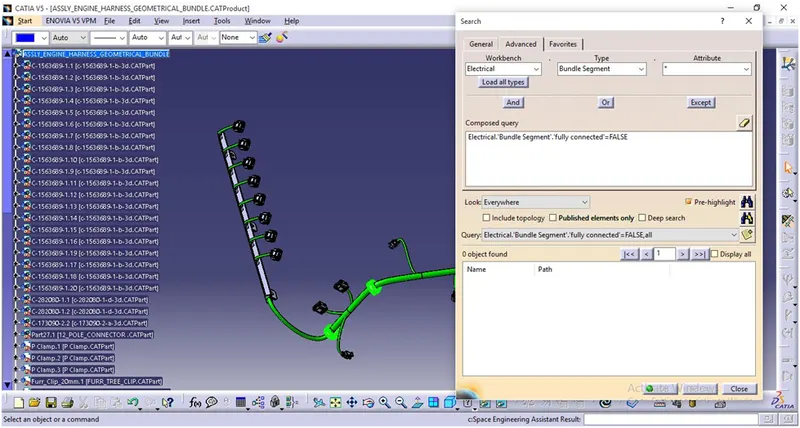
- By selecting 'True' option will show all the connected bundle segments while selecting 'False' option will show all the non-connected bundle segments.
Step 12: Creating flatten view of the engine harness geometrical bundle assembly.
In this step, for creating flatten view we have to work in Electrical Harness Flattening workbench of Catia V5. We should also make sure that the flattening file is saved in the same folder where other files of harness assembly are saved.
- We have extracted the bundle assembly into Engine Harness Flattening Product file and then flattened the file along face of interconnection connector as shown in above figure.
- At this stage, for clarity, we have been hidden the flattening diagram of the plastic guiding channels from the drawing view.
- We have to rotate bundle segments connecting to the 4 cam-shaft connectors using 'Rotate' feature in the flattening workbench as above figure.
- It should be noted that we have 'face' of the interconnection connector as the flattening plane so we should make sure that we rotate the bundle segments along that plane only.
- Here, we have used different features like bend, rotate, roll to streamline the harness for better representation.
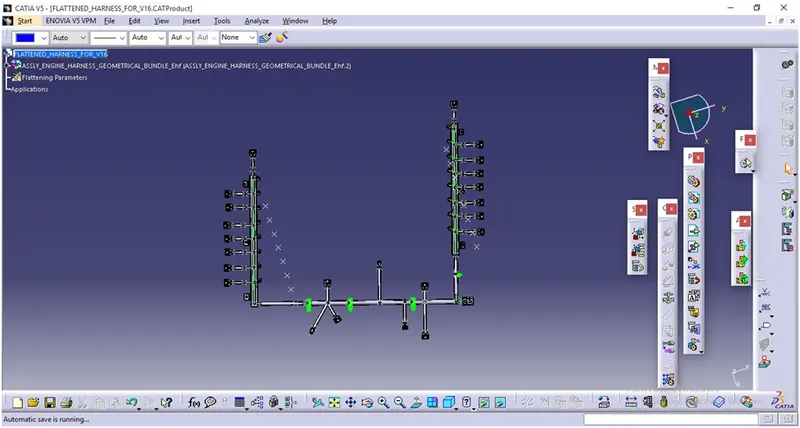
- Final representation of the flatten view as shown in above figure.
Step 13: Creating a flatten view drawing for the wiring harness assembly.
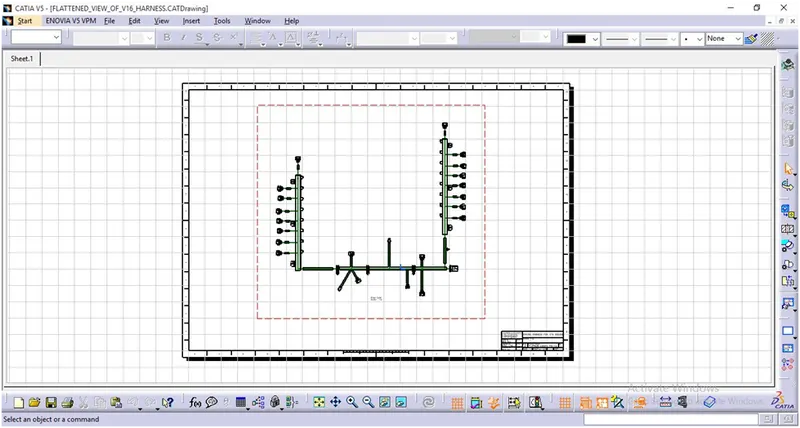
- In above figure, we are creating new drawing file and defined all the necessary drawing parameters. We have to insert the front view of the Engine Harness Flattening Product file into the Drawing file.
- We have to define drawing properties as shown in above figure. It should be noted that in 'Dress up' settings 3D wireframe is always ON. If this setting is not selected then th bundle segments won't be visible on drawing view.
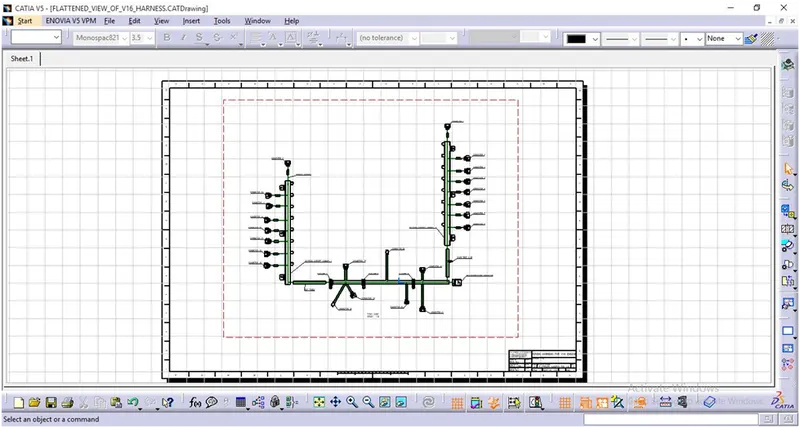
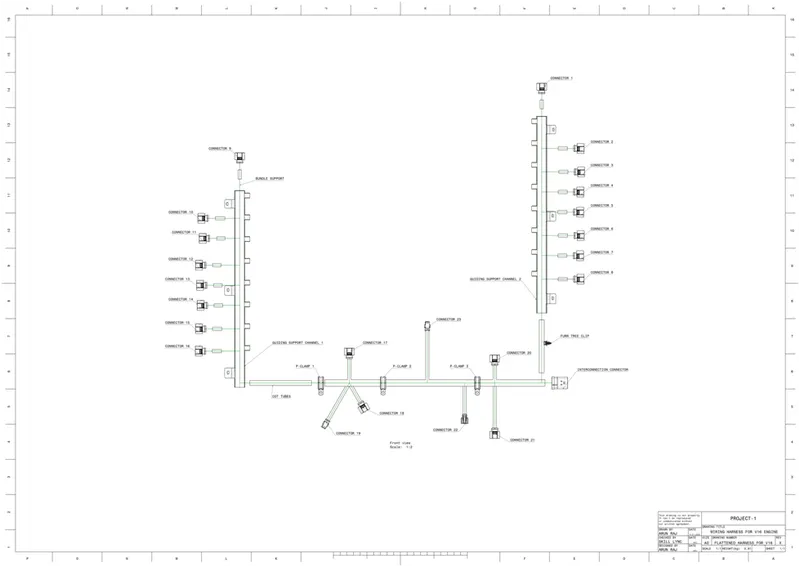
- Above figure shows, the final Drawing view of the Engine Harness Flatten view.
Conclusion:
In this way, we have routed wiring harness for the V16 Engine. Also, prepared flatten view drawing in CATIA V5.