MATALB Simulink Mathematical Model of lead-acid battery discharge characteristics.
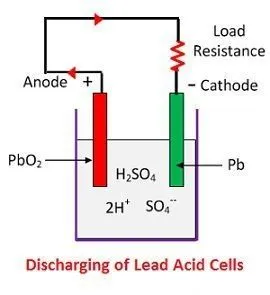
What is the lead-acid battery?
Lead-acid batteries are low cost, have high maintenance requirements, and have long-life rechargeable batteries.
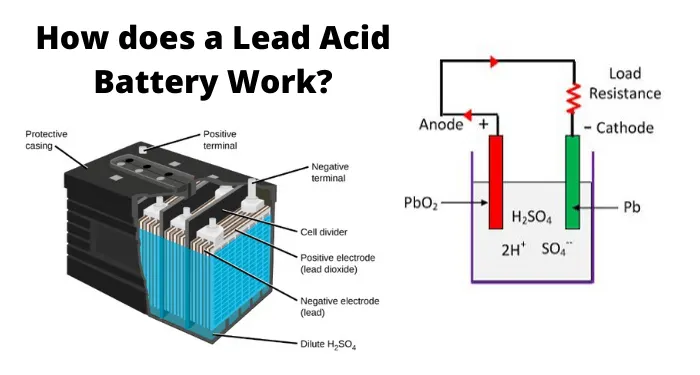
The overall chemical reaction is:
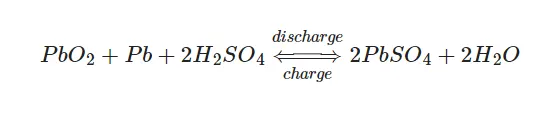
At the negative terminal the charge and discharge reactions are:
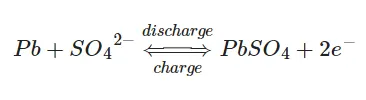
At the positive terminal the charge and discharge reactions are:

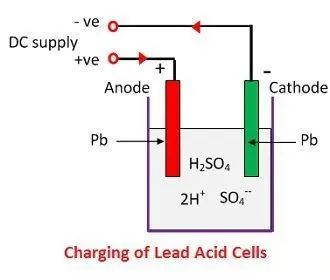
Reference Circuit Diagram and Equation for MATLAB Simulation:
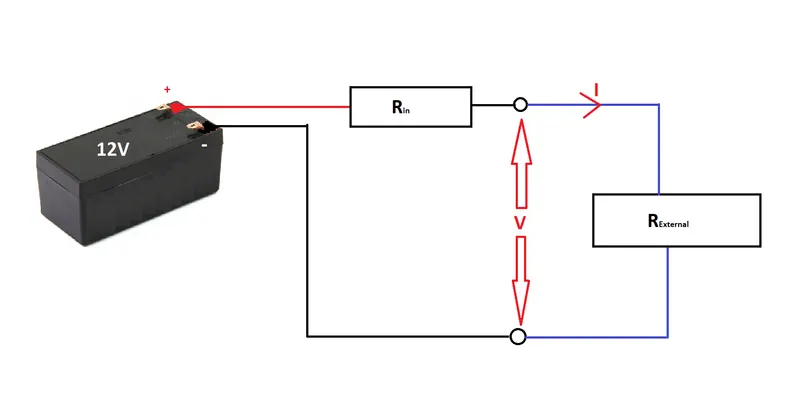
Assumption:
The voltage at Full charge: 12V (Open Circuit Voltage) ---- OCV
The Voltage after connecting Load: 11.8V ------------------ LCV
The Voltage at Full discharge: 8V ------------------- DV
let I=1A,
According to the Ohms Law, Voltage at Rext is,
=> V = I x Rext
=> I = V/Rext -------------------- (i)
from equation 1 we can say that our assumption I = 1A is true only if V = Rext.
Given Equation:
=> E = load circuit voltage - [ Depth of Discharge x (load circuit voltage - discharge voltage)]
=> E =LCV - [DoD x (LCV - DV)] --------- (ii)
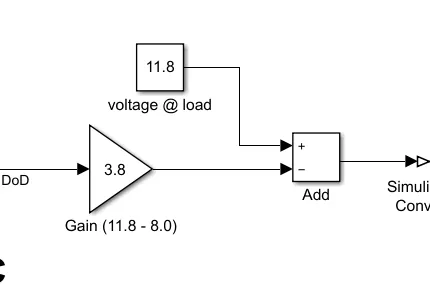
=> E = 11.8 - DoD x(11.8 - 8) ----------(iii)
MATLAB Model:
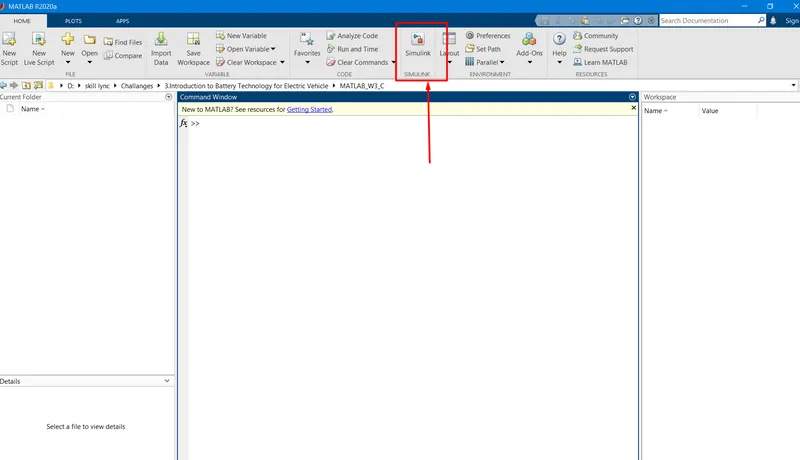
open MATALB and click to Simulink.
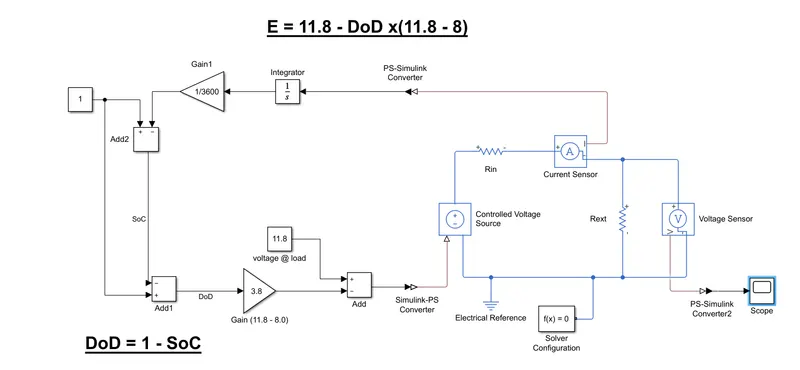
According to the circuit diagram select the components from the library browser.
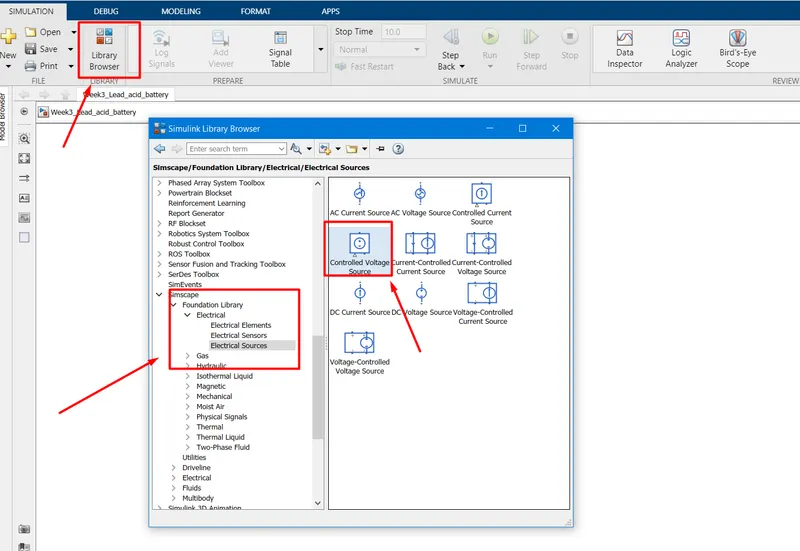
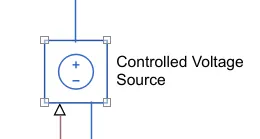
Controlled Voltage Source because Lead-acid battery voltage is not constant throughout.
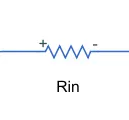
Resistor - Rin
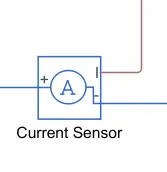
Current Sensor to measure current.
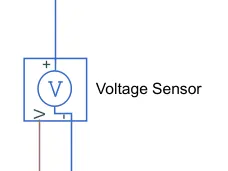
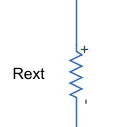
voltage sensor to measure the voltage across Rext.
Rest resistor
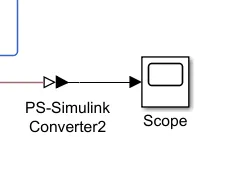
Scope to plot the output graph drop in voltage over 1 hour of time.
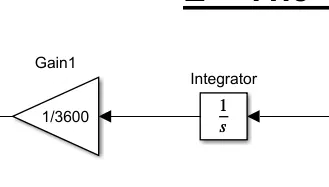
this section of the model is for converting the current to charges for 1 hour, that gain block is for conversion of the second to an hour. (1sec = 1/3600 hr)
State of Charge (SoC) = 1 - Charge per hour &
Depth of charge (DoD) = 1 - SoC
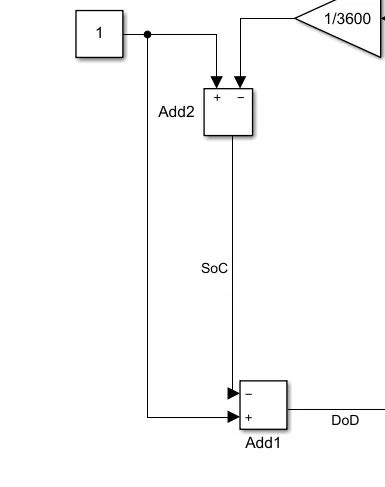
this section is the final voltage that is for the circuit which carries over time.
Below is the final Circuit Model:
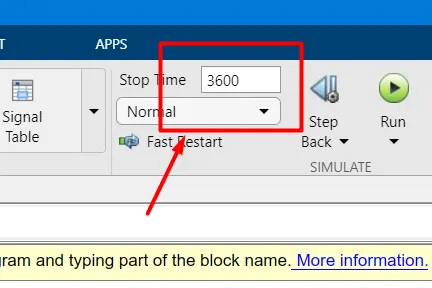
we set the stop time as 3600sec so that the circuit simulates for 1hr.
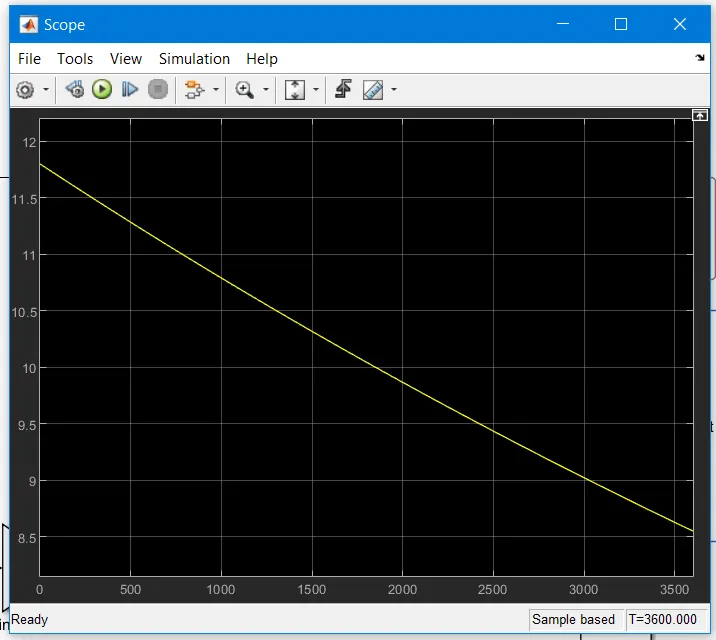
Final Result,
Comments:
As you can see in the graph above that, over 1 hour of the time the battery fully discharge from 11.8V to 8.0 V with a discharge rate of 1Ah.
Our assumption was i=1A, which is verified by this graph.