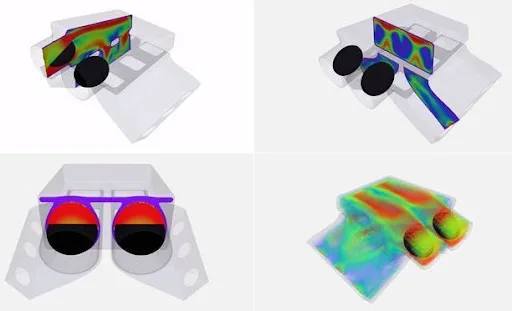
Steady and Transient Flow over a Throttle Body
In this project, the students will simulate airflow through a throttle body under different conditions. They will also study the effect of valve dynamics.
Black FridayUpgrade your career this Black Friday. Get up to ₹60,000 Scholarship on IIT programsUp to ₹60K Black Friday Scholarship52 seats leftOffer ends Fri, 27 Nov, 11:59 pm IST.
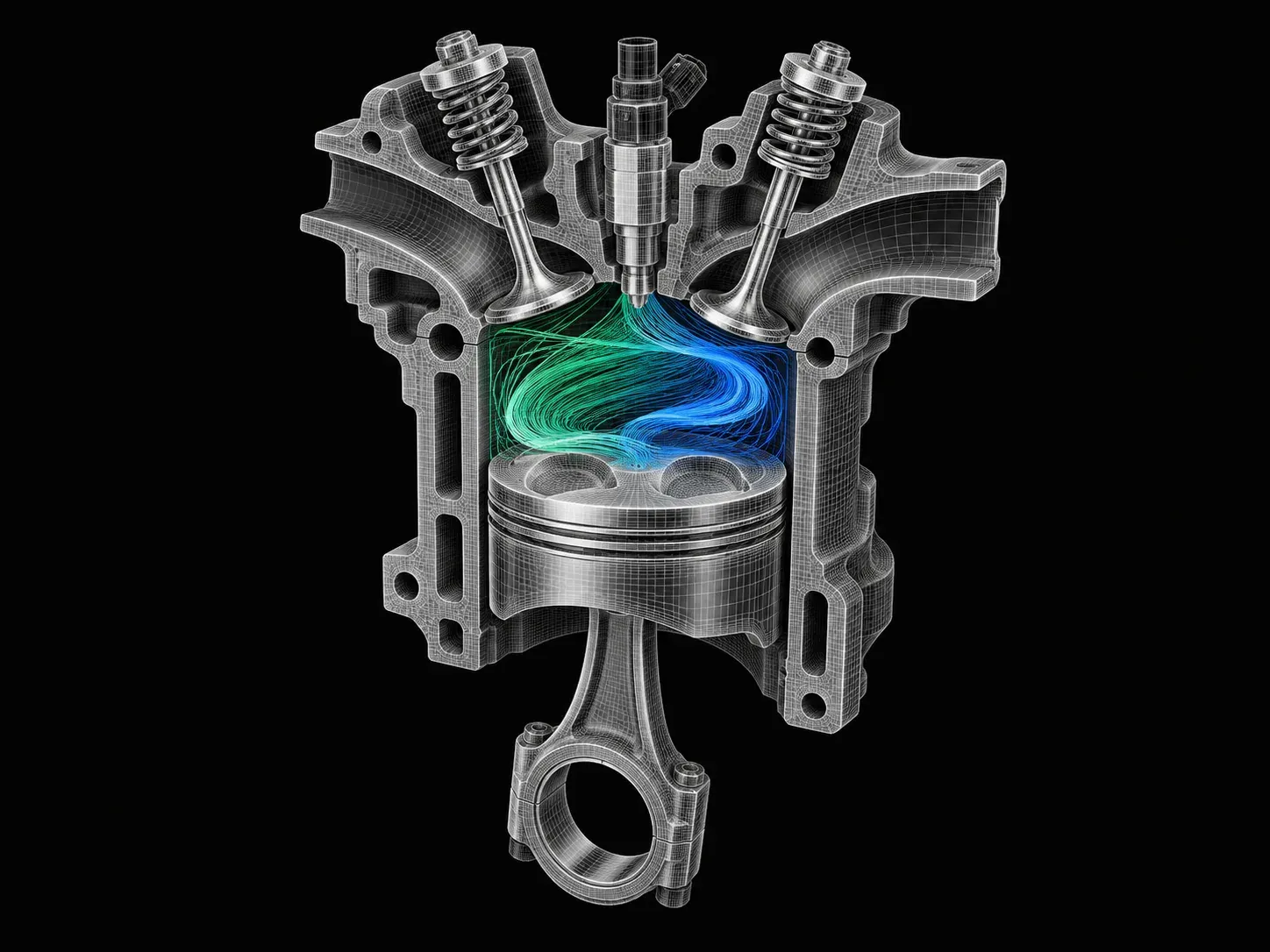
A comprehensive course on Advanced CFD for IC Engine Applications using CONVERGE-CFD Software. This course is highly suited for beginners
Advanced CFD for IC Engine Applications using CONVERGE is an online course from Skill-Lync: 12 weeks, 13 hours of content and 3 industry projects.
1 h 2 min of this course's own recorded sessions, with transcripts, on Grow by Skill-Lync:
Our projects are designed by experts in the industry to reflect industry standards. By working through our projects, Learners will gain a practical understanding of what they will take on at a larger-scale in the industry. In total, there are 3 Projects that are available in this program.
In this project, the students will simulate airflow through a throttle body under different conditions. They will also study the effect of valve dynamics.
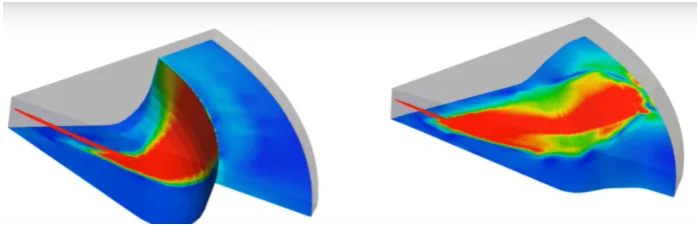
In this project, the students will run simulations of the CAT3410 engine using different piston bowls. They will also understand the effects due to changes in piston bowl shapes.
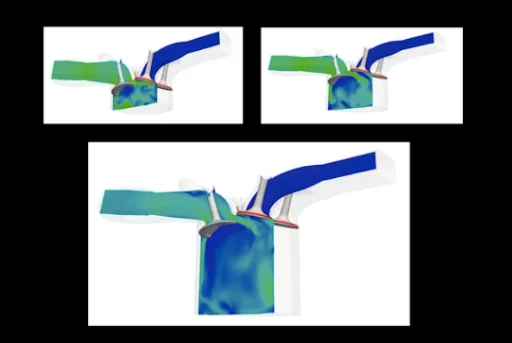
In this project, the students will perform the simulations of port fuel injection. They will analyse the data from the plots obtained.
1 from Advanced CFD for IC Engine Applications using CONVERGE itself, the rest from related mechanical programs. Videos from Skill-Lync's YouTube channel.
by the Skill-Lync team
CONVERGE is a 3D CFD package from Convergent Science that builds its own mesh while the simulation runs. A mesh is the grid of small cells the flow equations are solved on. This course is built around it, with ParaView to view the results.
Convergent Science's pages (read 24 Nov 2026) say CONVERGE "automatically creates the mesh at runtime" and uses a "cut-cell" approach. Picture a box-shaped grid where the geometry trims the cells it cuts through, like pressing a cookie cutter into dough. Moving parts such as a piston or valve then pass through the grid without stretching it. Adaptive Mesh Refinement (AMR) adds cells where the physics is hard, such as flame fronts and sprays, and removes them elsewhere.
The catch: automatic is not effortless. You still clean up the CAD, split it into boundaries and regions, and set the base cell size and where to refine. Weeks 1 to 3 of the syllabus are exactly that work, including CAD import and cleanup, boundary flagging and valve motion setup. Also note the version. The recorded lessons use a version 3 release, while Convergent's site now lists CONVERGE 6 as the latest, so some menus will look different.
It predicts how air, fuel spray and flame move and burn inside the cylinder while the piston and valves move, one small step of crank angle at a time. Crank angle (CA) is just the crankshaft position in degrees. From the run you read pressure, temperature, burn timing and emissions.
The course syllabus covers, week by week, CONVERGE Studio setup, surface preparation (piston motion profile, boundary flagging, intake and exhaust valves), region initialisation and valve motion, turbulence modelling with RANS, combustion modelling with the SAGE detailed chemistry solver and the Shell CTC model, and emissions with the Hiroyasu soot model and the Zeldovich NOx model. The course lists three projects: steady and transient flow over a throttle body, diesel engine characterization on a CAT3410 engine with different piston bowls, and a port fuel injection simulation.
The free overview lesson adds detail. The instructor describes a 12-week plan and a first run called no-hydro, where no flow equations are solved and you only watch the mesh move. From it you can measure the chamber volume and so the compression ratio (worked below). A later week turns a combustion run into engine numbers: work done, combustion efficiency, CA10, CA50, fuel consumption, torque and power. CA50 is the crank angle by which half of the fuel's heat has been released, and the combustion phasing calculator shows how to read it.
The recorded course is 41 lessons, about 12.7 hours (762 minutes), after removing the two feedback forms. All lessons are locked except the first four, which are free to watch on Grow: a Zoom set-up clip, the overview, licence and software set-up, and running cases from Cygwin. The titles of the locked ones, such as Spray Modeling in Converge and Comparative Analysis of Piston Configurations, are all we claim about them.
Compression ratio is the cylinder volume with the piston at the bottom divided by the volume left at the top. In a diesel, that leftover volume is the bowl in the piston crown plus the thin gap above the piston, so swapping bowls changes it unless you adjust the gap.
With swept volume (the volume the piston sweeps) and clearance volume (what is left at the top):
The course's second project compares piston bowls on a CAT3410 diesel. The numbers here are assumed values, not that engine: bore 100 mm, stroke 110 mm, a target ratio of 16, and two bowls of 40 cc and 48 cc. Valve pockets, the head gasket and crevices are ignored, which real engines cannot do. The swept volume is cc, so cc. The gap volume is what is left after the bowl, and a gap is a cylinder of height .
import math
bore, stroke, cr = 100.0, 110.0, 16.0
area = math.pi / 4 * bore ** 2
vs = area * stroke / 1000
vc = vs / (cr - 1)
for name, bowl in (("bowl A", 40.0), ("bowl B", 48.0)):
    gap = (vc - bowl) * 1000 / area
    print(f"{name}: bowl {bowl:.0f} cc, squish gap {gap:.2f} mm")
vc_b = (vc - 40.0) + 48.0
print(f"bowl B, same gap: CR {1 + vs / vc_b:.1f}")
It prints:
bowl A: bowl 40 cc, squish gap 2.24 mm
bowl B: bowl 48 cc, squish gap 1.22 mm
bowl B, same gap: CR 14.2
Bowl A leaves cc for the gap, a height of 2.24 mm. Bowl B leaves cc, a height of 1.22 mm. Swap in bowl B and keep the 2.24 mm gap, and the clearance grows to 65.6 cc, so the ratio falls from 16 to 14.2. That is why a bowl comparison has to hold the compression ratio fixed, or it compares two things at once. In CONVERGE you do not guess: the no-hydro run measures the volume of your real geometry. For swept volume and mean effective pressure on your own numbers, try the engine performance calculator; the cycle theory is in the Thermal Engineering book.
Swirl is air rotating around the cylinder axis, like water circling a drain. The swirl ratio is how many turns the air makes per turn of the crankshaft. At a ratio of 2 and 1,500 rpm, the air spins at 3,000 rpm.
ANSYS's Forte documentation defines the initial swirl ratio as the air rotation rate over the crankshaft rotation rate. Engine textbooks add that the air is treated as one solid spinning disc with the same angular momentum as the real flow. Angular momentum is the amount of spin the air carries. In a solid disc the speed at radius is:
where is the spin rate in radians per second. These numbers are assumed: swirl ratio 2, 1,500 rpm, bore 100 mm.
import math
rpm, bore, r1, r2, rs = 1500, 100.0, 50.0, 30.0, 2.0
w = rs * rpm * 2 * math.pi / 60
print(f"swirl {rs * rpm:.0f} rpm = {w:.1f} rad/s")
print(f"speed at r = {r1:.0f} mm: {w * r1 / 1000:.2f} m/s")
print(f"after squeeze to r = {r2:.0f} mm: {rs * rpm * (r1 / r2) ** 2:.0f} rpm, {w * (r1 / r2) ** 2 * r2 / 1000:.2f} m/s")
print(f"1 crank degree = {1 / (6 * rpm) * 1e6:.1f} us; one 720 degree cycle = {120 / rpm * 1000:.0f} ms")
It prints:
swirl 3000 rpm = 314.2 rad/s
speed at r = 50 mm: 15.71 m/s
after squeeze to r = 30 mm: 8333 rpm, 26.18 m/s
1 crank degree = 111.1 us; one 720 degree cycle = 80 ms
So rad/s, and at mm (the cylinder wall) m/s. Now squeeze a ring of air from 50 mm in toward a bowl of 30 mm radius. With no friction, spin per unit mass, , stays constant, so rises by times, to 8,333 rpm. That spin-up is one reason bowls are shaped as they are. The catch: real air loses spin to wall friction, so this is an upper bound, and the CFD run is what gives you the real number.
The last line shows why engine CFD is expensive. One crank degree at 1,500 rpm lasts 111.1 microseconds and one 720 degree cycle lasts 80 ms. Steps of 0.1 degree, 11.1 microseconds each, would mean 7,200 steps per cycle. The step size is held back by stability limits, which the Courant number calculator explains.
The course supplies the CONVERGE licence, but it is time-limited: in the free set-up lesson the instructor says it is valid for three months from activation. Start the clock only when you are ready to work through the course.
The licence is a server-based one, activated by filling a request form. The same lesson says you connect to a VPN (through SoftEther) before CONVERGE Studio will launch or a simulation will run, and the set-up uses Windows with Cygwin, a command-line tool, to launch runs. The instructor says there will be no grace extension for a licence that lapsed while unused. Twelve weeks of content fits inside three months only if you work steadily.
On hardware, the overview lesson says the weekly assignments are simplified so they run on your own computer. Prerequisites in the course FAQ: a technical background, with at least some mechanical or automotive engineering. Outside the course, Convergent Science's academic programme page (read 24 Nov 2026) offers licences for academic research, free in the United States and Europe.
Our data cannot show it for engine CFD in particular. As of 24 Nov 2026, none of Skill-Lync's 3,905 placement records names this course, and none has "combustion" or "IC engine" in the role or job title.
For the wider CFD and CAE picture, I counted by role and job title containing CFD, CAE, combustion, IC engine or powertrain:
The caveat: this is a self-reported learner sample covering 2019 to 2026, and mostly 2021 to 2023 starting offers. 11 powertrain titles out of 3,905 is thin, and engine simulation is a narrow field. Treat this course as a specialisation on top of general CFD skills, such as those in the PG Program in CFD, not as a route to a job on its own.
| Course | Length | Projects | Tools | Fee |
|---|---|---|---|---|
| Advanced CFD for IC Engine Applications using CONVERGE (this page)3D in-cylinder CFD in CONVERGE: 12 weeks, 3 projects | 12 weeks, 13 h | 3 | CONVERGE, Paraview | ₹40,000 |
| PG Program in Computational Fluid DynamicsPG program that includes this course | 48 weeks, 125 h | 28 | ANSYS Fluent, SpaceClaim, CFD Post, CONVERGE, Paraview, MATLAB, OpenFOAM, Octave, GT POWER, GT-SUITE, ANSA, ICEM CFD, Visual Studio | ₹2,75,000 |
| IC Engine Calibration using GT-POWER and GT-SUITE1D engine models in GT-POWER and GT-SUITE | 12 weeks, 19 h | 3 | GT POWER, GT-SUITE | ₹40,000 |
| Internal Combustion Engine Analyst course using Python and CanteraCombustion chemistry in Python and Cantera | 12 weeks, 22 h | 5 | Python, Cantera, CONVERGE, Paraview | ₹2,75,000 |
| Combustion CFD SpecialistComputational combustion in MATLAB, Octave and Python | 24 weeks, 35 h | 9 | Python, Cantera, CONVERGE, Paraview, MATLAB, OpenFOAM, Octave | ₹2,75,000 |
Lengths, projects and fees are taken from each course page on 24 Nov 2026; fees are the Premium plan in INR, including all charges.
Become job ready with our comprehensive industry focused curriculum for freshers & early career professionals
All the mentors of this course are seasoned professional experts who are the best in the industry.
Yes, the course has three projects on the steady and transient flow of the throttle body, engine characterization and fuel injection.
Yes for CONVERGE. The course provides a server-based licence, which the instructor says is valid for three months from activation, so activate it when you are ready to start. The other tools in the course, such as ParaView and Cygwin, are separate downloads that the set-up lessons walk through.
If you want to apply for this course, you must have a technical background. You must have at least some experience in mechanical or automotive engineering.
Payment options are shown when you enrol, so check the course page for whether EMI is offered for your plan.
You will get a participation certificate post the completion of the course. You can present the certificate to the recruiters to prove that you have taken the course.
A counsellor will walk you through the syllabus, projects and fee options — and tell you honestly if another course suits you better.