Vehicle dynamics courses online
Every Skill-Lync course on vehicle dynamics, suspension and steering, ADAMS and multibody simulation, with fees, hours, projects and the maths behind them.
- 6
- short courses
- ₹40,000
- each
- 838+
- student vehicle and MBD projects
- 5
- vehicle dynamics job titles in our records
As of 16 Nov 2026 · Fees are the list price on each course page, inclusive of all charges
Skill-Lync teaches vehicle dynamics and multibody dynamics in 6 online short courses: vehicle dynamics in MATLAB, suspension design in ADAMS, multibody simulation in MotionSolve and SOLIDWORKS, and two controls and powertrain courses built on vehicle models. Here they all are with fees, hours and projects, the cornering maths they start with, which one fits the job you want, and an honest note on vehicle dynamics jobs.
Every Skill-Lync course that teaches Vehicle Dynamics
| Course | Level | Duration | Projects | Fee |
|---|---|---|---|---|
| Vehicle Dynamics using MATLAB | Short course | 4 weeks | 2 | ₹40,000 |
| Multibody Dynamics using SolidWorks | Short course | 5 weeks | 3 | ₹40,000 |
| Autonomous Vehicle Controls using MATLAB and Simulink | Short course | 12 weeks | 2 | ₹40,000 |
| Development of Hybrid Drives using MATLAB & Simulink | Short course | 12 weeks | 2 | ₹40,000 |
| Multibody Dynamics for Automotive Applications using Motionview and Motionsolve | Short course | 12 weeks | 3 | ₹40,000 |
| Suspension Design using ADAMS | Short course | 16 weeks | 2 | ₹40,000 |
Projects is the number of industry projects listed on the course page. Programs also include the courses' smaller assignments. EMI figures are the lowest monthly plan shown on the course page.
Which one should you pick?
- You want one course on vehicle dynamics itself. Take Vehicle Dynamics using MATLAB (4 weeks, 37 h of video, ₹40,000). It covers suspension and steering kinematics, tyre modelling, ride (quarter car, bounce-pitch, ISO road profiles) and handling (understeer, the bicycle model, rollover). Its projects: spring and anti-roll bar selection from vehicle targets, and an understeer budget for a light sports vehicle.
- You want to design suspensions in industry software. Take Suspension Design using ADAMS (14 h over 16 weeks, ₹40,000): suspension and steering kinematics in depth, ride geometry, compliance, K&C testing and Adams/Car, with projects on hardpoint tuning for a target and compliance testing. Take it after or instead of the MATLAB course; they share the kinematics.
- You want multibody dynamics (MBD) as a CAE skill. Multibody Dynamics for Automotive Applications using Motionview and Motionsolve (12 weeks, 8 h, ₹40,000) builds mechanisms and automotive assemblies in Altair MotionView and MotionSolve and adds flexible bodies; projects: a trunk lid, a flexible lower control arm and a full vehicle assembly. Multibody Dynamics using SolidWorks (3 h, ₹40,000) is a short introduction on mechanisms (Geneva drive, vice, planetary gears, piston, valve train), not vehicles.
- You come from controls or ADAS. Autonomous Vehicle Controls using MATLAB and Simulink (12 weeks, 24 h) uses the longitudinal model and the bicycle and tyre models to design cruise control, adaptive cruise, lane keeping and a combined 5-DOF controller. It is on the ADAS courses page too.
- You care about performance and energy. Development of Hybrid Drives using MATLAB & Simulink (12 weeks, 21 h) starts from the longitudinal traction and road-load equations and drive cycles, then models conventional and hybrid powertrains for fuel use. It is on the electric vehicle courses page too.
- You want a program. No Skill-Lync program is built around vehicle dynamics, and none contains the vehicle dynamics or ADAMS course. MBD using SOLIDWORKS is one course inside the PG Program in SOLIDWORKS Design and Analysis and the Mechanical Engineering Essentials Program; Autonomous Vehicle Controls is in the optional autonomous track of the IIT Roorkee EV program. If you want a program, choose it for its main subject and add the vehicle dynamics course separately.
What is Vehicle Dynamics?
Vehicle dynamics is the study of how a vehicle moves in response to the driver, the road and the air: how it accelerates and brakes (longitudinal dynamics), how it turns and stays stable (lateral dynamics, or handling), and how it rides over bumps (vertical dynamics, or ride). A vehicle dynamics course teaches the models engineers use for each direction, the suspension and steering geometry that shapes them, and the tyre, which makes every force the car feels.
Most vehicle dynamics work in industry is simulation and testing. Engineers lay out suspension hardpoints and check how camber, toe and roll centre move with wheel travel; build multibody models of a suspension or a whole car in tools such as Adams/Car or Altair MotionView and MotionSolve; tune springs, dampers and anti-roll bars against ride and handling targets; and fit tyre models to test data. Multibody dynamics (MBD) is the general method underneath: rigid or flexible bodies joined by joints and bushings, solved in time. It is also used for engine valve trains, mechanisms, landing gear and robots.
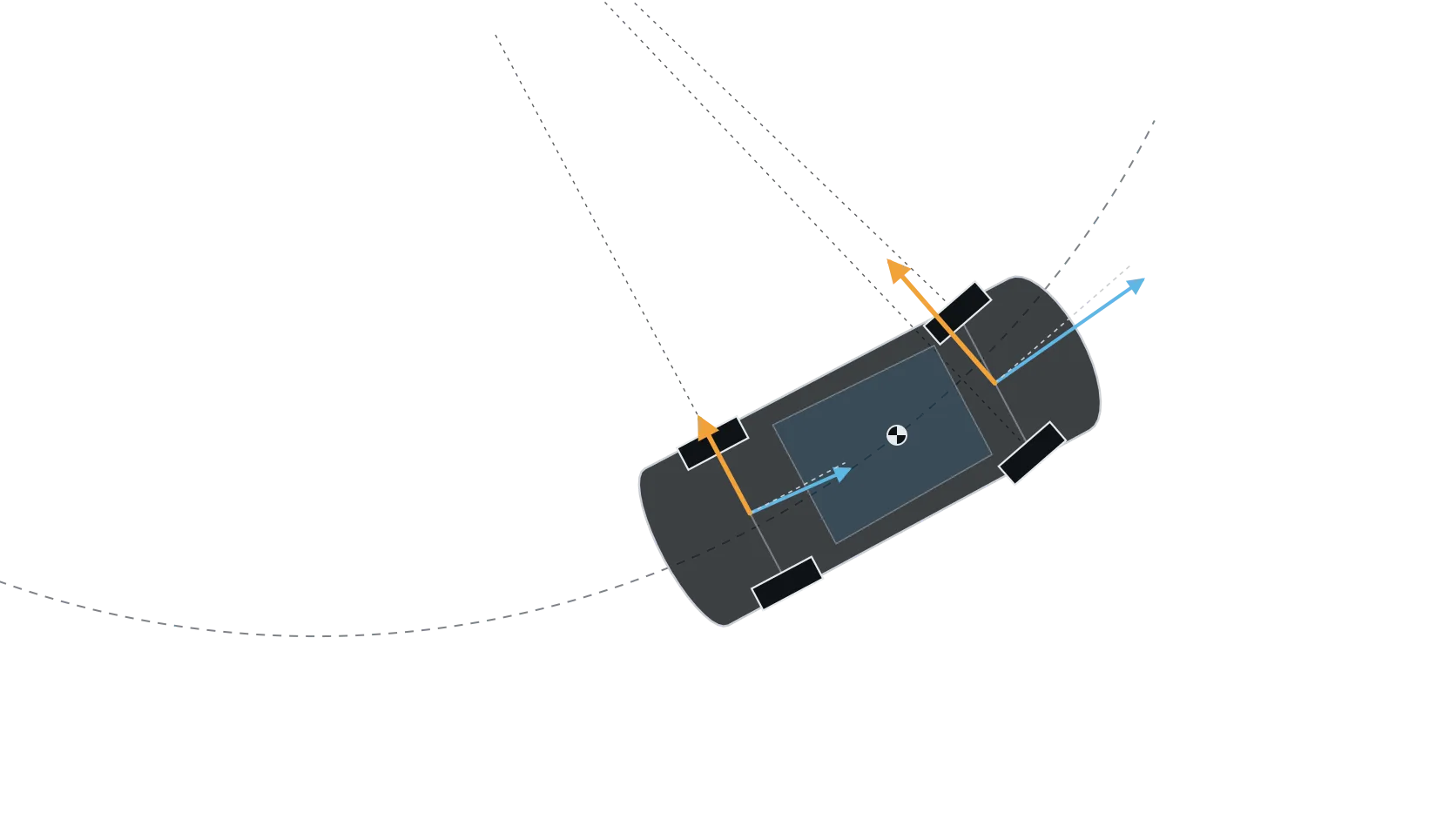
Here is the cornering arithmetic every handling course starts with. Take a hypothetical 1,500 kg sedan with a 2.7 m wheelbase and 60% of its weight on the front axle: 8,829 N on the front axle, 5,886 N on the rear. Give all four corners the same tyre with a cornering stiffness of 1,200 N per degree of slip angle (real tyres stiffen with load; ignore that here). Each axle needs a slip angle proportional to the load it carries, so the understeer gradient is the front axle load divided by the front axle's cornering stiffness (two tyres, 2,400 N/deg) minus the same ratio at the rear: 8,829 ÷ 2,400 − 5,886 ÷ 2,400 = 1.23 degrees per g. Positive K means understeer: the front tyres slip more than the rears, and the driver must add steering as the car corners faster. On a 100 m radius at 72 km/h the lateral acceleration is 4 m/s² (0.41 g). The geometric (Ackermann) steer angle is 57.3 × 2.7 / 100 = 1.55°, the front slip angle 1.5° and the rear 1°, so the front wheels need 2.05°: about 33° at the steering wheel with a 16:1 steering ratio.
Two more numbers from the same car. Its characteristic speed, the square root of 57.3 × wheelbase × g ÷ understeer gradient, is 127 km/h: at that speed it needs twice the Ackermann angle for any corner. Put 60% of the weight on the rear axle instead (a rear-engined layout on the same tyres) and K becomes -1.23° per g: the car oversteers, and above a critical speed of 127 km/h it is directionally unstable, which is why such cars run wider or stiffer rear tyres. The simplest rollover check divides half the track by the centre-of-gravity height: with a 1.55 m track and a 0.55 m CG height the car would need 1.41 g of lateral acceleration to tip, more than its tyres can produce on a dry road, so it slides first. An SUV with a 1.6 m track and a 0.75 m CG height tips at 1.07 g on this rigid-body estimate, close to its grip limit; body roll on the springs lowers the threshold further. And straight-line driving: at 100 km/h, with a drag coefficient of 0.30, 2.2 m² of frontal area and a rolling-resistance coefficient of 0.012, the car needs 306 N to push the air and 177 N to roll its tyres, 482 N in all, or 13.4 kW at the wheels. Every number on this page is a linear, steady-state estimate; courses teach the tyre models and multibody simulations that replace it near the limit.
What a Vehicle Dynamics course covers
- Suspension kinematics. Degrees of freedom of the wheel carrier, instant centres and swing arms, front-view geometry (camber change, scrub, roll centre height), side-view geometry (anti-dive, anti-squat, anti-lift), and double wishbone, McPherson strut and multi-link layouts.
- Steering kinematics. Kingpin axis, caster, mechanical trail, scrub radius, kingpin inclination, Ackermann geometry and turning circle, steering ratio, and roll steer, bump steer and torque steer.
- Tyres. Tyre structure, nomenclature and the tyre coordinate system, how a tyre generates lateral force and aligning moment from slip angle, and tyre models built in MATLAB.
- Ride. Wheel rate, motion ratio and ride rate, ride frequencies and the flat-ride concept, dampers, the quarter-car and bounce-pitch models, ISO road roughness (power spectral density) and human response to vibration.
- Handling. Steady-state cornering, understeer gradient and how to measure it (constant-radius test), the 2-DOF bicycle model in state space, transient handling, understeer budgets, anti-roll bar selection, four-wheel steering and rollover thresholds.
- Compliance and K&C testing. Bushing and component compliance under braking, traction, lateral force and aligning torque, its effect on ride and handling, and kinematics and compliance (K&C) rig tests.
- Multibody simulation. Adams/Car databases, templates, subsystems and assemblies, parallel and opposite wheel travel analyses; MotionView/MotionSolve joints, motion, forces and flexible bodies; SOLIDWORKS Motion studies of mechanisms.
- Longitudinal dynamics and control. Tractive force and road loads (aerodynamic drag, rolling resistance, grade), drive cycles and energy use, cruise and adaptive cruise control, and lateral controllers built on the bicycle and tyre models.
The courses in detail
Vehicle Dynamics using MATLAB
4-week vehicle dynamics course: longitudinal, lateral and ride models built in MATLAB, with 2 projects on real vehicle problems.
Projects include: Spring and Anti-Roll bar Selection based on Vehicle Targets; Understeer Budget sheet preparation and ARB selection for a Light Sports Vehicle.
Tools: MATLAB
Multibody Dynamics using SolidWorks
5-week online course using SOLIDWORKS, with 3 industry projects. Covers Design and MBD simulation on Geneva Mechanism, Design and MBD Simulation on a Machine…
Projects include: Design and MBD Simulation on IC Engine Valve Train; Design and MBD simulation of Shaper Machine; Design and MBD simulation of Pumpjack.
Tools: SOLIDWORKS
Autonomous Vehicle Controls using MATLAB and Simulink
Learn how to control the autonomous vehicle with Skill-Lync's Autonomous Vehicle Controls using MATLAB and Simulink Course.
Projects include: Design and Develop Adaptive Cruise Control Model in Simulink; Develop an Integrated Automated Driving Model.
Tools: MATLAB, Simulink
Development of Hybrid Drives using MATLAB & Simulink
12-week online course using MATLAB, Simulink, with 2 industry projects. A course which discusses about the basics of hybrid electric powertrains used in the…
Projects include: Development of Forward Energy Based Fuel Consumption Model of a Conventional Vehicle; Development of a Forward Energy Based Fuel Consumption Model of a P1 Hybrid Vehicle.
Tools: MATLAB, Simulink
Multibody Dynamics for Automotive Applications using Motionview and Motionsolve
12-week online course using Motionview/Motionsolve, with 3 industry projects. A comprehensive course on Multi-body Dynamics for Automotive Applications using…
Projects include: Automobile Trunk Lid; Flexible Bodies Simulation of a Lower Control Arm of a Suspension; Simulation of a Full Vehicle Assembly.
Tools: Motionview/Motionsolve(Altair Hyperworks)
Suspension Design using ADAMS
16-week vehicle suspension design course in MSC Adams: kinematics, compliance and half-car models, with 2 suspension projects.
Projects include: Achieving Target Acceleration Using Hardpoint Tuning ; Compliance Testing of the Suspension System.
Tools: Adams
Jobs after a Vehicle Dynamics course
Typical job titles: vehicle dynamics engineer (ride and handling, simulation or testing), suspension design engineer, chassis engineer, steering systems engineer, tyre simulation engineer, K&C test engineer, and MBD or durability engineer (multibody loads for fatigue). Employers include car and two-wheeler makers, tyre makers, suspension and steering suppliers, motorsport and Formula Student teams, and the engineering services companies that work for them.
We can't show a vehicle dynamics salary figure, and here is why. As of 16 Nov 2026, only 5 of Skill-Lync's 3,905 placement records (2021 to 2023) have a job title that names vehicle dynamics, multibody dynamics, suspension, chassis or tyres: a vehicle dynamics engineer at Vioma Motors, a multibody dynamics engineer at T-Shell, a tyre simulation intern at Apollo Tyres, and chassis design engineers at Kawasaki India and GTX Electric. Salaries ranged from 3 to 7 LPA, too few for a median. All five came through our PG programs in hybrid EVs (2), CAE (2) and CAD (1), not through a vehicle dynamics course.
"MBD engineer" usually means something else. 124 more of our records say MBD engineer, but in Indian automotive job ads MBD almost always means model-based development: control software built in MATLAB and Simulink, which those learners studied in our EV and HEV programs. Read a job ad's tool list before applying: Adams, MotionSolve or Simpack means multibody dynamics; Simulink, Stateflow and AUTOSAR mean model-based development. For CAE pay, see CAE engineer salaries; for who hires mechanical freshers, companies hiring mechanical engineering freshers. These are learners who told us they were placed, so treat every figure as a starting point, not as today's market rate.
Projects students built
Skill-Lync learners have published at least 228 suspension, steering and handling project reports (67 students) and 610 multibody simulation reports (237 students), as of 16 Nov 2026. We count only completed reports whose title names the task. The most common vehicle ones: steering geometry (53), building and post-processing a suspension in Adams/Car (45), front-view geometry and roll centre height (34), anti-roll bar optimisation (29), anti-dive and anti-squat characteristics (28), hardpoint tuning to hit a pitch-gradient target (13). The most common multibody ones: a Geneva mechanism (206), a piston and crank assembly (194), an engine valve train (190).
Four to read: hardpoint tuning in ADAMS to hit a pitch-gradient target with anti-dive and anti-squat, anti-roll bar optimisation, transient handling of the bicycle model and an MBD simulation of an engine valve train in SOLIDWORKS.
Software and calculators, course by course
Each tool page lists every Skill-Lync course that uses it, with fees and syllabus notes; the calculators work in your browser:
- MATLAB and Simulink courses (tyre, ride and handling models, controllers)
- SOLIDWORKS courses (including MBD with SOLIDWORKS Motion)
- ADAS courses (vehicle models inside lateral and longitudinal control)
- Electric vehicle courses (road loads, drive cycles, range)
- Steering geometry calculator: Ackermann percentage, turning circle, steering effort
- Ride frequency calculator: motion ratio, wheel rate, ride rate, damping
Free vehicle dynamics lessons before you pay
Try the basics free before you pick a course:
- Vehicle dynamics questions answered: roll centre, anti-dive, bump steer, dampers (resources.skill-lync.com)
- GATE theory of machines and vibrations, solved past questions (linkages, gears, vibration)
- What a vehicle dynamics engineer does
- Vehicle dynamics for FEA engineers, part 1
- What is multibody dynamics?
Free Vehicle Dynamics tutorials
Start here before you pay for anything. These are written by Skill-Lync learners and engineers:
- Here's What You Should Know About Becoming a Vehicle Dynamics Engineer
- A Guide to Help FEA Engineers Get Started With Vehicle Dynamics - Part 1
- A Guide to Help FEA Engineers Get Started With Vehicle Dynamics - Part 2
- Everything about Ackermann Steering Geometry
- Ackerman's Principle of Steering: Working & Applications
- Different Types of Steering Gear Box Mechanisms
- Importance of A Vehicle’s Roll Centre Explained
- What is the Motion Ratio?
- The Basics of Independent Front Suspension Systems
- The Science Behind Hydro Elastic Suspension Systems
- Why Suspension Matters for Your Car’s Comfort
- How Rolling Resistance Affects Your Ride and Fuel Efficiency
- Exploring Different Types of Vehicle Chassis
- What is Multibody Dynamics?
- What Is Multibody Dynamic Simulation And How It Can Transform The Way You Design Your Products
- Understanding Constraints in Multibody Dynamics: Degrees of Freedom and Joint Types
- Building a Simple Suspension Model in MotionView
- Integrating the Steering System in Multibody Dynamics Simulation
- Road Modeling and Vehicle Motion in Multibody Dynamics
- Setting Up Motion Analysis in SolidWorks: A Step-by-Step Guide
- Kinematics and Dynamics: An Introduction To The Mechanics Of Machines
Before you pay
Compare hours, not weeks. Every course here costs ₹40,000, but Vehicle Dynamics using MATLAB is 37 h of video in 4 weeks while Suspension Design using ADAMS is 14 h spread over 16 weeks, Multibody Dynamics for Automotive Applications using Motionview and Motionsolve 8 h and Multibody Dynamics using SolidWorks 3 h. Hours are what you are paying for.
The two vehicle dynamics courses overlap. Vehicle Dynamics using MATLAB and Suspension Design using ADAMS both teach suspension and steering kinematics and ride basics. The MATLAB course adds tyres, ride models and handling; the ADAMS course adds compliance, K&C testing and Adams/Car. If you can take only one, pick by that list.
ADAMS is a licensed tool. Hexagon offers a free Adams Student Edition with model-size limits; check that it includes the Adams/Car module the course uses before you rely on it at home. MotionView and MotionSolve come with Altair's student edition. SOLIDWORKS Motion needs SOLIDWORKS Premium or the student edition that includes it.
Two of the six are only partly vehicle dynamics. Autonomous Vehicle Controls using MATLAB and Simulink is mainly a controls course (vehicle models in about 3 of 12 weeks) and Development of Hybrid Drives using MATLAB & Simulink mainly a powertrain course (road loads and drive cycles in weeks 2 to 4). They are here because they teach the longitudinal and lateral models; they are not substitutes for the vehicle dynamics course.
Vehicle dynamics jobs for freshers are few. Only 5 of our 3,905 placement records have vehicle dynamics, multibody, suspension, chassis or tyre titles. Treat it as a specialisation on top of CAE, design or controls skills, build a portfolio (Formula Student or BAJA experience counts), and ask the counsellor for recent vehicle dynamics placements before you pay.
Vehicle Dynamics course FAQs
What is the fee for a vehicle dynamics course at Skill-Lync?
As of 16 Nov 2026, each of the 6 courses on this page is ₹40,000, inclusive of all charges. That includes Vehicle Dynamics using MATLAB (4 weeks, 37 h of video) and Suspension Design using ADAMS (16 weeks, 14 h). No Skill-Lync program contains either course.
Which vehicle dynamics course should I take first?
Vehicle Dynamics using MATLAB. It covers suspension and steering kinematics, tyre models, ride and handling in MATLAB, with projects on anti-roll bar selection and an understeer budget. Take Suspension Design using ADAMS next if you want to work on suspension design in Adams/Car.
What is understeer gradient?
It is how many extra degrees of steering a car needs for each g of lateral acceleration, above the geometric (Ackermann) angle. For a linear model it is the front axle load divided by the front axle's cornering stiffness, minus the same ratio for the rear axle. A 1,500 kg car with 60% of its weight on the front and the same 1,200 N/deg tyres all round has K = 1.23°/g, so it understeers; with 60% on the rear, K = -1.23°/g and it oversteers.
What is the difference between multibody dynamics and FEA?
Multibody dynamics (MBD) simulates how connected bodies move: joints, bushings, springs, dampers and contacts, solved over time, usually with rigid or reduced flexible bodies. It gives motion and the loads at each joint. FEA (finite element analysis) divides a single part or assembly into small elements to find stresses, strains and deflections. The two are linked: MBD loads go into FEA for strength and fatigue, and FEA reduced models become flexible bodies in MBD.
Is MBD the same as model-based design?
No, although both are abbreviated MBD. Multibody dynamics simulates mechanisms and vehicles in tools such as Adams, MotionSolve or SOLIDWORKS Motion. Model-based design (or development) builds control software as Simulink models and generates code from them. Most "MBD engineer" job ads in Indian automotive companies, and 124 of our placement records, mean model-based development.
Which software is used in vehicle dynamics?
MATLAB and Simulink for tyre, ride and handling models and controllers; Adams/Car (Hexagon) for suspension and full-vehicle multibody models; Altair MotionView and MotionSolve for multibody models with flexible bodies; SOLIDWORKS Motion for mechanisms. Industry also uses IPG CarMaker, VI-grade and Simpack, which these courses do not teach.
What is the salary of a vehicle dynamics engineer in India?
We don't have enough of our own data to say. Only 5 of Skill-Lync's placement records (2021 to 2023, as of 16 Nov 2026) have vehicle dynamics, multibody, suspension, chassis or tyre titles, with salaries from 3 to 7 LPA. For a larger sample of simulation roles, see the CAE engineer salary page.
Can I learn vehicle dynamics for free?
Yes, the basics. Read the vehicle dynamics questions on resources.skill-lync.com, try the steering geometry and ride frequency calculators on this site, and build a quarter-car and a bicycle model in MATLAB, Octave or Python. Formula Student and BAJA SAE teams are the best free practice: you design a real suspension. A paid course adds reviewed projects, Adams/Car or MotionSolve work, and mentor feedback.