Bridge design courses online
Every Skill-Lync course on bridge loads, piers, foundations, girders and metro viaducts, with fees, hours, projects and the IRC maths behind them.
- 7
- courses
- ₹40,000
- per short course
- 14
- projects in the PG program
- 3,100 kN·m
- midspan moment, 70R on a 20 m span
As of 19 Nov 2026 · Fees are the list price on each course page, inclusive of all charges
Skill-Lync teaches bridge design in 7 online courses: 6 short courses (IRC loads, piers and substructures, foundations, steel superstructures, RCC and PSC decks in LUSAS, metro viaducts) and a 48-week PG program. Here they all are with fees, hours and projects, the moving-load maths they start with, which one fits the work you want, and an honest note on bridge jobs.
Every Skill-Lync course that teaches Bridge Design
| Course | Level | Duration | Projects | Fee |
|---|---|---|---|---|
| Design of Bridge Substructures / Piers using STAAD.Pro | Short course | 11 weeks | 2 | ₹40,000 |
| Design of Bridge Foundations using STAAD.Pro | Short course | 12 weeks | 2 | ₹40,000 |
| Design loads considered on bridges | Short course | 12 weeks | 2 | ₹40,000 |
| Design of Elevated Metro Viaducts using STAAD.Pro | Short course | 12 weeks | 2 | ₹40,000 |
| Design of RCC and PSC Superstructures using LUSAS | Short course | 12 weeks | 2 | ₹40,000 |
| Design of Steel Superstructure in Bridges | Short course | 12 weeks | 2 | ₹40,000 |
| Post Graduate Program in Bridge Design and Analysis | PG program | 48 weeks | 14 | ₹2,75,000 · EMI from ₹14,375/mo |
Projects is the number of industry projects listed on the course page. Programs also include the courses' smaller assignments. EMI figures are the lowest monthly plan shown on the course page.
How much does a bridge design course cost in India?
As of 19 Nov 2026, other providers' bridge design courses range from free lessons (NPTEL) to ₹75,000 (StructureX); the cheapest paid one is MIDAS Academy India at ₹350. Skill-Lync's options in this table cost ₹40,000 to ₹2,75,000, inclusive of all charges, with graded projects and doubt support; the programs add placement support.
| Provider and course | Fee | Duration | Format |
|---|---|---|---|
| NPTEL (IIT (ISM) Dhanbad) Bridge Engineering (Prof. Piyali Sengupta) | Free to watch | 12 weeks of recorded lectures | Recorded video lectures, self-paced |
| Coursera (L&T EduTech) Bridge Infrastructure Design Specialization (3 courses) | Free to enrol and learn | 4 weeks at 10 hours a week (3 courses of 8, 9 and 19 hours) | Recorded, self-paced, with graded assessments |
| MIDAS Academy India (MIDAS IT) MIDAS Civil for Beginners (IRC): Let's Do it | ₹350 | 21 videos, 3 hours 19 minutes | Recorded, self-paced |
| MIDAS Academy India (MIDAS IT) MIDAS Civil for Intermediate (IRC): Not so tough | ₹990 | 48 videos, 9 hours 6 minutes | Recorded, self-paced, lifetime access |
| MIDAS Academy India (MIDAS IT) Intermediate: Steel Composite Bridge as per IRC 22 | ₹1,099 | 39 videos, 6 hours 9 minutes | Recorded, self-paced |
| Skill-Lync Design of RCC and PSC Superstructures using LUSAS | ₹40,000 incl. all charges | 12 weeks | Online: recorded lessons, live doubt sessions, graded projects |
| Skill-Lync Design of Bridge Substructures / Piers using STAAD.Pro | ₹40,000 incl. all charges | 11 weeks | Online: recorded lessons, live doubt sessions, graded projects |
| Skill-Lync Design of Bridge Foundations using STAAD.Pro | ₹40,000 incl. all charges | 12 weeks | Online: recorded lessons, live doubt sessions, graded projects |
| Skill-Lync Design of Steel Superstructure in Bridges | ₹40,000 incl. all charges | 12 weeks | Online: recorded lessons, live doubt sessions, graded projects |
| StructureX PG Program in Bridge Design & BrIM Technology | ₹75,000 including 18% GST | 8 months | Live online with recordings |
| Skill-Lync Post Graduate Program in Bridge Design and Analysis | ₹2,75,000 incl. all charges | 48 weeks | Online: recorded lessons, live doubt sessions, graded projects |
Read from each provider's own course page on 19 Nov 2026, sorted by fee: free first, then rupee fees, then fees in US dollars, then pages that show no fee. Some providers include GST and many don't say. Free courses usually charge for the certificate. For certificates, placement support and how to choose, see the full comparison: Best bridge design course in India (2026).
Which one should you pick?
- You are new to bridges. Start with Design loads considered on bridges (12 weeks, 10 h of video, ₹40,000). Every other bridge course assumes you can work out IRC loads and combinations. Its projects calculate design loads for a 20 m span in Mumbai and a 24 m span in Manali.
- You want substructure and foundation work. Design of Bridge Substructures / Piers using STAAD.Pro (11 weeks, 21 h) for pier caps, corbels and a 5-span box-girder substructure; Design of Bridge Foundations using STAAD.Pro (23 h) for raft, pile and well foundations. These two are the bread and butter of fresher bridge jobs in consultancies.
- You want to design decks and girders. Design of RCC and PSC Superstructures using LUSAS (23 h) for RCC slabs, PSC I and box girders, strut-and-tie and construction stages in LUSAS; Design of Steel Superstructure in Bridges (16 h) for truss, plate-girder and composite bridges in STAAD.Pro.
- You want metro work. Design of Elevated Metro Viaducts using STAAD.Pro (20 h) walks one elevated viaduct from planning to U-girders, I-girders, bearings, pier caps, piers and piles, with an I-girder superstructure and a substructure-plus-foundation project.
- You want the full path. The Post Graduate Program in Bridge Design and Analysis (48 weeks, 89 h, 14 projects, ₹2,75,000, EMI from ₹14,375 a month) bundles the loads, foundations, metro viaduct and substructure courses, a steel superstructure course and Seismic Design and Analysis of Bridges, which is not sold on its own. It does not include the LUSAS course; add that separately if you want PSC decks.
What is Bridge Design?
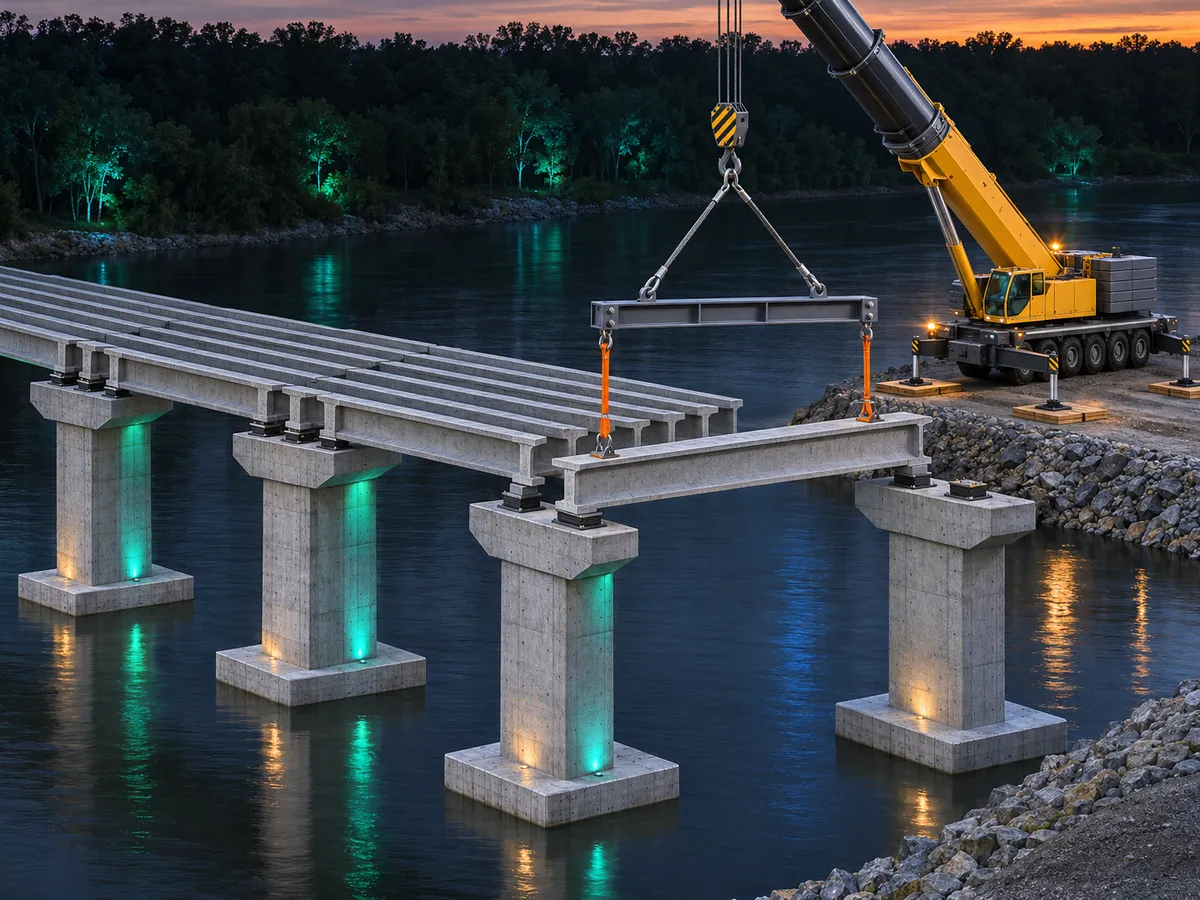
A bridge carries a road, railway or metro over a river, valley or another road. Bridge design is working out every load it will see over its life and sizing each part to carry them: the superstructure (the deck slab and the girders, trusses or box girders under it), the bearings it sits on, the substructure (pier caps, piers and abutments) and the foundations (open, raft, pile or well foundations) that take everything into the ground.
In India, road bridges are designed to the Indian Roads Congress codes (IRC:6 for loads, IRC:112 for concrete, IRC:24 for steel), railway and metro bridges to the Indian Railway Standards. What makes bridges different from buildings is that the main load moves: a vehicle rolls across, so the designer has to find where on the span it causes the worst effect for each member. On top come earth pressure on abutments, water current and scour on piers in rivers, wind, earthquake, braking, temperature, creep and shrinkage of prestressed concrete, and the stresses that exist only while the bridge is being built.
Here is the moving-load idea in numbers. Take a simply supported 20 m span. The influence line for bending moment at midspan, the moment there caused by a 1 kN load placed at each point of the span, is a triangle peaking at L/4 = 5 m under midspan. So a 100 kN point load gives 500 kN·m at midspan when it stands at midspan, but only 250 kN·m when it stands at the quarter point. Now spread a 700 kN tracked vehicle over 4.57 m, the size of IRC Class 70R tracked loading. Centred on the span it gives W(2L − c)/8 = 700 × (40 − 4.57)/8 = 3,100 kN·m, 11.4% less than treating the same 700 kN as a single point load (3,500 kN·m). Driven to the end of the span, it puts 620 kN on that bearing, the case that designs the bearing and the pier cap below it.
Temperature matters too. Concrete expands about 7 to 13 millionths of its length per °C depending on the aggregate; at 12 × 10⁻⁶ per °C, a 30 °C swing moves the end of that 20 m deck by 12 × 10⁻⁶ × 20,000 mm × 30 = 7.2 mm. Free movement goes into the expansion joint and sliding bearing; restrained movement becomes force in the piers. These are first estimates before the impact factor, lane rules and load factors the codes add; the courses teach those and the software checks that replace hand sums.
What a Bridge Design course covers
- Bridge loads. Dead and superimposed dead load, IRC road live loads (Class A, Class 70R, tracked loading, footway), influence lines, IRS railway and metro loading, earth pressure, wind, seismic, water current and braking, centrifugal and impact, snow, temperature, fatigue, barge impact and load combinations, each applied in STAAD.Pro.
- Substructures and piers. Abutment types (wall, spill-through, abutment pier), retaining walls, RCC and PSC pier caps, corbels, a full bridge model in STAAD.Pro, capacity checks in Autodesk Structural Bridge Design, and RC detailing (crack width, ductile detailing, laps).
- Foundations. Site parameters, abutments and piers on open foundations, raft foundations, pile foundations (components, stability checks, design) and well foundations for river bridges.
- Superstructures. RCC solid, voided and ribbed slabs with grillage models, PSC I-girders and box girders, strut-and-tie for bearing regions and anchorages, integral bridges, creep, shrinkage and prestress loss, construction stages (LUSAS); steel truss, plate-girder and steel-concrete composite bridges with shear connectors and fatigue (STAAD.Pro).
- Metro viaducts. Planning and the design basis report, prestressed U-girders and I-girders, bearings, PSC and RCC pier caps, piers, pile caps, pile, open and well foundations for an elevated metro line.
The courses in detail
Design of Bridge Substructures / Piers using STAAD.Pro
Abutments and piers, RCC and PSC pier caps, corbels, a full bridge model and load combinations in STAAD.Pro, capacity checks in Autodesk Structural Bridge Design, and RC detailing.
Projects include: Portal Pier Analysis; Analysis and Design of Substructure of 5 - spans Box girder bridge..
Tools: STAAD.Pro, Autodesk Structural Bridge Design
Design of Bridge Foundations using STAAD.Pro
Shallow and deep bridge foundations: site parameters, abutments and piers on open foundations, raft foundations, pile components, stability checks and design, and well foundations.
Projects include: Design a Raft Foundation for a Box Bridge with Specific Dimensions and Safe Bearing Capacity; Design a Pile Foundation for an RCC Slab Bridge with Specific Dimensions and Safe Bearing Capacity.
Tools: STAAD.Pro
Design loads considered on bridges
Every load on a bridge, week by week: dead, IRC road and IRS rail live loads, earth pressure, wind, seismic, water current, braking, impact, snow, temperature, fatigue and barge impact, then load combinations, each applied in STAAD.Pro.
Projects include: Calculate the Design Load for a Single Long-span Bridge in Mumbai; Calculate the Design Load for a Double Long-span Bridge in Manali.
Tools: STAAD.Pro
Design of Elevated Metro Viaducts using STAAD.Pro
One elevated metro viaduct end to end: planning and design basis, prestressed U- and I-girders, bearings, PSC and RCC pier caps, piers, pile caps, piles, and open and well foundations.
Projects include: Design of I-girder Superstructure; Design of Substructure & Foundation.
Tools: STAAD.Pro
Design of RCC and PSC Superstructures using LUSAS
Concrete bridge decks in LUSAS: RCC solid, voided and ribbed slabs with grillage models, PSC I and box girders, strut-and-tie, integral bridges, creep and shrinkage, and construction stages.
Projects include: Analysis of Concrete Bridge proposed across a river based on given site details; Detailed Analysis and Design of Bridge proposed across a industrial site.
Tools: LUSAS
Design of Steel Superstructure in Bridges
Steel truss bridges (tension, compression and bending members, connections), plate-girder bridges (buckling, shear, splices, fatigue) and steel-concrete composite bridges with shear connectors.
Projects include: Design a Truss Bridge and its Detailed Drawings; Design a Steel Composite Bridge Structure.
Tools: STAAD.Pro
Post Graduate Program in Bridge Design and Analysis
Six bridge courses: design loads, bridge foundations, elevated metro viaducts, substructures and piers, steel superstructures, and seismic design and analysis of bridges, all in STAAD.Pro.
Projects include: Design a Raft Foundation for a Box Bridge with Specific Dimensions and Safe Bearing Capacity; Design a Pile Foundation for an RCC Slab Bridge with Specific Dimensions and Safe Bearing Capacity; Design of I-girder Superstructure; Design of substructure & foundation.
Tools: STAAD.Pro, Autodesk Structural Bridge Design
Jobs after a Bridge Design course
Typical job titles: bridge design engineer, trainee or graduate bridge engineer, structural engineer (bridges), detailing engineer, and proof-checking engineer. Employers are infrastructure design consultancies (highway, railway and metro), the design wings of EPC contractors, international engineering firms with Indian offices, and authority and metro-corporation consultants.
We can't give a bridge salary median, and here is why. Only 5 of Skill-Lync's 3,905 placement records (2022 to 2023) are bridge job titles or learners of the PG Bridge program: trainee bridge engineers at RD Civil Solutions, a design engineer at Maps Global CivilTech, a structural bridge design engineer at K&J Projects and a bridge engineer at WSP. The four who reported pay were offered 1.4 LPA, 2.4 LPA, 5.25 LPA, 8 LPA: too few, and too spread, for a median.
For context, across all 367 civil placements with a salary in our records (as of 19 Nov 2026) the median starting offer is 2.4 LPA, middle half 2.4 to 3.5 LPA. By role, employer and city: civil engineer salary in India. These are self-reported offers from learners who told us they were placed; treat them as a starting point, not as today's market rate.
Free bridge lessons before you pay
Every Skill-Lync bridge course has free lessons you can watch without signing up. For theory, NPTEL's Bridge Engineering (IIT (ISM) Dhanbad) and Pre-stressed Concrete Structures (IIT Madras) lectures are free too; they are listed on the bridge course comparison page.
- Design Loads Considered on Bridges: free lessons
- Bridge Substructures and Piers in STAAD.Pro: free lessons
- Bridge Foundations in STAAD.Pro: free lessons
- Steel Superstructure in Bridges: free lessons
- Elevated Metro Viaducts: free lessons
- GATE Civil structural analysis, solved past questions (influence lines, indeterminate beams)
- Bridge design in civil engineering: what you need to know
Free Bridge Design tutorials
Start here before you pay for anything. These are written by Skill-Lync learners and engineers:
- Bridge Design in Civil Engineering: What You Need to Know
- What Is STAAD.Pro? Uses, History, Indian Codes and a Worked Example
- Role of Earthquake Engineering in Predicting the Impact of Seismic Activity on Infrastructure
- What Are the Methods for Steel Structure Design?
- Frequently Asked STAAD.Pro & AutoCAD Interview Questions and Answers
Before you pay
Compare hours, not weeks. Every short course here costs ₹40,000, but Design loads considered on bridges is 10 h of video while Design of RCC and PSC Superstructures using LUSAS and Design of Bridge Foundations using STAAD.Pro are 23 h each.
Learn RCC, prestressed and steel design first. Bridge courses assume you can design an RCC section, understand prestress losses and size a steel member. If those are weak, start with the RCC design and structural analysis courses on the structural design page, or the free NPTEL lectures.
Check which software the jobs you want use. These courses use STAAD.Pro, Autodesk Structural Bridge Design and LUSAS. Many Indian bridge consultancies also use MIDAS Civil, CSiBridge or SOFiSTiK, which Skill-Lync does not teach; MIDAS Academy sells short MIDAS Civil courses for a few hundred rupees (see the comparison page). The design thinking transfers; the menus do not.
Codes change. IRC codes are revised every few years. Make sure your course and your project use the edition the client asks for, and buy or borrow the current IRC:6 and IRC:112.
Bridge jobs for freshers are few and pay is modest. Only 5 of our placement records are bridge roles, and civil offers in our records have a median of 2.4 LPA. Bridges are a specialisation to build on a civil structural base; ask the counsellor for recent bridge placements before you pay for the PG program.
Bridge Design course FAQs
What is the fee for a bridge design course at Skill-Lync?
As of 19 Nov 2026: each of the 6 bridge short courses is ₹40,000, and the PG Program in Bridge Design and Analysis is ₹2,75,000 (EMI from ₹14,375 a month). Fees are inclusive of all charges.
Which bridge course should I take first?
Design loads considered on bridges. It teaches every IRC and IRS load on a bridge, influence lines and load combinations in STAAD.Pro, which all the other bridge courses build on.
Which IRC codes are used in bridge design?
IRC:6 gives the loads and load combinations for road bridges (dead, live vehicle loads such as Class A and Class 70R, wind, seismic, water current, temperature and more). IRC:112 covers concrete road bridges, IRC:24 steel road bridges, IRC:22 composite construction and IRC:78 foundations and substructure. Railway and metro bridges follow the Indian Railway Standards.
What is an influence line?
A graph of how one response, such as the bending moment at midspan or the reaction at a support, changes as a unit load moves across the span. For a simply supported 20 m span the midspan-moment influence line is a triangle peaking at 5 m, so a 100 kN load gives 500 kN·m at midspan when it stands there and 250 kN·m from the quarter point. Designers use it to place moving vehicle loads in their worst position.
Which software is used for bridge design?
STAAD.Pro for frame and grillage models of decks, piers and foundations, LUSAS, MIDAS Civil and CSiBridge for bridge-specific analysis (staged construction, prestress, moving loads), and Autodesk Structural Bridge Design for section and code checks. Skill-Lync's courses use STAAD.Pro, LUSAS and Autodesk Structural Bridge Design.
What is the salary of a bridge design engineer in India?
We don't have enough of our own data for a median: 5 bridge placement records (2022 to 2023), with offers of 1.4, 2.4, 5.25, 8 LPA among those who reported pay. Across all civil placements in our records the median starting offer is 2.4 LPA (n = 367).
Can I learn bridge design for free?
The theory, yes: NPTEL's Bridge Engineering and Pre-stressed Concrete Structures lectures are free, and every Skill-Lync bridge course has free lessons. What you cannot get free is feedback on a full design: a paid course adds reviewed projects (load calculations, a pier, a foundation, a girder) that you can show in interviews.