 Free · 3 lessons · no payment
Design of Bridge Substructures / Piers using STAAD.Pro: 3 free lessons
Three free lessons from Skill-Lync's Design of Bridge Substructures / Piers using STAAD.Pro course. They set up the background before any modelling: how bridges are classified, the parts of a bridge, Indian and international design codes with concrete and steel grades, and how load reaches the ground. The third lesson lists the loads on a bridge and the IRC 6 load combination factors.
Last updated 16 Nov 2026 · 3 free lessons (1 h 18 min) · full course: 45 lessons (20 h 54 min), paid · ₹40,000
 Free lesson 1 · 28 minBridge Structure Types and How Bridges Are Classified
What will you learn in the free Design of Bridge Substructures / Piers using STAAD.Pro lessons?
- Truss, cable, arch and portal frame behaviour
- Superstructure, substructure and foundation roles
- Indian and international bridge design codes
- Bridge loads and IRC 6 combination factors
Free lessons you can watch now
- Lesson 1 · 28 minBridge Structure Types and How Bridges Are ClassifiedThe instructor explains why bridges are built and what bridge engineering covers, then describes truss, cable, arch and portal frame structures and why each behaves as it does. The lesson classifies bridges by material, length, form, function, road level, navigation clearance, service and degree of redundancy, and previews STAAD.Pro modelling in later weeks.
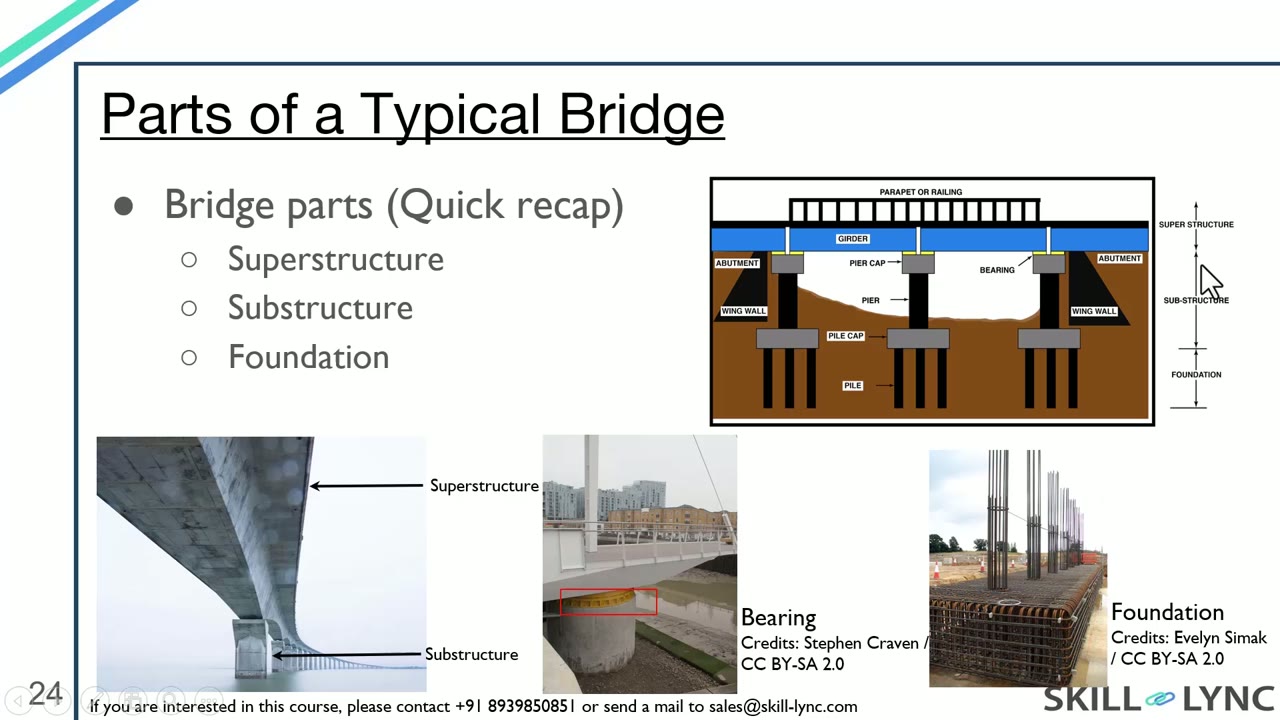 Lesson 2 · 29 minParts of a Bridge, Design Codes, Concrete and Steel GradesThe instructor divides a bridge into superstructure, substructure and foundation, with bearings between the first two, and explains why design runs top down while construction runs bottom up. The lesson lists IRC, IRS, IS, Eurocode and AASHTO codes, minimum concrete and steel grades by exposure, clear cover, and how loads reach the ground through end bearing and friction piles.
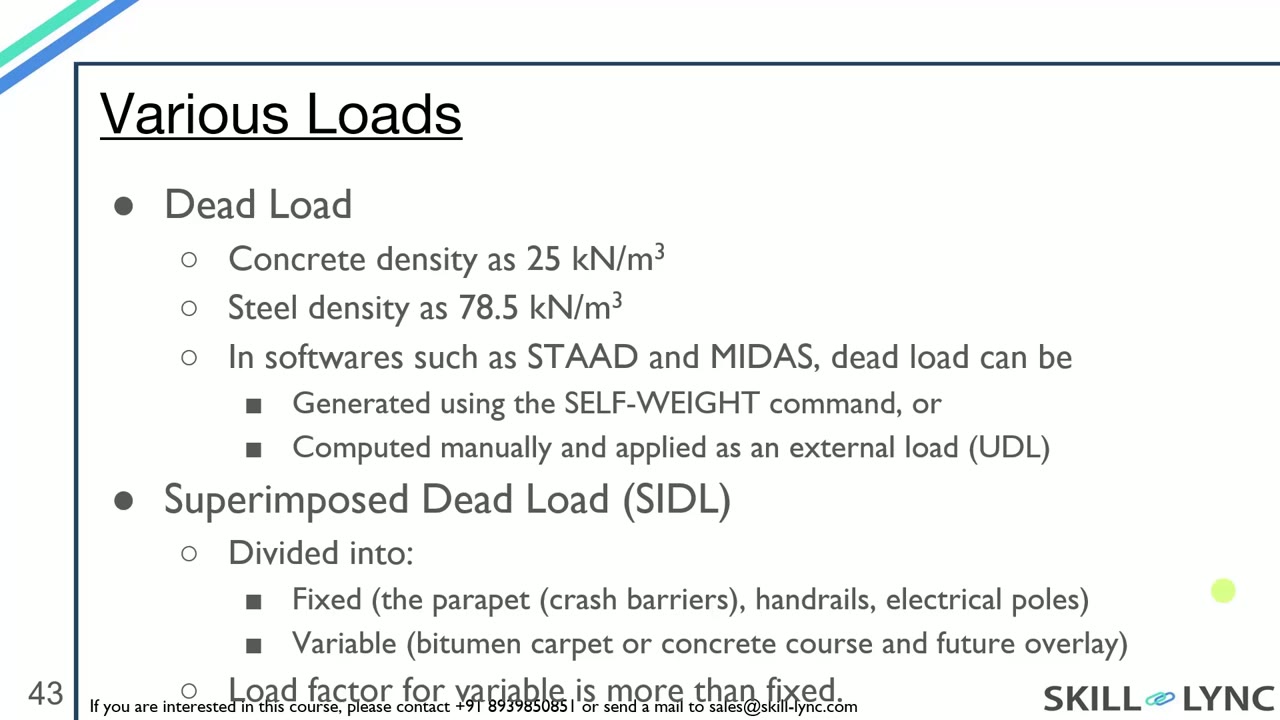 Lesson 3 · 21 minBridge Loads and IRC 6 Load Combination FactorsThe instructor defines dead load (25 kN/m3 for reinforced concrete, 78.5 kN/m3 for steel), fixed and variable superimposed dead load, live load, braking, centrifugal, temperature, wind, erection, collision and earth pressure loads. It ends with the IRC 6 ultimate limit state table, where dead load is 1.35, surfacing 1.75 and a leading live load 1.5.
Which lessons of Design of Bridge Substructures / Piers using STAAD.Pro are free?
The first 3 lessons are free on Grow by Skill-Lync: 1 h 18 min of video from Skill-Lync's Design of Bridge Substructures / Piers using STAAD.Pro course that you can watch here at no cost: leave your name and phone number once and they play (as of 16 Nov 2026). The full course is paid (₹40,000); its other 42 lessons are listed in the outline below so you can see what each one covers.
How long is the Design of Bridge Substructures / Piers using STAAD.Pro course?
The full course has 45 lessons and 20 h 54 min of recorded video, plus the projects and assignments that come with enrolment. The free lessons alone take about 1 h 18 min, so you can finish them in an evening and decide whether to continue.
What comes after the free lessons?
Lesson 4 onwards is in the paid Design of Bridge Substructures / Piers using STAAD.Pro course on Skill-Lync, with mentor support and a certificate. For a career in Civil & structural, the Post Graduate Program in Bridge Design and Analysis goes further with industry projects and placement support.