Week 9 Machining with Planer Challenge
Objective:
To perform an explicit dynamics simulation for Machining with planer and to find out the Equivalent Stress, Total Deformation and also insert a User defined result to calculate the temperature of the body. We need to perform this for 2 cases. One will be with a cutting velocity of 20000mm/s and the other will be with a cutting velocity of 15000mm/s.
Case setup & Procedure:
- In the Engineering data source we have selected structural steel and Steel 1006 for analysing the machining operation using Planer machine.
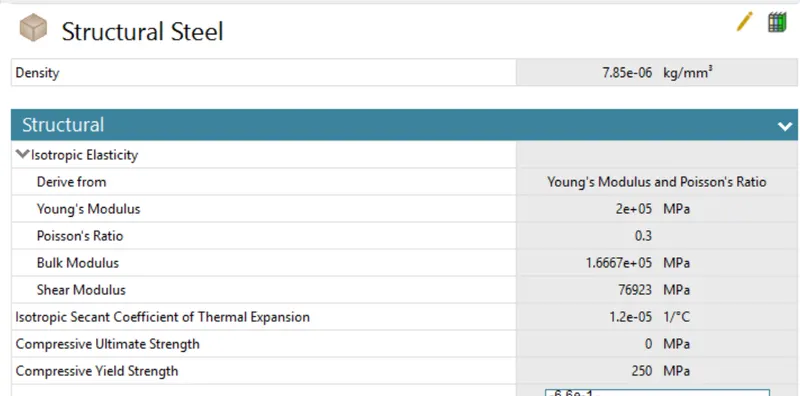
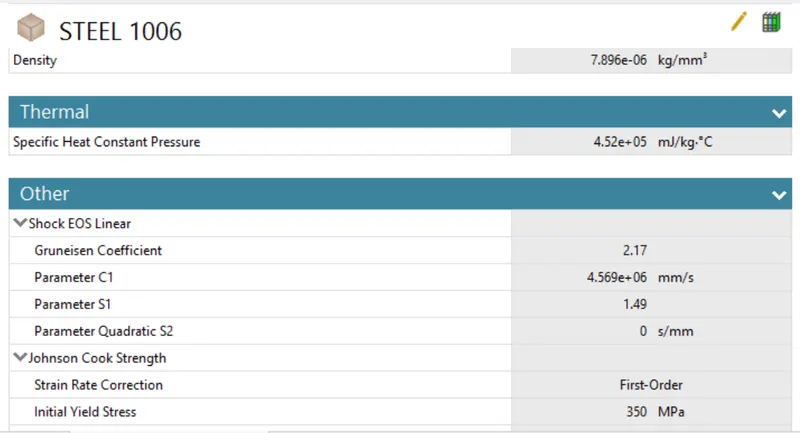
- The geometry has been imported and is shown below and the workpiece has been assigned material as steel 1006 where as for the planer we have assigned structural steel as a material.
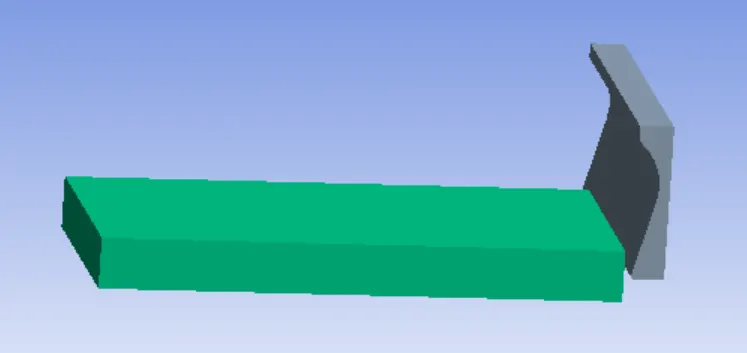
- The connection has been removed and their is only body interaction between the the planer and the workpiece.
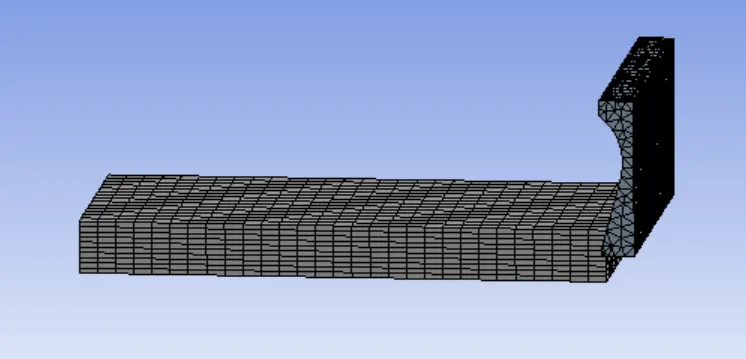
- In the mesh section we have assigned method as tetrahedron with patch confirming type. For the workpiece we have used selected as four edges with number of division as 10.
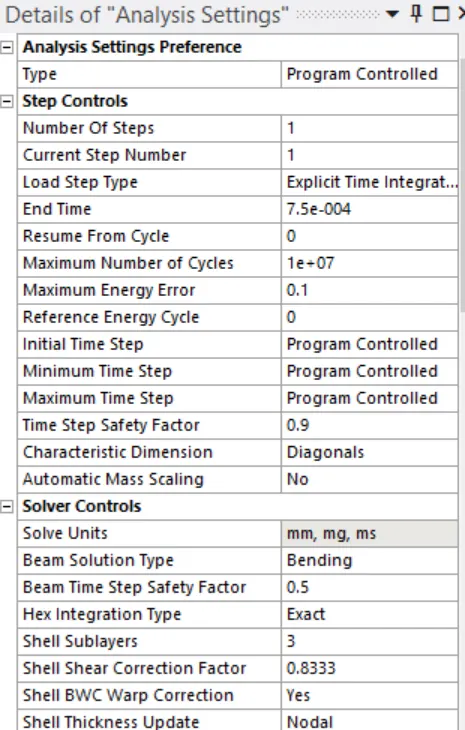
- In the analysis setting we have assigned 1 step to carry out the analysis with end time as 7.5e-4.
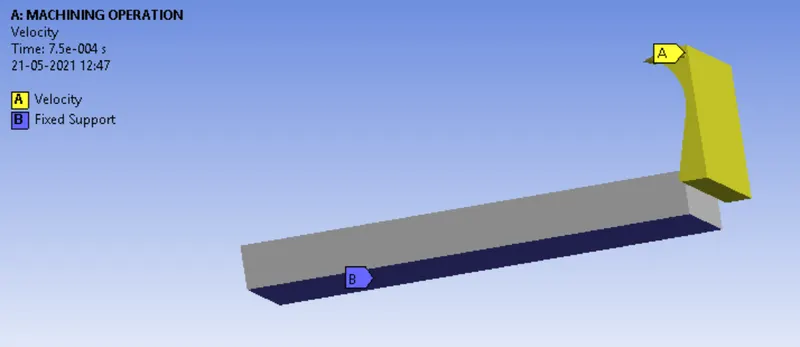
- For carrying out the analysis we have fixed the bottom surface of the workpiece where as a velocity is assigned to the planer in the direction of the workpiece as 20000 mm/s in case 1 and 15000 mm/s in case 2.
- Finally the results are obtain and we have listed the output in the result section.
Results:
Case 1:
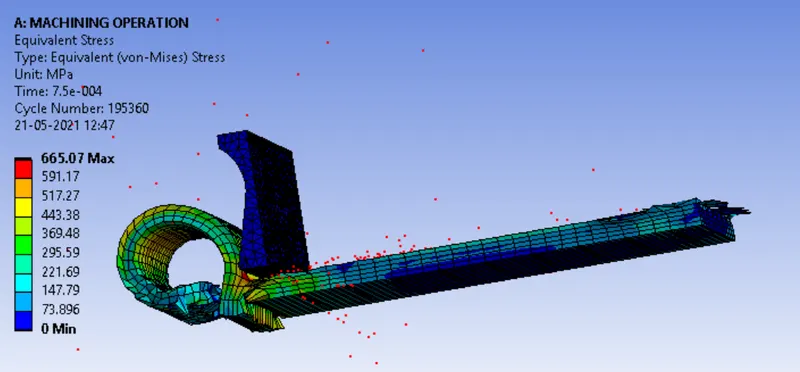
Equivalent Stress
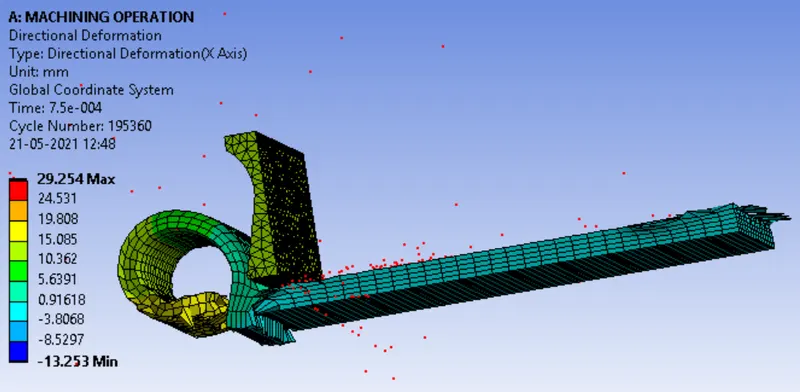
Total Deformation
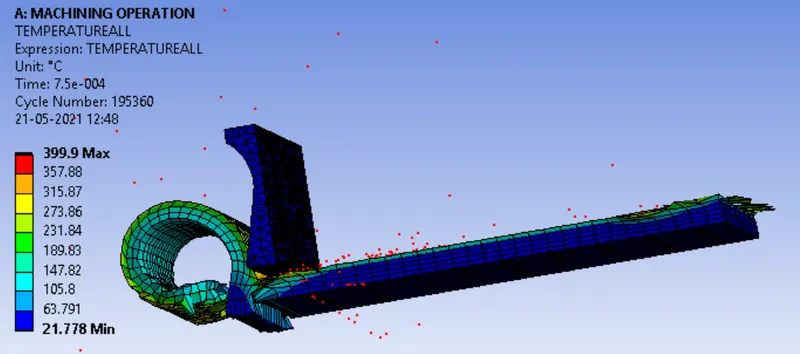
User defined temperature
Results:
Case 2:
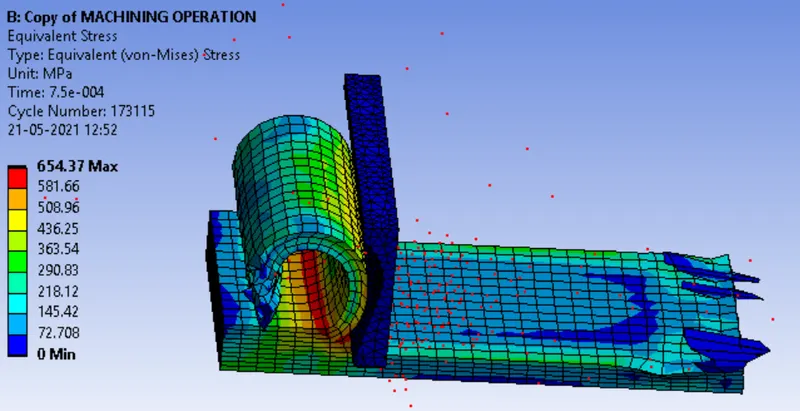
Equivalent Stress
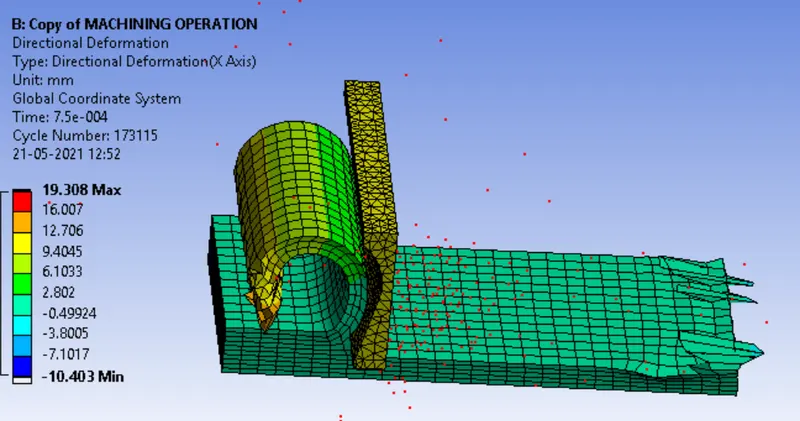
Total Deformation
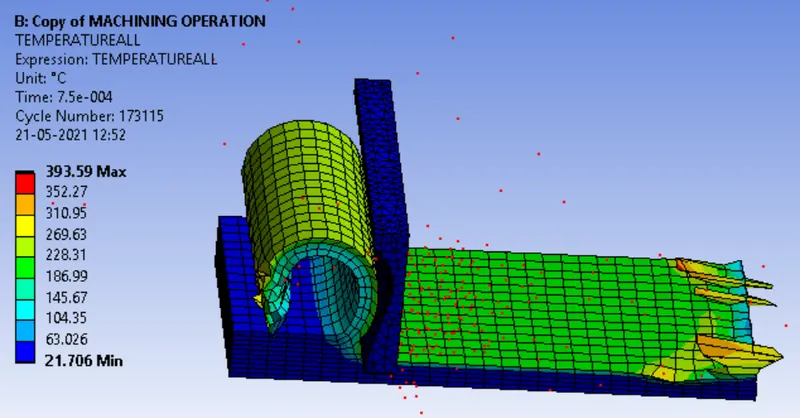
User defined temperature
Conclusion & Discussion:
|
Equivalent Stress |
Total Deformation | User defined Temperature | |
| Case 1 | 665.07 MPa | 29.25 mm | 399.9 *C |
| Case 2 | 654.37 MPa | 19.30 mm | 393.59*C |
From the above table we can observe that the equivalent stress is more in case 1 as the velocity is more in case 1.
The directional deformation is also more when velocity of planer is more
The Temperature is maximum in case 1 because the material removed from the surface is more in case 1 and that also in higher speed.
When a velocity of 20000mm/s is applied on the planer we can observe that too much material is flowing out of the workpiece however on reducing the velocity as in case 2 around 15000mm/s the planer is not able to cover all the length of the workpiece.
https://drive.google.com/file/d/1iz_1030faVWK9YHBaQcxgPFlhYJTTS8s/view?usp=sharing