Week 11 Car Crash simulation
Objective:
To perform a parametric study using 3 different values of thickness for the car body and to Analyse the total deformation and Equivalent stresses acting on the model.
Case Setup:
- From the engineering data source we have selected structural steel and stainless steel NL for carrying out our analysis.
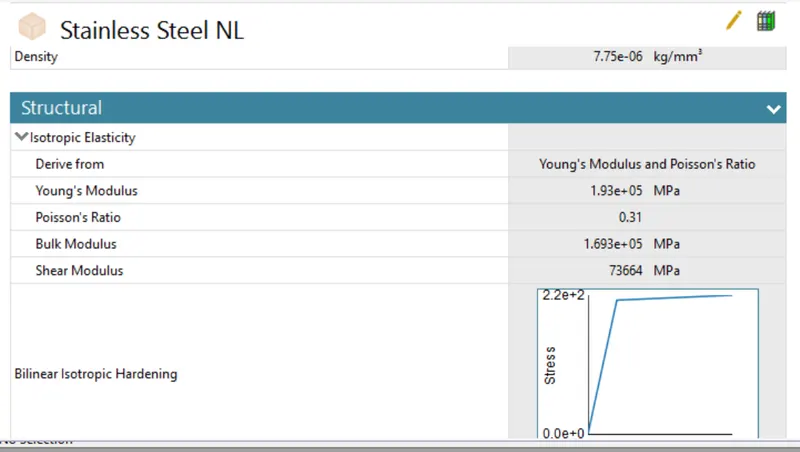
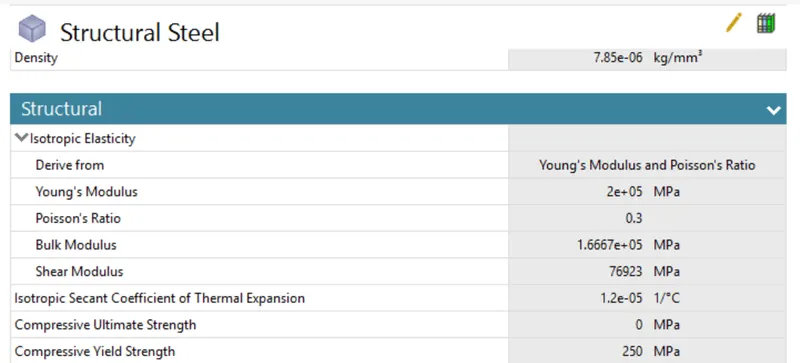
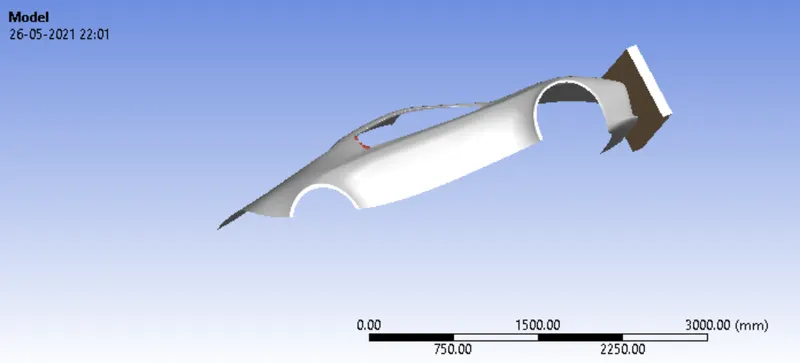
- The geometry has been imported and we have assigned structural steel to the wall and stainless steel to the car body.
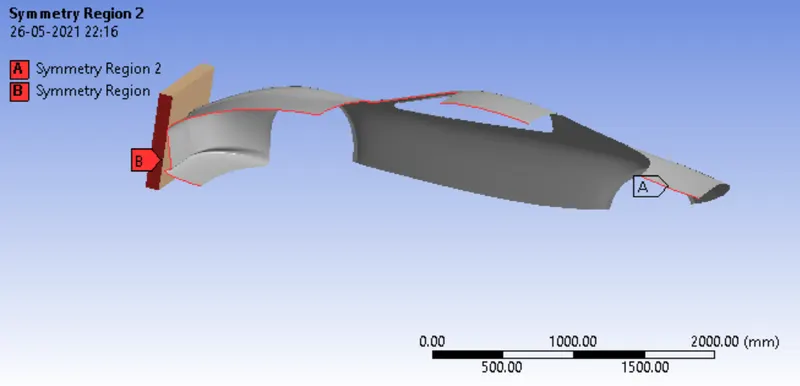
- We have also assigned two symmetrical section to the geometry one to the car and other to the wall.
- Since there is going to be impact between the wall and the car we have neglected the contact between them.
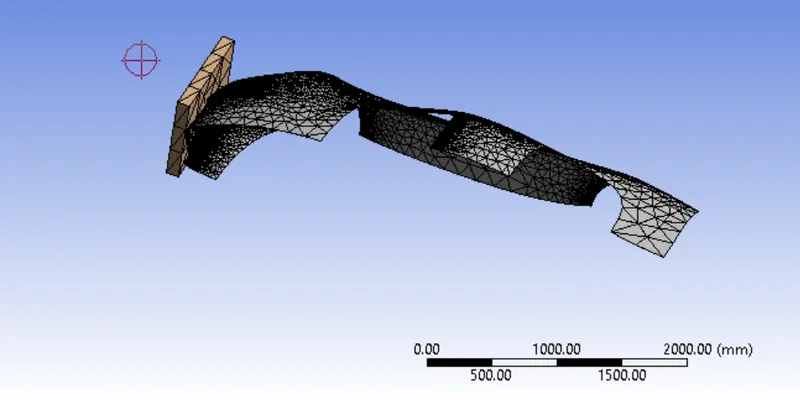
- For the mesh we have assigned tetrahedron elements for the wall and triangular elements for the car body. We have even applied face sizing to the car body with element size as 200mm in order to keep the elements within the academic limits.
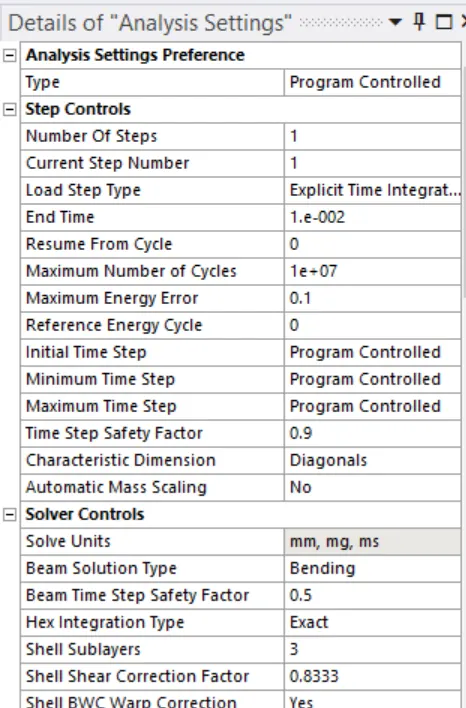
- In the analysis setting we have applied one step and end size of 1e-2 and other setting are shown below.
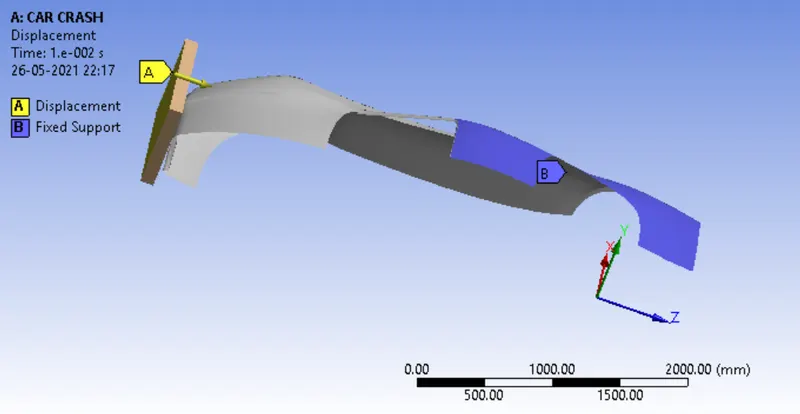
- For the analysis we have fixed the car body and appied a displacement to the wall of magnitude of 500mm.
- The initial analysis is carried out with the thickness of 0.3mm to the car body.
- Finally the output which are required are called out to obtain the result.
- In order to carry out the parametric analysis we have assigned thickness as an input parameter and total deformation and equivalent stress as an output parameter.
Results:
Case 1: (0.3 mm thickness)
Total deformation: 672.49 mm
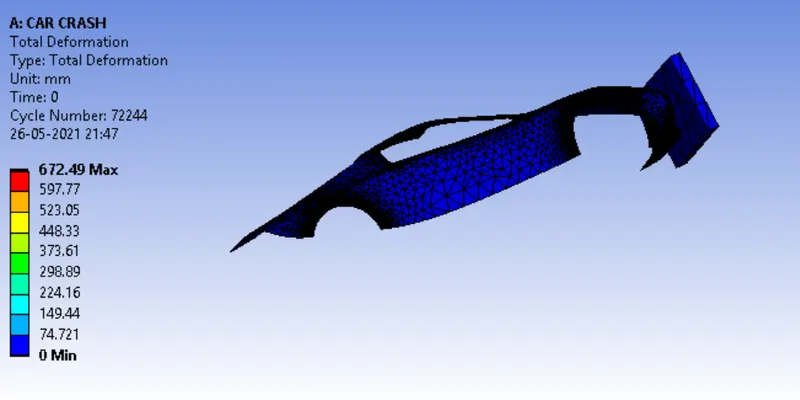
Equivalent stress: 469.78 MPa
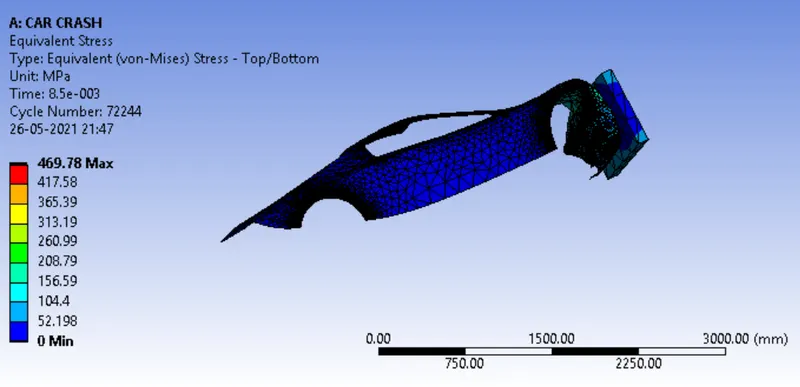
Case 2: (0.4 mm thickness)
Total deformation: 773 mm
Equivalent stress: 656.16MPa
Case 3: (0.5 mm thickness)
Total deformation: 770.42 mm
Equivalent stress: 531.3 MPa
Case 4: (0.6 mm thickness)
Total deformation: 770.28 mm
Equivalent stress: 537.49 MPa
Discussion & Conclusion:
| Total deformation | Equivalent stress | |
| Case 1 | 672.49 mm | 469.78 MPa |
| Case 2 | 773 mm | 656.16 MPa |
| Case 3 | 770.42 mm | 531.3 MPa |
| Case 4 | 770.28 mm | 537.49 MPa |
From the above case we can observe that the maximum deformation has occured in case 2 and the least is observed in case 1 where the thickness is around 0.3mm.
The equivalent stress is minimum in case 1 when the thickness is around 0.3mm.
Thus we can conclude that the use of car body with thickness of 0.3 mm is preferred.
https://drive.google.com/file/d/1FEtOpMfA2g81o929S2Qu_hKe8zKLG-zM/view?usp=sharing