Week 8 - Natural Convection-II
JORGE LOZANO
Electronic Cooling Simulations using ANSYS ICEPAK
Week 8 - Natural Convection-II
- Build the model as per the following information.
- Mesh the model with nonconformal meshing
- Solve the problem for natural convection.
- Panel dimensions: height 2000mm, width 800 mm depth: 900mm.
- Actual current incoming: 1214A. Circuit breaker losses are given as per the following table. The current distribution and bus bar dimensions are given as per the following table
Process
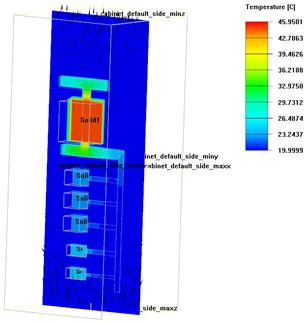
The process will be introduced from a new project document by opening the Icepak software, and starting to generate each block representing the system, fluid or solid, according to its coordinates and its properties given earlier, as seen in the image having an open system, having side boundary layers as ambient conditions.
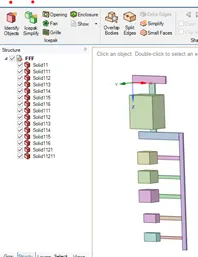
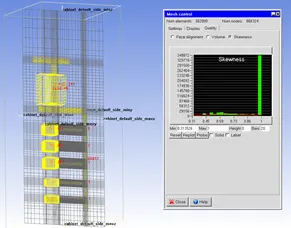
As seen in the videos the mesh conforming conditions will begin by creating an assembly with the inner parts of the system and indicating the max mesh element size as 5 mm and a minimum gap of 0.1 in all directions, considering the approximation to a good or excellent quality mesh due to the skewness.
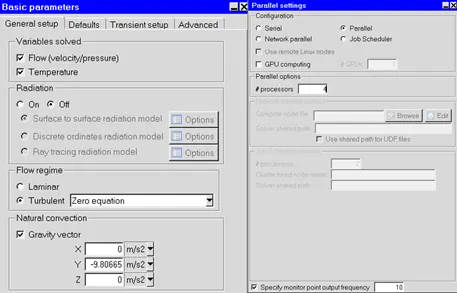
Once all preprocessing conditions and geometry are processed, the processing conditions will be selected, as follows having a parallel of 4 processors, transient simulation using a Zero equation turbulence model, applying gravity in the y- direction with the default discretization conditions.
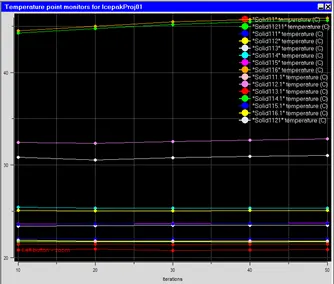
By adding into the postprocessing configuration probe points to generate a monitor while running the simulation, helps determine the increment or variation and comparison of all components in critical or desired focus.
The contour, plane cut and vectors postprocessing are generated, seeing the natural convection effect from having a heated inner volume of air at 45 C and an ambient temperature of 20 C. Being able to see the velocity pattern that the air follows and the gradient in which the outer fluid is being heated.
Seeing the arrows’ direction where in flow inside the volume is moving and the effect of the density variation in the outer fluid.