Week 5 Challenge : Surface wrap on Automotive Assembly
SURFACE WRAPPING ON AUTOMOTIVE ASSEMBLY USING ANSA
(WEEK-5 CHALLENGE)
1. AIM
Our aim is to surface wrap an automotive assembly which includes an engine, transmission, and a gear box in ANSA v20.1.4 using tria element type and given target length.
2. THEORY/ EQUATIONS/ FORMULAE USED
ANSA is a computer-aided engineering tool for Finite Element Analysis and CFD Analysis widely used in the automotive industry. It is developed by BETA CAE Systems. The software is distributed worldwide by a number of BETA CAE Systems subsidiaries and business agents. In the United States, it is distributed by Beta CAE Systems, USA, based in Farmington Hills, Michigan.
ANSA maintains the association between CAD geometry and the FE mesh. This means that the FE meshes are better representations of their geometric parents. Also it is easy to maintain and update any changes in the geometry by simply reworking the updated area instead of recreating the FE from scratch. It carries several proprietary algorithms for meshing suitable for both CFD and structural models. ANSA was initially standing for Automatic net generation for structural analysis, but the software has gone beyond that very quickly.
Surface Wrapping
Surface wrapping refers to the process of generating a geometric representation of a computational domain, typically consisting of a collection of surfaces. This step is crucial because CFD solvers require a well-defined geometry to accurately solve the governing equations of fluid flow.
It involves creating a watertight representation of the domain's surfaces, which can include solid objects, boundaries, and fluid interfaces. This representation is usually in the form of a surface mesh composed of triangles or quadrilaterals.
3. GENERAL PROCEDURE
- Firstly the software’s are downloaded and installed in the
- Geometry is imported in ANSA, firstly the diagnosis is carried out to check for any errors, then the errors are rectified, Property ID’s are defined and necessary surfaces, coons and hot points are created in topology
- Mesh Parameters such as target length, Perimeters and macros length, Quality parameters such as Min and max mesh length are defined before surface mesh is created using various algorithms available such as free mesh, Spot mesh etc. as required in Mesh Check the quality and refine the mesh as required.
4. DISCRETIZATION
- Geometric Model
The 3D geometry file of all three components of the automotive assembly is imported in ANSA as per the figure given below.
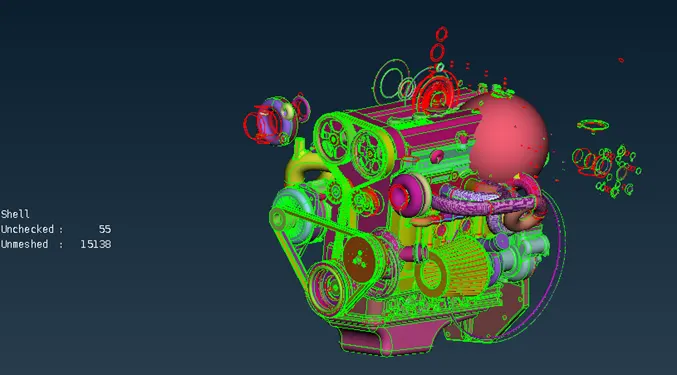
Fig: 3D Geometry – Engine
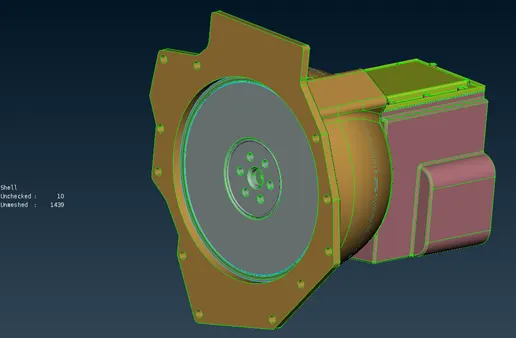
Fig: 3D Geometry – Transmission
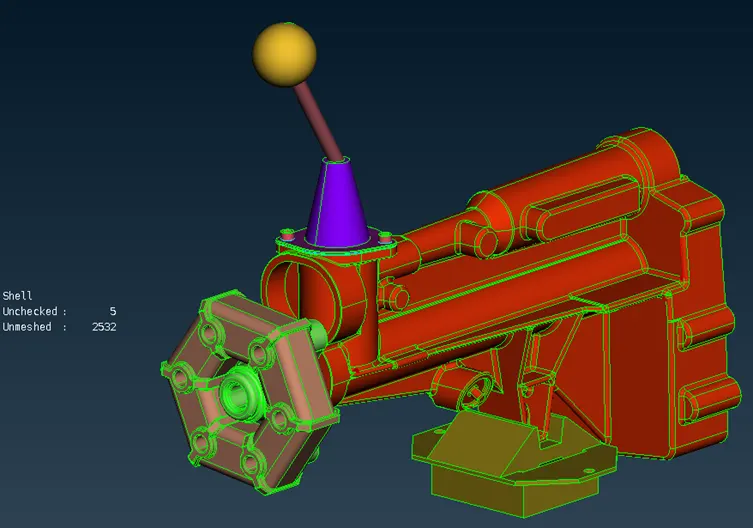
Fig: 3D Geometry – Gearbox
Meshing Process
- After the model is imported, the draw mode is changed to PID and the available perimeter points, cons are
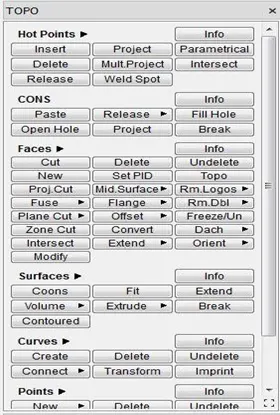
- Check for errors such as unchecked faces, collapsed cons, triple cons, single cons, needle faces, cracks, overlap faces, [Check > Geometry>Execute]
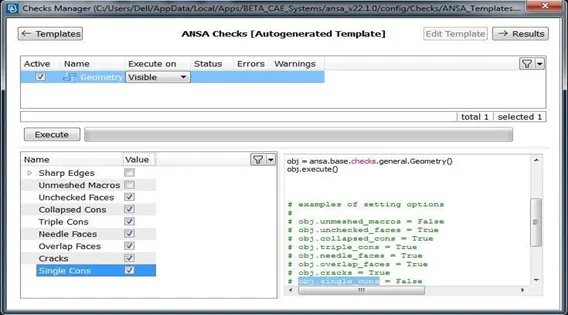
- Surface wrapping of an assembly requires a water tight geometry so we are interested only on the error on the outer surfaces.
- The openings/ errors are rectified by applying topo, creating new faces by various surface type options such as existing surface, planar, fitted, [TOPO > faces > new].
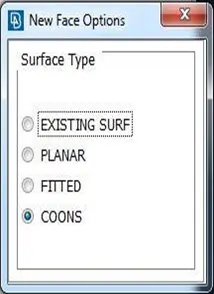
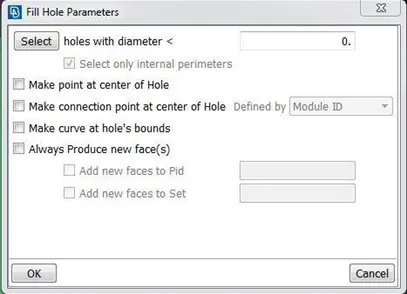
- We need to get rid of all the other surface used to create the features which are present in the model and also fill all the openings in order to create a single volume inside the assembly.
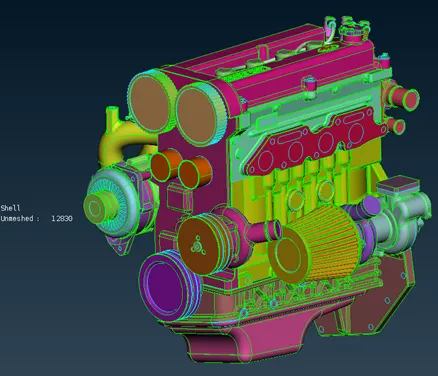
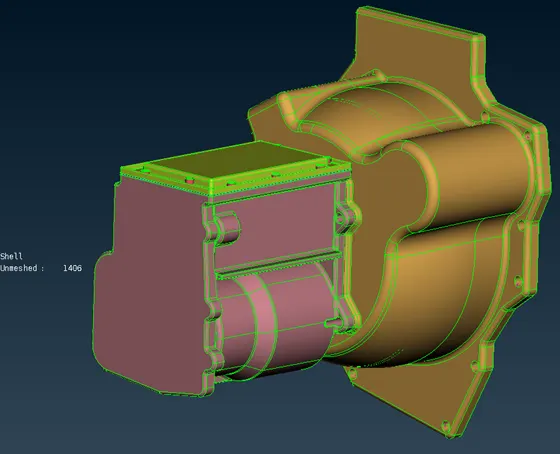
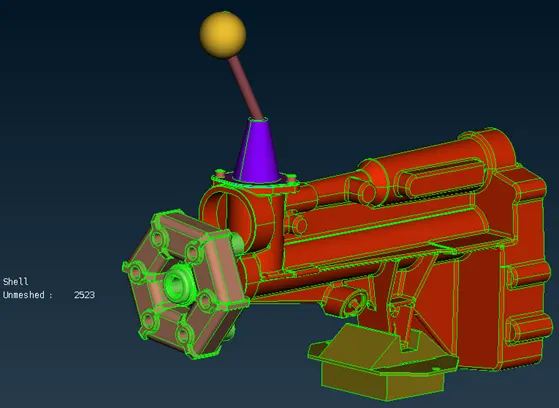
- Once all the unnecessary surfaces are cleared and opening are filled, merge all the individual component files to assemble.
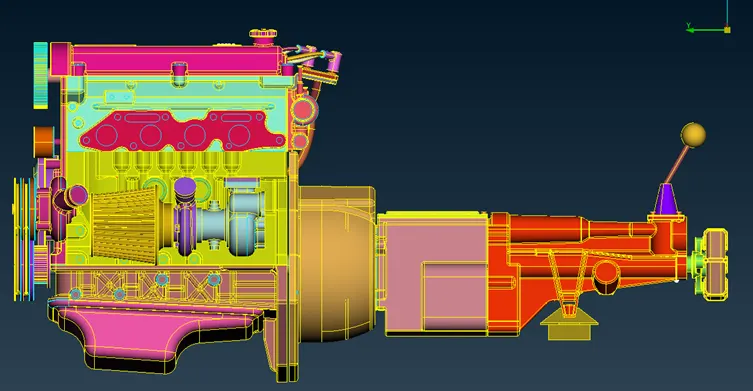
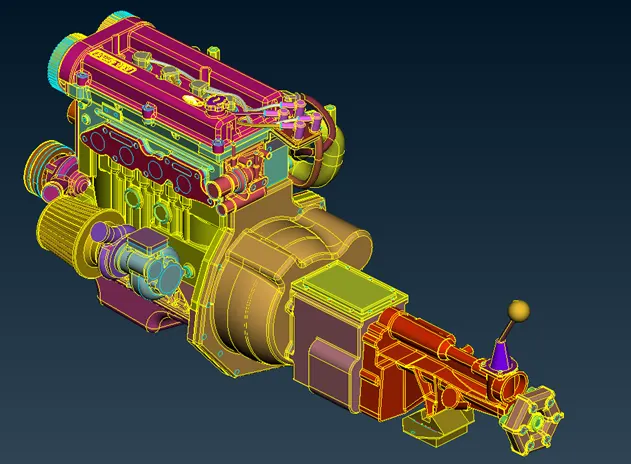
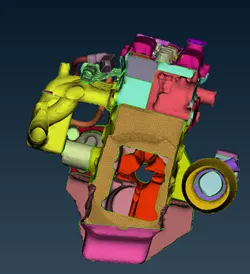
- After the assembly the done, Surface wrap is initiated with constant length, as we have been given 3 mm target length for wrap. [Elements>Wrap>Constant Length].
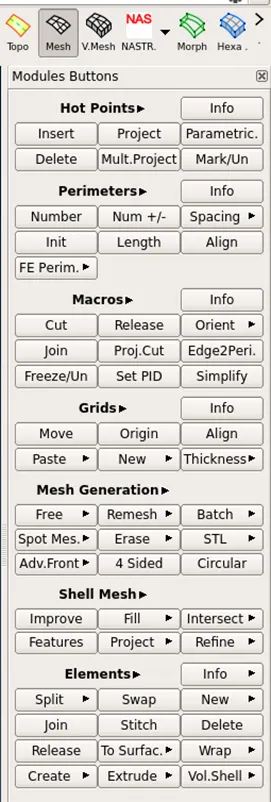
- More importantly the unwanted surfaces and parent PID are deleted by checking the surfaces in order to avoid
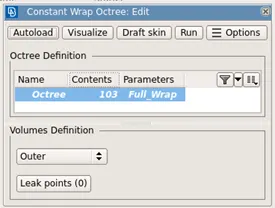
- Specify the wrap target length in parameters section and add all the necessary PID’s in contents section and also the surface wrap is named as shown in the below images.
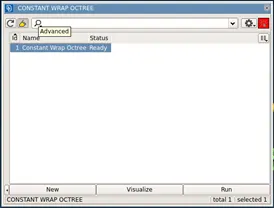
- As the target length is 3 mm it might take some time to finish the wrapping process.
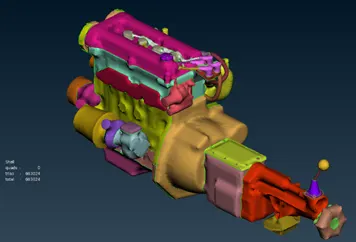
- Once the wrapping is done, examine by switching to FE mode, whether a single volume is available.
5. CONCLUSION
- Flow domain is created through an automotive assembly which includes an engine, transmission, and a gearbox by surface wrapping in ANSA v20.1.4 using the Graphical User Interface (GUI)
- Surface topology is cleaned by rectifying various geometrical errors such as single cons, triple cons, and unnecessary surfaces etc., by deleting the surfaces, closing the holes, creating new surfaces in order to avoid any error while wrapping.
- Surface wrapping is carried out using tria element type and given target wrap length of 3 mm.
- We can conclude that a single volume is available as we can see through the volume from one side to the other by switching to FE mode.
- By reducing the target wrap length, the surface curvatures can be captured with even better accuracy.