Program that compares the effect of number carbon atoms on the stoichiometric co-efficient with respect to the combustion of different fuel type.
DETAILED REPORT ON STOICHIOMETRIC RATIO CALCULATOR (WEEK-3 CHALLENGE)
- AIM
To write a program that compares the effect of number carbon atoms on the stoichiometric co-efficient with respect to the combustion of different fuel type.
- EQUATIONS/ FORMULAE USED
Generic alkane combustion, Cn H2n+2 + ar(O2 + 3.76 N2) = aCO2 + bH2O + cN2
Generic alkene combustion, Cn H2n + ar(O2 + 3.76 N2) = aCO2 + bH2O + cN2
Generic alkyne combustion, Cn H2n-2 + ar(O2 + 3.76 N2) = aCO2 + bH2O + cN2
Here
n = Number of atoms of C
ar = Stoichiometric co-efficient
a = Number of moles of Carbon-di-oxide
b = Number of moles of water
c = Number of moles of nitrogen
Relation between stoichiometric co-efficient and number of atoms of carbon
Alkane combustion, ar = (3n+1)/2
Alkene combustion, ar = (3n)/2
Alkyne combustion, ar = (3n-1)/2
- OBJECTIVES & PROCEDURE
- The main objective of the challenge is to write a simple code to compare the behavior of Alkane, Alkene and Alkyne combustion.
- In the process, Firstly we balance the chemical equation and find the relation between stoichiometric co-efficient and number of atoms of carbon.
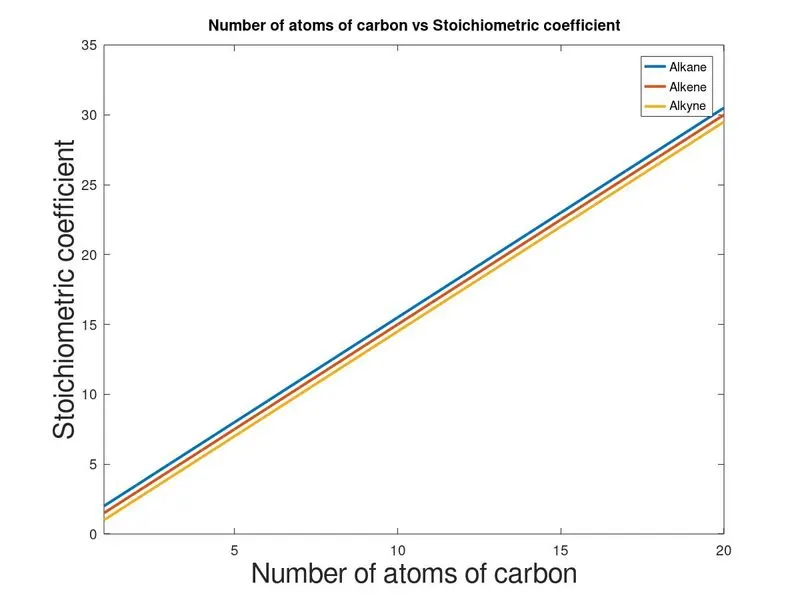
- The stoichiometric coefficient (ar) value is calculated over a range of number of carbon atoms (n ranging from 1 to 20) for each hydrocarbon and graph is plotted.
- PROGRAM
Programming language used – Octave 5.1.1
---------------------------------------------------------------------------------------
Program
---------------------------------------------------------------------------------------
% Stoichiometric cumbustion of Hydrocarbons
% n = number of atoms of carbon and a_r = stoichiometric coefficient

n = linspace(1,20,20);

% Alkane combustion
% Generic Alakne - Cn H2n+2

% Relation between n and ar =(3n+1)/2
a_r1 = (3*n+1)/2;

% Alkene combustion
% Generic Alkene - Cn H2n

% Relation between n and ar =3*n/2
a_r2 = (3*n)/2;

% Alkyne combustion
% Generic Alkyne - Cn H2n-2

% Relation between n and ar =(3n-1)/2
a_r3 = (3*n-1)/2;

% Plot comparing the relation between n and ar of Hydrocarbons
figure(1)
plot(n,a_r1, 'Linewidth',2)
hold on
plot(n,a_r2, 'Linewidth',2)
hold on
plot(n,a_r3, 'Linewidth',2)

axis([1 20 0 35])

title('Number of atoms of carbon vs Stoichiometric coefficient');

xlabel('Number of atoms of carbon','Fontsize',20);
ylabel('Stoichiometric coefficient','Fontsize',20);

legend('Alkane','Alkene','Alkyne');

---------------------------------------------------------------------------------------
5. RESULTS
Graph
6. CONCLUSION
- From the above graph, it can be clearly seen that its stoichiometric coefficient is increasing linearly as the number of carbon atoms increases.
- The trend obtained from the results is that for the same number of carbon atoms the stoichiometric coefficient is more for alkane than the alkene and more for alkene than the alkyne.