Week-3 Challenge: ADVISOR Tool
AIM:-
To use the ADVISOR tool and simulate the following
OBJECTIVE:-
1 For the EV_defaults_in file, if cargo mass is 500 kg with all other default conditions, can the vehicle travel for 45 km with FTP drive cycle? Conclude your observations.
2 In the above case, try changing the battery capacity and repeat the simulation.
3 Perform gradeability test with PRIUS_Jpn_defaults_in file
Compare your results in a table and conclude.
INTRODUCTION:-
. Created by National Laboratory for Renewable energy (NREL) and Department of Energy USA
. Development phase 1994 to 2004
. Rapid analysis of the performance and fuel economy of conventional electric and vehicles
. Use a backward flow (driving cycle to energy storage.)
. Vehicle models are mostly experimentally relying on the drivetrain component input/output relationship measured in the laboratory.
.it is a set of models data script text files for use with Matlab and Simulink
The benefits of using ADVISOR:-
. Estimate the fuel economy of vehicles that have not yet been built
. Compare relative tailpipe emission produced on a number of cycles
. Evaluate an energy management strategy for your hybrid vehicle's fuel converter
. Optimize the gear ratios in your transmission to minimize fuel use or maximize performance etc.
How to start ADVISOR toll:-
. Launch Matlab and first set a default location folder to the advisor
. Now in the command window of MATLAB type advisor and press enter.
. A new window will open and then set the metric for unit and ADVISOR.
.It will launch in a new window ADVISOR TOOL HAVE 3 window.
1) Vehicle input window
2) simulation parameter window
3) Result in window
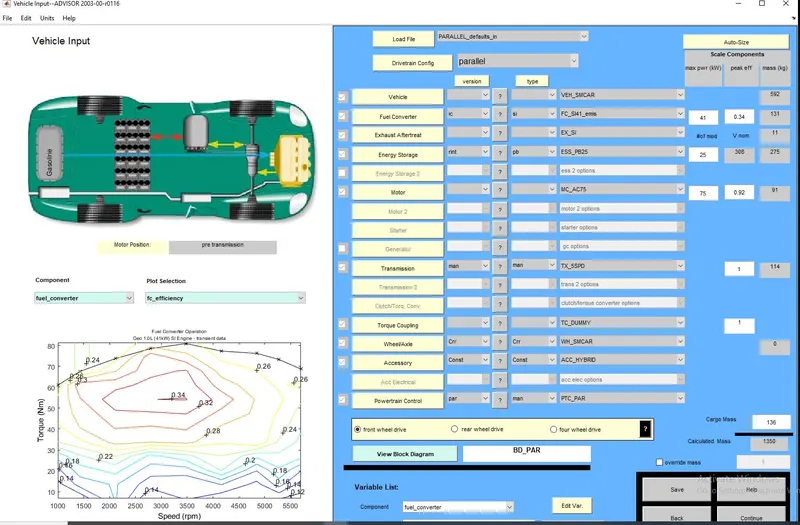
1. For the EV_defaults_in file, if cargo mass is 500 kg with all other default conditions, can the vehicle travel for 45 km with FTP drive cycle? Conclude your observations.
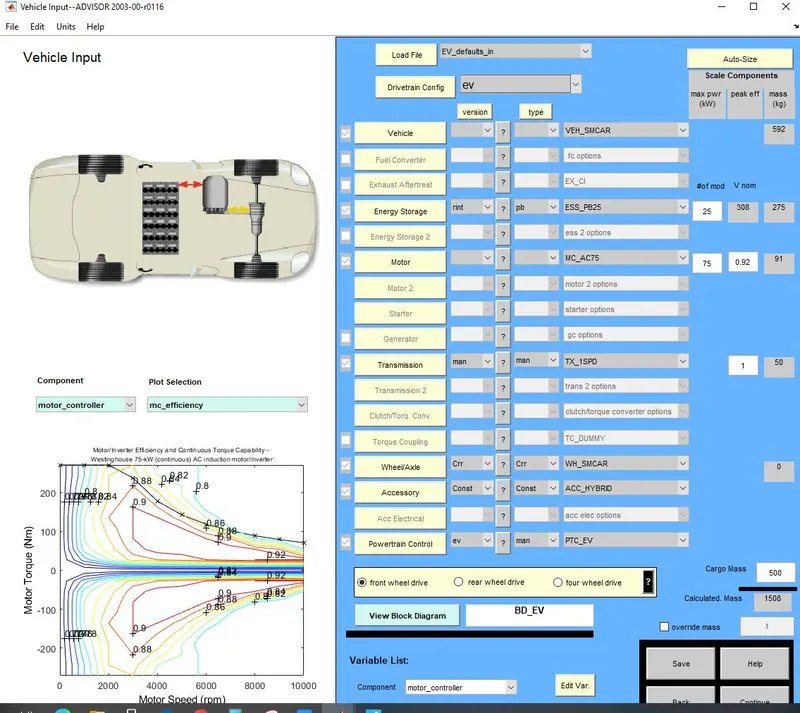
First, loading EV_defaults_in from the drop-down menu and changing Parallel_default_in to EV_defaults_in from the Vehicle Input window.
- Now changing the cargo mass to 500 kg
- A change in the total mass of the vehicle can be seen.
- Clicking on the continue button after that a new window simulation parameter will pop up.
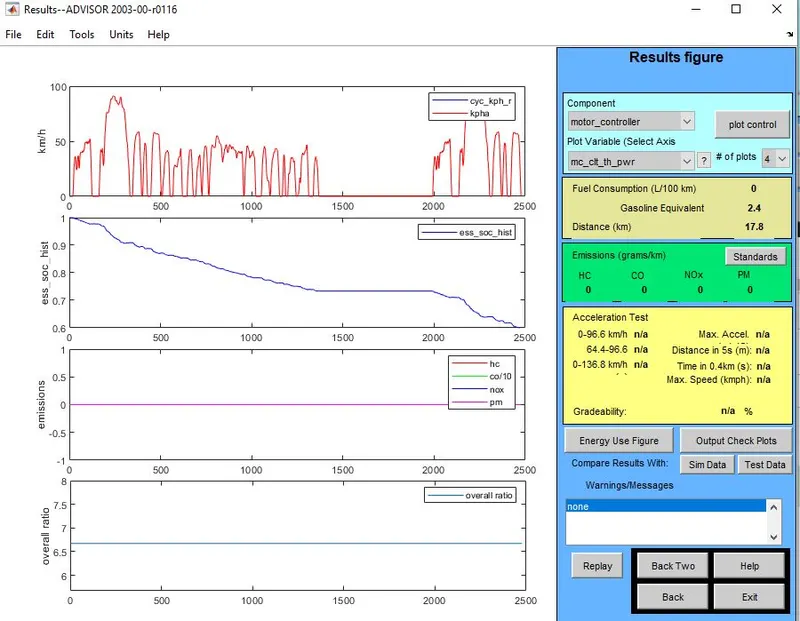
- In Simulation Parameter window change drive cycle to CYC_FTP by selecting the drop-down menu.
- Below that we will see # of cycles from here we can set our drive cycle.
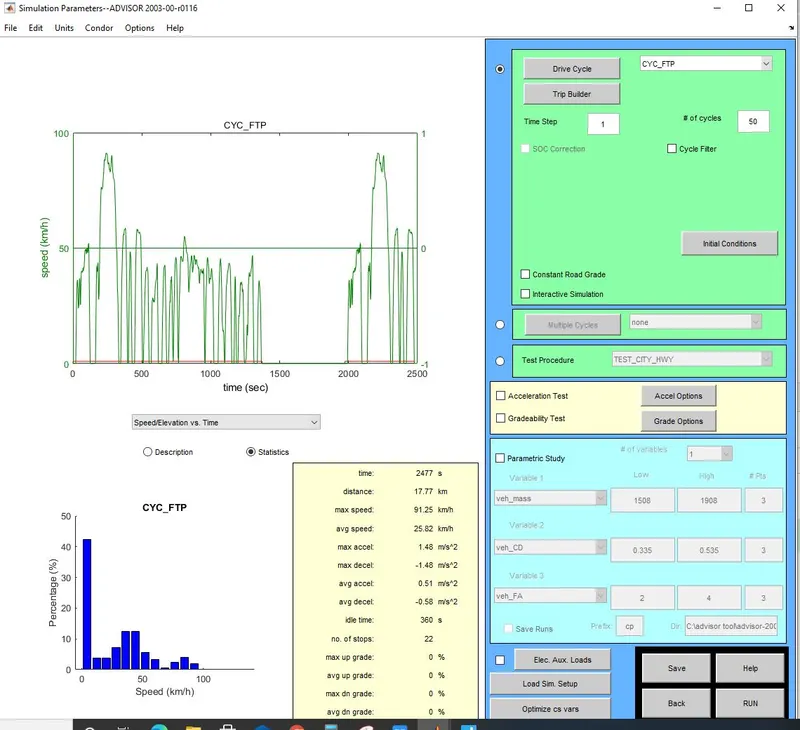
After pressing the RUN button, the simulation will start and it will show results in a new window
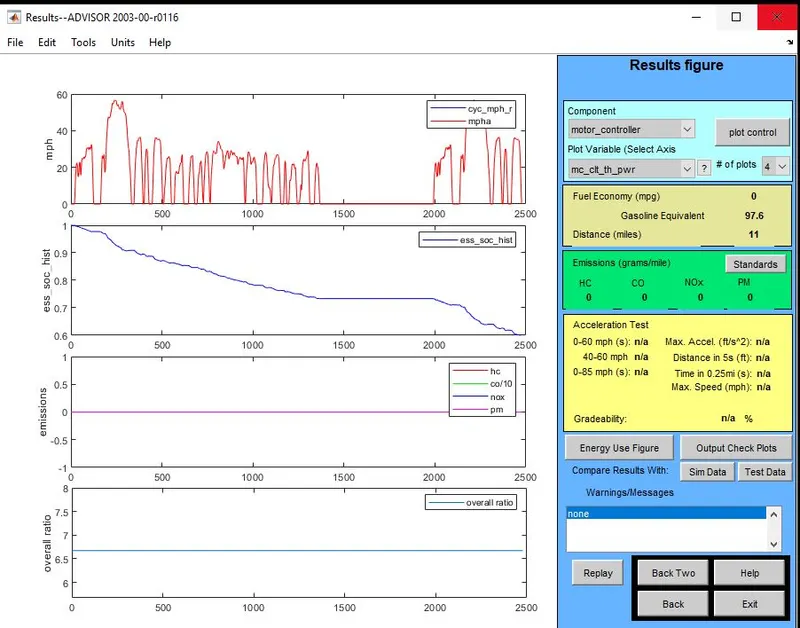
The distance traveled by the vehicle in a 1 drive cycle is 17 km Used almost 40% SOC.
Increasing no. of drive cycles to 2.
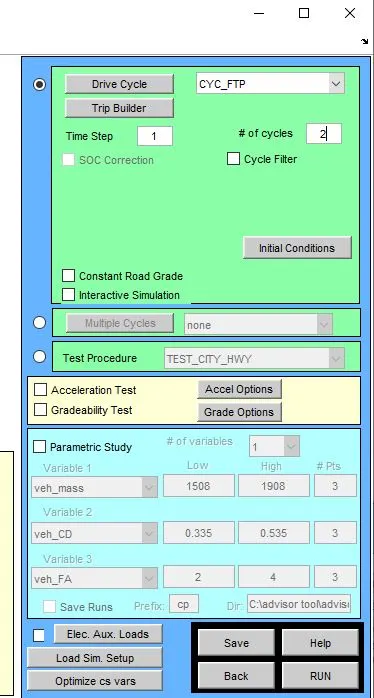
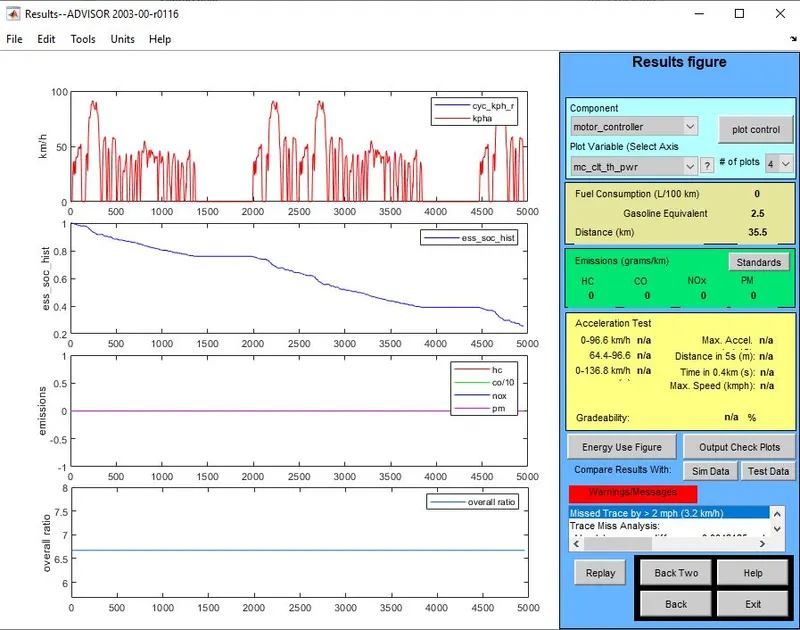
Result with 2 drive cycles.
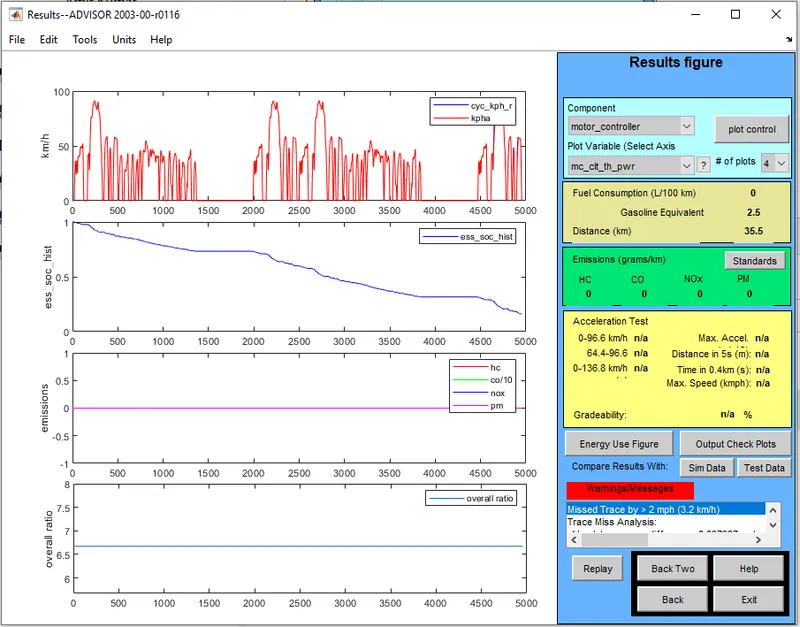
The distance traveled by the vehicle in 2 drive cycles is 35.5km. Used almost 81% SOC.
Increasing no. of drive cycles to 3.
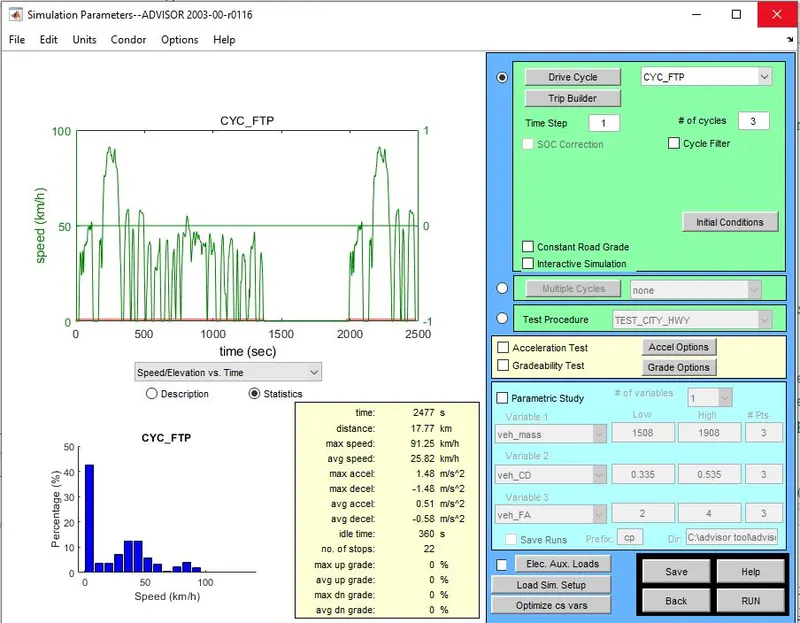
Result with 3 drive cycles.
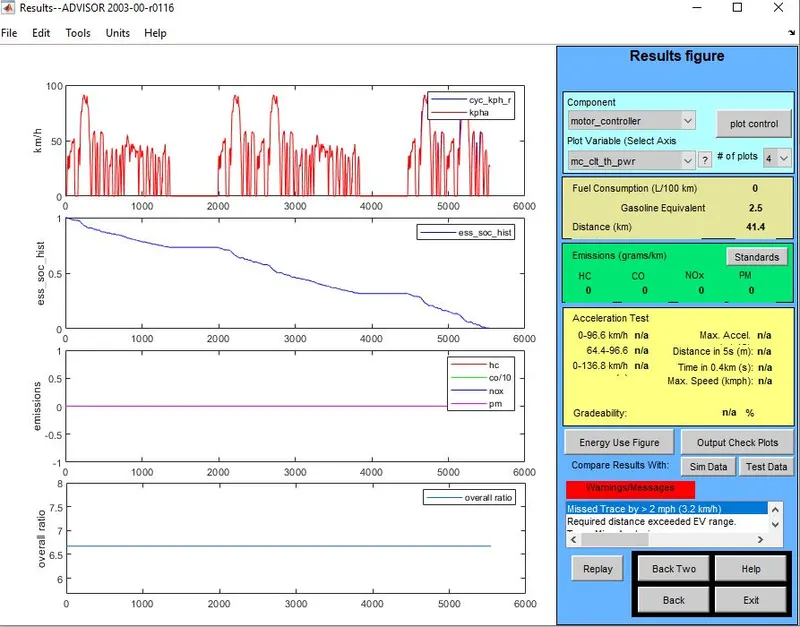
The distance traveled by the vehicle in 2 drive cycles is 41.4km. Used completely 100% SOC.
|
No. of Drive cycles |
Distance covered in km |
|
1 |
17.8 |
|
2 |
35.5 |
|
3 |
41.4 |
The minimum distance travel by car is 17.8 km with drive cycle CYC_FTP – 1 whereas the maximum distance travel by car is 41.4 which consumes 100% of battery in 3 Drive cycles.
Therefore EV_default cannot travel a distance of 45 km due to insufficient SOC.
Q2. In the above case, try changing the battery capacity and repeat the simulation.
- In-Vehicle Input window we will change the capacity of the battery from energy storage which will be open in 1st
- “#of mod V nom” describes the battery capacity, so we will change the module number of batteries from the first box and we will see that changes in voltage and weight of the battery.
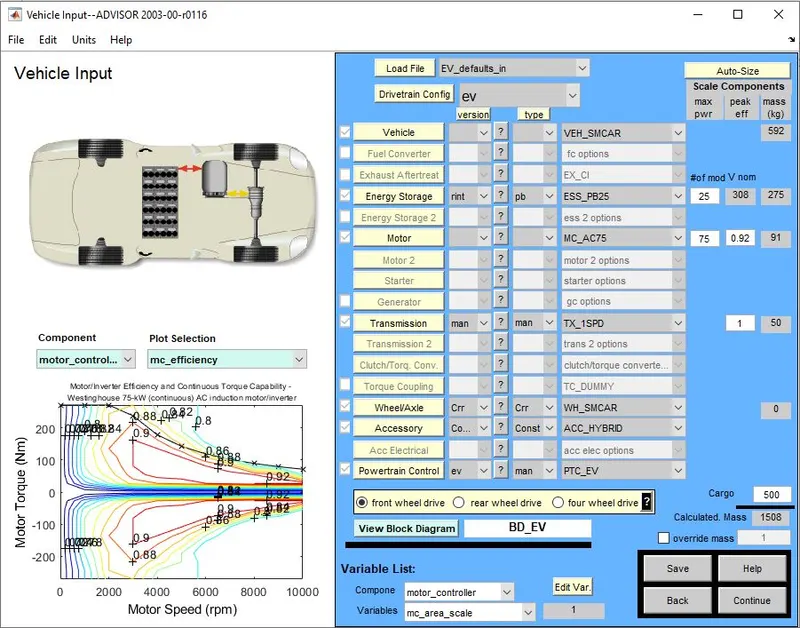
- A new Simulation Parameter window will open, here we will change the drive cycle to 2 or 3, one at a time, and run the simulation.
- After completing of simulation, we will see the result window where we observe the change in distance of vehicle travel.
- We can repeat this simulation by changing the battery module and the drive cycle.
Energy Storage System with 26 modules and 2 drive cycles

Result:-
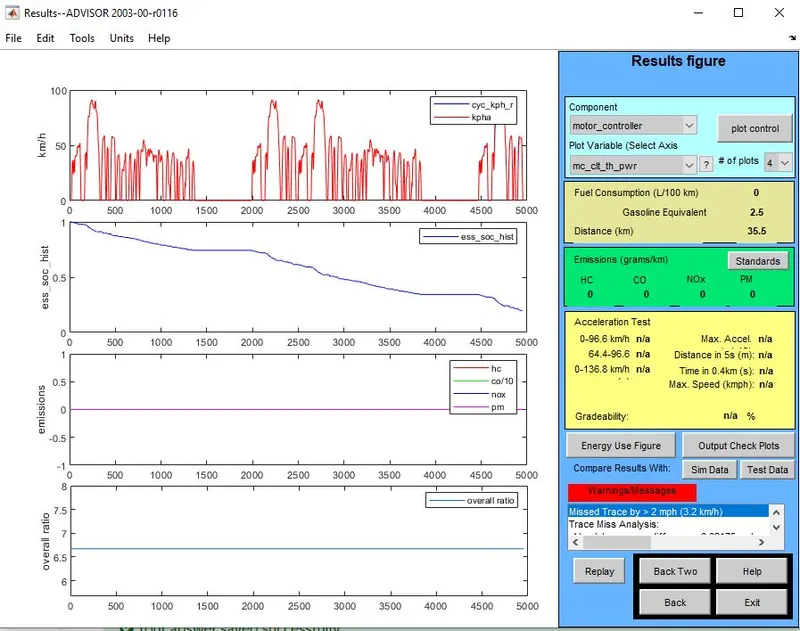
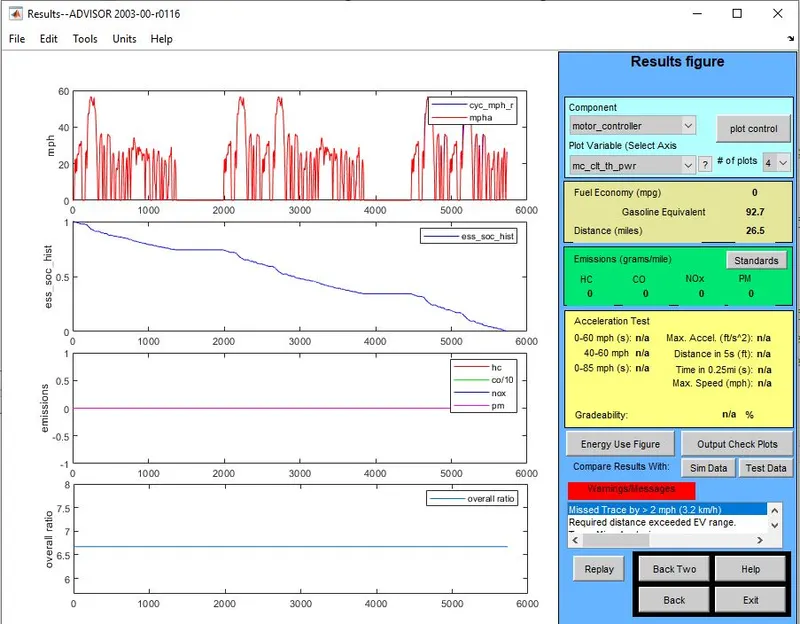
Energy Storage System with 27 modules and 2 drive cycles

Result:-
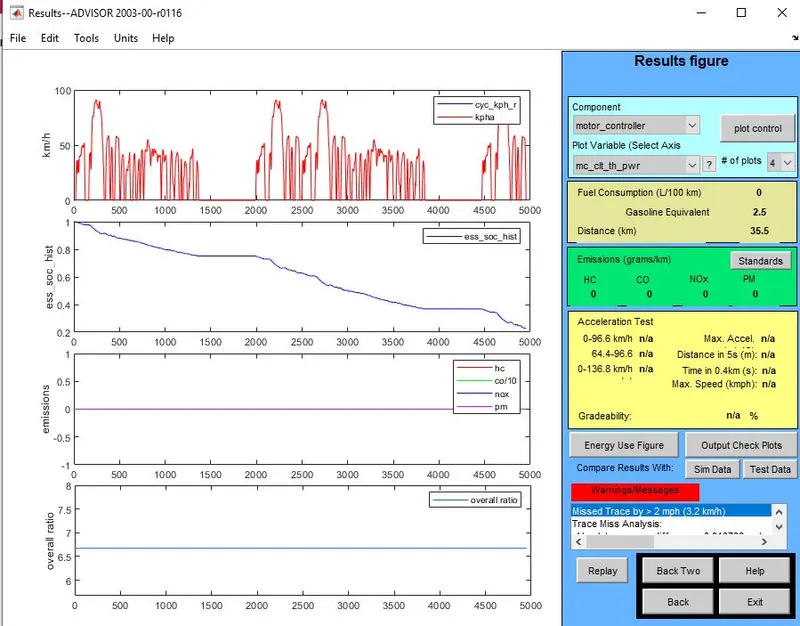
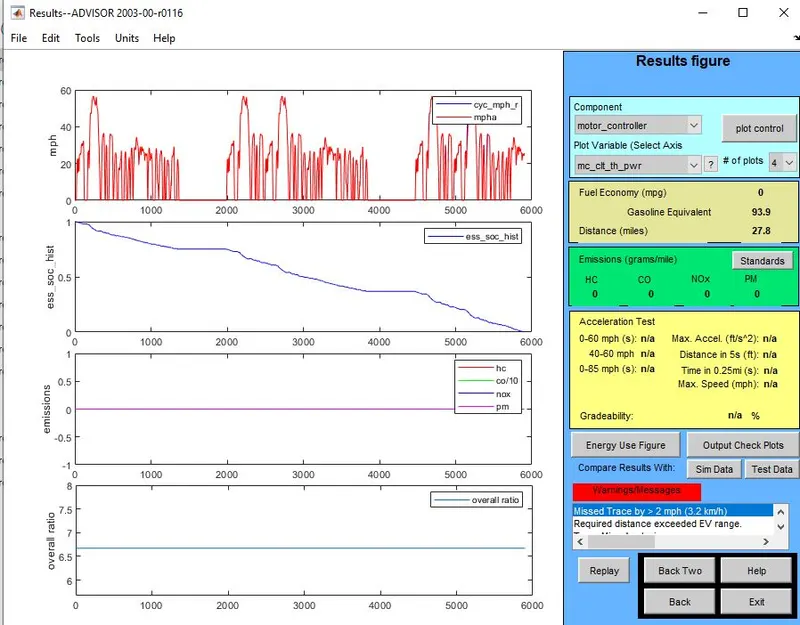
Energy Storage System with 28 modules and 2 drive cycles

Result:-
Energy Storage System with 26 modules and 3 drive cycles

Result:-
Energy Storage System with 27 modules and 3 drive cycles

Result:-
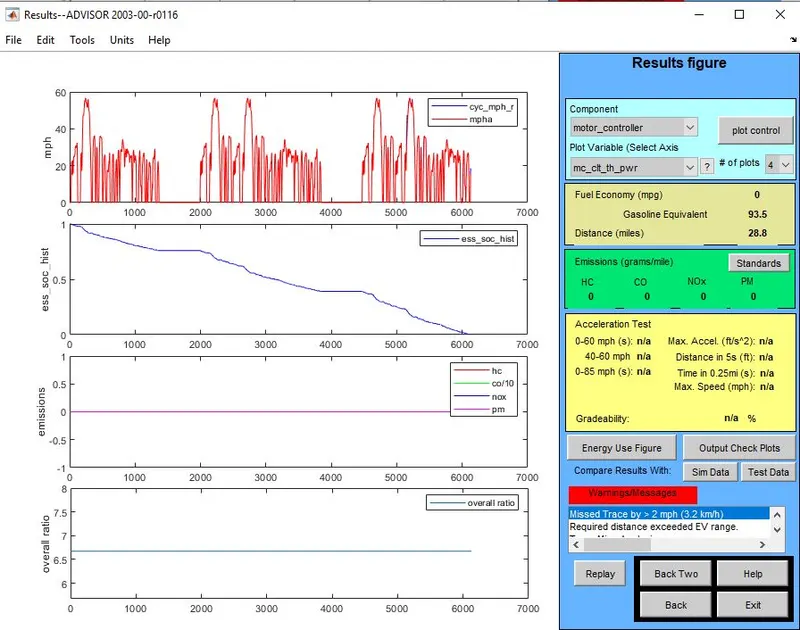
Energy Storage System with 28 modules and 3 drive cycles

Result:-
|
Drive cycle - 2
|
|||||||
|
26 |
321 |
35.5 |
286 |
||||
|
27 |
333 |
35.5 |
297 |
||||
|
28 |
345 |
35.5 |
308 |
||||
|
Drive cycle - 3
|
|||||||
|
26 |
321 |
42.7 |
286 |
||||
|
27 |
333 |
44.8 |
297 |
||||
|
28 |
345 |
46.3 |
308 |
||||
Battery modules 28 and with 3 drive cycles, the distance traveled is 46.3km.
- While changing the battery module in drive cycle 2 we get constant distance travel.
- Changing the battery module in drive cycle 3 we get changes in distance travel by vehicle.
- To cover a 45km distance a 28 module 345-volt battery is required.
3. Perform gradeability test with PRIUS_Jpn_defaults_in file. Compare your results in the table and conclude.
- In the ADVISOR tool Vehicle Input window select the PRIUS_Jpn_default model.
- Continue to the next window.
- The simulation Parameter window will open.
- Select the gradeability test and click on the grade Option box, a new dialogue box will open.
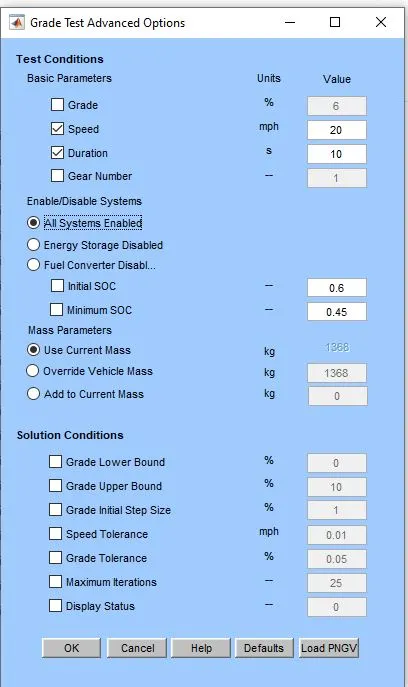
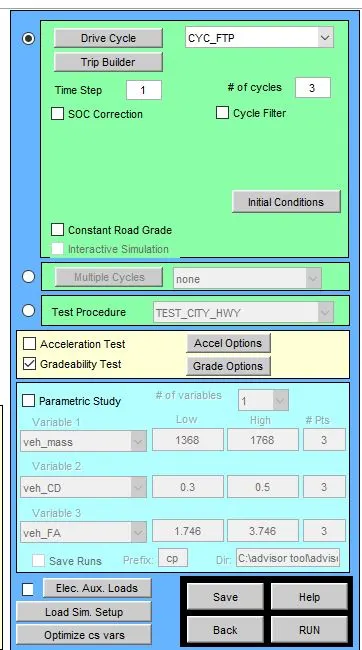
- In the grade option box, we can change speed or duration with respect to our simulation.
- So, for this simulation, I change speed one time and duration another time.
- Click on All system enabled.
- Also, click on constant road grade.
- Click Ok and run the simulation and a Result window will open showing different results depend upon input data.
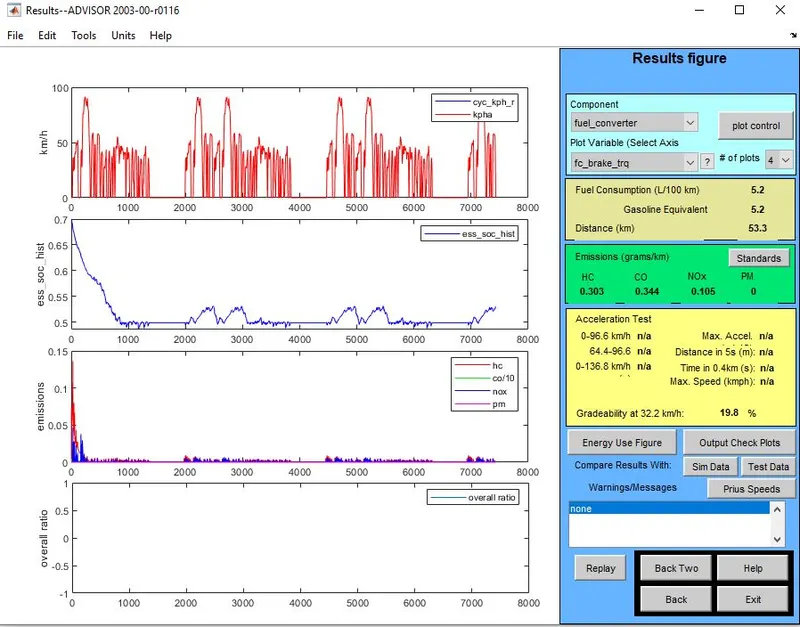
Results for the duration - 10sec
i) Speed - 20 miles/h or 32.2 kmph
Gradeability = 19.8%
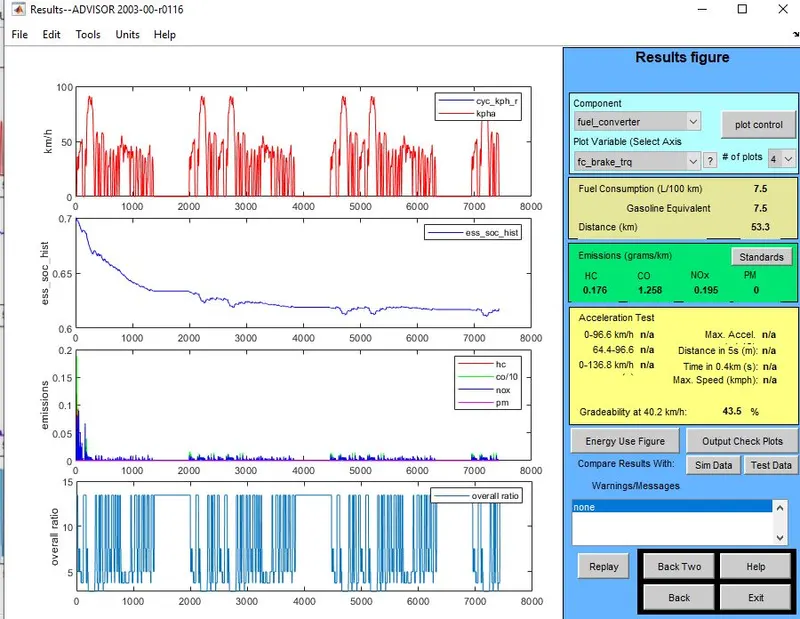
Speed - 25 miles/h or 40.2 kmph
Gradeability = 43.5%
Speed - 30 miles/h or 48.3 kmph
Gradeability = 14.7%
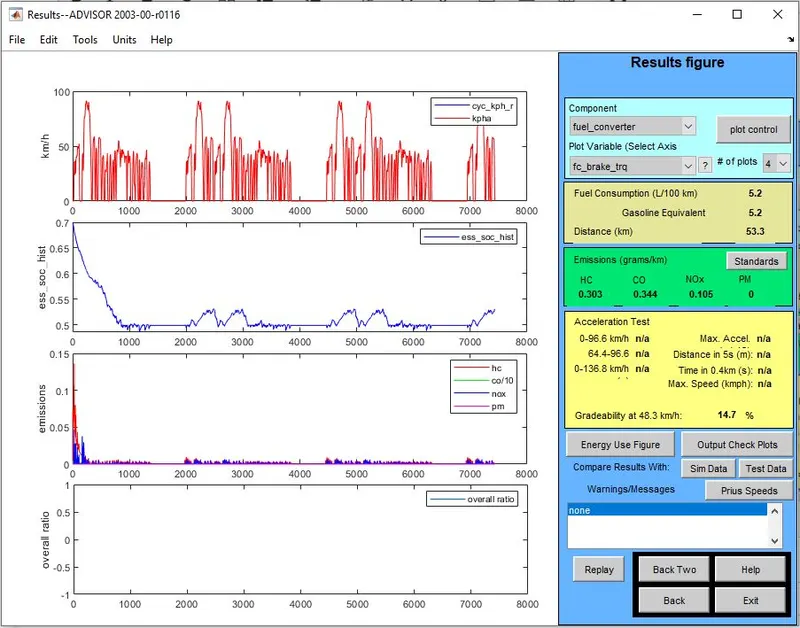
Speed - 35 miles/h or 56.3 kmph
Gradeability = 13%
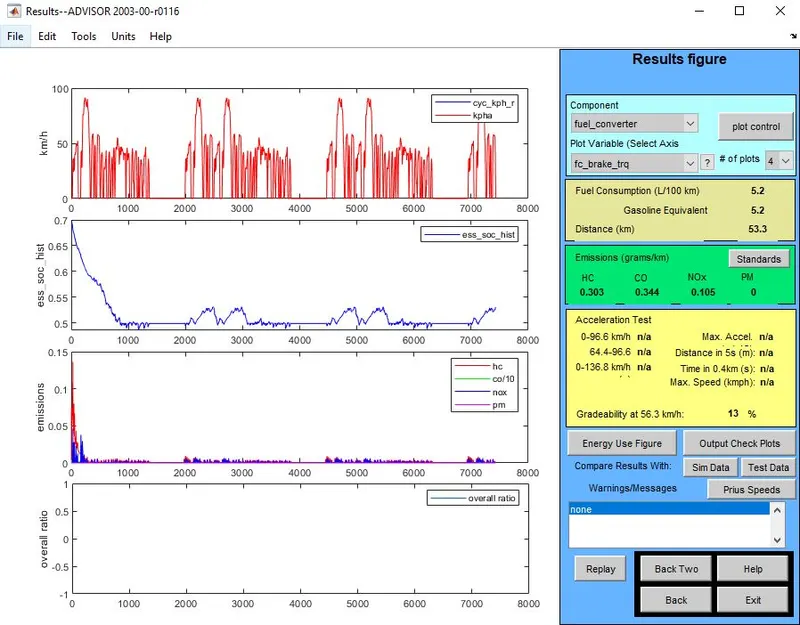
Speed - 40 miles/h or 64.4 kmph
Gradeability = 25.7%
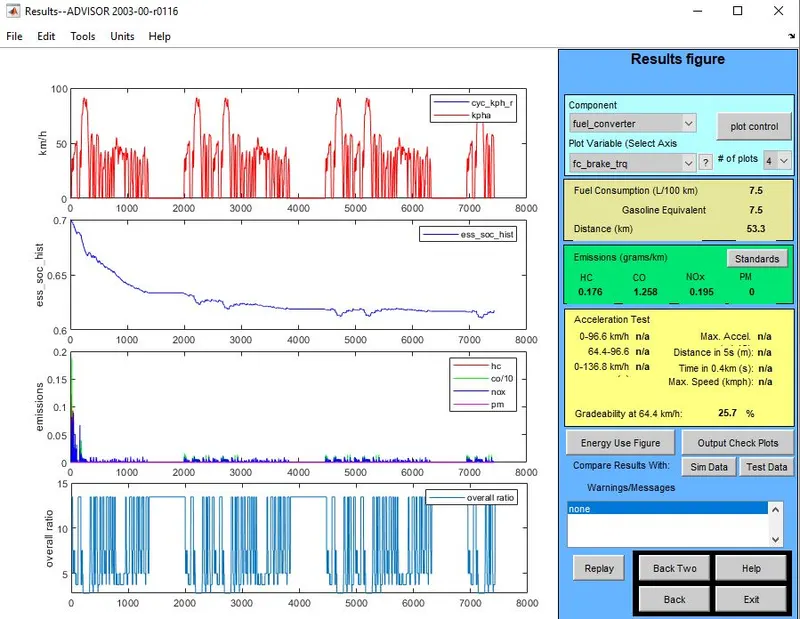
Speed - 45 miles/h or 72.4 kmph
Gradeability = 10.7%
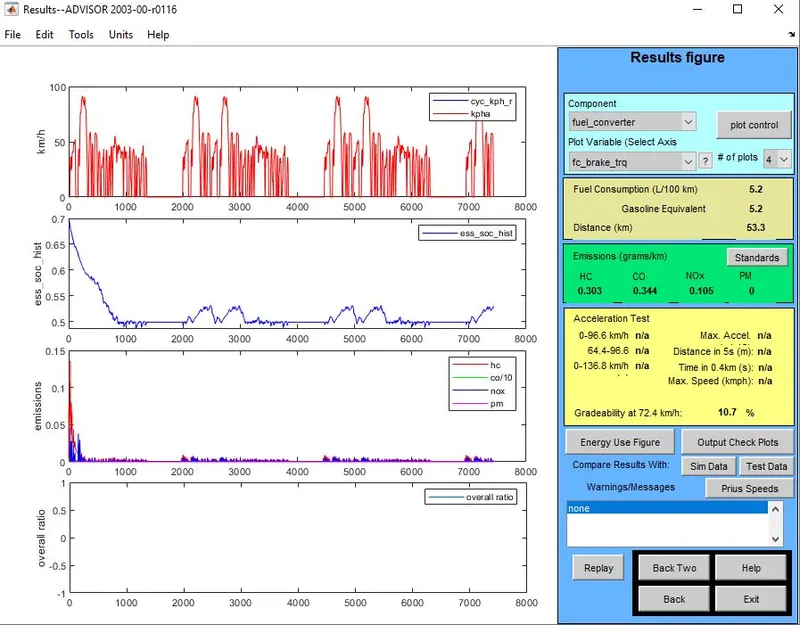
or Duration - 20sec
|
S.No |
Vehicle Speed mph |
Vehicle Speed kmph |
Gradeability % |
| 1 |
20 |
32.2 |
19.8% |
| 2 |
25 |
40.2 |
43.3 % |
| 3 |
30 |
53.3 |
14.7 % |
| 4 |
35 |
56.3 |
13 % |
| 5 |
40 |
64.4 |
25.7 % |
| 6 |
45 |
72.4 |
10.7 % |
From the above tables, it can be seen that when vehicle speed increases there is a decrease in upgradeability for both 10sec and 20sec duration.
∴ when vehicle speed increases there is a decrease in grade ability.