Week - 2 - Explicit and Implicit Analysis
Explicit and Implicit Analysis
Aim: To use the given equation and solve using both Explicit and Implicit Methods
Introduction:
The finite element method is a numerical technique for obtaining approximate solution to a wode variety engineering problems. FEA (Finite Element Analysis) has done by three phases.
1. Pre-processing
2. Solution
3. post-Processing
Sloving the problems systematically yields equations and attempts to approximate the values of the unknowns. This method subdivides the overall problem into simpler sub-issues that are easier to solve. In turn, these sub-issues called finite elements require implicit vs explicit analysis. All of these implicit vs explicit problems are expressed through mathematical partial differential equations
Explicit analysis: An Explicit FEM analysis does the incremental procedure and at the end of each increment updates the stiffness matrix based on geometry changes and material changes. In this type of analysis if the increments are small enough the results will be accurate.
To calculate the displacement every time we have to refer previous data. to solve a mathematical problem Explicit analysis is time dependent that is time step is very small so that effects of acceleration cannot be neglected. Explicit analysis involve mass matrix inversion. In this type the deformation is large because of velocity, acceleration with mass and inertia. cost per time step is less because time taken to slove dynamic problems are less. parallel processing is not posible. The Explicit method should be used when the effects of strain rates are more such are crash, impact test.
Implicit analysis: An Implicit FEM analysis is the same as Explicit with the addition that after each increment the analysis does Newton-Raphson iterations to enforce equilibrium of the internal structure forces with the externally applied loads.
Implicit methods find a solution by solving an equation involving both the current state of the system and the later one. to solve a mathematical problem Implicit analysis is time independent that is time step is large so that effects of acceleration are neglected. Implicit analysis involve stiffness matrix inversion.
in this type the deformation is small because involves in pure force. cost per time step is large because time taken to slove dynamic problems are more. parallel processing is posible. The implicit method should be used when the events are much slower and the effects of strain rates are minimal.
Calculations
Explicit analysis:
Given function `f(u) = u^3+9u^2+4u` use this equation and solve using both Explicit and Implicit Methods
The given function 'F(u) is the function of displacement 'u' ehich is given by
`f(u) = u^3+9u^2+4u` eq1
to get stiffness diffrencitating force F wrt to displacement u so that we can get stiffness (K = force /deformation)
`K(u)= (dF)/(du) = 3u^2+18u+4` eq 2
We have F = Ku - eq3 from the stiffness equation
here the force is `DeltaF` and displacement `Deltau`
So we can return eq 2 as
`DeltaF=K*Deltau` eq4
Step 1
When there is no deformation that is initial condation `u_0 = 0` substitute in eq 2 and 2
`f(u_0) =0`
`K(u)= (dF)/(du) = 3u^2+18u+4`
`K(u_0) = 3X0+18X0+4, K(u_0) = 4`
For this example three equal load increments (or steps) of ∆F = 1 unit each are used to load the tension bar.
when `DeltaF=1` duve to extranal force there will be deformation so from the equation 4
`Deltau_1=(DeltaF)/(K(u_0)) = 1/4 = 0.25`
`u_1 = u_0 +Deltau_1`
`u_1 = 0 + 0.25`
`u_1 = 0.25`
Step 2
consider `u=u_1 = 0.25` and load increments (or steps) of ∆F = 1
`K(u_1)= 3(0.25)^2+18(0.25)+4`
`K(u_1)= 8.69`
`Deltau_1=(DeltaF)/(K(u_1)) = 1/8.69 = 0.115`
`u_2 = u_1+Deltau_2`
`u_2 = 0.25+0.115`
`u_1 = 0.365`
Step 3
consider `u=u_2 = 0.365` and load increments (or steps) of ∆F =1`
`K(u_2)= 3(0.365)^2+18(0.365)+4`
`K(u_2)= 10.97`
`Deltau_2=(DeltaF)/(K(u_2)) = 1/10.97 = 0.091`
`u_3 = u_2+Deltau_2`
`u_2 = 0.365+0.0911`
`u_1 = 0.456`
So from the above force extranl is given by 3 times of applied step load in every instant.
`F_(external) = DeltaF+ DeltaF+ DeltaF=1+1+1+=3`
And the force produced internal due to extranal force for every step is given by
`f_((Internal)_1) = u_1^3+9u_1^2+4u_1 = 0.25^3+9(0.25^2)+4(0.25) = 1.578`
`f_((Internal)_2) = u_2^3+9u_2^2+4u_2 = 0.365^3+9(0.365^2)+4(0.365) = 2.707`
`f_((Internal)_3) = u_3^3+9u_3^2+4u_3 = 0.456^3+9(0.456^2)+4(0.456) = 3.79`
| Step i | `DeltaF_i` | `Deltau_i` | `u_i` | `(F_(external))_i` | `(f_(Internal))_i` | `(f_(Internal))_i-(F_(external))_i =R` |
| 1 | 1 | 0.25 | 0.25 | 1 | 1.578 | 0.578 |
| 2 | 1 | 0.115 | 0.365 | 2 | 2.707 | 0.707 |
| 3 | 1 | 0.091 | 0.456 | 3 | 3.79 | 0.79 |
Implicit analysis:
An implicit analysis is the same as the explicit analysis, except that at the end of each step Newton-Raphson iterations are used to enforce equilibrium before moving to the next step.
`δu^(j+1) = -[k(u^j )]]^-1R^j .`
The implicit analysis proceeds as follows (results are approximate,they are more precise if done in a computer to machine precision)
Step 1
When there is no deformation that is initial condation `u_0 = 0` substitute in eq 2 and 2
`f(u_0) =0`
`K(u)= (dF)/(du) = 3u^2+18u+4`
`K(u_0) = 3X0+18X0+4, K(u_0) = 4`
For this example three equal load increments (or steps) of ∆F = 1 unit each are used to load the tension bar.
when `DeltaF=1` duve to extranal force there will be deformation so from the equation 4
`Deltau_1=(DeltaF)/(K(u_0)) = 1/4 = 0.25`
`u_1 = u_0 +Deltau_1`
`u_1 = 0 + 0.25`
`u_1 = 0.25`
Check the residual
`F_(external)` = `DeltaF=1`
`f_((Internal)_1) = u_1^3+9u_1^2+4u_1 = 0.25^3+9(0.25^2)+4(0.25) = 1.578`
`R^0=(f_(Internal))_i-(F_(external))_i`
`R^0=1.578-1=0.578 > 10^-2` Newton-Raphson iterations are necessary
Calculate the correction to `u_1 = u_1 ^0`
`δu^(j+1) = - [k(u^j )]]^-1R^j .` where j=0`
`δu^(1) = - [k(u_1^0 )]]^-1R^0`
`K(u_1) = 3X0.25^2+18X0.25+4, K(u_1) = 8.687`
`δu^(1) = - [8.687]^-1*0.578 = -0.066`
The updated value of `u_1^1 = u_1 ^0+δu^(1)`
`u_1^1 = 0.25-0.066=0.184`
Check the residual again,
`F_(external)` = `DeltaF=1`
`f_((Internal)_1) = (u_1^1)^3+9(u_1^1)^2+4u_1^1= 0.184^3+9(0.184^2)+4(0.184) = 1.046`
`R^1=(f_(Internal))_i-(F_(external))_i`
`R^1=1.046-1=0.046 > 10^-2` Newton-Raphson iterations are necessary`
Calculate the correction to `u_1 = u_1 ^1`
`δu^(j+1) = - [k(u^j )]]^-1R^j .` where j=1`
`δu^(2) =δu^(1) - [k(u_1^1 )]]^-1R^1`
`K(u_2) = 3X0.184^2+18X0.184+4, K(u_2) = 7.41`
`δu^(1) =- 0.066 - [7.41]^-1*0.046 = -0.0722`
The updated value of `u_1^2 = u_1 ^0+δu^(2)`
`u_1^2 = 0.25-0.0722=0.177`
Check the residual again,
`F_(external)` = `DeltaF=1`
`f_((Internal)_1) = (u_1^2)^3+9(u_1^2)^2+4u_1^2= 0.177^3+9(0.177^2)+4(0.177) = 0.995`
`R^2=(f_(Internal))_i-(F_(external))_i`
`R^2=0.995-1= -0.005 < 10^-2` no further iterations are necessary.
hence the value of `u_1=0.177`
Step 2
`u_1=0.177`
`K(u)= (dF)/(du) = 3u^2+18u+4`
`K(u_1) = 3X0.177^2+18X0.177+4, K(u_0) = 7.27`
`Deltau_2=(DeltaF)/(K(u_0)) = 1/7.27 = 0.137`
`u_2 = u_1 +Deltau_2`
`u_2 = 0.177+ 0.137`
`u_2=0.314`
Check the residual
`F_(external)` = `DeltaF=2`
`f_((Internal)_2) = u_2^3+9u_2^2+4u_2 = 0.314^3+9(0.314^2)+4(0.314) = 2.174`
`R^0=(f_(Internal))_i-(F_(external))_i`
`R^0=2.174-2=0.174> 10^-2` `Newton-Raphson iterations are necessary
Calculate the correction to `u_2 = u_2 ^0`
`δu^(j+1) = - [k(u^j )]]^-1R^j .` where j=0`
`δu^(1) = - [k(u_2^0 )]]^-1R^0`
`K(u_2) = 3X0.314^2+18X0.314+4, K(u_1) = 9.9477`
`δu^(1) = - [9.947]^-1*0.174= -0.017`
The updated value of `u_2^1 = u_2 ^0+δu^(1)`
`u_2^1 = 0.314-0.0174= 0.296`
Check the residual again,
`F_(external)` = `DeltaF=2`
`f_((Internal)_2) = (u_2^1)^3+9(u_2^1)^2+4u_2^1= 0.296^3+9(0.296^2)+4(0.296) = 1.9984`
`R^1=(f_(Internal))_i-(F_(external))_i`
`R^1=1.9984-2=-0.0015 < 10^-2`no further iterations are necessary.
hence the value of `u_2=0.296`
Step 3
``u_2=0.296`
`K(u)= (dF)/(du) = 3u^2+18u+4`
`K(u_2) = 3X0.296^2+18X0.296+4, K(u_2) = 9.59`
`Deltau_3=(DeltaF)/(K(u_2)) = 1/9.59 = 0.104`
`u_3 = u_2 +Deltau_3`
`u_2 = 0.296+ 0.104`
`u_3=0.4`
Check the residual
`F_(external)` = `DeltaF=3`
`f_((Internal)_3) = u_3^3+9u_3^2+4u_3 = 0.4^3+9(0.4^2)+4(0.4) = 3.104`
`R^0=(f_(Internal))_i-(F_(external))_i`
`R^0=3.104-3=0.104> 10^-2` `Newton-Raphson iterations are necessary
Calculate the correction to `u_3 = u_3 ^0`
`δu^(j+1) = - [k(u^j )]]^-1R^j .` where j=0`
`δu^(1) = - [k(u_3^0 )]]^-1R^0`
`K(u_3) = 3X0.4^2+18X0.4+4, K(u_1) = 11.68`
`δu^(1) = - [11.68]^-1*0.104= -0.0089`
The updated value of `u_3^1 = u_3 ^0+δu^(1)`
`u_3^1 = 0.4-0.0089= 0.391`
Check the residual again,
`F_(external)` = `DeltaF=3`
`f_((Internal)_3) = (u_3^1)^3+9(u_3^1)^2+4u_3^1= 0.391^3+9(0.391^2)+4(0.391) = 2.999`
`R^1=(f_(Internal))_i-(F_(external))_i`
`R^1=2.999-3=-0.00029 < 10^-2`no further iterations are necessary.
hence the value of `u_2=0.391`
| Step i | `DeltaF_i` | `Deltau_i` | `u_i` | `(F_(external))_i` | `(f_(Internal))_i` | `(f_(Internal))_i-(F_(external))_i =R` |
| 1 | 1 | 0.25 | 0.177 | 1 | 0.995 | -0.005 |
| 2 | 1 | 0.137 | 0.296 | 2 | 1.998 | -0.0015 |
| 3 | 1 | 0.104 | 0.391 | 3 | 2.999 | -0.00029 |
Results: To use the given equation and solve using both Explicit and Implicit Methods is done and comparison results are plotted.
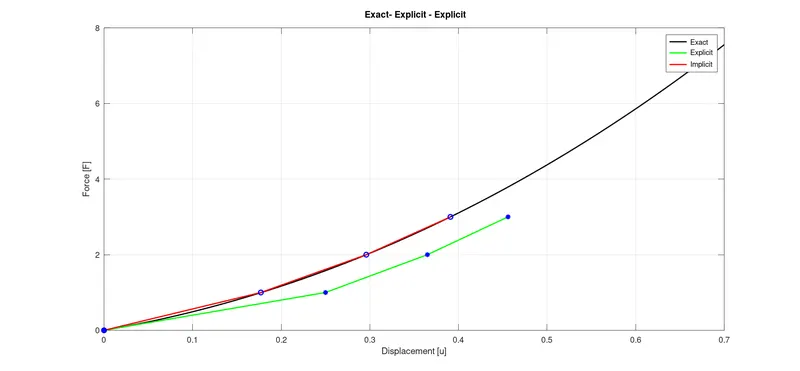
In the plot below the comparison done on Exact , Explicit and Implicit, where Explicit analysis is deveating from the exact solution this is beacuse of lack of equilibrium between the internal and external forces.
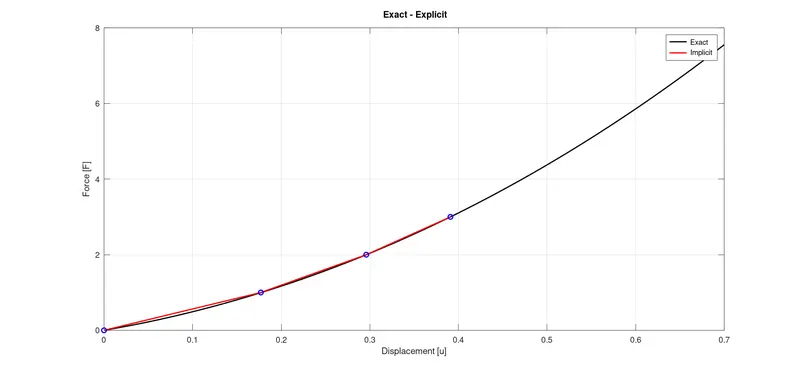
In order to achive the sulution near to exact the an implicit analysis is required. The results for the implicit analysis are shown in the below plot. Because of The Newton-Raphson iterations correct we achived the solution which almost equal to the exact solution.