Week 2 Bevel Gear Challenge
Grid Dependency Test on Spur Gears Using
ANSYS Workbench 2020 R2
Thejan Sasilal
|
Abstract: Gear is one of the most important machine elements in mechanical power transmission system. It is a rotating machine part having cut tooth which meshes with another tooth part in order to transmit torque. Bevel gears, have teeth formed on conical surface and used mostly for transmitting motion between intersecting shafts. The bending stress and total deformation of gear tooth is considered to be the paramount objective of for gear design. Since the teeth are tapered, to achieve perfect line contact passing through the cone center, the teeth should bend more at the large end than the small end. |
OBJECTIVES
- Write a few words on what a grid dependency test is and it’s use.
- Perform a grid dependency test for the Bevel gear simulation for mesh sizes of 6, 5 and 4mm
- Solve for Von-Mises stress, Equivalent elastic strain and Total Deformation using the previously mentioned mesh sizes.
- Present your findings in an organized manner.
- INTRODUCTION
To reduce the cost of actual prototypes and field testing of gears, analysis software was introduced. Analysis software such as ANSYS is capable of performing finite element analysis (FEA) over not only gear teeth but each part of the gear body such as the hub.
- GRID DEPENDENCY TEST
In finite element analysis the mesh creation is fundamental. Selection of mesh size is key parameter for the best result of the analysis. The grid dependency test is to find the optimum mesh size according to the result. Fineness of the mesh will improve the accuracy of the result. After some particular mesh size, further reduction of mesh size will not make improvements in the result, finding this particular point is the grid dependency test. While doing the grid dependency test the designer can be able to find the very near realistic figures of the results.
In this challenge, we are obtaining the optimum results of static structural analysis of a straight bevel gear system through grid dependency test.
- DESIGN SPECIFICATION
Selected Structural steel and material of construction from Engineering data.
|
Number of teeth in Gear (Big Gear) – 24 nos Number of teeth in pinion (Small Gear) – 16 nos |
||
|
Material Properties of Structural Steel |
||
|
Property |
Value |
Unit |
|
Density |
7850 |
Kg/m3 |
|
Coefficient of Thermal Expansion |
1.2E-05 |
C-1 |
|
Young’s Modulus |
2E+11 |
Pa |
|
Poisson’s Ratio |
0.3 |
|
|
Bulk Modulus |
1.6667E+11 |
Pa |
|
Shear Modulus |
7.6923E+10 |
Pa |
|
Tensile Yield Strength |
2.5E+8 |
Pa |
|
Compressive Yield Strength |
2.5E+8 |
Pa |
|
Ultimate Tensile Strength |
4.6E+8 |
Pa |
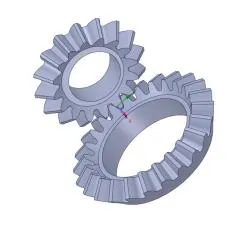
For doing the analysis, we have imported the bevel gear model provided by Skill-Lync to Ansys workbench.
Removed unwanted areas from gear using Space Claim as in the below figure.
- STATIC ANALYSIS
As our bevel gear system is considered as a static loading system, the magnitude, direction & point of application of the load is not changing as per time.
Open Mechanical modeller for analysis.
Consider all units are in metric.
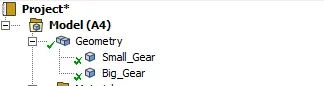
Rename geometry as Small_gear & Big_Gear
4.1 CONNECTIONS
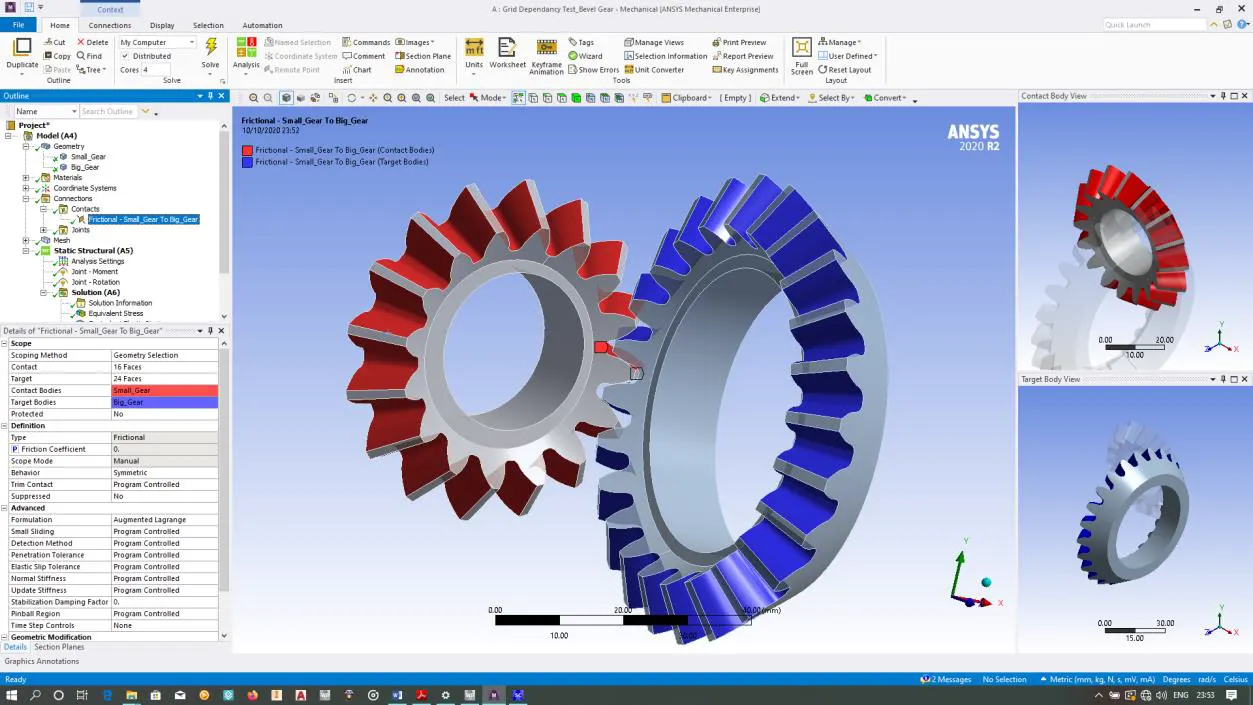
Select contact each faces of each tooth’s as in the figure.
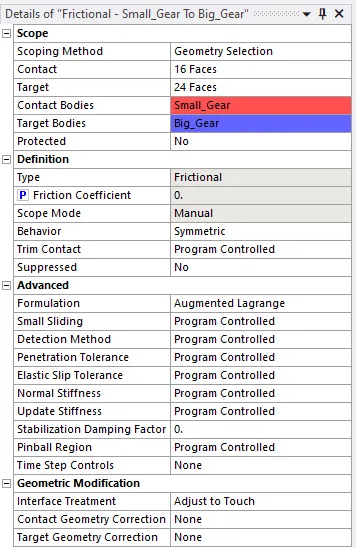
Consider the following settings
4.2 JOINTS
Insert revolute joint for both gears
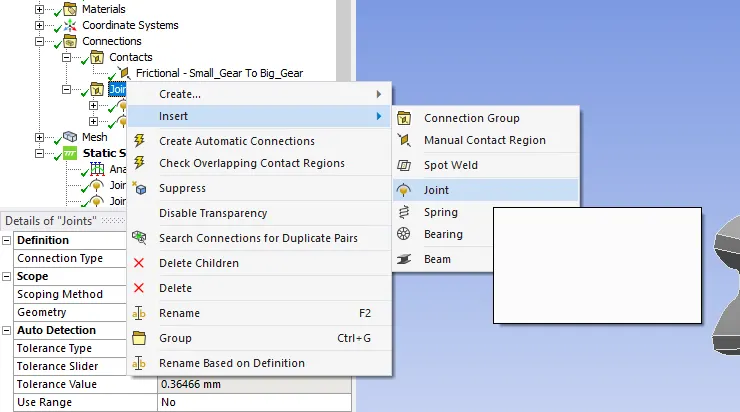
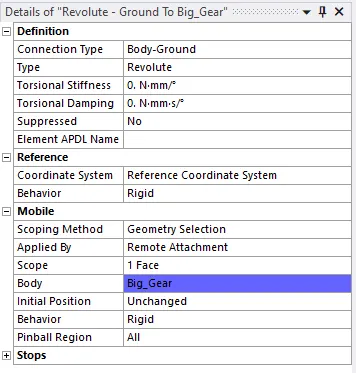
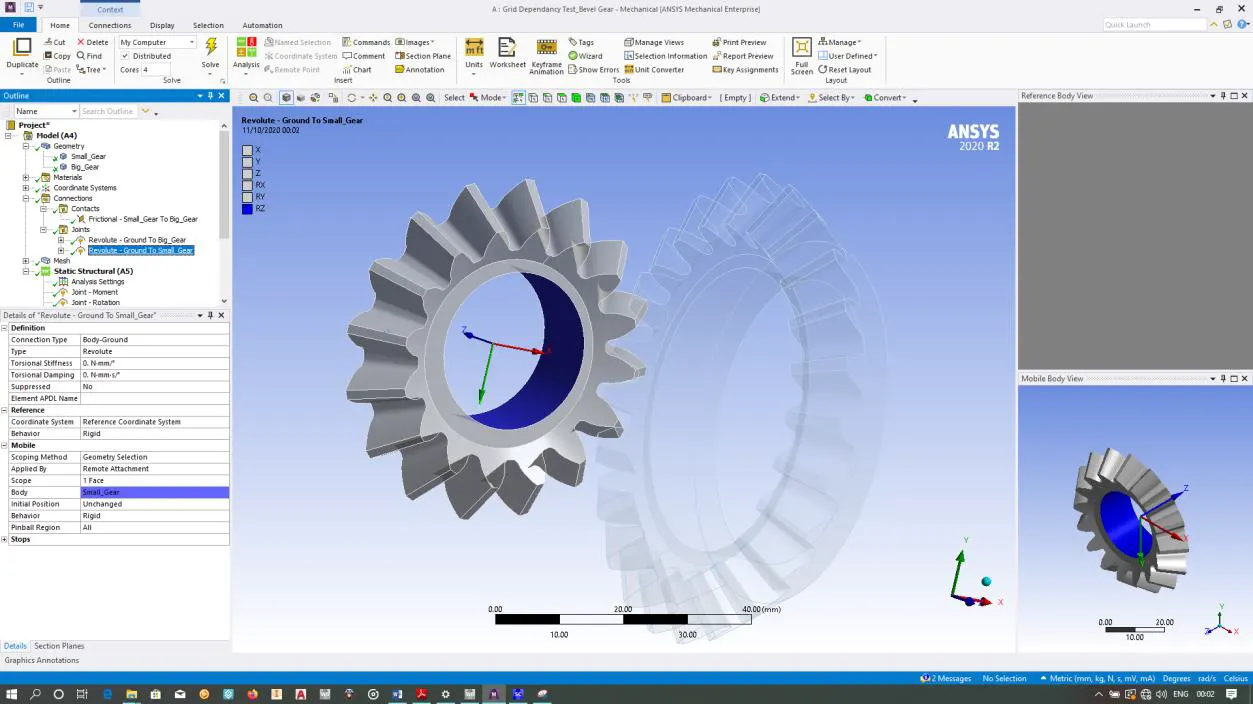
Select inner circular face of Big_Gear as Body and settings as follows. Repeat it for Small_Gear.
4.3 ANALYSIS SETTINGS
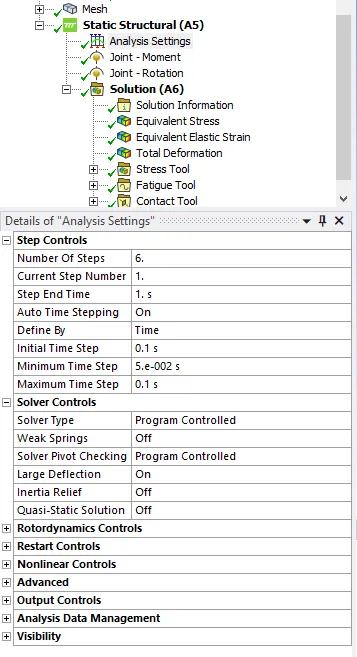
Consider following as the analysis settings.
4.4 JOINT LOADS
Insert Joint Load for each gears
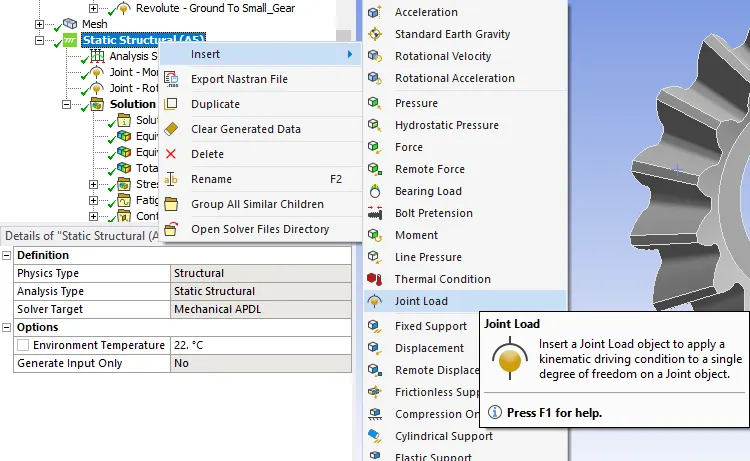
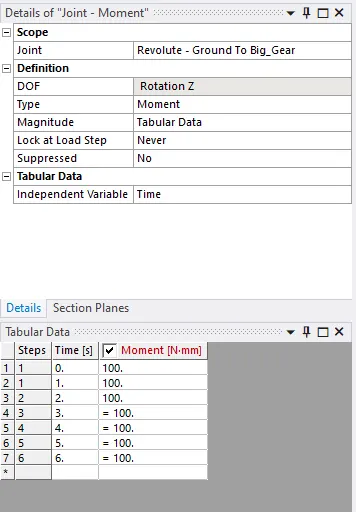
As we are giving momentum in Big_Gear, consider following settings for Joint Load for Big_Gear
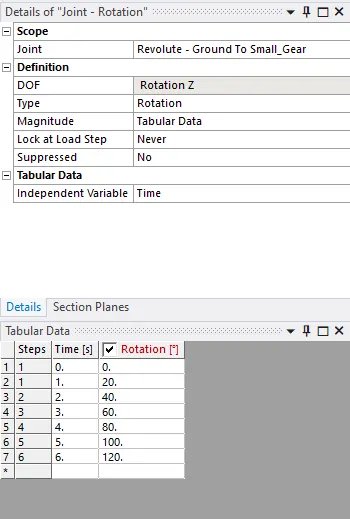
As we are giving rotation to Small_Gear, consider following settings for Joint Load for Small_Gear
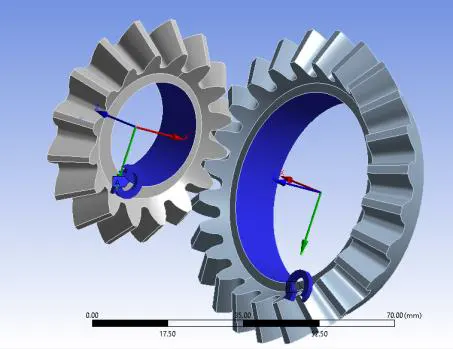
Check the direction of rotation of both gears after applying joint loads. Both gears should rotate in opposite directions as shown in the figure.
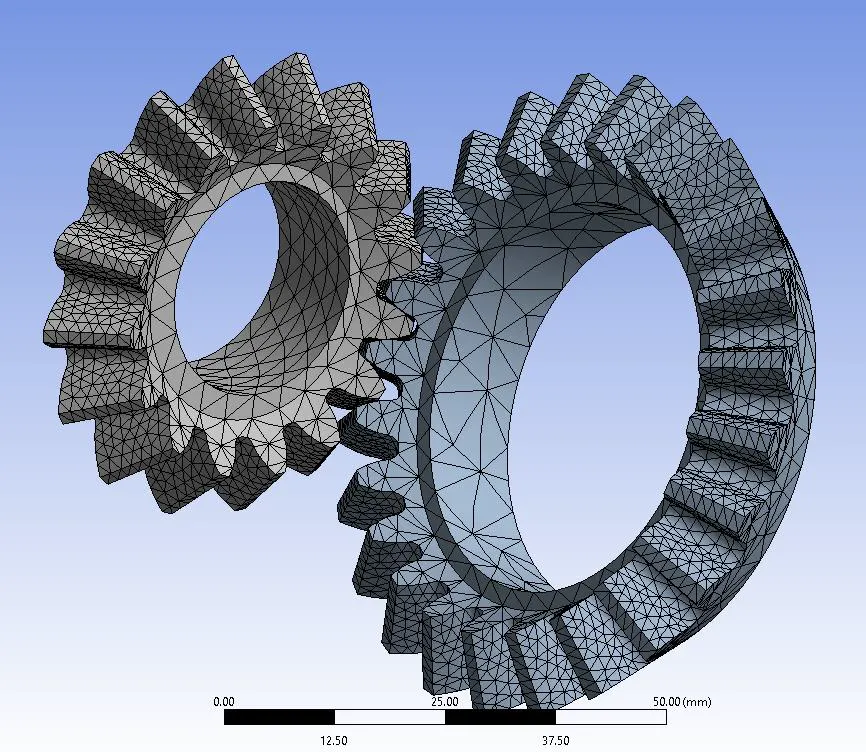
4.5 MESH CREATION
Meshing is basically the division of the entire model into small cell so that at each and every cell the equations are solved. It gives the accurate solution and also improves the quality of solution.
We are giving 3 different mesh sizes using parameters.
Case 1 – 6mm
Case2 – 5mm
Case3 – 4mm
4.6 SOLUTIONS
|
|
Case 1 – 6mm |
Case2 – 5mm |
Case3 – 4mm |
|
Von-Mises stress |
 |
 |
 |
|
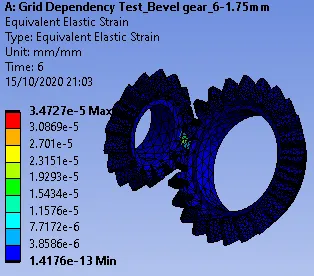
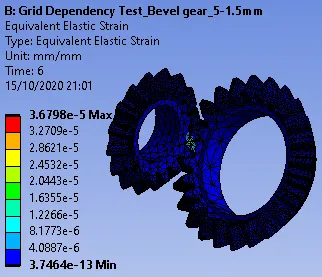
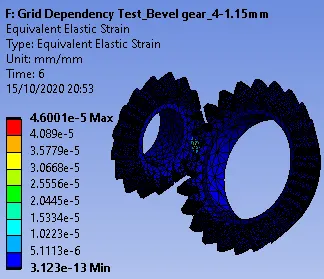
Equivalent elastic strain |
 |
 |
 |
|
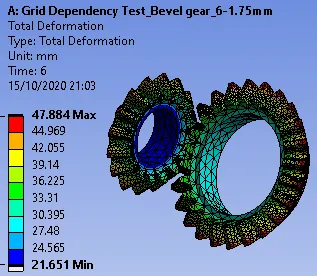
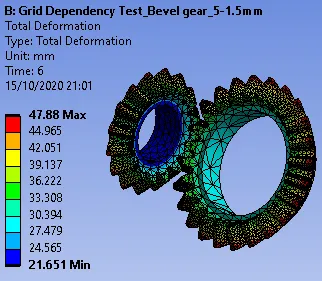
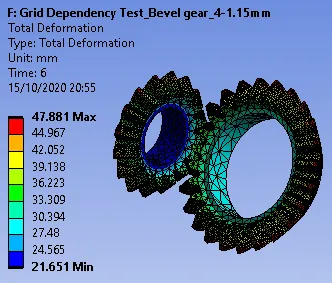
Total Deformation |
 |
 |
 |
- CONCLUSSION
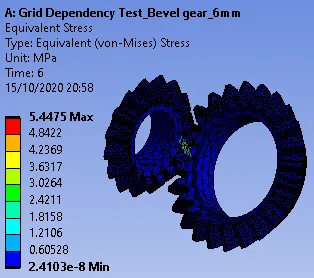
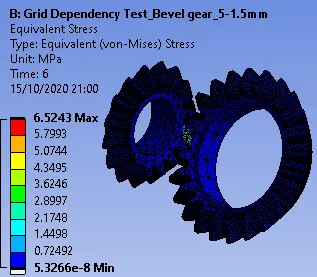
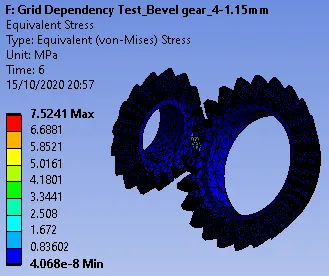
The grid dependency test conducted on bevel gear with different mesh sizes of 6mm, 5mm, 4mm. The results of each cases are tabulated below.
|
Von-Mises stress (Max) |
Equivalent elastic strain (Max) |
Total Deformation (Max) |
|
|
Case 1 – 6mm |
5.4475 MPa |
3.4727e-005 mm/mm |
47.884 mm |
|
Case 2 – 5mm |
6.5243 MPa |
3.6798e-005 mm/mm |
47.88 mm |
|
Case 3 – 4mm |
7.5241 MPa |
4.6001e-005 mm/mm |
47.881 mm |
Number of nodes & elements generated in each cases are tabulated below
|
Case 1 – 6mm |
Case 2 – 5mm |
Case 3 – 4mm |
|
|
Nodes |
26137 |
31732 |
51005 |
|
Elements |
14039 |
17277 |
28279 |
It is observed that Nodes/Elements generated is increases number with decrement in mesh size. Finer the mesh size more the Nodes/Elements generated.
While comparing each cases, highest value of Equivalent stress & Equivalent elastic strain found on the finest mesh size of 4mm. In each cases, change Total deformation is very negligible.
How accurate the result required, need to reduce the mesh size. From this challenge, while decreasing the mesh size further, the change in result is getting reduced and also it takes a more time to solve the simulation. From this test, it is evident that 4mm mesh size gives optimum result as it gives accurate result.