Week-11 Challenge: Braking
1.
Drive cylce:
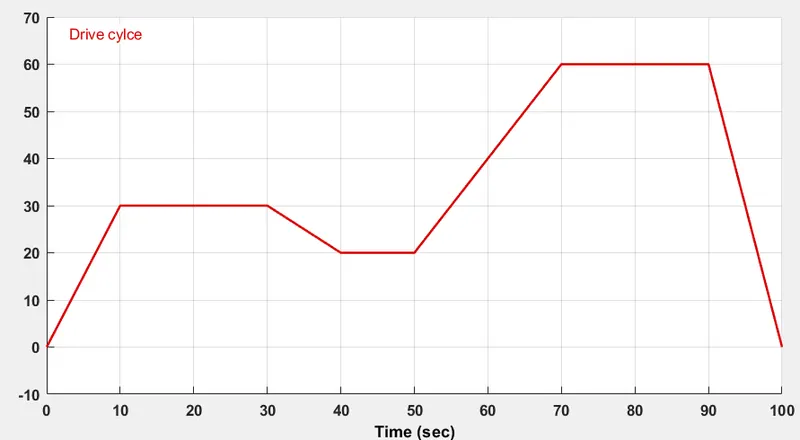
- Energy required to brake the vehicle is the change the change in kinetic energy that occurs while decreasing the vehcile speed.
`E=1/2*M*(V_i^2-V_f^2)`
where Vf is the final speed of the vehicle
Vi is the initial speed of the vehicle when brakes are applied. - In the above given drive cycle braking occurs two times in the given span of time. one during 30<t<40 sec and other at last i.e., 90<t<100
- let the mass of the vehcile along with the payload= 1000kg
- 30<t<40 sec
initial speed `V_i=30 kmph= (30*5/18) = 25/3 m/sec`
final speed `V_f=20kmph=(20*5/18)=50/9 m/sec`
`E=1/2*M*(V_i^2-V_f^2)`
`=1/2*1000*((25/3)^2-(50/9)^2)`
`=19290 J` - 90<t<100
`V_i=60 kmph= (60*5/18) = 50/3 m/sec`
`V_f=0kmph= 0 m/sec`
`E=1/2*1000*((50/3)^2-0)`
`=138888J` - Total energy required for braking= 19290 + 138888
= 158178 J
`1J = 1/(1000*3600) KWh`
`=> 158178 J= 158178/(1000*3600)`
`=0.0439 KWh`
2. Torque speed characteristics of typical motor used for EV:
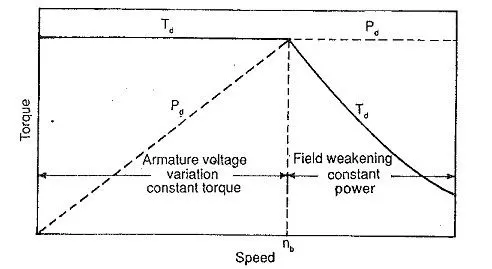
- Power is a product of torque and speed, so the rated power of a motor has a rated speed at rated voltage and speed. The motor should not be operated at ratings greater than the rated values with certain tolerance value.
- So when we want to operate the motor at greater than rated speed, we cannot increase the voltage greater than voltage keeping in mind that insulation for the motor is designed for rated only, operating the motor greater than rated voltage can cause insulation failure.
- Till the rated speed the power keeps on increasing with the speed at constant torque. After the based speed the power remains constant. Since power=torque * speed, as speed is increasing torque value must decrease to keep the power cosntant.
- Thus we cannot get higher torque at high speeds in electric vehicles.
Co-ordination of Electric and mechancial brakes:
- At lower speed the power generated by the motor is less than rated, which will be in the range of regenrative capability of the motor or we can say the at lower speeds the braking power required(as the power generated by motor to brake the vehicle is to be harnessed by the battery)will be in range of regenerative capabilty. so for lower speeds only regenerative braking us used.
- For higher speeds the power generated by motor is nearly equal to the rated. So the braking power required will be higher which will be greater than the regenerative capabilty. We used both mechanical brakes and regenrative brakes.
- There are some limitations in regenerative braking because the battery charging rate is half of the discharing rate keeping in mind the battery safety measures.
3. MATLAB code:
% w is the speed
% T is the torque
x=linspace(0,1000);
y=linspace(0,250);
% allot value og loss constants
Kc=0.2;
Ki=0.008;
Kw=0.00001;
% Constant loss
Con_Loss=20;
[X,Y]=meshgrid(x,y);
P_out=(X.*Y);
% Copper loss
Cu_loss= (Y.^2)*Kc;
% Iron loss
Iron_loss= Ki.*X;
% windage loss
win_loss=(X.^3)*Kw;
P_in= P_out + Cu_loss + Iron_loss + win_loss + Con_Loss;
% efficiency
Z = P_out./P_in;
% set the efficiencies for which contour will be plotted
p=[0.70 0.80 0.85 0.88 0.90 0.91 0.92 0.925 0.93];
box off
grid oN
contour(X,Y,Z,p);
xlabel('Speed (rad/sec)');
ylabel('Torque (N-m)');
hold on- The input power is calculated as a sum of ouput power and losses.
- Output power, P_out= speed * torque and the losses are modelled as follows
`copper loss= T^2*Kc`
`Iron loss= Ki*W`
`windage loss= W^3*Kw` - Efficeincy is calucated as P_out/P_in
- Contour is plotted for the different efficiency points given in matrix p.
contour plot:
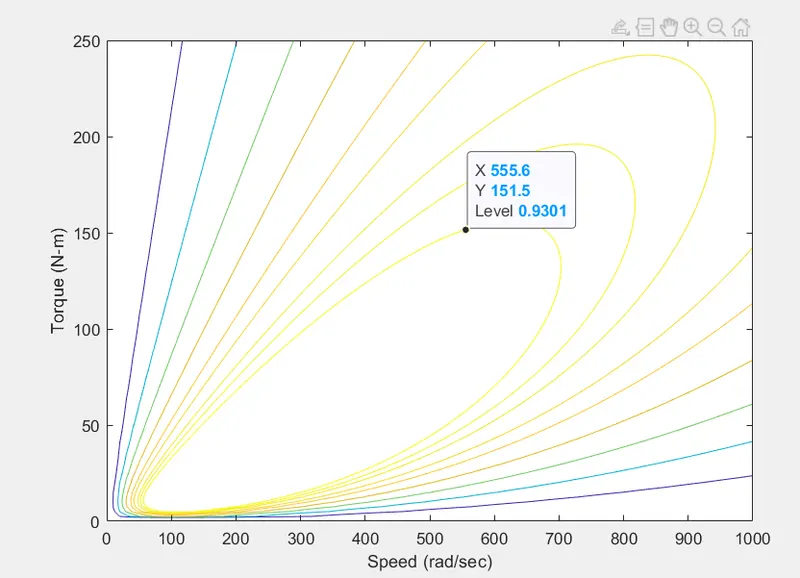
- Each contour in the plot represents the area in which the efficiency of plot is same i.e., the efficiency value for which contour is plotted.