Project-1: Powertrain for aircraft in runways
PART-A
1.
| Aircraft | Empty weight(EW) | Max fuel weight(MFW) | Max cargo weight(MCW) | Max Gross Take off wieght(MGTW) |
| Antanov AN- 225 | 285,000 kg | 300,000 kg | 190,000 kg | 640,000 kg |
| Airbus A380-800 | 277,000 KG | 254,00KG | 84,00 KG | 575,000KG |
| Boeing 747-800 | 220,100 kg | 194,00 kg | 134,000 kg | 447,700 kg |
| Airbus A340-500 | 168,00 kg | 175,00 kg | 54,000 kg | 372,000 kg |
| Boeing 777-300ER | 168,000 kg | 145,500 kg | 67,100 kg | 352,000 kg |
| Boeing 787-10 | 135,000 kg | 101,500 kg | 57,300 kg | 254,000 kg |
| Boeing 737-900 | 44,700 kg | 24,00 kg | 20,200 kg | 85,000 kg |
| Airbus A320-100 | 42,600 KG | 22,100 KG | 20,000 KG | 68,000 KG |
| Embraer 190 | 28,800 kg | 13,000 kg | 13,100 kg | 48,000 kg |
| Gulfstream G650 | 24,500 kg | 21,900 kg | 3,000 kg | 45,200 kg |
| Bombardier CRJ900 | 21,850 KG | 8,900 kg | 2,760 kg | 36,500 kg |
| Bombardier Q400 | 17,800 kg | 5,300 kg | 8,500 kg | 28,000 kg |
| Learjet 75 | 6,300 kg | 2,750 kg | 1,300 kg | 9,700 kg |
| Cessna Citation CJ4 | 4,700 KG | 2,650 KG | 1,000 KG | 7,800 kg |
| Beechcraft King Air B100 | 3,200 kg | 1,450 kg | 1,900 kg | 5,400 kg |
| Diamond DA50 RG | 1,450 kg | 155 kg | 560 kg | 2,000 kg |
| Beechcraft Bonanza G36 | 1,150 kg | 200 kg | 385 kg | 1,660 kg |
| cessna 206H | 990 kg | 235 kg | 520 kg | 1,630 kg |
| Sirrus SR22 | 1,000 kg | 220 kg | 430 kg | 1,630 kg |
| Cessna 172R | 770 kg | 170 kg | 255 kg | 1,100 kg |
- Care is taken that the total weight i.e., EW + MFW + MCW is less than the MGTW to take off. MGTW is mentioned by the aircraft manufacturer.
2.
- The difference between the ground speed and the air speed depends on the speed of the wind relative to the ground.
- the relation between the ground speed and air speed is given as
`V_(P/G)=V_(P/W)+V_(W/G)`
Where `V_(P/G)`= velocity of the plane with respect to ground (or) Ground speed
`V_(P/W)`=velocity of the plane with respect to wind (or) Air speed
`V_(W/G)`=velocity of the wind with respect to ground (or) wind speed - If wind speed with respect to ground is 0 then ground speed and air speed are same.
3.
- The air crafts are meant to move in air for more time than on ground, so there is a necessity to use the fuel fairly.
- Generally aircraft engines are used for traction where path is clear and requiress less time and no start-stop of the engine is required.
- Also sometimes the plane may pick up speed and move toward the other crafts or buildings nearby and may crash then while using the engine power. So its not not use the engine power mostly while on the airplane track.
4.
- When we want to park the vehicle and for taking aeroplane out of parking area, it is not recommended to use engine for traction instead pushback truck are used to move the aircraft along the taxiway where the wheels of the aircraft are place on the pushback truck and steered through to the runway.
- The pushback trucks are very high powered nearly about 700 HP which can be an IC engine or a electric motor.
5.
Take-off power:
-
On take-off, in order to position the aircraft to a safe height away from terrain and obstacles (i.e. a flight path of maximum height and minimum ground distance desired), the engine thrust is set to a high 'take-off power' setting (although this is not necessarily full power) and the aircraft attitude is pitched up to maintain a specific speed. Once the safe height is reached the engine thrust can therefore be reduced to a more appropriate settinf and the aircraft flight path can be changed to a more appropriate flight path.
-
The amount of power that an engine is allowed to produce for a limited period of time for takeoff. The use of takeoff power is usually limited to 5 min for reciprocating engines and up to 2½ min for gas turbine engines. This may not always be the case.
The accelartion required by the aircraft during take off can be predicted by the following equation
`(dV)/(dt)=(T-D-F)/M`
Where T,D,F are the forces involved
T- Thrust of propulsion system pushing aircraft along the runway.
D- Aerodynamic drag of the vehicle.
F- Rolling resistance friction due to the contact of tyres on the ground.
M- Mass of the aircraft.
Tyre design:
-
Carcass plies are used to form the tire. They are sometimes called casing plies. An aircraft tyre is constructed for the purpose it serves.
1.They support the weight of an aircraft while it is on the ground.
2.It also provides the necessary traction for braking and stopping of an aeroplane.
3.Tyre also helps to absorb the shock of landing and provide cushioning the roughness of takeoff, roll-out, and taxi operations. -
Unlike an automobile or truck tyre, it does not have to carry a load for a long period of continuous operation. However, an aircraft tyre absorbs the high impact loads of landing, and also it’s operating at high speeds for a short time when required.
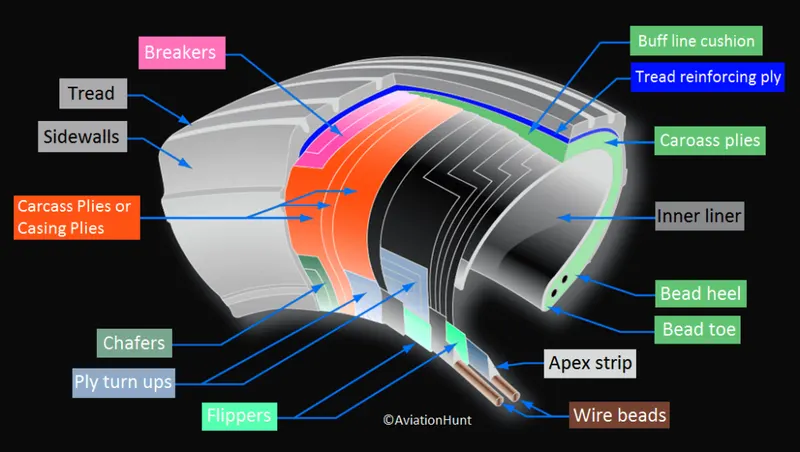
Technical aspects of aircraft tyre:
- Retreading – Retreading is methods of restoring a worn tyre by renewing the tread area or by renewing the tread area plus one or both sidewalls. Repairs are included in the tyre retreading process.
-
Load Rating – Load rating is the maximum permissible load at a specified inflation pressure
-
Ply Rating – Ply Rating is used to identify the maximum recommended load rating and inflation pressure for a specified tyre. It is an index of tyre strength.
-
Speed Rating – The speed rating is the maximum takeoff speed to which the tyre has been tested.
-
Skid Depth – Skid depth is the distance between the tread surface and the deepest groove as measured in the mould.
Aircraft tyres must have an approved speed and load rating and have sufficient clearance when retracted through landing gear to allow for tyre growth. Tyre growth is the increase in the size of the tyre due to centrifugal forces at high speed.
- Aircraft tyres may be tube-type or tubeless type. Tubeless tyres are more advantageous over tube-type. There is no longer the use of tube-type tyre in recent aviation. Nowadays all airliners are using tubeless tyres.
-
Aircraft tyres may be Radial or Bias. Almost all airliners are using Radial tyre. Bias is an older design, and it’s mainly used for road vehicles. Radial tyres have the word RADIAL on the sidewall. Radial tires are more expensive than bias-ply tyres. Radial tires are in demand because of their lower life cycle cost and long term value.
-
Today’s tyres are conductive. Aircraft tyres are manufactured with tread rubber with conducting compounds to permit earthing of static charges. In early days when tyres were not sufficiently conductive, aircraft used to have a conductive strip hanging down from the axle of the landing gear. Upon landing, this strip would be the first part of the aircraft to touch the earth. This discharges any static electricity accumulated on the outer surfaces of the aircraft. Now you don’t see them anymore.
-
Chines on the aviation tyre are aslo called deflectors.Chine tyre used on the nose wheel of aircraft, specially fuselage-mounted jet engines. It diverts runway water away from the engine inlets. Chines are circumferential protrusions that are moulded into the sidewall of nose tyres that deflect water sideways to help reduce excess water ingestion into the engines. Tyres may have chines on one or both sides, depending on the number of nose tyres on the aircraft.
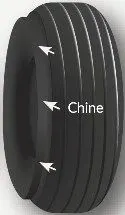
Rolling resistance:
- Rolling resistance, sometimes called rolling friction or rolling drag, is the force resisting the motion when a body (such as a ball, tire, or wheel) rolls on a surface.
- Rolling resistance force is experienced by the vehicle when the aircraft is taking off from the runway and while landing.
Rollinf resistance force is given as `F_(rr)=mu_(rr)*m*g`
where `mu_(rr)` is the coefficient of rolling resistance which depends on the tyre material, tyre structure, tyre inflation pressure, tread design on the tyre, road roughness, road material and on presence or absence of liquids on the surface of road and tyre. - `mu_(rr)` is also the function of speed of the vehicle.
Tyre pressure:
-
Aircraft tires generally operate at high pressures, up to 200 psi (14 bar; 1,400 kPa) for airliners, and even higher for business jets. The main landing gear on the Concorde was typically inflated to 232 psi (16.0 bar), whilst its tail bumper gear tires were as high as 294 psi (20.3 bar).
-
Tests of airliner aircraft tires have shown that they are able to sustain pressures of maximum 800 psi (55 bar; 5,500 kPa) before bursting.
-
During the tests the tires have to be filled with water, to prevent the test room being blown apart by the energy that would be released by a gas when the tire bursts.
-
Aircraft tires are usually inflated with nitrogen to minimize expansion and contraction from extreme changes in ambient temperature and pressure experienced during flight. Dry nitrogen expands at the same rate as other dry atmospheric gases (normal air is about 80% nitrogen), but common compressed air sources may contain moisture, which increases the expansion rate with temperature.
-
The requirement that an inert gas, such as nitrogen, be used instead of air for inflation of tires on certain transport category airplanes was prompted by at least three cases in which the oxygen in air-filled tires had combined with volatile gases given off by a severely overheated tire and exploded upon reaching autoignition temperature. The use of an inert gas for tire inflation eliminates the possibility of tire explosion.
Brake forces while landing:
-
A commercial aircraft is on approach for landing. It’s flying at around 145 miles per hour. The pilot flying pulls back gently on the control column to slow the sink rate and flare for landing. The wheels touch down in a cloud of burnt rubber. The landing gear and wheels absorb the impact of the massive aircraft.
The braking comes from three sources:
- Ground spoilers
- Wheel disc brakes
- Reverse thrusters
Ground spoilers:
-
In general, when the wheels touch the ground, a set of spoilers raise up quickly, which kills the lift provided by the wings. There are two sets seen in the image below ground spoilers that only deploy on landing, and spoilers that are used in flight as speed brakes as well as on landing.
-
While the spoilers provide some drag, their primary purpose is to stop the plane from actually flying, putting all of the weight on the landing gear and in turn making the brakes that much more effective.
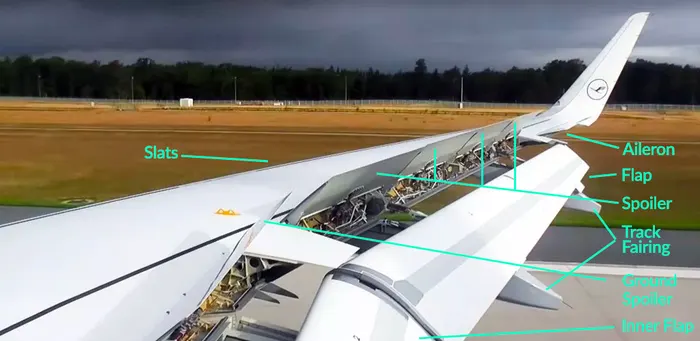
Wheel disc brakes:
-
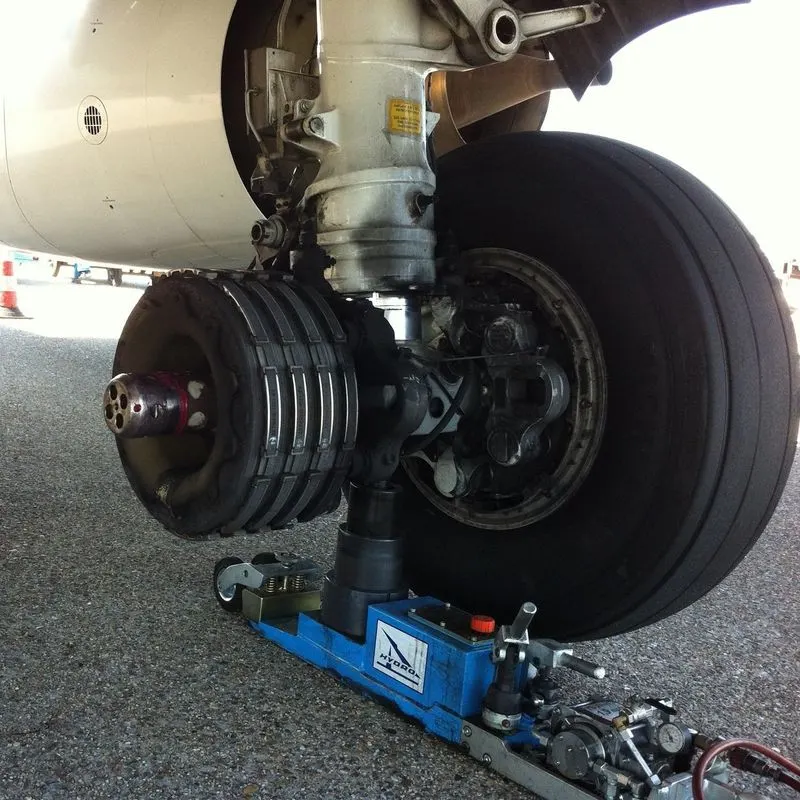
In addition to wing spoilers, airplanes use disc brakes. Airplane disc brakes are similar to the braking system in automobiles. They consist of a pair of calipers that, when engaged, squeeze pads against the rotors of an airplane’s landing gear.
-
Disc brakes are designed to remain static at all times. In other words, they don’t rotate with the wheels of an airplane’s landing gear. As the wheels turn, the disc brakes will remain static and stationary. They are a vital component of an airplane’s braking system because they are designed to apply pressure to the airplane’s wheels. Disc brakes will squeeze the wheels, thereby slowing down the speed at which they spin. In turn, this reduces the speed of the airplane so that it can come to a complete stop on the runway.
Reverse thrusters:
- Many jet airplanes use reverse thrust to assist with braking during landings. Reverse thrust is a feature in jet engine airplanes that, as the name suggests, involves the reversal of the engines thrust. When flying, the thrust is projected out the rear of an airplane’s engines.
- When landing, however, pilots may use the reverse thrust feature. Reverse thrust changes the direction of the engines’ thrust. Rather than projecting out the rear, the thrust will be projected out the front. This reversal of thrust provides deceleration that allows airplanes to slow down more quickly when landing.
6.
A.
6.
A. Let the aircrat me boeing 787-10.
mass of the aircraft, M=254000 kg
mass of the pushback truck, m=30000 kg
speed of the aircraft-truck combination, v=18kmph=5 m/sec
calculation of rolling resistance force (`F_(rr)`):
coefficient of rolling resistance of aircraft, `mu_(rr1)`=0.004
coefficient of rolling resistance of truck, `mu_(rr2)`=0.0035
`=>`total rolling resistance force= rolling resistance force due to aircraft + rolling resistance force due to truck
=`mu_(rr1)*M*g +mu_(rr2)*m*g`
=`(0.004*254000*9.81)+(0.0035*30000*9.81)`
`F_(rr)`= 10997.01 N
Calculation of air drag force (`F_(ad)`):
air drag coefficienct of air craft, `C_(d1)`=0.025
air drag coefficient of truck, `C_(d2)`=1.15
frontal area of aircraft, `A_1=15 m^2`
frontal area of truck, `A_2=1.5m^2`
air density, `rho=1.25 (kg)/m^3`
`=>`total air grag force= air drag force on aircraft + air drag force on truck
=`0.5*rho*A_1*v^2*C_(d1)+0.5*rho*A_2*v^2*C_(d2)`
=(0.5*1.25*15*5^2*0.025)+ (0.5*1.25*1.5*5^2*1.15)
`F_(ad)`=32.81 N
Total force acting while the aircraft is towed by the truck, F= `F_(rr)+F_(ad)`
= 10997.01+32.81
F=11029.822 N
Power required to push/pull the aircraft= F*v
= 11029.822*5
P =55.149 KW
B.
MODEL:
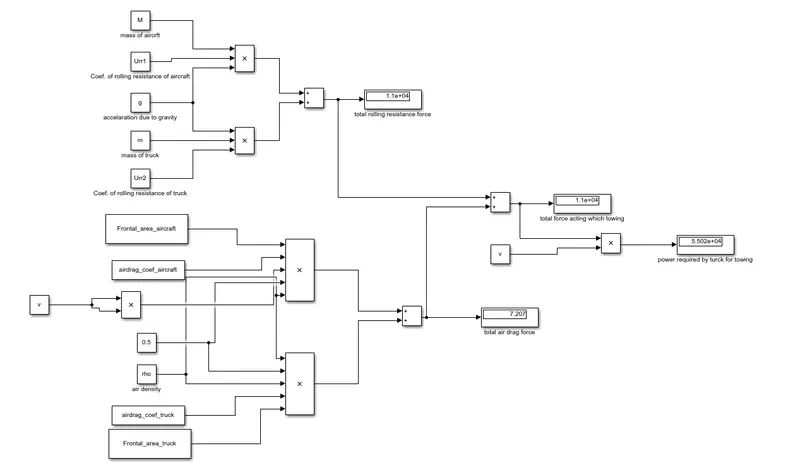
7. A.
Electric vehicle power train:
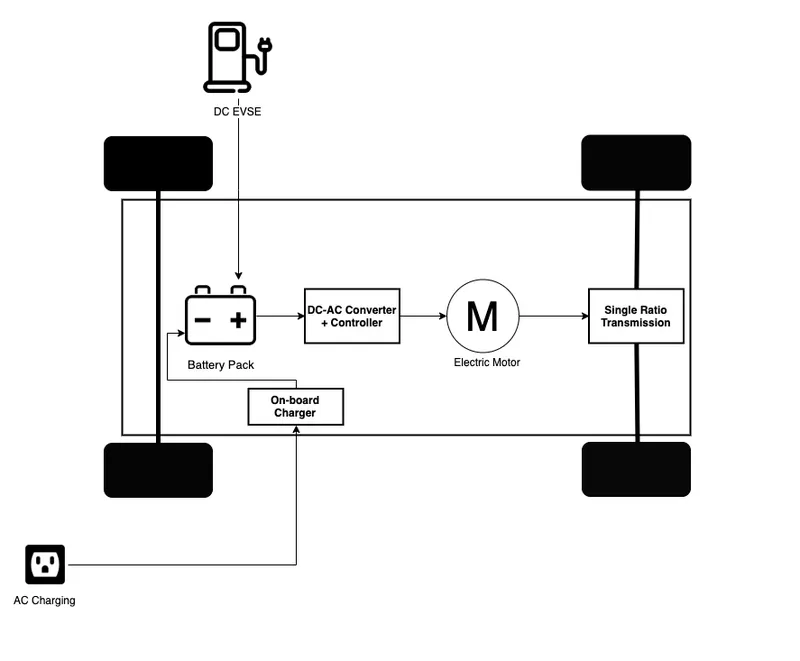
Battery pack:
- The battery pack is combination of small reachargeable cells in series and parllel combinations depending on the rating of the battery required. This is the power house of the electric vehicle which energises the motor and the other auxiliary components.
- The battery is charged through a charger from the electrical outlets.
Converter:
- Converts DC to AC which is required by the motor which is an Inverter. If motor is a DC motor then a DC-DC converter is used to control DC level of output of the converter.
- Converters are made of power semiconductor switches which switch at higher frequencies. There will be losses in the converters but the efficiencies are quite high.
Controllers:
- The control signals to the switches of the converters is given by the controller where the control signals are modified by the controller using different control strategies according to the reference signals given.
- The EV motor controllers required high computational ability because a lot of calculations to be done on the values sensed by the different sensors placed in the motor parts.
Electric motor:
- Electric motor in the EV does the same work as an engine in ICE vehicles but with higher efficiencies and advantges.
Most of the motors used in the EV are AC type which reuqired AC to run. for example presently BLDC and IM are more prevalent in EV. - Electric motor also provide regenerative braking, where the kinetic energy of the vehicle while braking is converted into electricity which furthur charges the battery making the electric vehicles more advantageous.
On-board charger :
- The On-board charger charges the vehicle from the AC outlets generally found in the household outlets. The On charger converts AC to DC and then charges the battery. It takes more time to charge as the outlet voltahe levels are low and more current cannot obtained from the outlet for fast charging.
- Also the battery can be charged form the charging stations where the DC charging is done which is very fast compared to AC charging.
Duty cycle calculation:
from problem 6 calculation the power required for towing is calculated as, P= 55.15 KW
let the towing time be 10 min= 10*60=600sec
Energy required for towing= P*time for towing
= 55.15*600=33090 KJ
= 33090*0.000278 KWH
= 9.19 KWH
`=>` Let the motor used be DC7 rated 200 hp, 150 V
let the input current drawn by the motor= 500A
input voltage=150 v
`=>` input power= 150*500= 75KW
output power is the power required for towing= 55.15 KW
`=>` duty cycle= OUTPUT POWER/ INPUT POWER
= 55.15/75=0.735
SIMULINK block diagram:
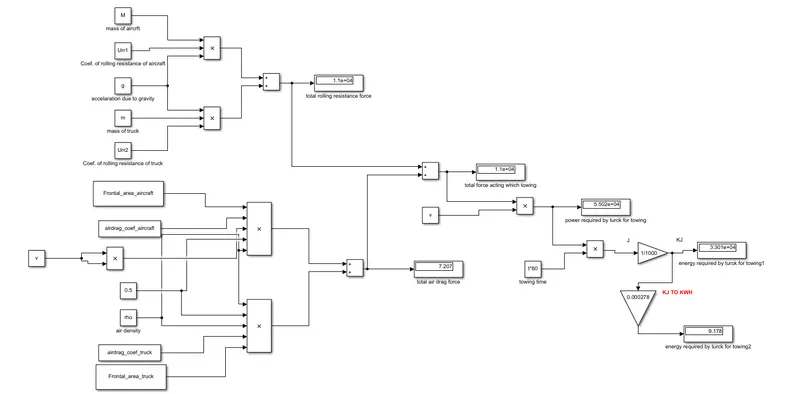
Assumptions:
| Aircrafft mass, M | 254000 kg |
| Truck mass, m | 30000kg |
| Coefficient of rolling resistance of aircraft | 0.004 |
| Coefficient of rolling resistance of truck | 0.0035 |
| Frontal area of aircraft | 15 m^2 |
| Frontal area of truck | 1.5 m^2 |
| Air drag coefficient of aircraft | 0.025 |
| Air drag coefficient of truck | 1.15 |
| Velocity of aircraft | 5 m/sec |
Assuming the maxium speed to be 5m/sec which is the previously assumed value, the range of duty cycle to move the aircraft from 0 to maximum speed will be 0 to 0.735.