Week 7 State of charge estimation
1. TestCase 1: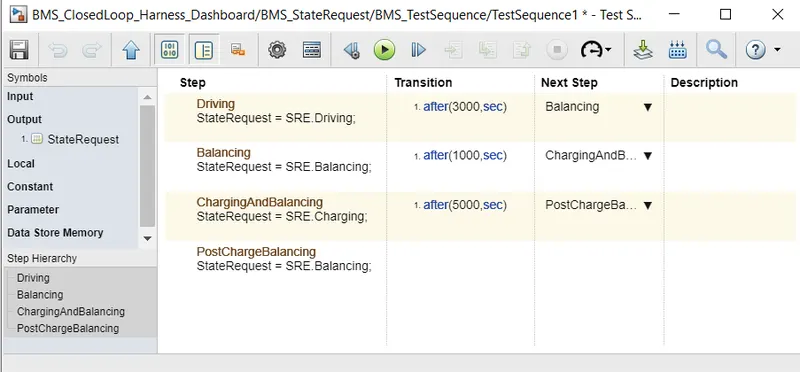
- for first 3000 sec driving mode, after 3000sec Balacing mode of battery, then after 1000 sec charging and balacing both takes places simulataneously after another 5000 sec Post charge balancing occurs till 20000sec (end).
- results
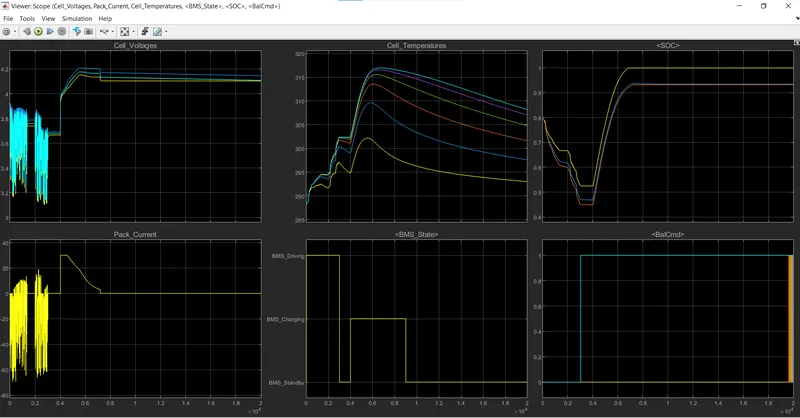
- while driving the cell voltage decreases, temperature increases as battery pack current also varies according to the drive cycle. SOC decreases as the battery energy is utilized.
- After 3000 sec there is a standby conditions where cell voltage, SOC are constant. Temperature decreases because the battery energy is not utilized in this mode.
- After 4000 sec till 7000sec, charging mode occurs where the battery charges so the cell voltage, temperature, SOC increases. If we observe the Pack current plot at the starting of charging mode current is constant for sometime indicating Constant Current charging after that the current decreases and voltage remains constant indicating Constant Voltage charging. SOC increases to 100 %
- After 9000 sec the vehicle enters into stand by mode where pack current os 0,temperature decreases gradually, SOC remains at 100%.
- The cell balancing will be active from 3000sec iself.
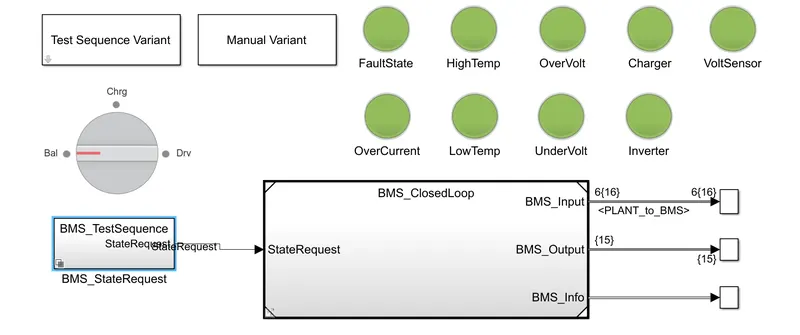
- No fault or limits is breached as shown by indicators in harness model
TestCase 2: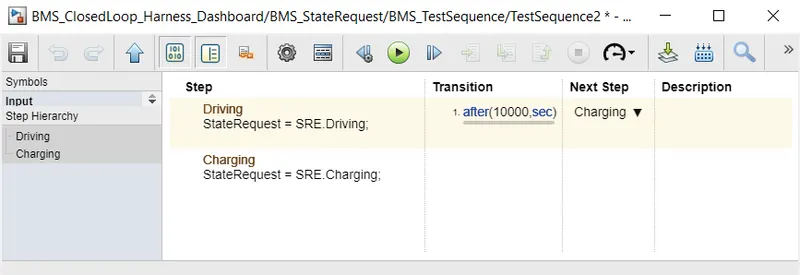
- for first 10000 sec there would be driving and after that charging till the end.
- result
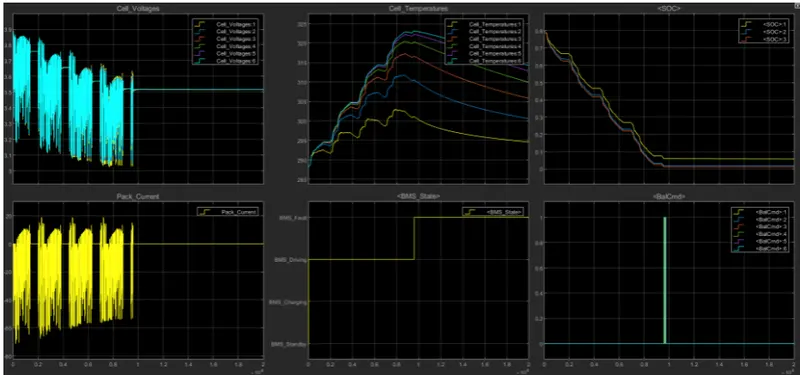
- Since till 10000 sec vehicle is in driving mode, the battery discharges continously resulting in increment of temperatures.
- Due to continous charging the apck temperature increases and reaches the limit which is indicated by the red light in harness model
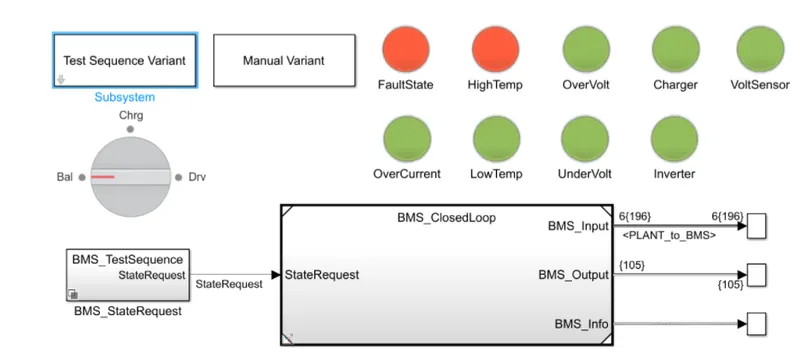
so the model enters into fault state which is indicated by red light.
TestCase 3: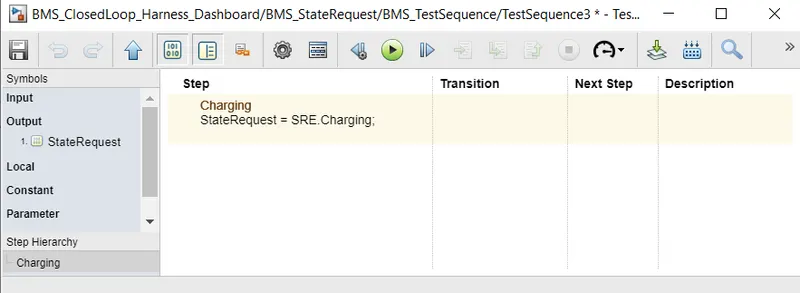
- There is only charging mode for entire simulation time.
- result
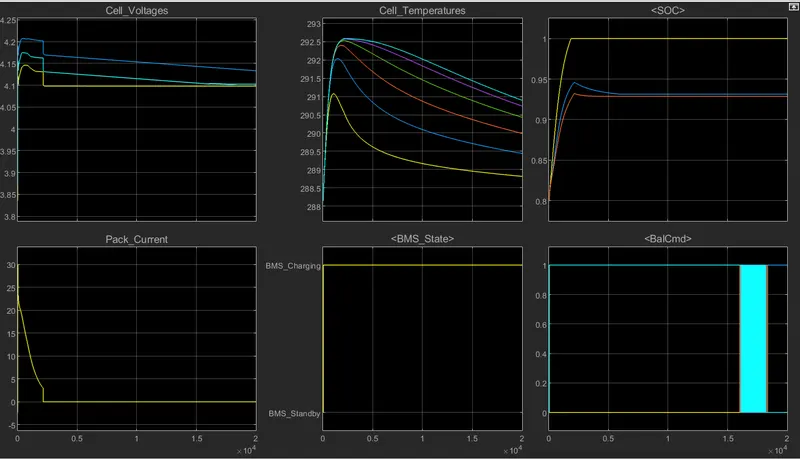
after the SOC of the battery reaches 100% the vehicle enters into standby and the increased temperatures while charging deacreases gradually in standby mode.
There are no fault conditions met as and when SOC reaches 100 % the model enters into standby mode.
2. State of charge (SOC):
SOC of a battery indicates the remaining capacity of the battery, it is important parameter for control strategy in BMS.
`SOC= (Q(t))/Q_n`
Q(t) is the current capacity at time t
Q_n is the nominal capacity is given by the manufacturer and represents the maximum amount of charge that can be stored in the battery.
- As the SOC is an important parameter, which reflects the battery performance, so accurate estimation of the SOC can not only protect battery, prevent overdischarge, and improve the battery life but also allow the application to make rational control strategies to save energy.
- However, a battery is a chemical energy storage source, and this chemical energy cannot be directly accessed. This issue makes the estimation of the SOC of a battery difficult. Accurate estimation of the SOC remains very complex and is difficult to implement, because battery models are limited and there are parametric uncertainties.
SOC estimation methods:
- Direct measurement: this method uses physical battery properties, such as the voltage and impedance of the battery.
- Book-keeping estimation: this method uses discharging current as the input and integrates the discharging current over time to calculate the SOC.
- Adaptive systems: the adaptive systems are self-designing and can automatically adjust the SOC for different discharging conditions. Various new adaptive systems for SOC estimation have been developed.
- Hybrid methods: the hybrid models benefit from the advantages of each SOC estimation method and allow a globally optimal estimation performance. The literature shows that the hybrid methods generally produce good estimation of SOC, compared to individual methods.
Book keeping estimation:
Book-keeping estimation method uses battery discharging current data as input. This method permits to include some internal battery effects as self-discharge, capacity-loss, and discharging efficiency. Two kinds of book-keeping estimation methods have been employed: Coulomb counting method and modified Coulomb counting method.
- Coulomb Counting Method:
The Coulomb counting method measures the discharging current of a battery and integrates the discharging current over time in order to estimate SOC [20]. Coulomb counting method is done to estimate the SOC(t) which is estimated from the discharging current, I(t) and previously estimated SOC values SOC(t-1)
`SOC(t)= SOC(t-1) + (I(t))/Q_n*deltat`
Coulomb counting method for BMS model: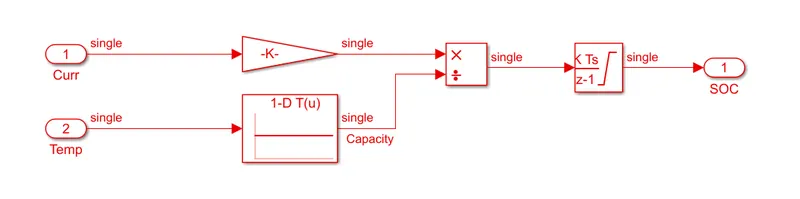
output of math block is (current/3600)/(capacity) which is integrated by a discrete integrator to get SoC.