Week-4 Challenge WOT Condition Part-2
1.
| Mapped engine/motor/generator model | Dynamic engine/motor/generator model |
| 1.relationship between the variable in engine/motor/generator is given in the form of look-up tables. | 1.relationship between the variable in engine/motor/generator are excuted in real time by sensing the parameters continously. |
| 2.These models are static and executes fast than the dynamic models as there is no real time sensing of parameters and computing them. | 2.These models slower than static model as these are lot number of computations taking place continously. |
| 3.Blocks of motor model and motor controllers are not used in this model as already the predefined values are represented in the look-up tables. | 3. Contains block of motor and controller so that motor parameters are sensed and computed. |
- Right click on the screen got variation > label mode active choice > then the blocks which can be accessed are shown select the required block. Each block represents the different models.
2. The procedure goes as follows:
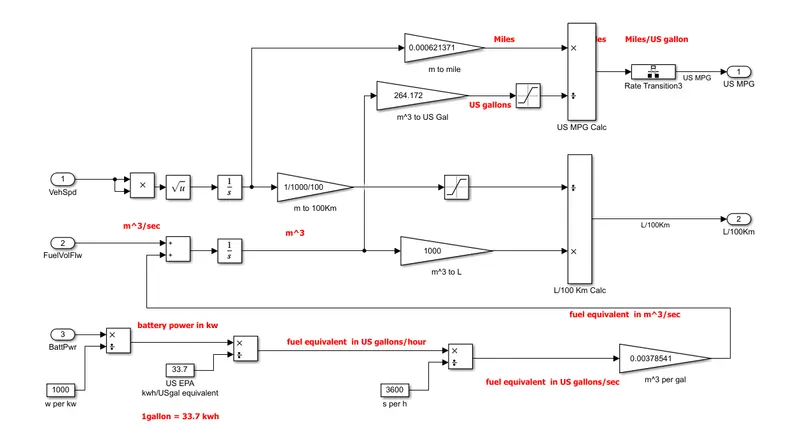
- first the vehicle speed is sensed and integrated to find the distance covered(d) in miles.
- In HEV model there will be both fuel for engine and battery for motor. Since we need miles/gallon, we need to convert the battery power used into engine fuel volume flow equivalent and then added with actual engine fuel volume flow in terms of gallon.
- Now divide the distance covered by vehicle in miles by the fuel consumed to get miles/gallon.
block diagram:
procedure to calculate battery power in gallon:
- first the battery power is which will be in watts is cob=nverted to kw by dividing it will 1000.
- 1US gallon = 33.7 kwh -> 1US gallon/h = 33.7kw, so battery power is divided by 33.7 to convert it to USgallon/hour.
- since 1hr=3600 sec, USgallon/hr = US gallon/3600sec= US gallon/sec.
- 1gallon = 0.00378541 m^3.
then add the fuel volume of engine in m^3/sec with fuel equivalent of battery power consumed and then integrated to find the total volume in m^3.
again convert fuel in m^3 to gallon, where 1m^3=267.172 US gallon
then divide miles by US gallon to get miles gallon.
- the factor considered in model flow are vehicle speed, fuel volume flow, battery power for a hybrid electric vehicle model.
3.
- As soon as the WOT is given to vehicle the motors starts accelarating the vehicle, when vehicle reaches 40mph the engine also start accelarting which inturn rotates the shaft of generator which charges the battery, we can observe this from the plot SOC of battery that rate of decrease of SOC decreases when the engine/generator starts running which indicates that battery battery is being charged by the generator.
Also the fuel economy increases till only the motor is running and when engine/generator is ON it remains alomost onstant till the WOT is removed. Also we can observe that the battery decreases when the engine starts to share the tractive power because the load on the batttery decreases.Vehicle reaches the top speed in 40 sec itself.
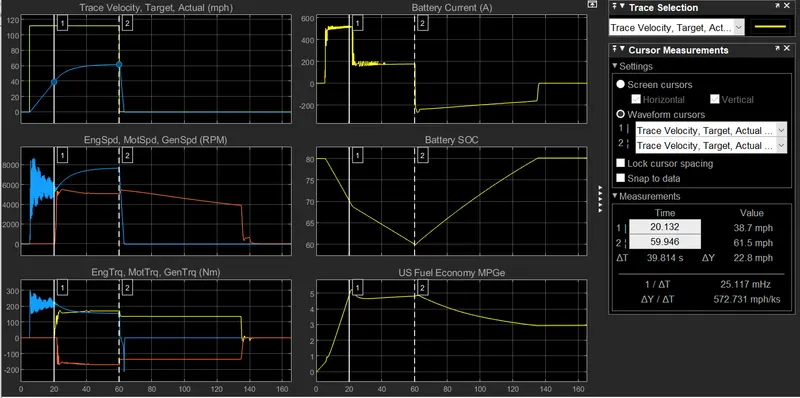
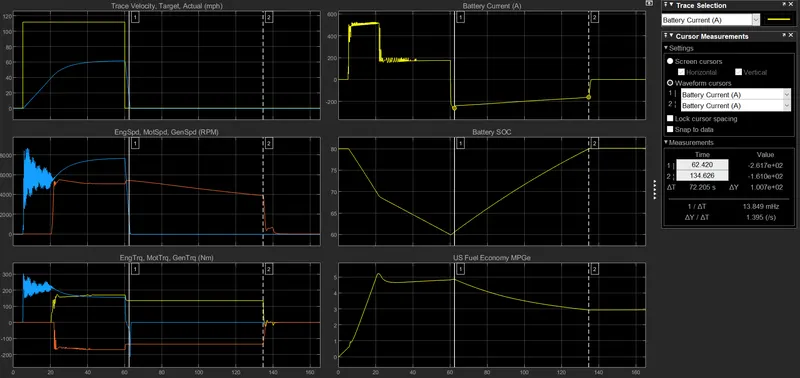
- When WOT is removed the vehicle decelarates to 0mph in 3sec at nearly 20mph/sec. Motor speed also falls to 0 in the meanwhile but the engine just runs due to its intertia even after the vehicle is came to rest. As the engine runs the generator which inturn charges the battery which is evident from the increase in SOC of the battery, the negative battery current is alsot the indication of battery charging. The charging current(-200A/sec) is almost 50 percent of the discharging current(500A/sec). The engine runs till the battery reaches to its maximum SOC and then engine is stopped by the ECU(engine control unit).
Also the economy decreases because the vehicle is at rest and fuel is consumed to charge the battery where miles remain constant and fuel consumed in gallon increases so economy in miles per gallon decreases.
4.
| Pure Electric Vehicle | Hybrid Electric Vehicle |
| 1.Only Electric Motor is responsible for full accelaration of the vehicle. | 1.Initially motor starts the accelaration of the vehcile and the engine also comes intp action. |
| 2.Regenerative action takes place after the WOT is removed only for a short duration of time till the vehicle comes to rest. | 2.Regenrative action takes place even after the vehicle comes to rest due to intertia of engine which runs the generator to charge the battery. |
| 3.The charging current is slighlty less in magnitude than the maximum discharging current. | 3.The charging current is almost half of the maximum discharging current |
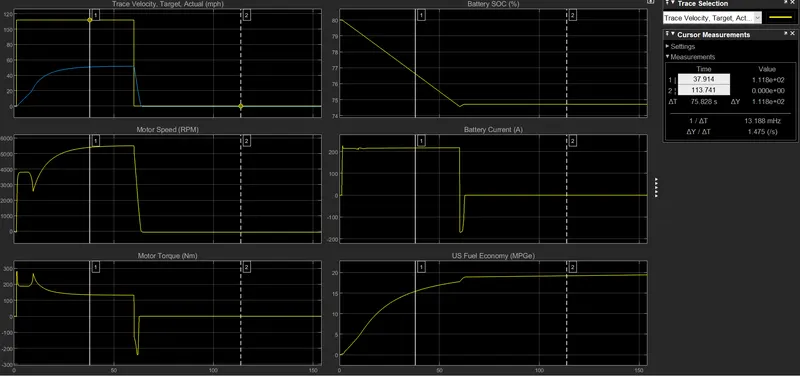
| 4.SOC of the battery decreases from 80% to 73% during WOT and the due to regeneration which is for a short duration time there nothing much considerable increase in the SOC of the battery it almost remains constant. | 4.SOC of the battery decreases from 80% to 60% during WOT and then due to engine inertia generator charges the battery to its maximum alllowable SOC i.e., 80%, making vehicle ready for next accelaration and engine is brought to rest by the Engine Control Unit(ECU). |
| 5.The fuel economy just go on increases untill the WOT is removed but the rate of increase in fuel economy go on decreasing, after the WOT is removed fuel economy remains constant. | 5. the fuel economy goes on increasing untill the egine is turned ON and remains almost constant when both motor and engine are running.After WOT is removed fuel economy goes on decreasing because vehicle is at rest but the fuel is consumed to run the battery. |
EV response:
HEV response:
Note: EV and HEV are simulated under the conditon, wind velocity= 10mph and grade angle = 10 degrees.