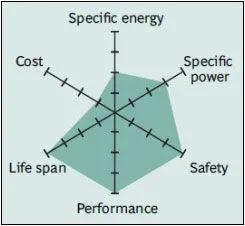
Week 1 Understanding Different Battery Chemistry
1.
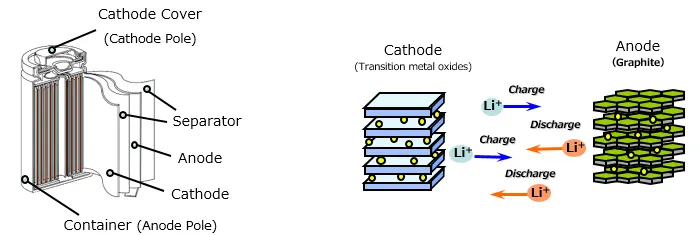
A lithium-ion battery or Li-ion battery is a type of rechargeable battery in which lithium ions move from the negative electrode through an electrolyte to the positive electrode during discharge, and back when charging. Li-ion batteries use an intercalated lithium compound as the material at the positive electrode and typically graphite at the negative electrode
- Electrolyte:
The Electrolyte is the medium that provides the ion transport mechanism between the cathode and anode of a cell. Electrolytes are often thought of as liquids, such as water or other solvents, with dissolved salts, acids, or alkalis that are required for ionic conduction. It acts as ion conductor and electron insulator. - Electrode:
An Electrode is used to make contact with the non metallic part of the circuit (for example electrolyte in batttery). It is also an element where the electrons enter and exit in a circuit. - Seperator:
A separator is a permeable membrane placed between a battery's anode and cathode avoiding the direct connection between them. They are important to batteries because their structure and properties considerably affect the battery performance, including the batteries energy and power densities, cycle life, and safety. - Current collectors:
Current collectors are electronic conductors with which the electrodes are mixed. It does not take part in the chemical reactions of a cell. It allows simple electronic connection to reduce the electric resistance of the electrode - Lithium ion cells have bettery energy density, power density, low self discharge and higher cycling ability.
- The differences are the cathode which contains changing cobalt, nickel or manganese concentrations. All various cathode types allow high lithium insertion and intercalation levels which result in large energy storage quantities.
| Type of lithium ion cells | Cathode material | Anode material | Electrolyte | Chemical Reaction |
| Lithium Cobalt Oxide(LCO) | `LiCoO_2` | `LiC_6` | `LiPF_6` in ethylene carbonate |
Anode: Cathode: Redox reaction: |
| Lithium Manganese Oxide(LMO) | `LiMn_2O_4` | LiC_6 | `LiPF_6` in Ethylene Carbonate |
Anode: Cathode: Redox Reaction: |
| Nickel Cobalt Aluminium(NCA) | `LiNiCoAlO_2` | `LiC_6` | `LiPF_6` in Ethylene Carbonate |
Anode: Cathode: Redox Reaction: |
| Nickel Manganese Cobalt(NMC) | `LiNi_0.8Mn_0.1Co_0.1O_2` | `LiC_6` | `LiPF_6` in Ethylene Carbonate | Anode: `Li_xC_6rarrxLi^++xe^-)+C_6` Cathode: `Li_(1-x)Ni_0.8Mn_0.1Co_0.1O_2+xLi^++xe^-)->LiNi_0.8Mn_0.1Co_0.1O_2` Redox Reaction: `C_6+LiNi_0.8Mn_0.1Co_0.1O_2harrLiC_6+Ni_0.8Mn_0.1Co_0.1O_2` |
| Lithium iron Phosphate(LFP) | `LiFePO_4` | `LiC_6` | `LiPF_6` in Ethylene Carbonate |
Anode: Cathode: Redox reaction: |
| Lithium Titanate Oxide(LTO) | `LiMn_2O_4` | `Li_4Ti_5O_12` | `LiPF_6` in Ethylene Carbonate |
Anode: Cathode: Redox Reaction: |
2.
The comparision of various characteristics of different lithium ion cells are rated as High to moderate to low.
- Specific Energy:
The gravimetric energy density or the specific energy of a battery is a measure of how much energy a battery contains in comparison to its weight, and is typically expressed in Watt-hours/kilogram (W-hr/kg). - Specific Power:
Specific power is the measure of how much power is generated in comparision to its weight. The specific power for a battery is the gravimetric power density expressed in Watts per kilogram (W/kg).
| Type of Li-ion cell | Specific Energy | Specific Power | Safety | Cost | Performance | Life span |
| LCO | 5 (high) | 2(moderate) | moderate(3) | high(4) | moderate(4) | 2(short span) |
| LMO | moderate | moderate | moderate | moderate | lower | lower |
| NMC | high | moderate | moderate | moderate | moderate | moderate |
| LFP | low | high | high | moderate | moderate | high |
| NCA | high | moderate | low | low | moderate | moderate |
| LTO | low | moderate | high | low | high | high |
Lithium Cobalt Oxide(LiCoO2) — LCO:
- Li-cobalt excels on high specific energy but offers only moderate performance specific power, safety and life span.
- The Li-cobalt is losing favor to Li-manganese, but especially NMC and NCA because of the high cost of cobalt and improved performance by blending with other active cathode materials.
- Used in Mobile phones, tablets, laptops, cameras.
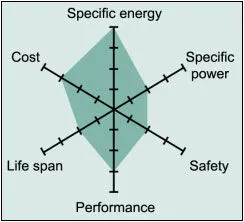
Lithium Manganese Oxide (LiMn2O4) — LMO:
- Li-manganese has a capacity that is roughly one-third lower than Li-cobalt.
- Although moderate in overall performance, newer designs of Li-manganese offer improvements in specific power, safety and life span.
- Most Li-manganese batteries blend with lithium nickel manganese cobalt oxide (NMC) to improve the specific energy and prolong the life span.
- Used in Power tools, medical devices, electric powertrains.
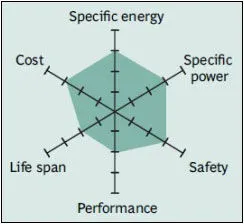
Lithium Nickel Manganese Cobalt Oxide (LiNiMnCoO2) — NMC:
- One of the most successful Li-ion systems is a cathode combination of nickel-manganese-cobalt (NMC)
- Nickel is known for its high specific energy but poor stability; manganese has the benefit of forming a spinel structure to achieve low internal resistance but offers a low specific energy. Combining the metals enhances each other strengths.The cathode combination is typically one-third nickel, one-third manganese and one-third cobalt, also known as 1-1-1.
- NMC has good overall performance and excels on specific energy.This battery is the preferred candidate for the electric vehicle and has the lowest self-heating rate.
- Used in E-bikes, medical devices, EVs, industrial.
Lithium Iron Phosphate(LiFePO4) — LFP:
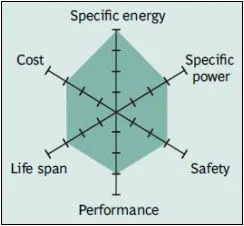
- Li-phosphate is more tolerant to full charge conditions and is less stressed than other lithium-ion systems if kept at high voltage for a prolonged time.Li-phosphate is often used to replace the lead acid starter battery in starting application.
- Li-phosphate has a higher self-discharge than other Li-ion batteries, which can cause balancing issues with aging.
- Li-phosphate has excellent safety and long life span but moderate specific energy and elevated self-discharge.
- Used in Portable and stationary needing high load currents and endurance.
Lithium Nickel Cobalt Aluminum Oxide (LiNiCoAlO2) — NCA:
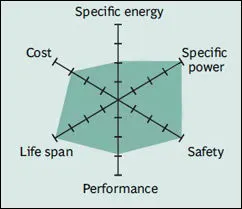
- It shares similarities with NMC by offering high specific energy, reasonably good specific power and a long life span.
- NCA is a further development of lithium nickel oxide; adding aluminum gives the chemistry greater stability.
- High energy and power densities, as well as good life span, make NCA a candidate for EV powertrains. High cost and marginal safety are negatives.
- Used in Medical devices, industrial, electric powertrain (Tesla).
Lithium Titanate (Li2TiO3) — LTO:
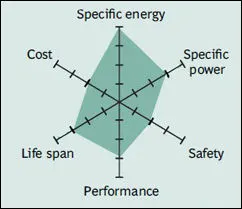
- Li-titanate replaces the graphite in the anode of a typical lithium-ion battery and the material forms into a spinel structure.
- The cycle count is said to be higher than that of a regular Li-ion. Li-titanate is safe, has excellent low-temperature discharge characteristics and obtains a capacity of 80 percent at –30°C (–22°F).
- Thermal stability under high temperature is also better than other Li-ion systems; however, the battery is expensive
- Li-titanate excels in safety, low-temperature performance and life span. Efforts are being made to improve the specific energy and lower cost.
- Used in UPS, electric powertrain (Mitsubishi i-MiEV, Honda Fit EV), solar-powered street lighting.