Week 2 Challenge
Fuel cells are classified on the basis of type of electrolyte used. These are as follows:
- Alkaline Fuel Cells (AFCs),
- Phosphoric Acid Fuel Cells (PAFCs),
- Proton Exchange Membrane Fuel Cells (PEMFCs),
- Molten Carbonate Fuel Cells (MCFCs) and
- Solid Oxide Fuel Cells (SOFCs).
- Direct Methanol Fuel Cells (DMFC)
| Type | specifications | Application |
| Proton Exchange Membrane Fuel Cells (PEMFCs) |
|
|
| Direct Methanol Fuel Cells (DMFC) |
|
|
| Alkaline Fuel Cells (AFC) |
|
|
| Phosphoric Acid Fuel Cells (PMFC) |
|
|
| Solid Oxide Fuel Cells (SOFC) |
|
|
| Molten Carbonate Fuel Cell (MCFC) |
|
|
(2)
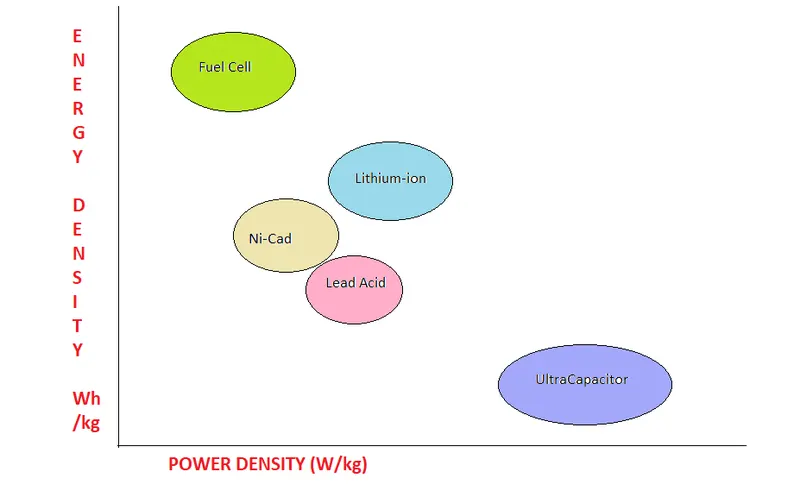
- Energy density :
Energy density is the amount of energy stored in a given system or region of space per unit volume. Expressed in kwh/kg of the energy source used. - Power density:
Power density is the amount of power (time rate of energy transfer) per unit volume. Expressed in kW/kg of the energy source used.
Lithium ion batttery:
- They have one of the highest energy densities of any battery technology today (100-265 Wh/kg). In addition, Li-ion battery cells can deliver up to 3.6 Volts, 3 times higher than technologies such as Ni-Cd or Ni-MH.
- Compared to the other high-quality rechargeable battery technologies (nickel-cadmium or nickel-metal-hydride), Li-ion batteries have a number of advantages. They have one of the highest energy densities of any battery technology today (100-265 Wh/kg).
Lead Acid battery:
- The lead–acid battery has a low energy density of 25–35 Wh/kg, although it has passed through many years of development. However, the power density is as high as 150 W/kg.
Nickel Cadmium battery:
- Nickel-cadmium (NiCd) batteries compete with lead-acid batteries because they have a higher energy density (50-75 Wh/kg) and have a longer life (2000-2500 cycles).
Ultra-Capacitor:
- The fabricated supercapacitor exhibits a very high energy density of 206 Wh/kg (59.74 Wh/L)/496 W/kg at a current density of 0.25 A/g, and a high power density of 32 kW/kg (9.8 kW/L)/9.58 Wh/kg at a current density of 50 A/g
Fuel cell:
- Diesel has an energy density of 45.5 megajoules per kilogram (MJ/kg), slightly lower than gasoline, which has an energy density of 45.8 MJ/kg. By contrast, hydrogen has an energy density of approximately 120 MJ/kg, almost three times more than diesel or gasoline.
plot: