Week-11 Challenge: Braking
- For a defined driving cycle, calculate the energy required for braking.
- Why electric motor can’t develop braking torque at high speed similar to starting? How electric and mechanical brakes are coordinated?
- Make a MATLAB program which plots contour of given motor speed, torque and efficiency values. Attach the code as a .m file attach a screenshot of all the plots
ANSWERS
- To calculate the energy required for braking to define the drive cycle.
Deceleration energy
The energy required to slow down the speed of the vehicle is known as deceleration energy or braking energy.
W.K.T Energy =1/2*m*v^2.
=1/2*m*(Vi-Vf)^2.
- mass of the vehicle m=1000kg(assume)
- velocity of the vehicle v
In the excel sheet create a drive cycle for 50 seconds
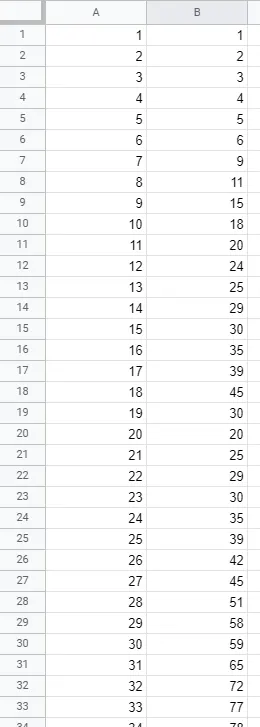
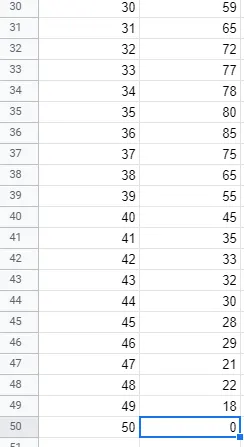
convert the data of the drive cycle to Graph representation for more detail explanation,here in the below graph we can see that two brakes are applied over all drive cycle.
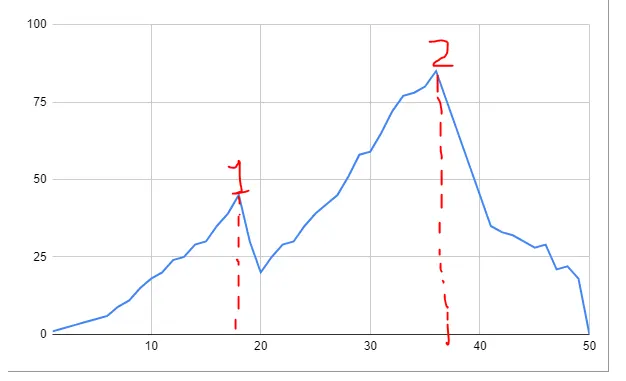
@First brake applies on the vehicle at 45kmph and it slows down to 20kmph speed again acceleration is done.
initial velocity Vi=45 kmph at 18th second change the velocity to mps by multiplying with 5/18 .
velocity in mps Vi=12.5 mps
final velocity Vf=20 kmph at 20th second
velocity in mps Vf=5.5 mps
Energy =1/2*m*(Vi-Vf)^2
=½*1000*(12.5-5.5)^2
=24500 J
=24.5 KJ
@ second brake applies at 85kmph at 36th second and slows down to 0 kmph at 50th second
Vi=85 kmph or 23.6 mps
Energy =1/2*m*(Vi-Vf)^2
=½*1000*(23.6-0)^2
= 278480 J
=278.480 KJ
Total energy for braking of drive cycle is addition of both energies
Total energy= first brake energy + second brake energy
=24.5 + 278.450
=302.9 KJ
Hence 302.9 KJ energy is required for braking of the vehicle.
2.Why can't electric motors develop braking torque at high speed similar to starting? How electric and mechanical brakes are coordinated?
Electric braking or regenerative braking
Regenerative braking is an energy recovery mechanism that slows down a moving vehicle or object by converting its kinetic energy into a form that can be either used immediately or stored until needed.
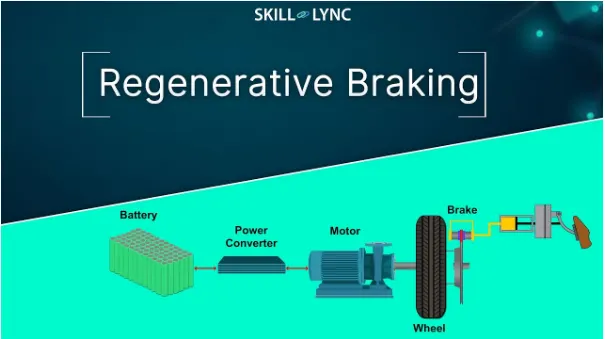
According to the electric braking system , the negative peak torque of deceleration is not higher than the positive peak torque of acceleration .The power which is generated for braking is not sufficient to stop the vehicle at the high speed but at the low speeds it is capable of stopping the vehicle.
Thus electric motors can’t develop braking torque at high speed similar to starting.
Regenerative braking and mechanical braking both should be use at high speed of the vehicle
Usage of electric and mechanical brakes.
- @low speed only regenerative braking can be used.
- @ High speed both mechanical and electric brakes should be used ,control and distribution of load is given by the brake pedal .
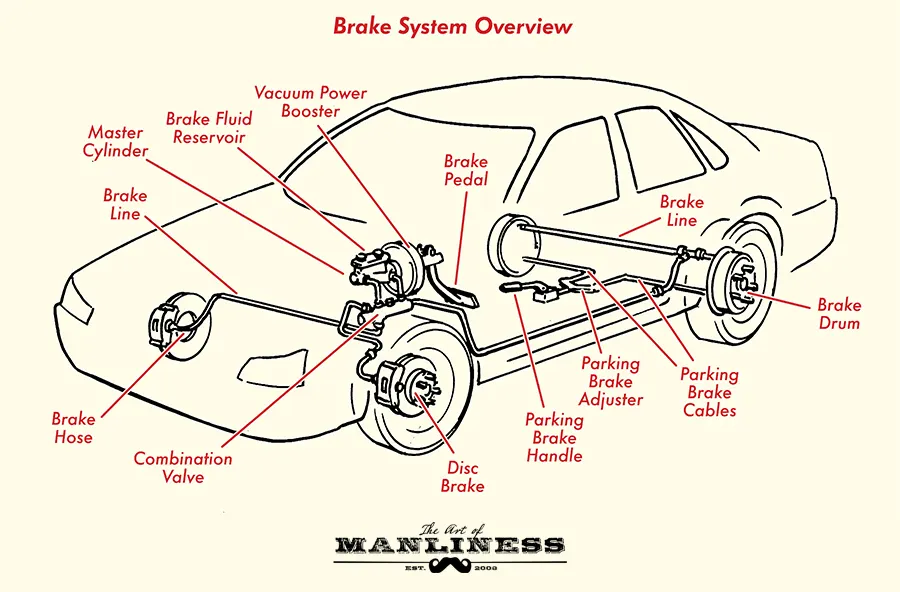
Coordination of electric and mechanical brakes by Nissian leaf EV vehicle is demonstrated below.
Safe braking
EVs and hybrid vehicles use regenerative braking, which utilizes the motor to convert the kinetic energy during deceleration into electrical energy. With energy regeneration, an EV is able to run on less electricity and a hybrid vehicle on less fuel.
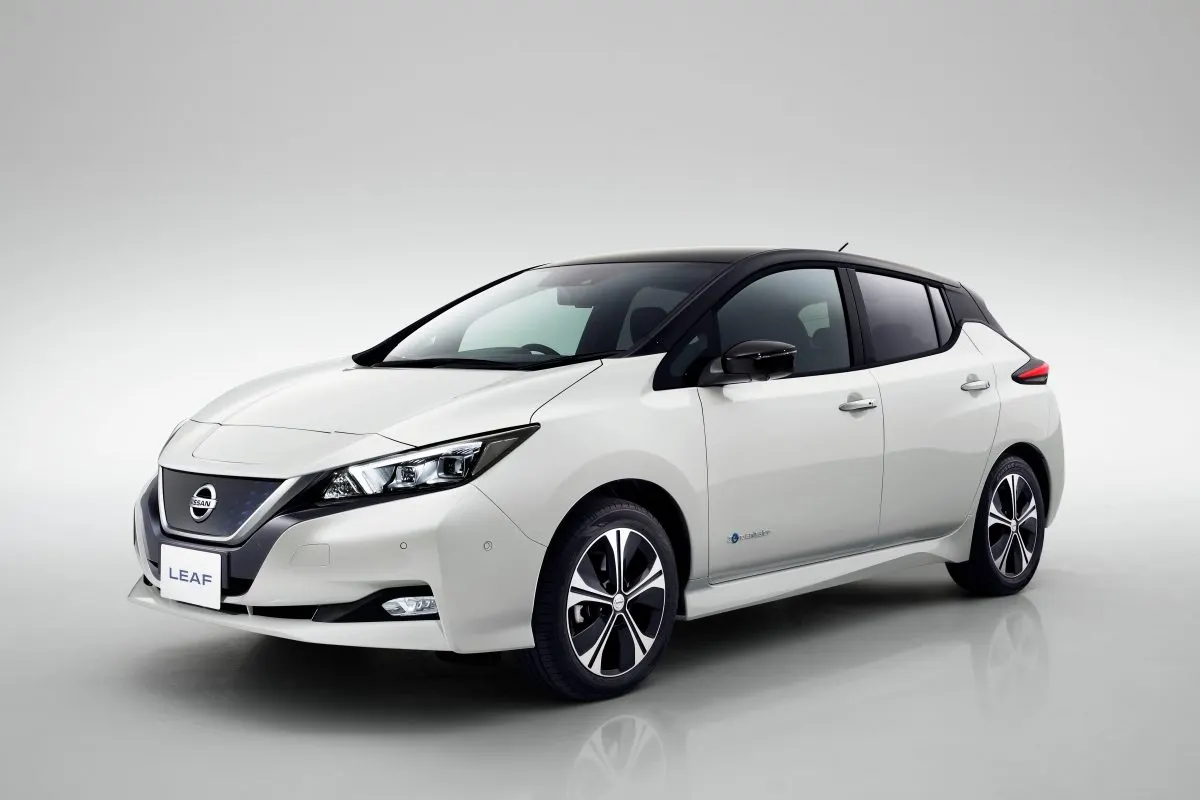
The EDIB (Electric Driven Intelligent Brake) allows and controls optimization of the regenerative brake and regular friction brake (hydraulic brake).
Technology Functionality
After stepping on the brake pedal, the system produces natural and adequate braking force that corresponds to the operation. The amount of energy regeneration also needs to be increased as much as possible.
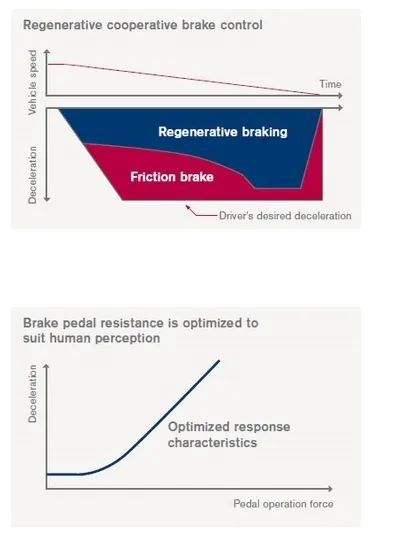
EDIB (Electric Driven Intelligent Brake) controls the regenerative brake and friction brake to support both of these requirements. Further, it also controls the reactive force from the pedal in order to unify the feeling when stepping down on the pedal and the sense of deceleration.
3.Make a MATLAB program which plots contour of given motor speed, torque and efficiency values. Attach the code as a .m file attach a screenshot of all the plots.
Contour
A contour line of a function of two variables is a curve along which the function has a constant value, so that the curve joins points of equal value. It is a plane section of the three-dimensional graph of the function f parallel to the-plane.
There are four types of losses in the motor
- Copper losses
- Iron losses
- Windage losses
- Constant losses
copper losses :Copper loss is the term often given to heat produced by electrical currents in the conductors of transformer windings, or other electrical devices
power losses=I^2*R=Kc*T^2
torque is directional proportional to current and Kc is resistance coefficient
Iron losses: the loss of available energy by hysteresis and eddy currents in an electromagnetic apparatus (as a transformer)
losses=Ki*omega
Windage losses :Windage loss is the reduction in efficiency due to windage forces. For example, electric motors are affected by friction between the rotor and air. Large alternators have significant losses due to windage.
losses=Kw*omega^3
Constant losses:
Normally, machines are operated with constant speed, so these losses are almost constant. These losses are categorized in two form; Hysteresis loss and Eddy current loss.
losses=C.
Total losses=Kc*T^2+Ki*omega+Kw*omega^3+C.
W.K.T Input power =output power + total losses
power output =T*omega.
- X as rotational speed and Y as torque meshgrid is created.
- Power output is the product of torque and speed at all (x,y) points
- Total losses is sum of copper,iron,windage and constant losses.
- Power input of the motor is sum of power output and toatal losses.
Here is program in MATLAB, coefficient of all losses are given in the code itself.
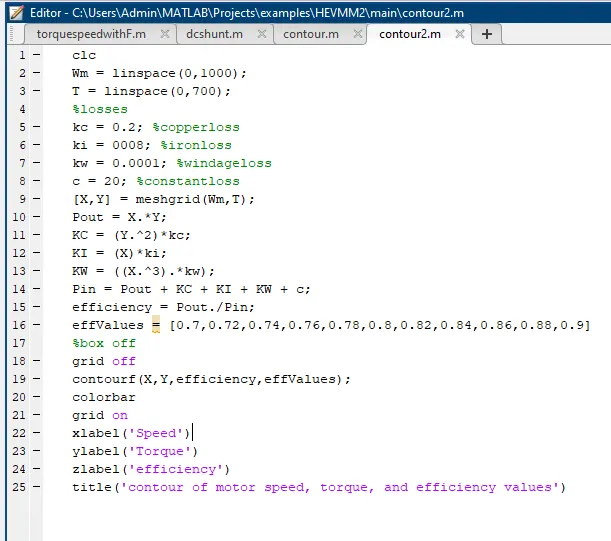
Formulas in the code according to above formulas .Effvalues are predefined values because for all values of efficiency it very diificult . Runn the program
Resultant contours are below. left side it shows the efficiency values 70% to 82%
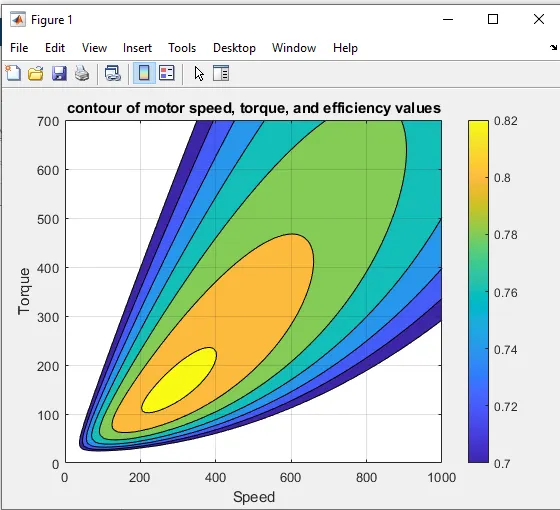
Here in the resultant contour of motor the inner contours are having high efficiency values. Outer ones are lesser values of efficiency.
Conclusion:
- Calculate the energy required for braking of a defined drive cycle is completed.
- Electric motor can’t develop braking torque at high speed similar to starting , electric and mechanical brakes are coordinated are explained .
- MATLAB program which plots contour of given motor speed, torque and efficiency values. Attach the code as a .m file attach a screenshot of all the plots is done successively.