Week-3 Challenge: ADVISOR Tool
1. For EV_defaults_in file, if cargo mass is 500 kg with all other default conditions, can the vehicle travel for 45 km with FTP drive cycle? Conclude your observations.
2. In the above case, try changing the battery capacity and repeat the simulation.
3. Perform gradeability test with PRIUS_Jpn_defaults_in file
Compare your results in table and conclude.
ANSWERS
1. For EV_defaults_in file, if cargo mass is 500 kg with all other default conditions, can the vehicle travel for 45 km with FTP drive cycle? Conclude your observations.
ADVISOR TOOL:
ADVISOR, NREL’s ADvanced VehIcle SimulatOR, is a set of model, data, and script text files for use with Matlab and Simulink. It is designed for rapid analysis of the performance and fuel economy of conventional, electric, and hybrid vehicles. ADVISOR also provides a backbone for the detailed simulation and analysis of user defined drivetrain components, a starting point of verified vehicle data and algorithms from which to take full advantage of the modeling flexibility of Simulink and analytic power of MATLAB.
You may benefit from using ADVISOR if you want to:
- estimate the fuel economy of vehicles that have not yet been built
- learn about how conventional, hybrid, or electric vehicles use (and lose) energy throughout their drivetrains
- compare relative tailpipe emissions produced on a number of cycles
- evaluate an energy management strategy for your hybrid vehicle’s fuel converter
- optimize the gear ratios in your transmission to minimize fuel use or maximize performance, etc.
The models in ADVISOR are:
- mostly empirical, relying on drivetrain component input/output relationships measured in the laboratory, and
- quasi-static, using data collected in steady state (for example, constant torque and speed) tests and correcting them for transient effects such as the rotational inertia of drivetrain components.
ADVISOR was preliminarily written and used in November 1994. Since then, it has been modified as necessary to help manage the US DOE Hybrid Vehicle Propulsion System subcontracts. Only in January 1998 was a concerted development effort undertaken to clean up and document ADVISOR.
Since then, over 4500 individuals have downloaded one or more versions of ADVISOR, including all of the OEMs and major suppliers. About 2/3 of the users are from industry and 1/3 from universities. A short list of major ADVISOR users includes:
- DaimlerChrysler
- Ford Motor Company
- General Motors Corp.
- Delphi Automotive Systems
- Visteon
- and hundreds of others
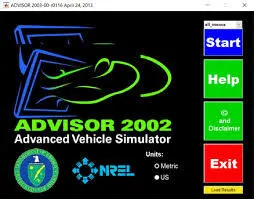
After installation of ADVISOR tool in the PC , add to the file of which the MATLAb path is currently connected.Open the ADVISOR tool ,the above figure will be visible as GUI.
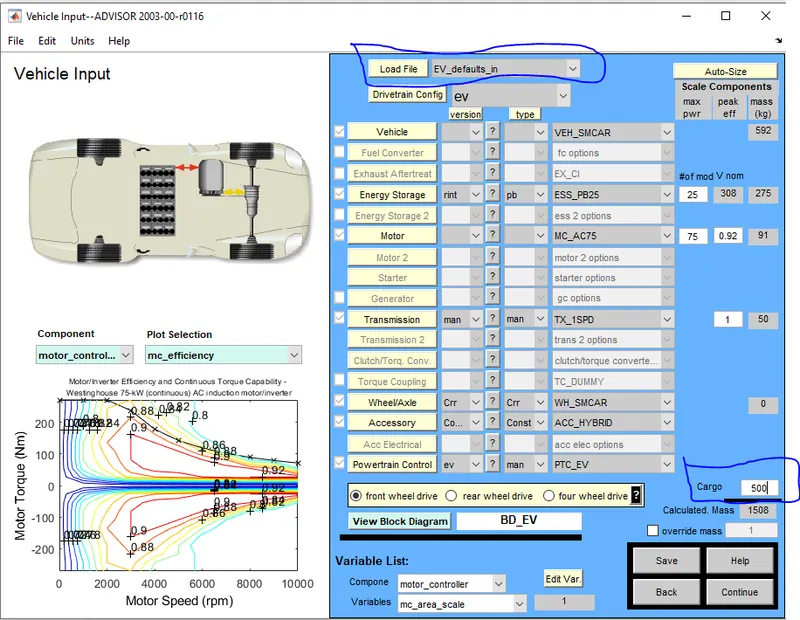
Consider a basic EV model at top of the GUI or interface and change the cargo mass to 500kgs at right bottom of the interface and all other parameters are default ,then click 'continue' at right bottom.
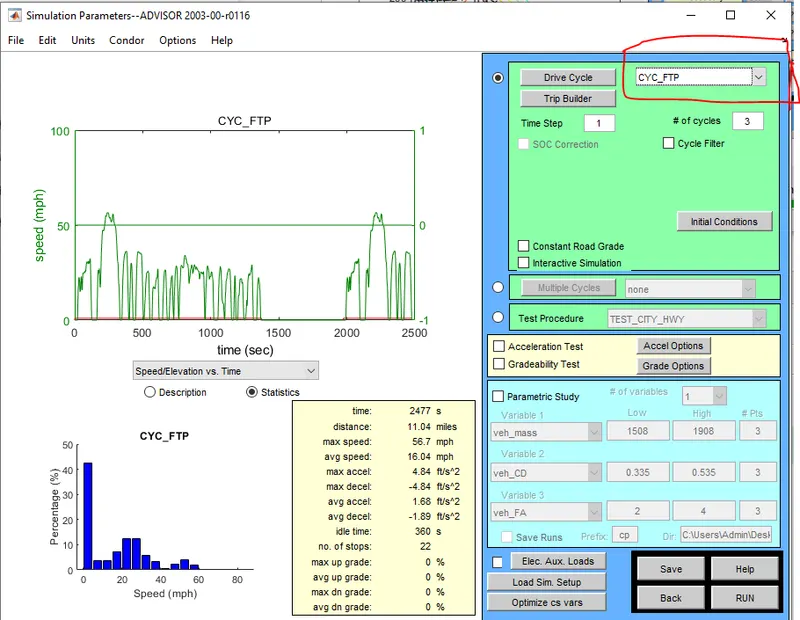
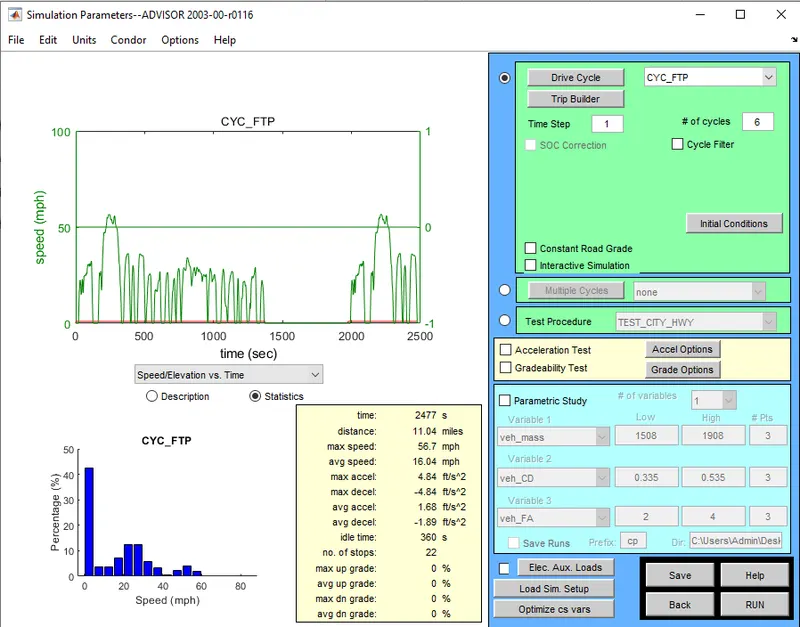
To select the FTP drive cycle, click the arrow which is at right top of the interface and select CYC_FTP drive cycle.We can observe that yhis drive cycle is for 2500 secs. click on 'RUN' at right bottom of the GUI.Maximum speed in the FTP drive cycle is 56.8 mph.
Here are the results. I change no. of cycles to 3 to drain the battery full.So the battery discharge is show in the second plot and after 5500 secs the battery is fully drain.In the first plot drive is repeated for three times.Third plot is emissions as we use only Electric model there is no emissions ,so it shows zero over the period and fourth plot is about the power losses.
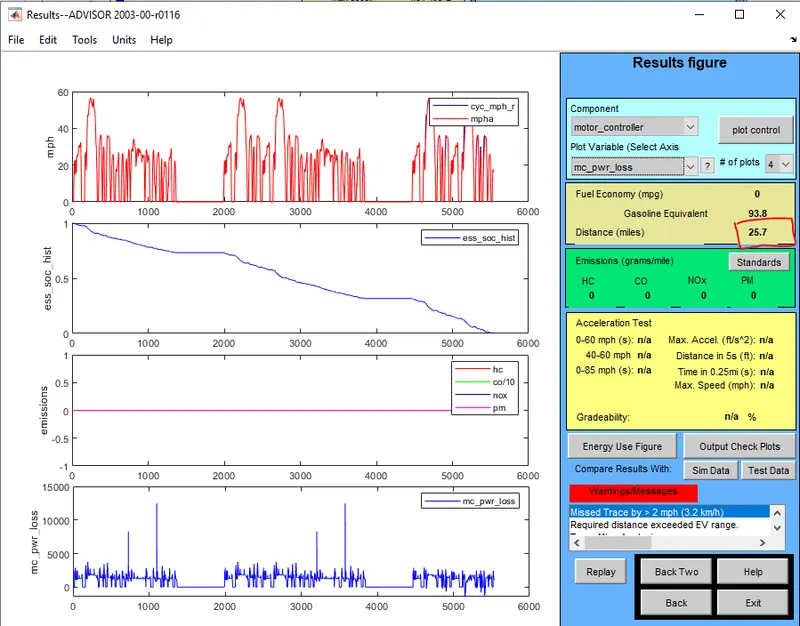
In the interface thedistance travelled by the vehicle is shown 25.7 miles, convert to km .So if we convert to km ,41.36 km is the result.
Hence the vehicle cannot travel for 45 km with FTP drive cycle.
2. In the above case, change the battery capacity and repeat the simulation.
Battery or Energy storage is changed the capacity to 50 modules previous is at 25 modules capacity. Click 'continue'.
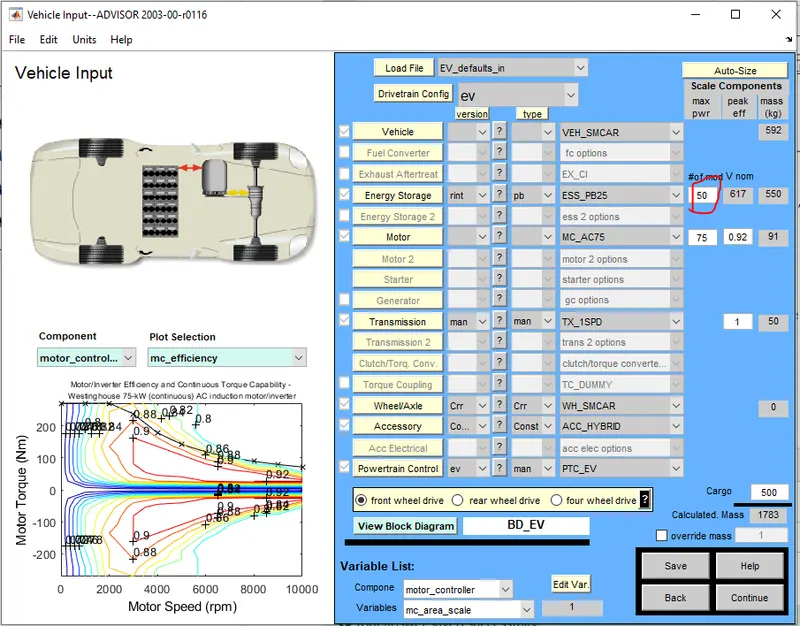
After that we can see this GUI ,change the number of cycles to six to known the total distance travelled by the vehicle.click"RUN".
Here are the results.The battery is fully drain at 12000 secs which can be seen in the second plot.
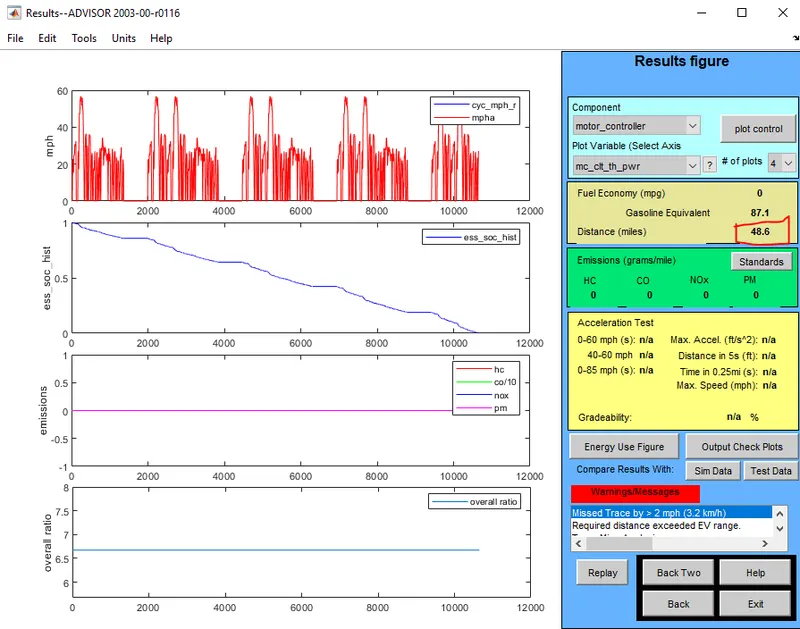
Hence the capacity of the battery is twiced than previous one,so it can travel upto 48.6 miles or 78.21 kms.
3. To Perform gradeability test with PRIUS_Jpn_defaults_in file
Compare your results in table and conclude.
Change the load file to 'PRIUS_JPN_defaults_in' . Then click 'continue'.
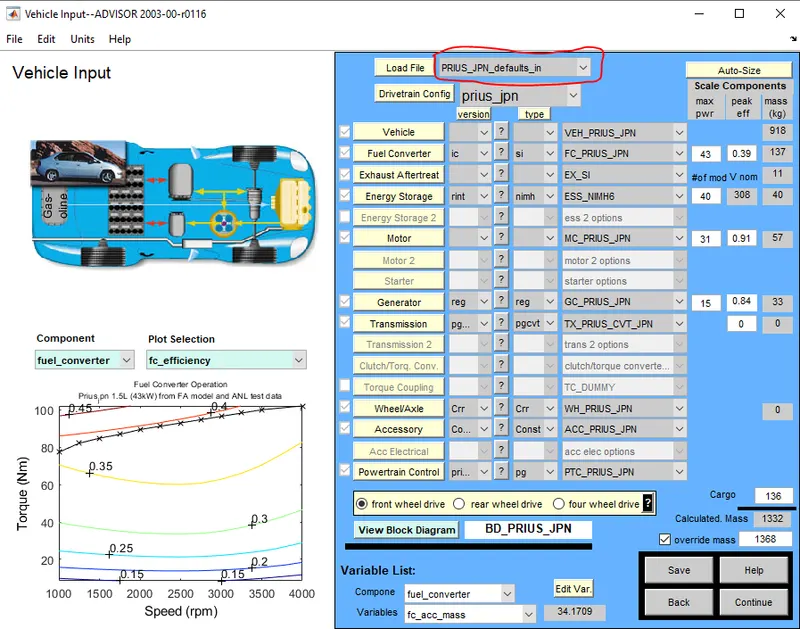
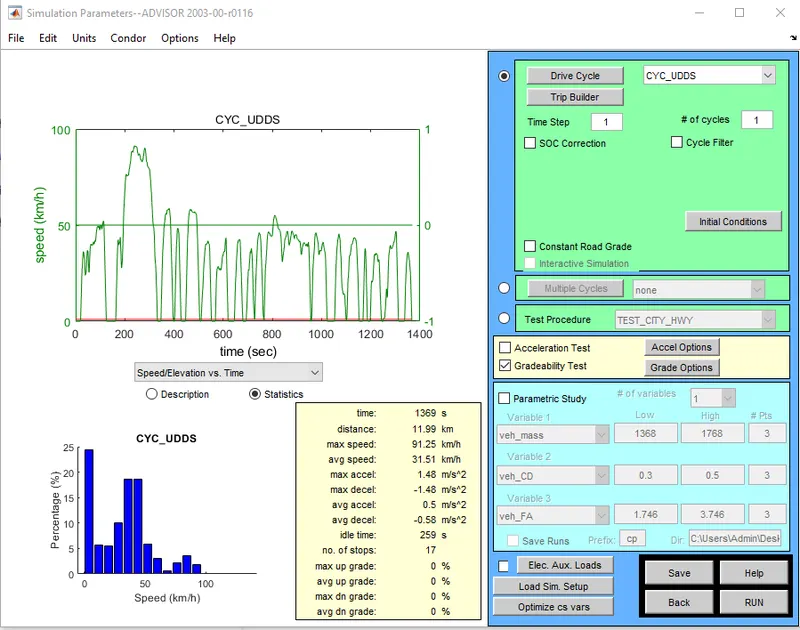
Select the 'Gradeability test' as shown in the fig. and click the grade options
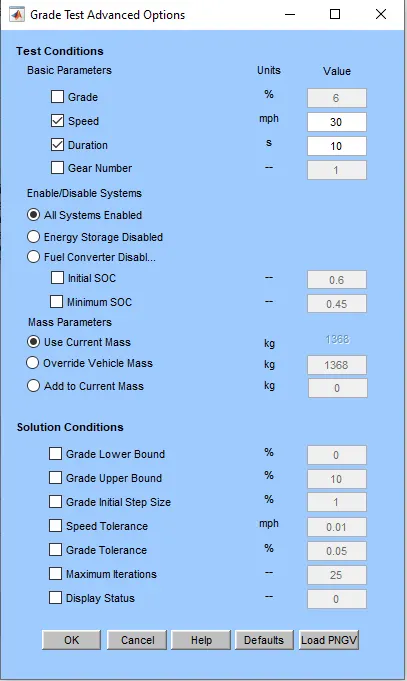
Here change the speed and then run the model.
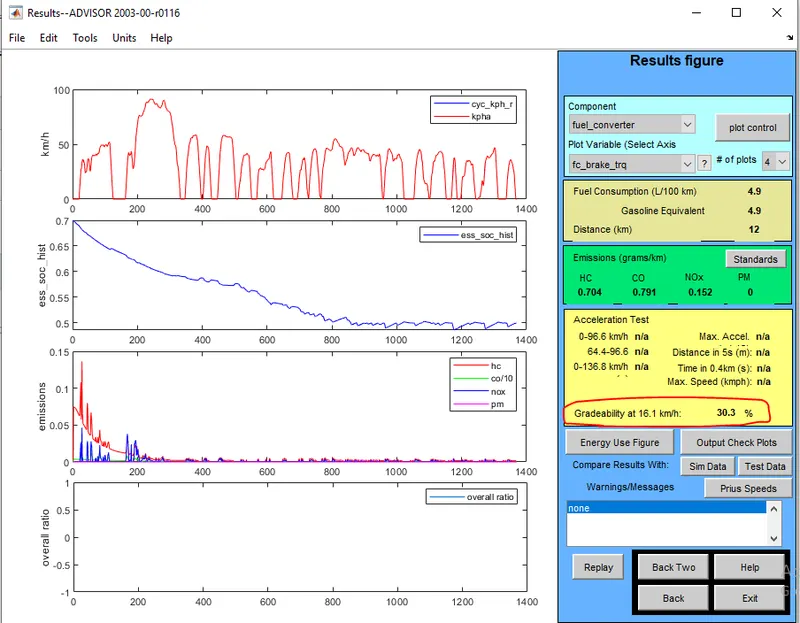
Here the result,gradeability is shown below.Repeat the stimulation for few number of speeds and observe the gradeability.
Relation between speed and gradeability
| Speed(kmph) | Gradeability(%) |
| 88.51 | 8.9 |
| 64.4 | 11.7 |
| 48.3 | 14.7 |
| 16 | 30 |
Hence the speed of the vehicle is inversly proportional to Gradeability.
CONCLUSION :
1. For EV_defaults_in file, if cargo mass is 500 kg with all other default conditions, the vehicle cannot travel for 45 km with FTP drive cycle.
2. In the above case, after changing the battery capacity the vehicle travel upto 78.21 kms.
3. The perform gradeability test with PRIUS_Jpn_defaults_in file
Compare your results in table and conclude is completed successively.