Week 1 Understanding Different Battery Chemistry
Objective:
To Prepare a table that includes materials & chemical reactions occurring at the anode and cathode of LCO, LMO, NCA, NMC, LFP, and LTO type of lithium-ion cells.
Procedure:
Introduction:
Lithium-ion Cells are a secondary type of battery cell that is they are rechargeable and also they are reusable which makes them ideally suited for automotive applications and certain consumer electronics. When two or more cells connected together they are referred to as batteries. Like other batteries, Lithium-ion batteries also rely on the chemical energy stored in the bonds and atoms of elements and compounds and utilize this energy in a chemical reaction occurring inside the cell. The chemical energy from this reaction is converted to electrical energy and it is used. Since the Lithium-ion cells are rechargeable, they can perform the reverse reaction using electricity as well.
Construction:
Electrolyte:
- The electrolyte is an ionic conductor that provides the medium for internal ionic charge transfer between the electrodes.
- The electrolyte must often comprise a liquid solvent containing dissolved chemicals(the solute) that provides the ionic conductivity.
- The Lithium-ion cells use non-aqueous electrolytes.
Cathode and Anode:
- The Cathode ad Anode is the two electrodes that are connected by a wire in an external circuit.
- The electrons are passing through the external wire and so an electric current is generated.
- The Anode refers to the Electrode through which the conventional current enters into a polarized electrical device.
- The Cathode refers to the electrode through which conventional current leaves an electrical device.
Separator:
- The Separator physically isolates the positive and negative electrodes.
- The separator is an ionic conductor but an electronic insulator.
- It prevents the internal short-circuiting between the two electrodes.
Current Collectors:
- The current collectors are the electronic conductors with which the electrodes are mixed.
- It does not take part in chemical reactions of the cell but instead, it either allows simple electronic connection to reduce the electronic resistance of an electrode.
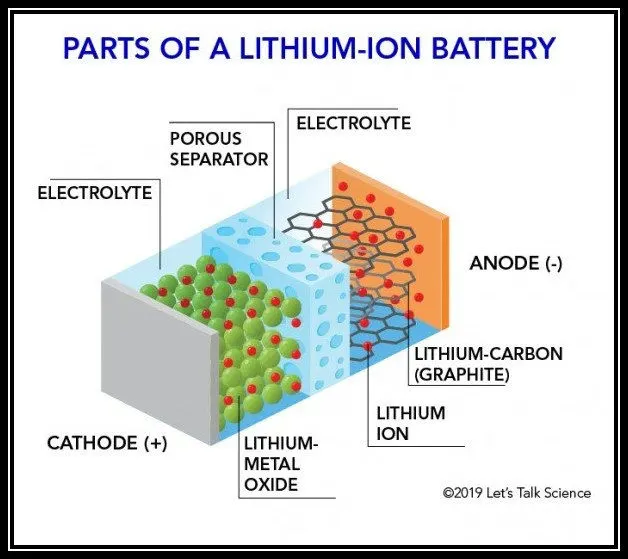
The following table gives the different types of Lithium-ion Batteries, Materials & chemical reactions occurring at the anode and cathode of LCO, LMO, NCA, NMC, LFP, and LTO type of lithium-ion cells.
| Si.No | Type of Li-Ion Battery | Cathode | Anode | Electrolyte | Chemical Reaction |
| 1 | Lithium Cobalt Oxide(LCO) |
LiCoO2 |
LiC6 | LiPF6 in Ethylene Carbonate |
Anode: LixC6→xLi++xe-+C6 Cathode: Li1-xCoO2+xLi++xe-→LiCoO2 Redox Reaction: C6+LiCoO2↔LiC6+CoO2 |
| 2 | Lithium Manganese Oxide(LMO) |
LiMn2O4 |
LiC6 |
LiPF6 in Ethylene Carbonate |
Anode: LixC6→xLi++xe-+C6 Cathode: Li1-xMn2O4+xLi++xe-→LiMn2O4 Redox Reaction: C6+LiMn2O4↔LiC6+Mn2O4 |
| 3 |
Lithium Nickel Cobalt Aluminium Oxide(NCA) |
LiNiCoAlO2 |
LiC6 |
LiPF6 in Ethylene Carbonate |
Anode: LixC6→xLi++xe-+C6 Cathode: Li1-xNiCoAlO2+xLi++xe-→LiNiCoAlO2 Redox Reaction: C6+LiNiCoAlO2↔LiC6+NiCoAlO2 |
| 4 | Lithium Nickel Manganese Cobalt Oxide(NMC) |
LiNi0.8Mn0.1Co0.1O2 |
LiC6 |
LiPF6 in Ethylene Carbonate |
Anode: LixC6→xLi++xe-+C6 Cathode: Li1-xNi0.8Mn0.1Co0.1O2+xLi++xe-→LiNi0.8Mn0.1Co0.1O2 Redox Reaction: C6+LiNi0.8Mn0.1Co0.1O2↔LiC6+Ni0.8Mn0.1Co0.1O2 |
| 5 |
Lithium Iron Phosphate(LFP) |
LiFePO4 |
LiC6 |
LiPF6 in Ethylene Carbonate |
Anode: LixC6→ xLi++xe-+C6 Cathode: Li1-xFePO4+xLi++xe-→LiFePO4 Redox Reaction: C6+LiFePO4↔LiC6+FePO4 |
| 6 |
Lithium Titanium Oxide(LTO) |
LiMn2O4 |
Li4Ti5O12 |
LiPF6 in Ethylene Carbonate |
Anode: Li4Ti5O12→Ti5O12+4Li++4e- Cathode: 4Li1-xMn2O4+4Li++4e-→4LiMn2O4 Redox Reaction: Li4Ti5O12+4Mn2O4↔4LiMn2O4+Ti5O12 |
- Akshay ChandelCan I know the reference/source of all this reaction.