Week 1:- Introduction to BiW and Fixtures Challenge
BIW-Body in White
in which a car body's frame has been joined together, that is before painting and before the motor, chassis sub-assemblies, or trim (glass, door locks/handles, seats, upholstery, electronics, etc.) have been integrated into the structure. Assembly involves different techniques such as welding (spot, MIG/MAG), riveting, clinching, bonding and laser brazing.
- In the Automotive Industry BIW (Body in White) is the common terminology used to mention the car sheet metal welded structure (body shell).
- In this generation, BIW is made of steel (various steel grade material -DP, DD, HDP etc.) as well as made of aluminium alloy (e.g. AUDI A8)
- Sub-assemblies like Underbody, Bodyside Left Hand Side/ Right Hand Side, Front End, Roof etc. gets welded together by various metal joining process e.g. resistance spot welding, Laser welding, MIG welding to make welded metal shell (Without Door, Trunk-lid / Tailgate), Fender, Bonnet Center) called Body in White.
- BIW joinery decides the exterior and interior look of any car.
- All the Interior Parts(Commonly used in Automotive) e.g. Dashboard, Trim (Door Trim, Pillar Trims, Roof liner, Seats are mounted on the BIW shell with the help of various brackets or nuts mounted on the BIW.
- Exterior (Commonly used term in the car industry) components e.g. Front Bumper, Rear Bumper, Fender LH/RH, Side Mirrors are mounted on the BIW shell with the help of various brackets or mounting systems.
BIW Components:
- A,B,C,D Pillars
- Dashboard mounting panel
- Windscreen & Rear Window rail
- Cant rail
- Roof structure
- Side Sill
- Quarter panel or window
- cross member
- Front & rear valance
- Scuttle
- Firewall
- Floor, seat & Boot pan
- Front & rear Spring tower
- Central Console
- Front & Rear Wheel arch
- Toe Board
- Heel Board
BIW-Body in White
in which a car body's frame has been joined together, that is before painting and before the motor, chassis sub-assemblies, or trim (glass, door locks/handles, seats, upholstery, electronics, etc.) have been integrated into the structure. Assembly involves different techniques such as welding (spot, MIG/MAG), riveting, clinching, bonding and laser brazing.
- In the Automotive Industry BIW (Body in White) is the common terminology used to mention the car sheet metal welded structure (body shell).
- In this generation, BIW is made of steel (various steel grade material -DP, DD, HDP etc.) as well as made of aluminium alloy (e.g. AUDI A8)
- Sub-assemblies like Underbody, Bodyside Left Hand Side/ Right Hand Side, Front End, Roof etc. gets welded together by various metal joining process e.g. resistance spot welding, Laser welding, MIG welding to make welded metal shell (Without Door, Trunk-lid / Tailgate), Fender, Bonnet Center) called Body in White.
- BIW joinery decides the exterior and interior look of any car.
- All the Interior Parts(Commonly used in Automotive) e.g. Dashboard, Trim (Door Trim, Pillar Trims, Roof liner, Seats are mounted on the BIW shell with the help of various brackets or nuts mounted on the BIW.
- Exterior (Commonly used term in the car industry) components e.g. Front Bumper, Rear Bumper, Fender LH/RH, Side Mirrors are mounted on the BIW shell with the help of various brackets or mounting systems.
BIW Components:
- A,B,C,D Pillars
- Dashboard mounting panel
- Windscreen & Rear Window rail
- Cant rail
- Roof structure
- Side Sill
- Quarter panel or window
- cross member
- Front & rear Valance
- Scuttle
- Firewall
- Floor, seat & Boot pan
- Front & rear Spring tower
- Central Console
- Front & Rear Wheel arch
- Toe Board
- Heel Board
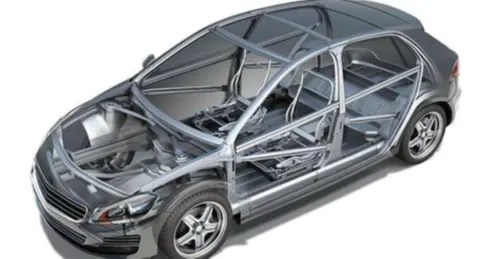
2. What do you understand by BIW nomenclature?
Body in white is the basic terminology of BIW, additionally, one more principal is viral that is Automotive car shell made before painting is called Body in White.
3.What is fixture & its types?
More of a permanent tool that is used for assembly purposes. • Typically does not have as much flexibility as a jig. • Most likely used for high volume production. • Made of durable materials such as tool steel, iron, aluminium alloys, etc.
Type of Fixtures
(a) Turning fixtures (b) Milling fixtures (c) Fixture for grinding (d) Fixture for broaching (e) Fixture for boring/drilling (f) Tapping fixture (g) Fixture for welding (h) Assembling fixture Standard Parts Co.
4. What is the basic principle of fixture design?
3-2-1 Principle of Fixture Design
For a fixture designer, the major portion of design time is spent deciding how to locate the workpiece in the fixture.
You know that any free body has a total of twelve degrees of freedom as below
6 translational degrees of freedom**: +X, -X, +Y, -Y, +Z, -Z**
And 6 rotational degrees of freedom:
- Clockwise around X-axis (CROT-X
- Anticlockwise around X-axis (ACROT-X)
- Clockwise around the Y-axis (CROT-Y)
- Anticlockwise around the Y-axis (ACROT-Y)
- Clockwise around Z-axis (CROT-Z)
- Anticlockwise around Z-axis (ACROT-Z)
You must fix all the 12 degrees of freedom except the three transitional degrees of freedom (-X, -Y and -Z) to locate the workpiece in the fixture. So, 9 degrees of freedom of the workpiece need to be fixed.
But, how? By using the 3-2-1 method as shown below:
Rest the workpiece on three non-collinear points of the bottom surface (XY), and you will be able to fix the +Z, CROT-X, ACROT-X, CROT-Y and ACROT-Y degrees of freedom**.**
Now, rest the workpiece at two points of the side surface (XZ), and you will be able to fix the +Y and ACROT-Z degrees of freedom.
Now, rest the workpiece at one point of the adjacent surface (YZ), and you will be able to fix the +X and CROT-Z degrees of freedom.
So, you can successfully fixate 9 required degrees of freedom by using the 3-2-1 principle of fixture design.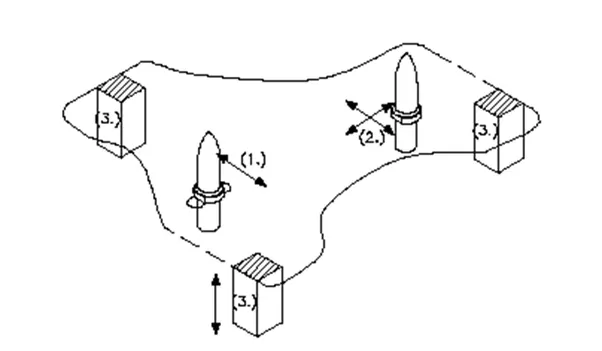
5. Elaborate types of BIW Stations?
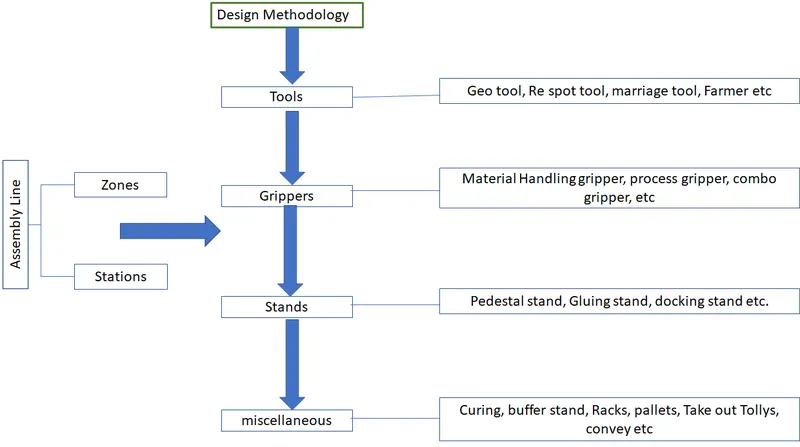
6. What are the basic terminologies used in the BIW fixture?
- Rest unit
- Fixed pin unit
- Retract unit
- Rough locator unit
- Sensor unit
- Base unit