Week 9 - Project 1 - Door Applique Design with Engineering Features
Title- Week 9 - Project 1 - Door Applique Design with Engineering Features
3-2-1 Principle (Arresting Degrees of Freedom)
A work-piece free in space can move in an infinite number of direction. For analysis, this motion can be broken down
into 12 directional movements or "degrees of freedom". All 12 degrees of freedom must be restricted to ensure proper
referencing of a work-piece.
As shown in Fig 1, the 12 degrees of freedom all relate to the central axis of the work-piece. Notice the 6 axial degrees
and 6 radial degrees of freedom. The axial degrees of freedom permit straight-line movement in both directions along
the 3 principle axis shown as X, Y & Z. The radial degrees of freedom permit rotational movement, in both clockwise &
counterclockwise radial directions around the same three axis.
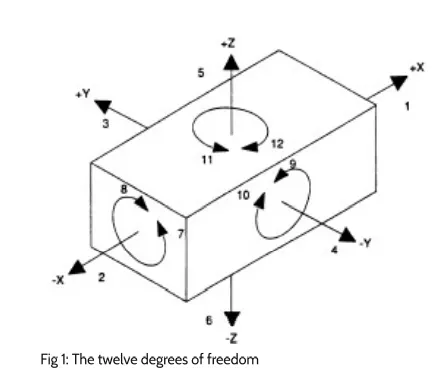
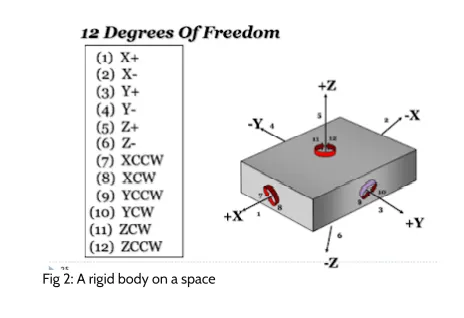
Consider the rigid body shown below which is situated in space. It can have 12 degrees of freedom.
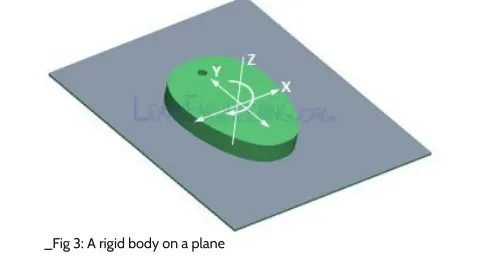
For a rigid body in plane has 6 degrees of freedom (i.e.) The motion of a ship at sea has the 6 degrees of freedom
(1) X+
(2) X-
(3) Y+
(4) Y-
(5) ZCW
(6) ZCCW
Now try to understand 3-2-1 principle of fixturing. The purpose of Fixturing is
Resting - Stability
Locating - W.r.t datum
Orienting - W.r.t secondary datum
Clamping - Ensuring above not disturbed.
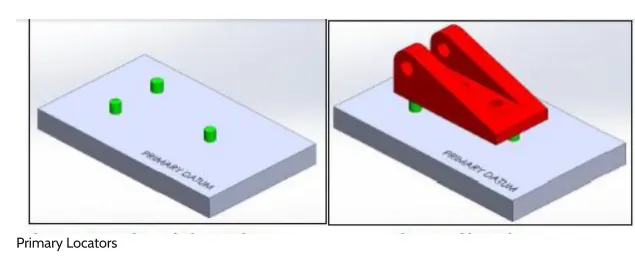
Primary Locators
First the three locators or supports are placed under the work-piece. It will be positioned on the primary locating surface
also known as datum. It will restrict 5 degrees of freedom.
Axial Movement downward along Z- axis (No.6 in Fig 2)
Rotation about the X & Y axis (No. 7, 8, 9 & 10 in Fig 2)
Secondary Locators
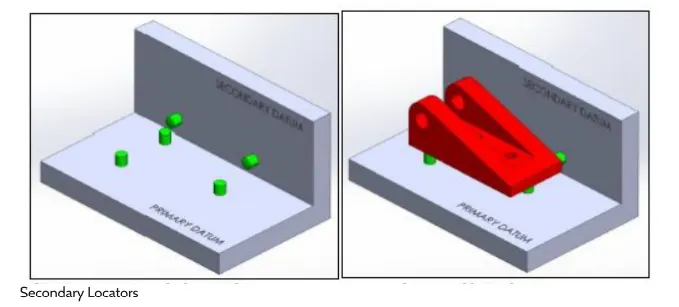
The next two locators are normally placed on the secondary surface, restricting an additional 3 degrees of freedom.
Axial movement along the Y+ axis (No.3 in Fig 2)
Rotation about the Z axis (No. 11 & 12 in Fig 2)
Tertiary Locator
This locator is positioned at the end of the part. It restricts 1 degrees of freedom
Axial movement along the X axis (No.2 in Fig 2)
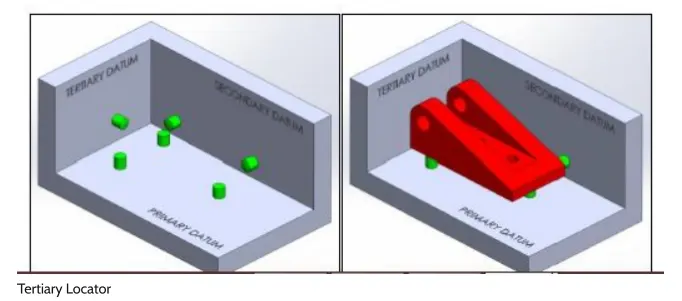
All these 6 locators will restrict a total of 9 degrees of freedom. The remaining 3 degrees of freedom (1, 4 & 5) will be
restricted by the clamps.
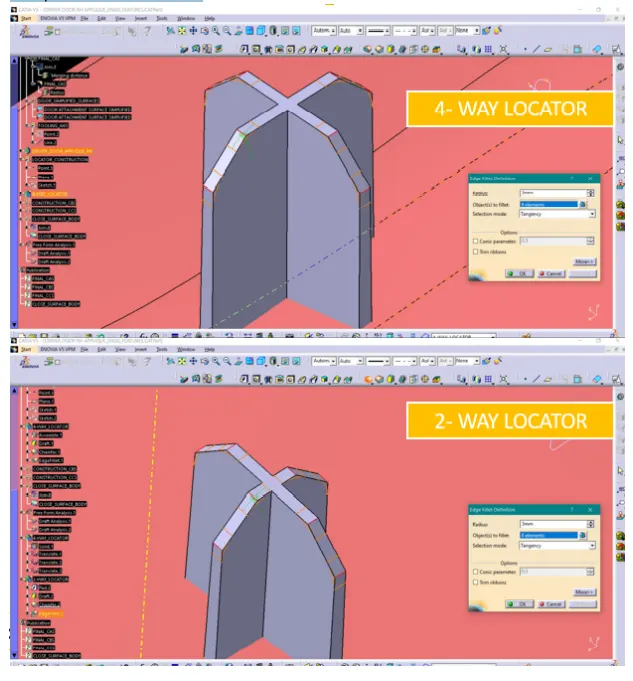
4- & 2-Way LocatorIn plastic parts locators are used to locate the part for assembly purpose. These parts All the components are having 12
DOFs in space. Using 321- principle necessary DOFs are restricted using 4- & 2-way locators while remaining DOFs can be
restricted using heat stakes in automobile plastic components.
With these locators part will be placed in its orientations with good accuracy so the assembly of components are easy.
4-way locators will be restricting 9 DOFs. With the combination of 4- & 2- way locators along with heat stakes all DOFs of
component are restricted.