Section Modulus calculation and optimization
SECTION MODULUS CALCULATION AND OPTIMIZATION OF HOOD
Objective:
Calculate section modulus of the previously created design of car hood by taking a cross-section of it and analyzing the result.
To come up with a new design that would increase or improve the section modulus of the existing car hood and optimize our design to obtain better
results.
Introduction:
What is Section Modulus?
Section modulus is a geometric property for a given cross-section used in the design of beams or flexural members. It defines the strength of beams which
depends upon the cross-section area of that beam.
Though section modulus is generally calculated for the extreme tensile or compressive fibers in a bending beam, compression is often the most critical case due
to onset of flexural torsional (F/T) buckling. Generally (except for brittle materials like concrete) tensile extreme fibers have a higher allowable stress or capacity
than compressive fibers.
In the case of T-sections if there are tensile fibers at the bottom of the T they may still be more critical than the compressive fibers at the top due to a generally
much larger distance from the neutral axis so despite having a higher allowable stress the elastic section modulus is also lower. In this case F/T buckling must still
be assessed as the beam length and restraints may result in reduced compressive member bending allowable stress or capacity.
Formula for calculating Section Modulus:
S or Z = I/y
S or Z - Section modulus of material
I- Moment of inertia
y- Length of extreme fiber from the neutral axis
For symmetrical sections the value of Z is the same above or below the centroid.
For asymmetrical sections, two values are found: Z max and Z min.
#Design 1: Section modulus of initial Hood
Calculating Section modulus of existing design by using NX-CAD by taking cross-section of hood along x-x axis and calculating moment of inertia.
Cross-section of hood
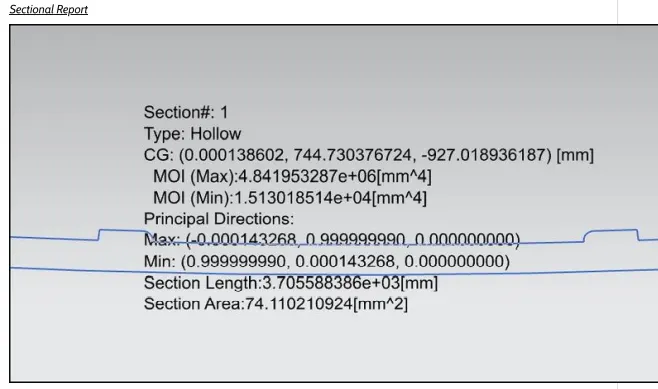
As, our hood shape is asymmetrical there will be two values of section modulus
so,
Imax =4.8419 X 10^6 mm^4
Imin= 1.5130 X 10^4 mm^4
y= 437 mm
Zmax= Imax/y
= 4.8419 X 10^6/437
= 11079.862 mm^3
Zmin= Imin/y
=1.5130 X 10^4/437
= 34.622 mm^3
This is the result of section modulus our initial hood design.
#Design 2: Section modulus of optimized Hood
To improve this value of section modulus we need to optimize our present hood design.
For that purpose, we will offset the outer panel of our hood by 2mm to increase the sectional area of our hood and thereby increase in section modulus.
The reason behind providing offset to the outer panel
As we know that section modulus
S= Σmi*Ai^2/y
where 'A' is the area
'M' is the mass of the body
From the above equation, it can be observed that Section modulus is directly proportional to the sectional area of the body.
That's why we can increase the section modulus by increasing the sectional area by offsetting the outer panel and reducing the emboss depth.
As the section area will increase Moment of inertia will also increase thereby Section Modulus of our hood will increase.
Cross-section of Improved Design
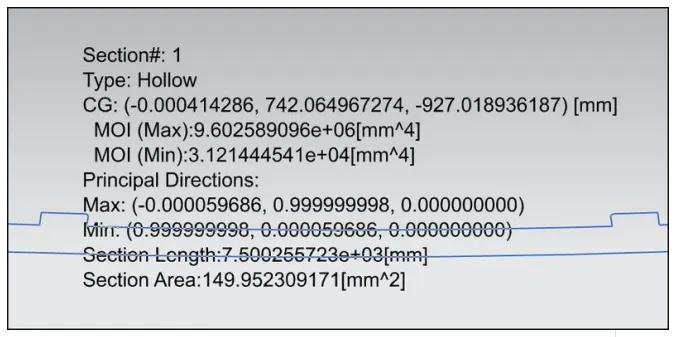
Here in the above sectional report, we can see that section area is increased as compared to the previous section area in the old design of our hood.
Also the Moment of inertia has been significantly changed as it is function of section area.
Now we will calculate the section modulus
Imax= 9.6025 X 10^6 mm^4
Imin= 3.1214 X 10^4 mm^4
y= 437 mm
Zmax= Imax/y
= 9.6025 X 10^6/437
= 21973.684 mm^3
Zmin= Imin/y
=3.1214 X 10^4/437
= 71.427 mm^3
Hence the section modulus of our hood has been increased as compared with the previous value which is 11079.862 mm^3 and the new value is 21973.684
mm^3.
Percentage increase in section Moudulus= 49.57%
CONCLUSION:
Hence, from the above study, it is clear that optimization helps to improve the results in a design as we have increased the Section Modulus of our hood.
Gain crucial insight about Section Modulus its relationship with bending stress, Moment of inertia and got an idea of how the section modulus changes with
respect to change in section area of a body and its effect on the value of section modulus.
Importance of section modulus when it comes to the selection of right material or right design which will have more strength.
Factors affecting Section modulus and how to enhance the strength of a material by using section modulus as a check parameter.