Roof Design
AUTOMOTIVE SHEETMETAL ROOF DESIGN USING NX CAD
OBJECTIVE:
- To create the Roof Sheetmetal design in NX cad, and also design Front roof rail, rear roof rail, bow roof front, bow roof rear, center roof rail.
- Do curvature study on Roof and performance calculations for Heat distortion and Snow load criteria to determine the position of the Bow roofs.
- Finding the moment of inertia and section modulus for Bow-roofs and center roof rail
- Perform the Draft Analysis of each part.
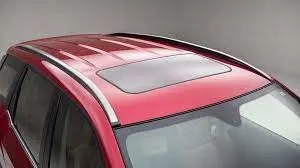
INTRODUCTION
An automobile roof or car top is the portion of an automobile that sits above the passenger compartment, protecting the vehicle occupants from sun, wind, rain, and other external elements.
When it is seeing from outside of the car, it is just closing the top portion. But in design point of view, it is hard to create the design. Because of you have to create no of support rails for enough strength to withstand the load. Bow roofs are primarily fixed in flatter region to enhance strength.
Front roof and rear roof rails are fixed to the ditch area using spot weld operation. But front, rear bow roof and center roof rails are fixed to roof using mastic sealants. We don’t want so much gap between roof rails and bow roof area. So, we reducing the NVH issues.
TESTING OF ROOF:
Roof strength evaluations are conducted on a quasi-static test system manufactured by MGA Research Corporation (see below fig.)
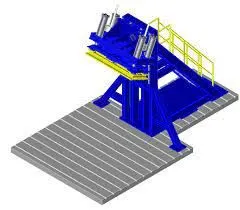
The system consists of an upright assembly and an attached loading head that can be fixed at varying heights from the ground as well as at pitch angles ranging from −5 to +5 degrees to accommodate testing on the driver or passenger side.
The roll angle is permanently fixed at 25 degrees. Four hydraulic actuators control the movement of the platen along two linear guides. The entire system is mounted on a T-slot bed plate anchored to the floor of the test facility.
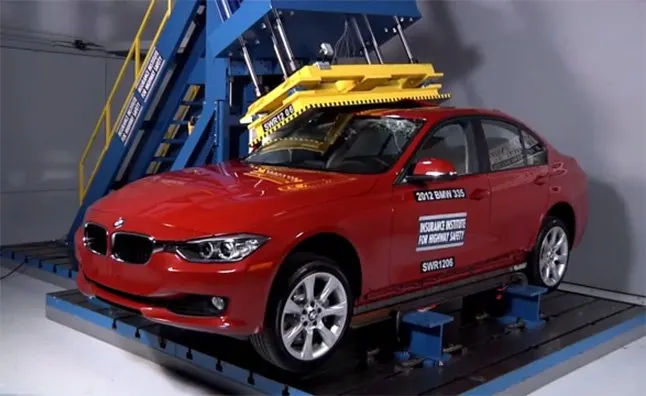
Two HR A-36 — W10x88 I-beams are mounted on the bed plate perpendicular to the longitudinal axis of the platen. The vehicle, with attached rocker panel support system, is placed on these beams. The vehicle is adjusted so that:
- The longitudinal centerline of platen is within 10 mm of the initial roof contact point.
- The yaw angle of the vehicle relative to the longitudinal axis of the platen is 0 ± 0.5 degrees.
- The midpoint of the platen’s forward edge is 254 ± 10 mm forward of the most forward point of the roof (including windshield trim if it overlaps the roof) lying on the vehicle’s longitudinal centerline.
- The pitch angle of the vehicle matches the on-road angle, while also accounting for any difference between the platen’s pitch angle and the nominal −5 degrees. The maximum combined difference of the vehicle and platen pitch angles from their targets is ± 0.5 degrees. (For example, if the onroad vehicle pitch angle is −0.2 degrees and the platen pitch angle is −5.2 degrees, the target sill angle for the test is −0.4 ± 0.5 degrees.) If necessary to achieve this angle, shims are inserted between the rocker panel supports and the W10x88 I-beams attached to the bed plate.
Once the vehicle is positioned correctly, the rocker panel supports are clamped to the two perpendicular I beams, and the beams are marked to allow confirmation that the vehicle position is maintained during the test.
For body-on-frame vehicles, the frame is supported to prevent the weight of the chassis from stressing the body at the body mounts. The roof is crushed to a minimum displacement of 127 mm at a nominal rate of 5 mm/second.
Some tests are conducted to a greater displacement to collect additional strength data for research purposes. Force data are recorded from five load cells (Interface Inc., model 1220) attached to the loading platen.
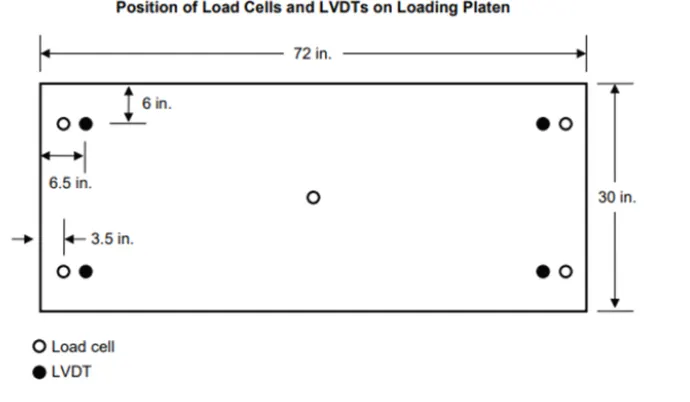
Displacement data are recorded from four linear variable displacement transducers (LVDTs) (MTS Temposonics model GH) integrated into the hydraulic actuators. Figure 4 shows the locations of the load cells and LVDTs on the loading platen.
Force and displacement data are collected with a National Instruments USB-6210 data acquisition system and reported at 100 Hz. These data are based on a sampling rate of 2,000 Hz, with every 20 points being averaged to produce the output data at 100 Hz.
The displacement-time histories from the LVDTs are compared to verify that the platen’s roll angle and pitch angle (relative to the vehicle’s on-road pitch) were maintained at 25 ± 0.5 degrees and −5 ± 0.5 degrees, respectively.
The precrash and post-crash conditions of each test vehicle are documented with still photographs. The position of the vehicle in the test fixture also is recorded. Motion picture photography is made of the test with real-time video cameras.
CALCULATING THE STRENGTH-TO-WEIGHT RATIO (SWR) RATING:
Force and displacement data are recorded for 5 seconds prior to each test, while the test system holds the loading platen at initial roof contact.
The data recorded from 1 to 4 seconds of this hold time are averaged for each channel to produce a measurement offset that is subtracted from the data recorded during the crushing of the roof.
After removing the offset for each channel, the force-displacement curve is plotted using the summed output from the five load cells and the average displacement from the four LVDTs. The maximum force prior to 127 mm of platen displacement is divided by the measured curb weight to obtain the SWR.
Both the force and curb weight are rounded to the nearest pound prior to performing the calculation, and the resulting SWR is rounded to the nearest one-hundredth of a unit.
Displacement is rounded to the nearest 0.1 mm. (The maximum displacement where the load can be used for the vehicle rating is 126.9 mm.) The vehicle’s rating is assigned based on the boundaries listed in.
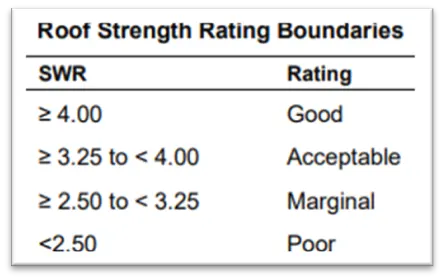
All trim levels sharing the tested vehicle’s body type and roof structure are assigned the same rating as the typically equipped trim level, provided their curb weights do not exceed 110% of the selected vehicle’s weight.
Based on published curb weights from multiple sources, any trim levels that may exceed this weight are identified and weighed. If the weight does exceed 110% of the weight of the selected vehicle, a unique SWR is calculated for that trim level.
If this SWR results in a lower rating, both ratings are reported for the model, with a split according to trim level. If a trim level weighs more than 110% of the typically equipped model, but the lower SWR does not fall in a lower rating band, only the original SWR and rating are reported for the model.
DESIGN CONSIDERATIONS OF ROOF:
- Visibility criteria
- Head room clearance
- Bow roof position
- Heat distortion and Snow load criteria
- Draft analysis
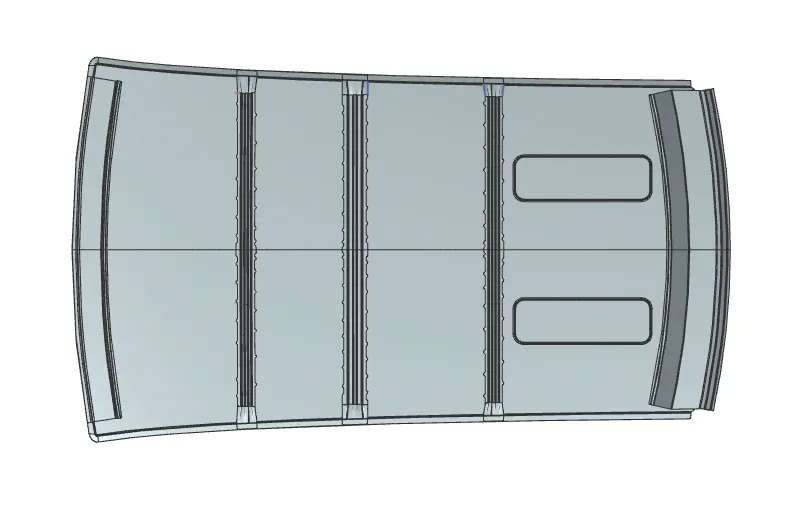
FRONT ROOF RAIL :
Front roof rail is the one which joins the wind shield glass , body side outer and the inner panel also. Here the front roof rail is designed based up on the master saection given
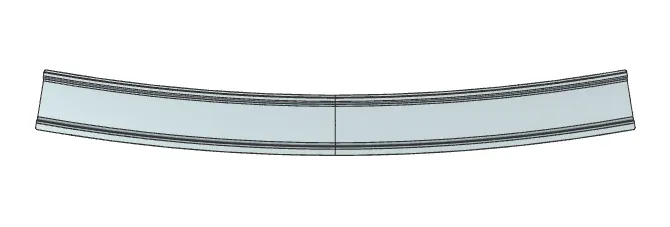
REAR ROOF RAIL :
Rear roof rail is the one which joins the back door and the body side outer
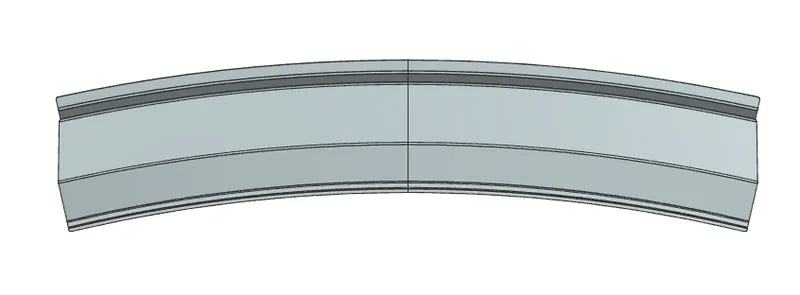
CENTRE ROOF RAIL :
centre roof rail helps in providing effectively support to the flat area of the roof as it is more susceptible to failure under the action of load . generally central roof rail is placed at the center of the roof which is connected to the B-pillar support structure . This central roof rail helps in adding the strength to the roof during the rool- over test.

BOW ROOFS :
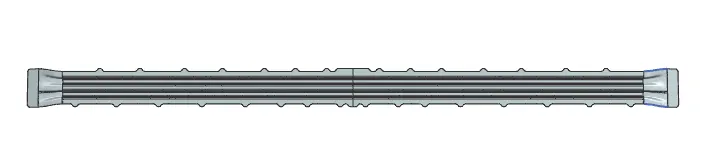
The bow roofs are give to improve the torsional stiffness and load bearing capacity of the roof structure . The number of bow roof present is depends on the overall size of the roof . Presently in this project two bow roofs are added.

HEAT DISTORTION STUDY ON THE ROOF :
The heat distortion study plays a major role in sheet metal usage . heat distortion temperature is a temperature limit above which the material cannot be used for the structural applications . This study is used to predict the heat distortion temperature at where the material starts to soften when exposed to a fixed load at elevated temperature . In order to avoid bending or damages on the roof, based on the heat distortion temperature , this study will predict the bow roof position which helps to strengthen the roof .
Bow – roof prediction Formula
W = [1.73 x 10^(-3) x L] + [1.85 x 10^(-8) x (R^2)/t] + [ 1.10x10^(-3) x l] - 2.68
Where
L = Roof Length in X-Direction[mm](Roof dimension in 0-Y)
R = Roof curvature
R = 2(Rx*Ry)/(Rx+Ry)
Rx = X curvature
Ry = Y curvature
t = Roof plate thickness [mm]
l = Bow Roof Span [mm]
Judgement Condition : OK< 2.7
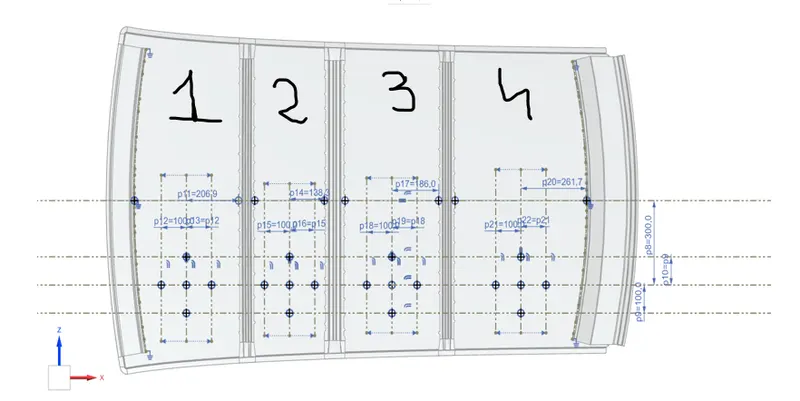
L = 1922.8687mm
t = 0.75mm
Section 1:
Ry1 = 2610.69mm
Rx1 = 5734.577mm
R1 = 2*2610.69*5734.577 / (5734.577+2610.69) = 29942405.6562/8345.267= 3587.9505mm
I1 = 417.497mm
W1 = 3.3265 + 0.3175 + 0.4592 – 2.68
W1 = 1.4232
Section 2:
Ry2 = 5783.572mm
Rx2 = 5073.562mm
I2 = 276.855mm
R2 = 5405.3511mm
W2 = 3.3265 + 0.7207 + 0.3045 – 2.68
W2 = 1.6717
Section 3:
Ry3 = 9210.148mm
Rx3 = 4256.752mm
I3 = 372.072mm
R3 = 5822.4707mm
W3 = 3.3265 + 0.8362 + 0.4092 – 2.68
W3 = 1.8919
Section 4:
Ry4 = 13651.516mm
Rx4 = 3425.17mm
I4 = 524.403mm
R4 = 5476.3275mm
W4 = 3.3265 + 0.7397 + 0.5768 – 2.68
W4 = 1.963
From the above calculation it is concluded that all values of w<2.7 so thus infers that current positioning of bow row are good in state as per design and found ok
SNOW LOAD CRITERIA :
This test is done to know how is the roof behaving when there is a snow over . normally due to the snow weight the dent will happen. But the roof should be designed in such a way that when the snow is removal the roof should go it its original position . This is the basic requirements for snow load criteria .
Qr = [Iy x t2] / [α x s x [(Rx + Ry)/2]2 x 10-8]
Where
α = My x Lx2 x 10-12 , My = Y(Ly-Y)
Judgement condition = Qr ≥ 3.1
250 ≤ s ≤ 380
t = Roof plate thickness [mm]
Ly = Distance between the front and rear roof Rails on the Vehicle along with 0Y[mm]
Length of Roof panel with the center point between Roof rail Front /Rear as the reference point of the front and the rear.
Lx = Distance between the Left and Right end of the roof on the Roof BOW [mm]
Width of the roof panel exposed on the surface.
Y = Distance front Front Roof Rail to Roof BOW[mm]
s = Distance for which Roof BOW bears divided load [mm]
s = L1/2 + L2/2
Iy = Geometrical moment of inertia of Roof BOW (Y cross-section )[mm4]
Rx = Lateral direction curvature radius of roof panel Y cross-section on Roof BOW [mm]
Roof panel curvature Radius of the Length Lx in Front view
Ry = Longitudinal Direction curvature radius of the Roof panel X cross-section on Roof BOW [mm]

It is observed from the above table that QR > 3.1 for the first two cases which is acceptable but the last case fails. Hence Embosses were provided in that are for the roof inorder to provide sufficient strength to withstand snow load.
DRAFT ANALYSIS :
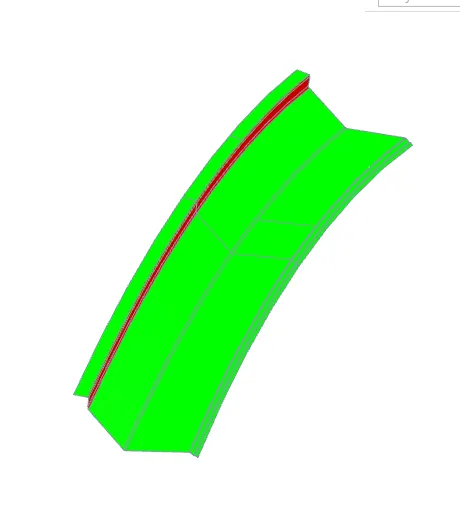
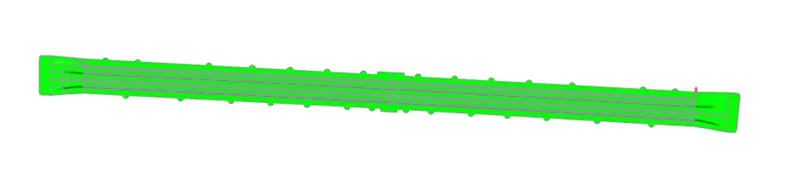
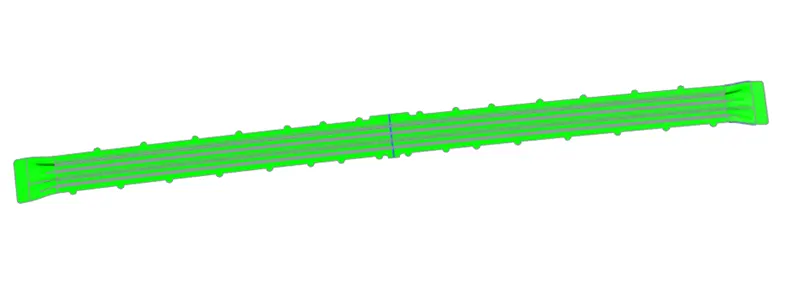
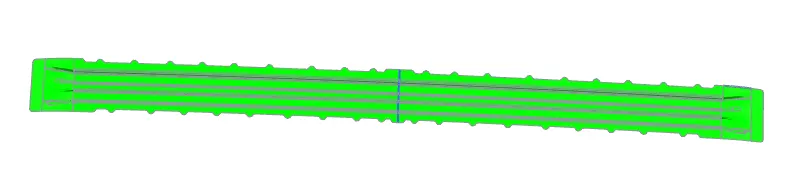
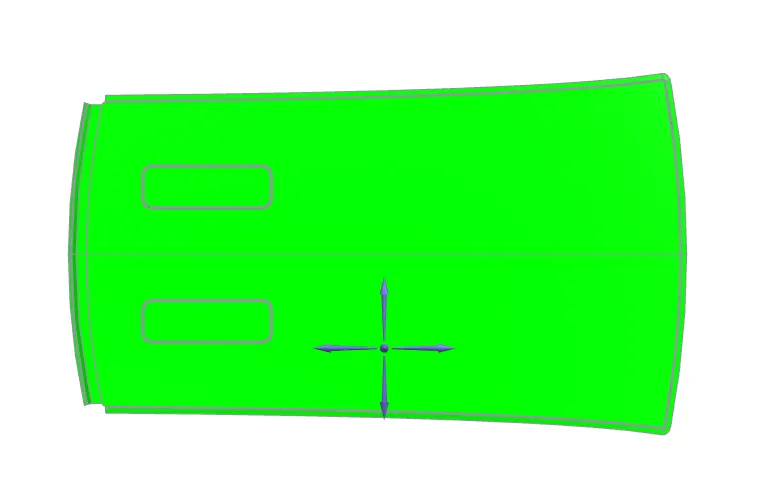
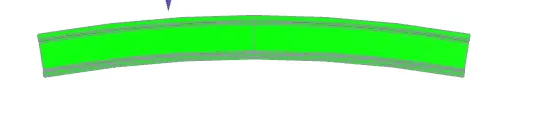
The Draft Analysis command enables you to detect if the part you drafted will be easily removed. This type of analysis is performed based on color ranges identifying zones on the analyzed element where the deviation from the draft direction at any point, corresponds to specified values.
Minimum draft angle of 70 is considered for analysis . green colour infer on the parts that all face along the tooling direction has positive draft angle greater than 70 and passed in analysis
Back Roof:
Bow Roof1:
Bow Roof2:
Centre Roof:
Roof:
Front Roof:
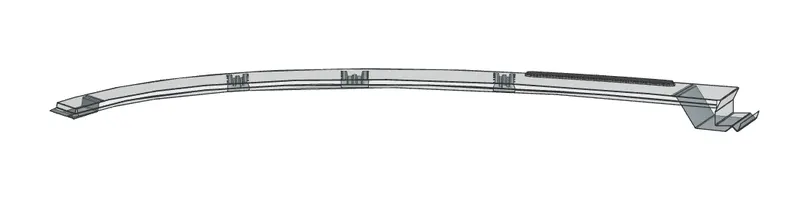
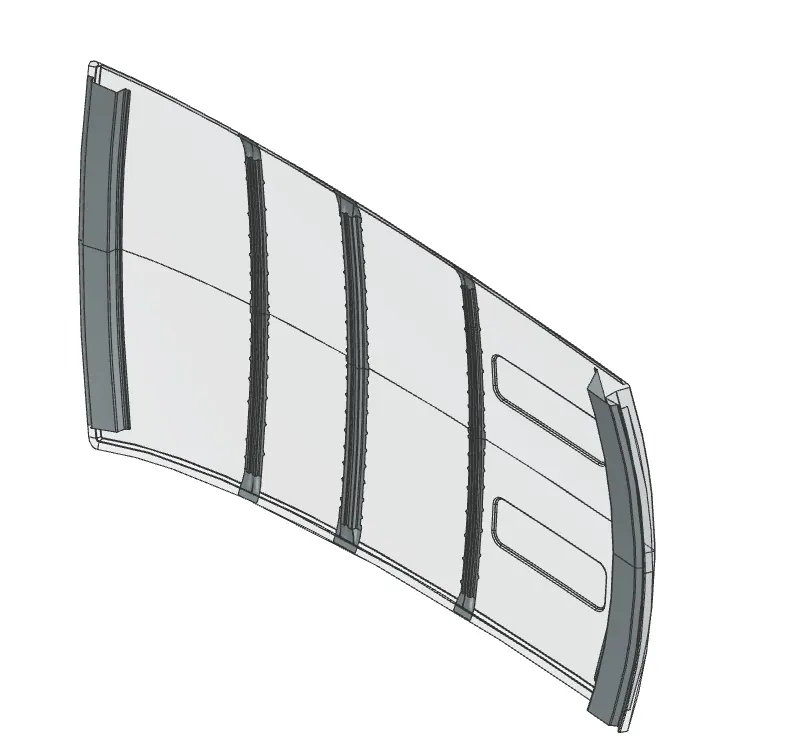
Roof Views:
Front View
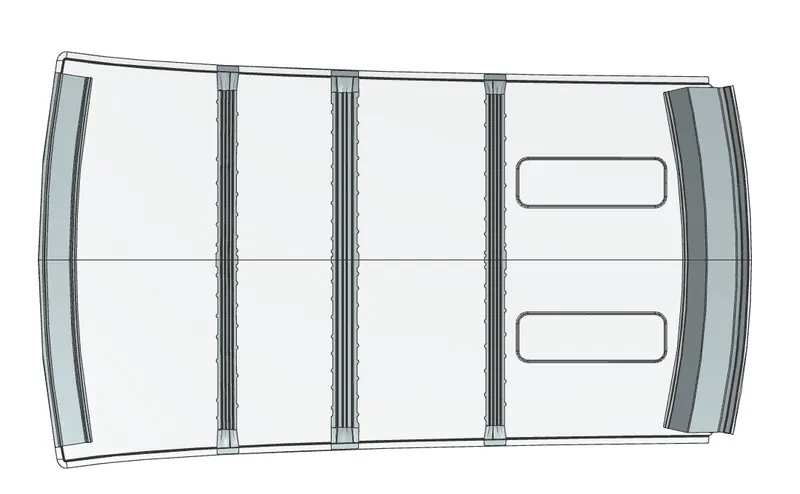
Top View
Isometric View
CONCLUSION :
Hence the roof , front roof rail, bow roof rails , central roof rail and the rear roof rail is designed by following the master sections and the moment of inertia and draft analysis are carried out to check feasibility manufacturing.