Project 1 (Mini Project on Vehicle Direction Detection
Requirement - 1:
- Steering wheel input as yaw rate (Signal name: SteeringWheel_YawDegreeInput) is the input for this system.
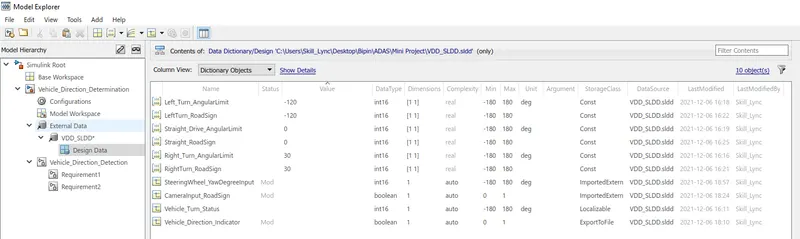
- This is compared against 3 angular values, one each for left turn, right turn & straight drive (Calibration Values: Right_Turn_AngularLimit, Left_Turn_AngularLimit, Straight_Drive_Steering_Angle) to say which specific direction the steering wheel is turning towards.
- Use switch blocks to compare & develop this requirement. Keep this requirement in a subsystem & output of this requirement is a local signal (Signal Name: Vehicle_Turn_Status).
Requirement – 2:
- Keep this requirement as a separate subsystem. Inputs to this requirement are local signal from requirement 1 (Signal Name: Vehicle_Turn_Status) & an input signal from camera (Signal Name: CameraInput_RoadSign), which confirms the occurrence of a road sign.
- Signal Vehicle_Turn_Status is compared against calibration values (Calibration Values: RightTurn_RoadSign, LeftTurn_RoadSign, Straight_RoadSign), if each of them is found equal, then each of the three corresponding output is compared against the camera input signal,
- Using a logical operator block, only one among them is finally given as output signal (Signal Name: Vehicle_Direction_Indicator).
---------------------------------------------------------------------------------------------------------------------------------------------------
Objective of Project:
- To develop the MATLAB Simulink model as per the provides requirement.
- Tagging the requirements to the resprective 'requirement 1' & 'requirement 2' subsystems of the simulink model.
- To create Data Dictionary, Code Generation & make necessary MBD compliant changes.
- While choosing code generation, Storage class for calibration signals: Const; Storage class for local signals: localizable; Storage class for Output signal: Export to File; Storage class for Input signals: ImportedExtern.
- Sample time kept for all signals as 0.01s.
SIMULINK Model:
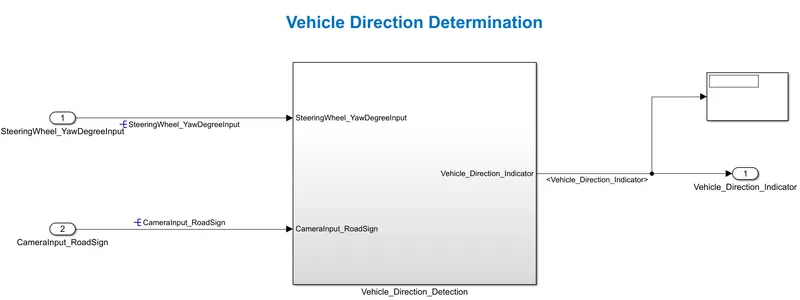
The 2 subsystem of main model is given below.
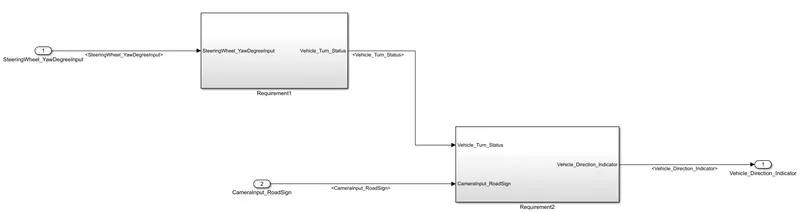
The corresponding subsystem as per Requirement1 is shown below.
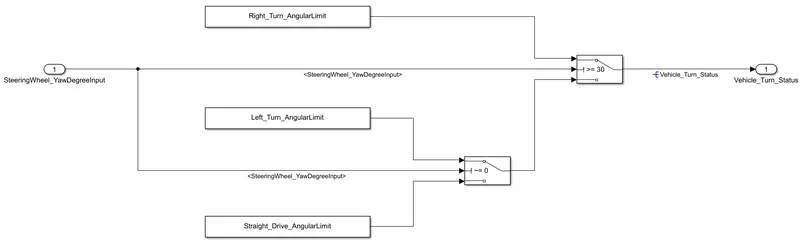
The logic in the Requirement_1 is, If the input is >=30 the vehicle will take a Right turn, else If the input is non-zero value (~=0) the vehicle takes a left_turn, else stright_drive (if input=0).
The input yaw rate is given to the middle port of the switch, and the threshold value is given as 30. If the input is greater than threshold value then the switch will takes the True condition (Right_Turn_AngularLimit) else false condition. In the second switch the threshold value is 0, if the threshold value is not equal to zero then the switch will takes the true condition (Left_Turn_AngularLimit) else takes the false condition (Sitight_Drive steering_Angle). This output from the second switch is given as a false condition to the first switch. And the output for the Requirement_1 is "Vehicle_Turn_Status".
Similarly the corresponding subsystem as per Requirement2 is shown below.
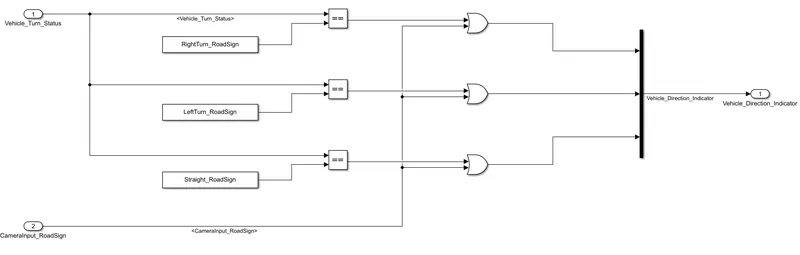
The logic in the Requirement_2 is to compare the Output of Requirement_1 ("Vehicle_Turn_Status" ) with "RoadSign" and an input signal from camera to get the Vehicle Direction indicaton.
After comparision with "Vehicle_Turn_Status" if any of them is found equal, then that corresponding output is compared against the camera input Road signal, by using the 'logical OR' block which will get the true case & it will be shown in display block.
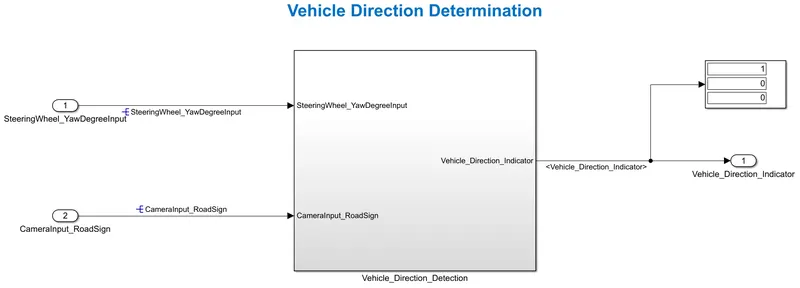
And the final output of the Vehicle_Direction_Detection Model will provide the indication pertaining to the direction of vehicle.
Linking Model with SLDD:
Once the model design is finished, the Simulink Data Cictionary is created (SLDD file) where all the calibration parameters & signals used in the model are linked.
Result & Discussion:
After Simulating the Model, the results can be seen in the Display block which is connected to check whether our designed model is working as per requirement or not.
CONCLUSION:
Autonomous system for an vehicle consists of various Advanced Driver Assisstance System(ADAS) features. Here discussed about 'Vehicle Direction Detection' which is very important ADAS feature.
Using the requirements (data) provided, the simulink model has been created. Similarly SLDD file has been created based on the requirements of model and the results has been successfully evaluated.