Hood design-Week 2
Hood Assembly_Harish Patil
OBJECTIVE:
To develop the hood inner and outer panels considering the safety, functionality and manufacturability, following the industrial standards.
ABSTRACT:
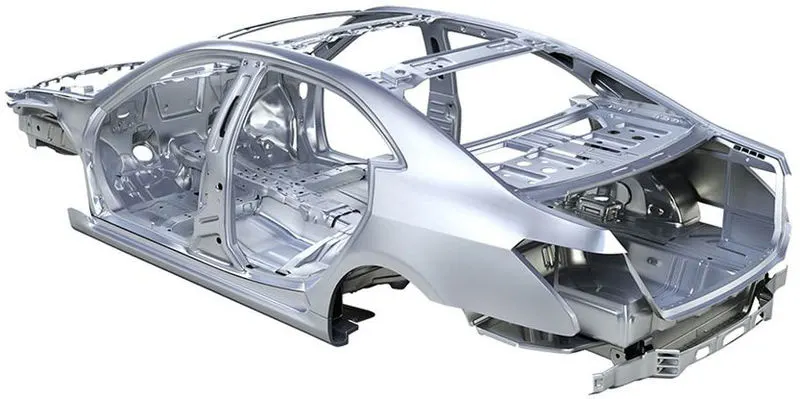
Body in white (BIW) is the stage in automobile manufacturing in which a car body's frame has been joined together, that is before painting and before the motor, chassis sub-assemblies, or trim (glass, door locks/handles, seats, upholstery, electronics, etc.) have been integrated into the structure. Assembly involves different techniques such as welding (spot, MIG/MAG), riveting, clinching, bonding and laser brazing.
In car design, the "body in white" phase is where the final contours of the car body are worked out, in preparation for the ordering of the expensive production stamping die. Extensive computer simulations of crash-worthiness, manufacturability, and automotive aerodynamics are required before a clay model from the design studio can be converted into a body in white ready for production.
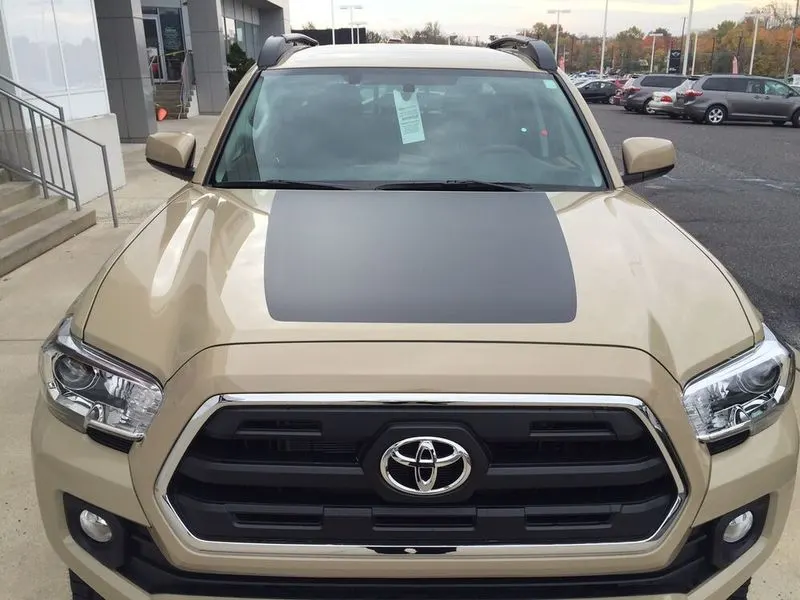
The hood (North American English) or bonnet (Commonwealth English) is the hinged cover over the engine of motor vehicles. Hoods can open to allow access to the engine compartment, or trunk (boot in Commonwealth English) on rear-engine and some mid-engine vehicles, for maintenance and repair. Hoods are typically made out of the same material as the rest of the body work. This may include steel, aluminium, fiberglass or carbon fibre. However, some aftermarket companies produce replacements for steel hoods in fiberglass or carbon fibre to make the vehicle lighter. Hood consists of an outer panel and an inner panel. The inner panel provides strength and support, where the outer panel is a metal cover which have styling factors.
HOOD-TYPES: There are two major types of hoods
- Inlaid hood
- Wrap around hood
- Inlaid hood: It is lightest among all types of hoods. But it is easily subjected to border defects and body unevenness during manufacturing. Here I am designing an inlaid hood
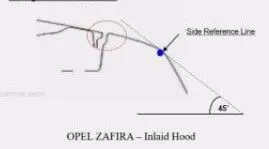
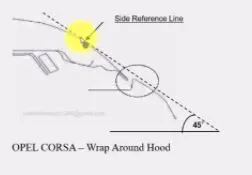
- Wrap around hood: As name itself it wrap around the car body. It can mask the geometrical defects and provide adequate stiffness. It is relatively safer than other types as it provides more safer areas for the pedestrian during impact.
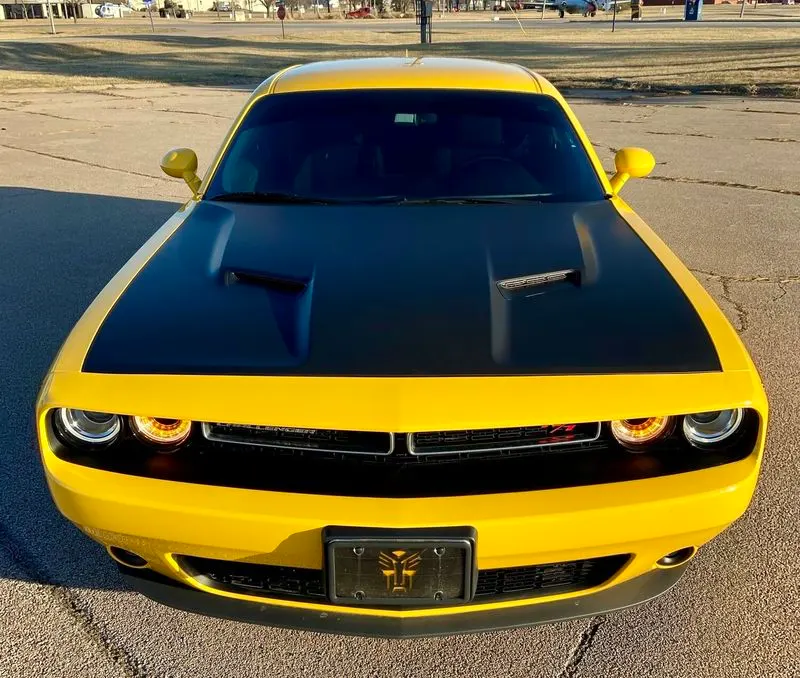
Hood - Design requirements:
- Pedestrian safety
- Occupant safety
- Vehicle quality
- Styling
- Ability to manufacture
- Pedestrian safety:
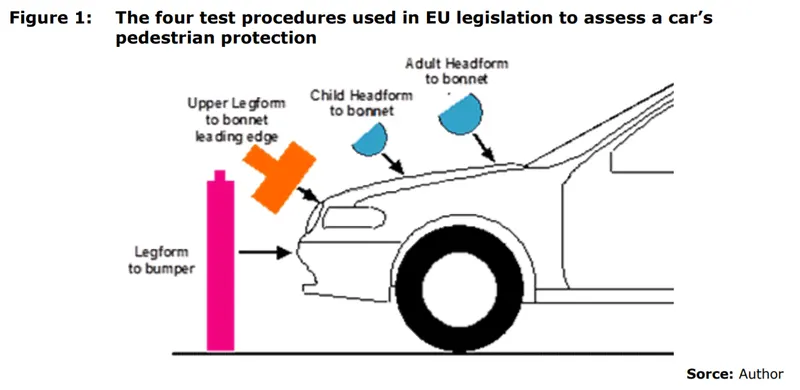
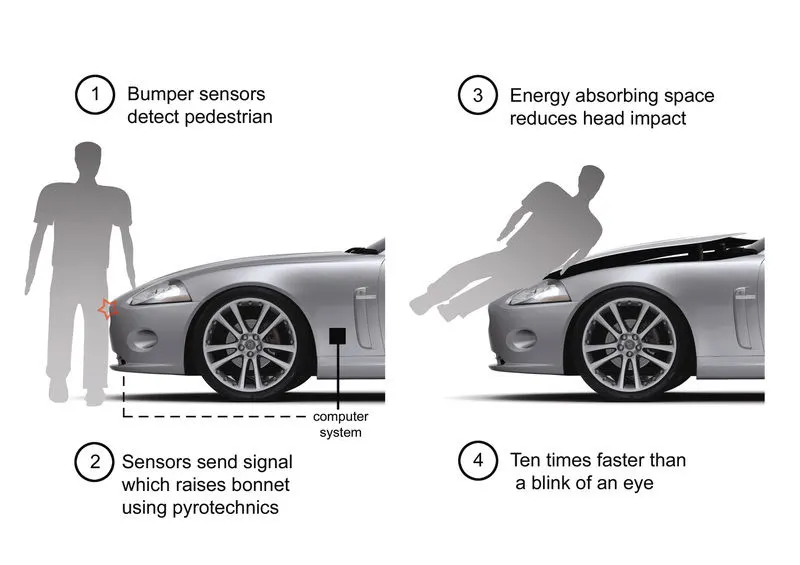
Vehicle designers usually focus on understanding the car-pedestrian interaction, which is characterized by the following sequence of events: the vehicle bumper first contacts the lower limbs of the pedestrian, the leading edge of the hood hits the upper thigh or pelvis, and the head and upper torso are struck by the top surface of the hood and/or windshield. Most pedestrian deaths occur due to the traumatic brain injury resulting from the hard impact of the head against the stiff hood or windshield. In addition, although usually non-fatal, injuries to the lower limb (usually to the knee joint and long bones) are the most common cause of disabilities. The hood of most vehicles is usually fabricated from sheet metal, which is a compliant energy absorbing structure which poses a comparatively small threat. Most serious head injuries occur when there is insufficient clearance between the hood and the stiff underlying engine components. A gap of approximately 10 cm is usually enough to allow the pedestrian’s head to have a controlled deceleration and a significantly reduced risk of death. Most limb injuries occur due to a direct blow from the bumper and the leading edge of the hood. Wrap Around Distance (WAD) is the distance from the ground level to the end of the hood as shown in the image.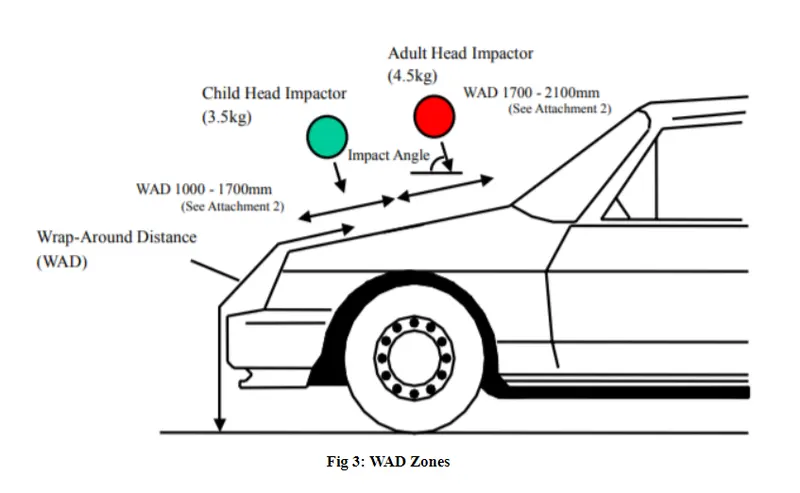
There are two main zones that are considered while designing stage; Child head impact zone (1000mm to 1700mm WAD) and Adult head impact zone. (1700mm to 2100mm WAD). . If the side reference line is on the fender, the WAD will be more and impact zone will be less and vice versa.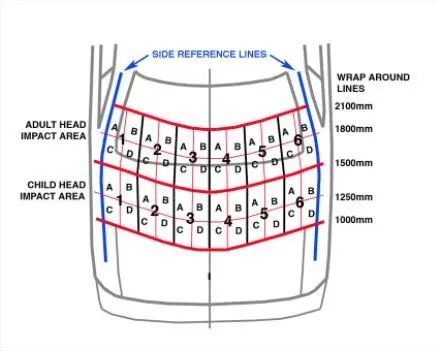
- Occupant safety:
The hood panels should be designed in such a way that it diverge the impact forces during a collision away from the occupants inside the cabin. The forces should be damped properly to avoid or reduce the risk of injuries and death. - Vehicle quality: Here the factors such as torsional stiffness, dent resistance, corrosion resistance, weight distribution, and noise attenuation etc. are considered.
- Styling: It is a major factor that often influence the vehicle sales in the market. The outer panel is the main consideration here as it is the only component that is visible outside. The factors such as surface quality, tight radii on hemmed panel edges aesthetic design etc. are crucial factors. Other than styling, aerodynamic factors are important while designing the outer panel.
- Ability to manufacture: Here various sheet metal operations such as blanking, piercing, embossing, hemming etc are used for manufacturing the hood components. Minimum 7 degree draft angle is maintained respective to the tooling direction considering the stamping process. Mastic points were implemented to join the outer and inner panels as we cannot apply spot welding process here. The materials used are typically steel or aluminium based.
Various manufacturing processes are as follows;
Blanking is a metal fabricating process, in which a metal workpiece is removed from the primary metal strip or sheet when it is punched. The material that is removed is used as new metal workpiece or blank.
Piercing is a shearing process. Here raw metal is pierced with a machining tool, resulting in the creation of a circular or other shaped hole.
Sheet metal embossing is a stamping process for producing raised or sunken designs or relief in sheet metal.
Hemming is the process in which the edge is rolled onto itself. Hems are commonly used to reinforce an edge, hide burrs and rough edges, and improve appearance.
PARTS OF AN HOOD:
Basically the hood has the inner pannel, outer panel and reinforcement (it will provide the strength) and emboss.Latch and striker mechanism is used to open and close the hood whenever is needed. Latch and hinge is needed some reinforcement for strength.
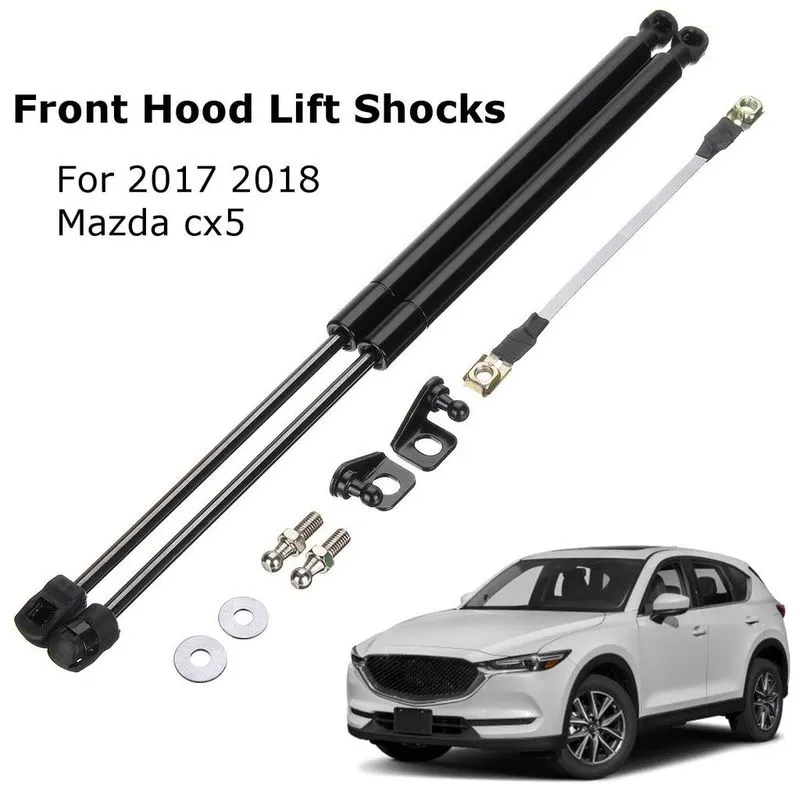
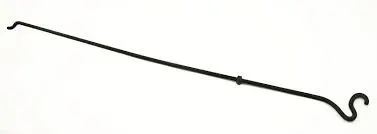
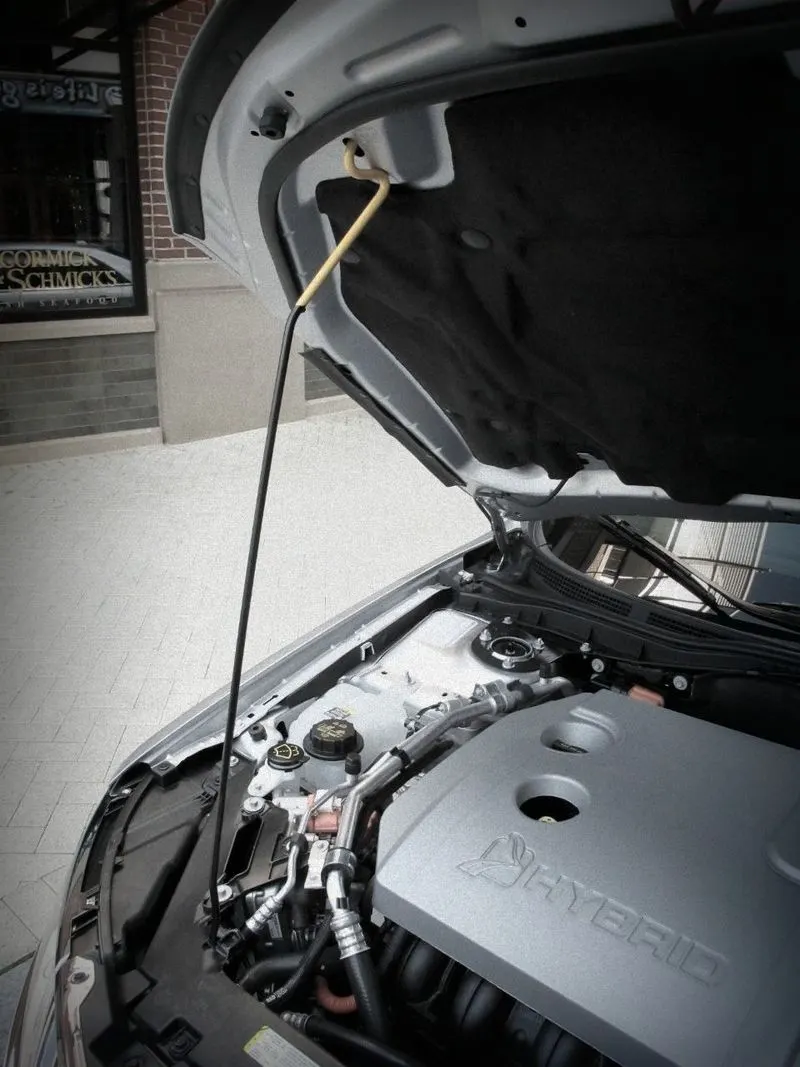
TYPES OF HOOD SUPPORT: There are two types of support is there,1) Gas stay & 2) Support rod.
- Gas stay: spring stays are designed to be used on upward lifting doors, once you have opened the door slightly the spring will push the door to the fully open position, Euro fit stock various size springs depending on the door size requirements. This is mostly used for where the car bonnet weight is heavy.
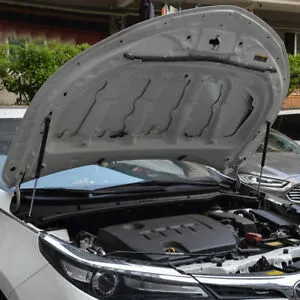
- Support rod: This is widely used in many car, because this very easy and cheap. In this type we have to lift the hood by ourselves and place the support rod in the space provided either in the hood or engine component. This is mostly used for where the car bonnet weight is small.
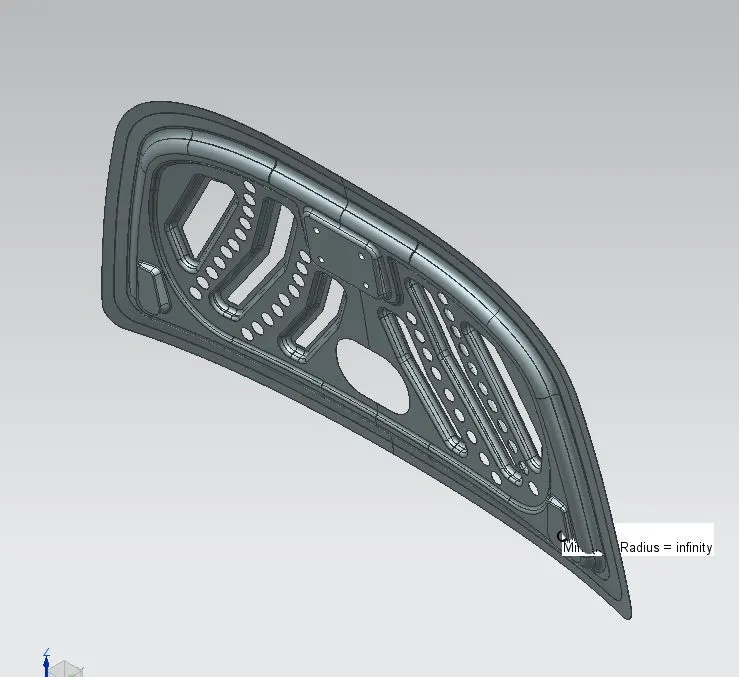
Inner panel:
Inner panel supports outer panel. It consists of different embosses and hole at different places. Embosses provide stiffness as well as dissipate energy towards hinges. To determine the most effective position of hole, the method of modal stiffness is employed.Inner pannel is offset of the parent work surface.inner pannel thickness is 0.75mm
OUTER PANNEL:
Outer panel is nothing but a outer skin of inner panel. Otherwise called as a cover of inner panel. It is the part, which gives luxurious look to the hood or bonnet. Outer pannel and inner pannel cannot join by any welding process like spot welding or rivet, which spoil the outer look of a car.The outer pannel is generally extracted model from the prototype design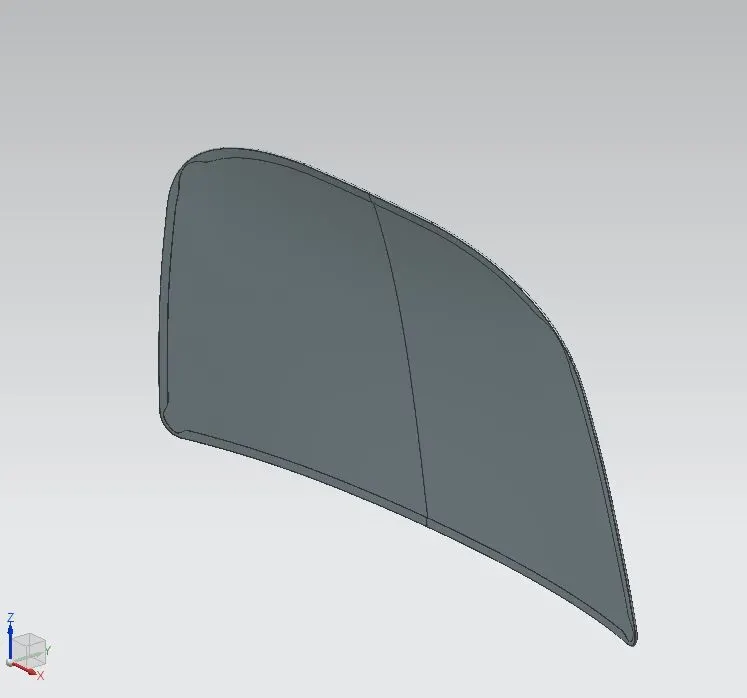
LATCH TRAJECTORY :
The hood latch on any car is used to connect the hood release cable to the hood locking mechanism. If it breaks you will no longer be able to open the hood using the hood release in the inside of the car, which will be problematic the next time you have to enter the engine bay.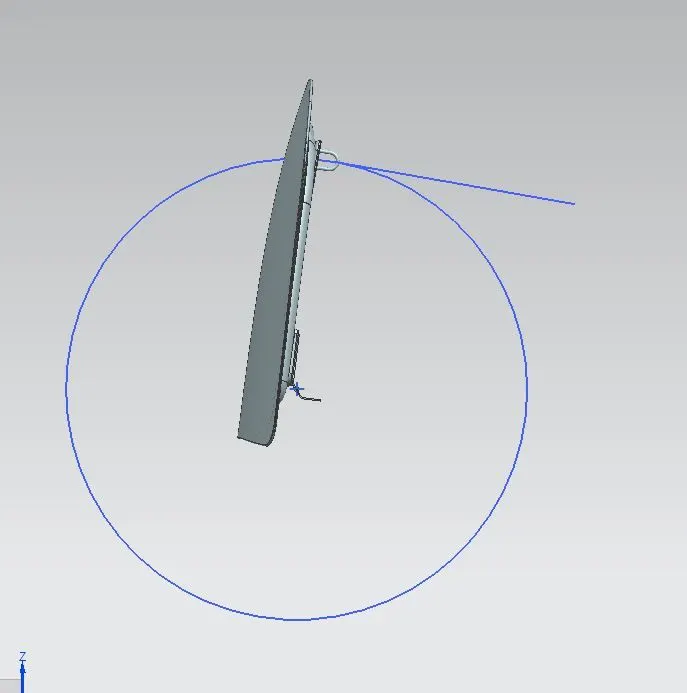
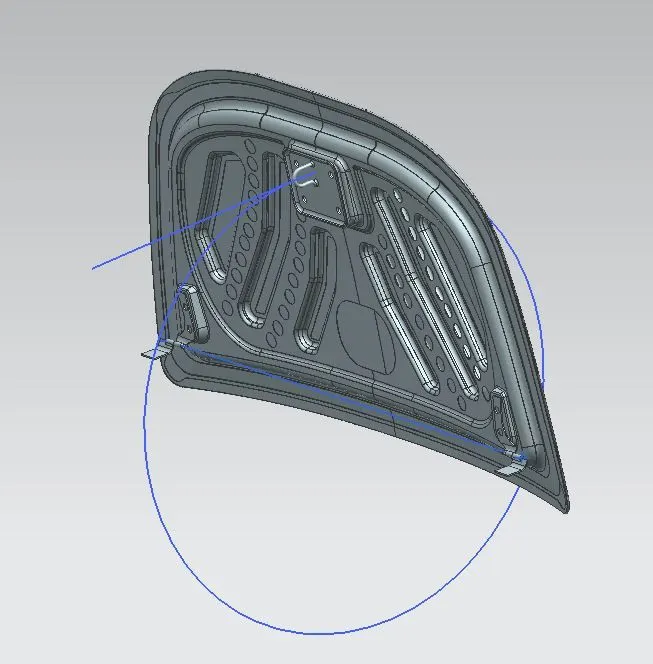
The trajectory path is perpendicular to the striker then my hinge position is correct. if these are not perpendicular opening and closing of the hood becomes hard.
MASTIC DATA:
Adding a Mastic seal improves the NVH of the hood. mastic seal is one type of hard rubber it will join the inner and outer panel of the hood. mastic sealant improves the strength of the around 80mm diameter.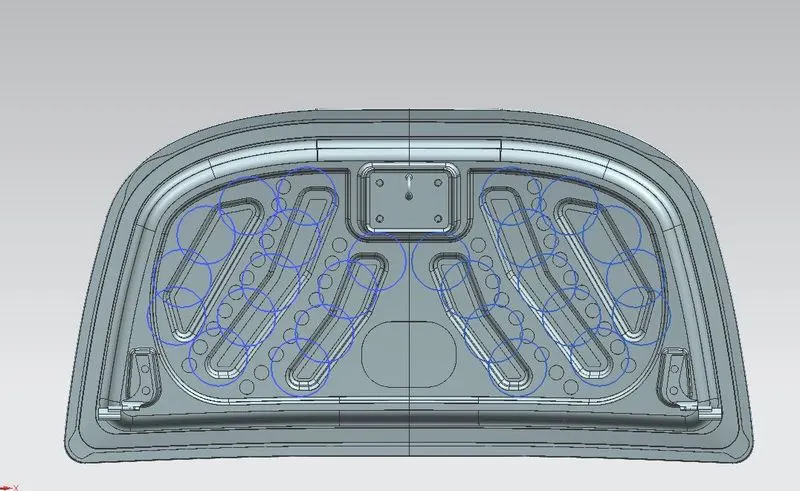
Emboss :
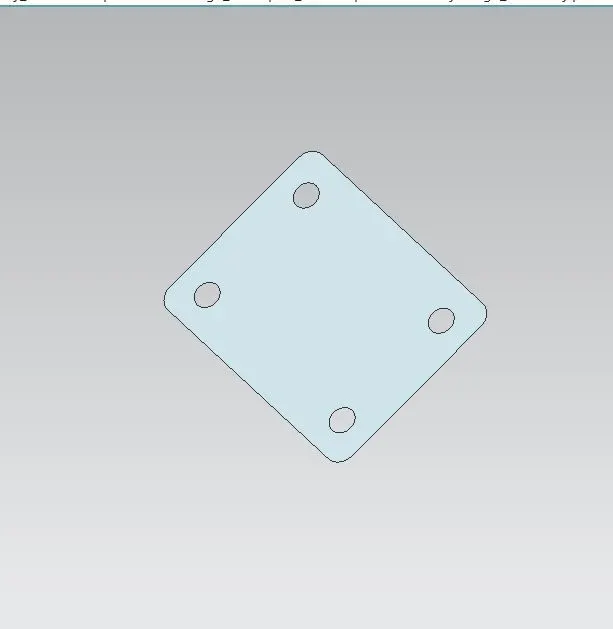
The Emboss feature raises or recesses a profile relative to the model face by a specified depth and direction. The embossed area can provide a surface for a decal or painting. A recessed embossed area can provide clearance for another component in an assembly.
Some example of emboss used to fix the hinge & striker.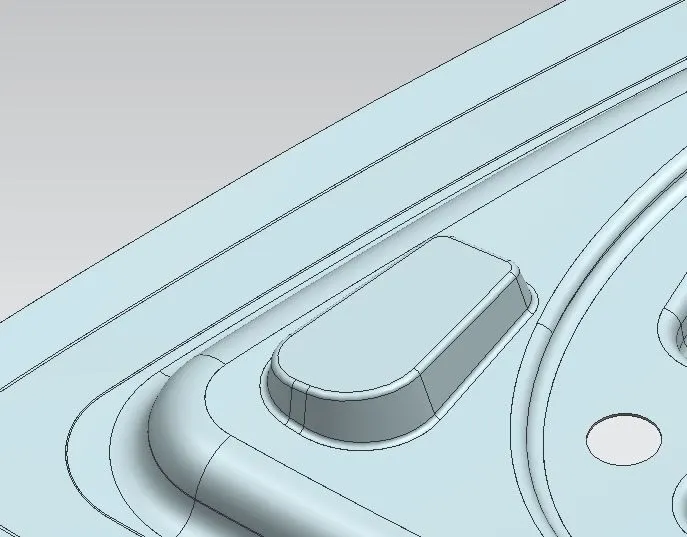
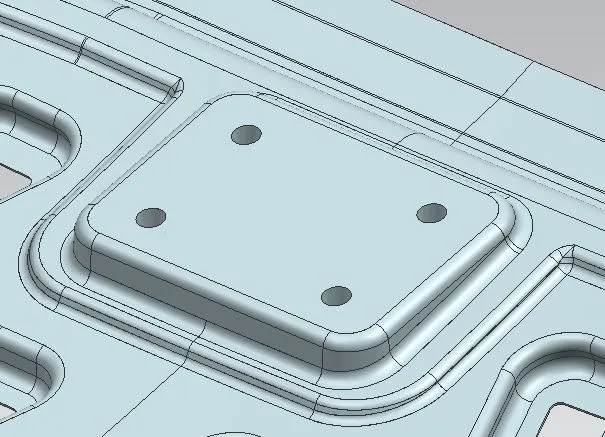
Reinforcement:
It provides latch and hinge region it provides and improves strength locally. the thickness of the reinforcement is more than the inner panel thickness according to design requirement hear it is given 1.5mm.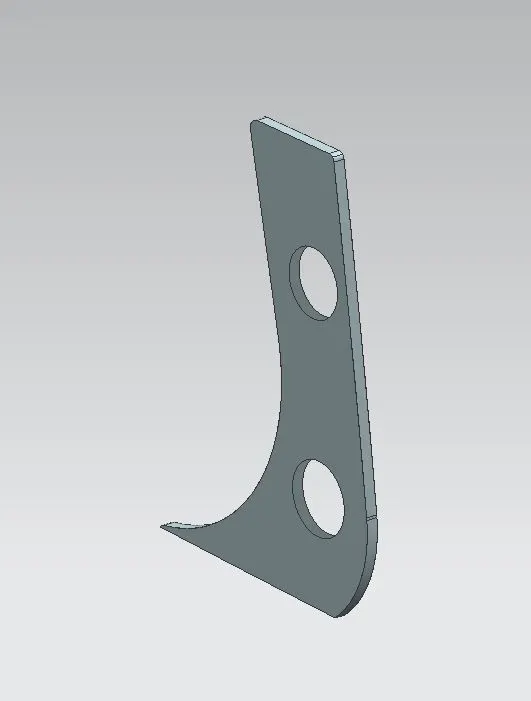
Hemming:
Hemming is a forming operation in which the edges of the sheet are folded or folded over another part in order to achieve a tight fit. Normally hemming operations are used to connect parts together, to improve the appearance of a part, and to reinforce part edges.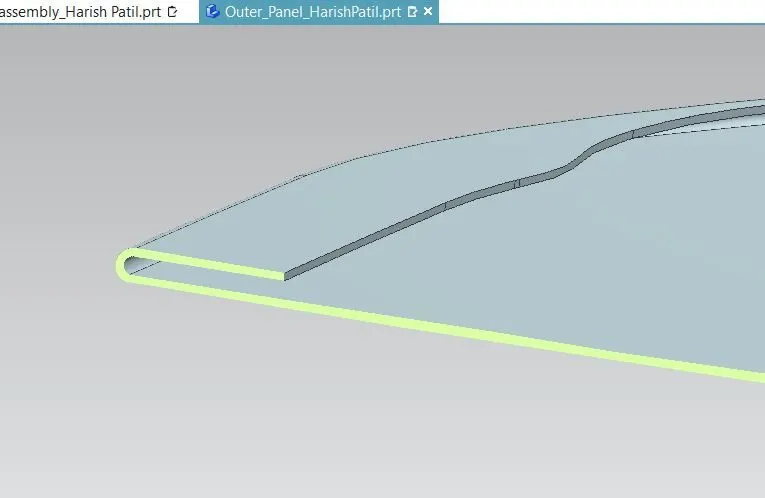
There are various types of hemming operations:
- Conventional die hemming:
conventional die hemming is suitable for mass production. In die hemming, the flange is folded over the entire length with a hemming tool. Normally the actual hemming is a result of a farming operation in which the flange is formed with a hemming tool after the drawing and trimming operations have been completed. - Roll hemming:
Roll hemming is carried out incrementally with a hemming roller. An industrial robot guides the hemming roller and forms the flange. Roll hemming operation can also be divided into several pre-hemming and final hemming process steps. Roll hemming is very flexible to use and tool costs are significantly lower as compared to those of conventional die hemming. However, the cycle times are much higher since the hemming is realized using a hemming roller that follows a defined path.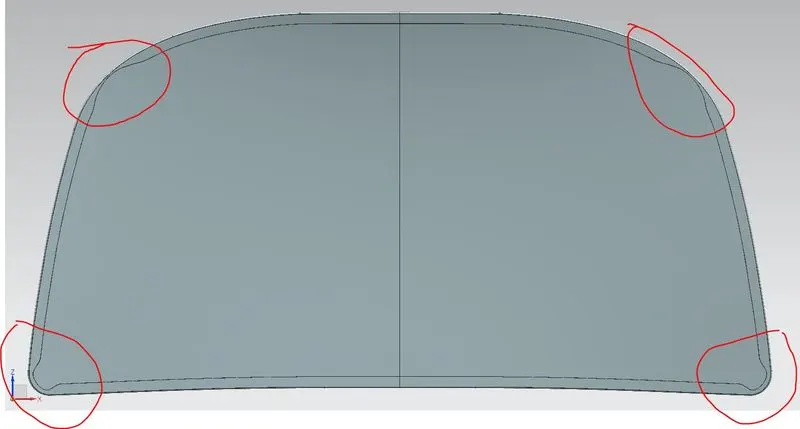
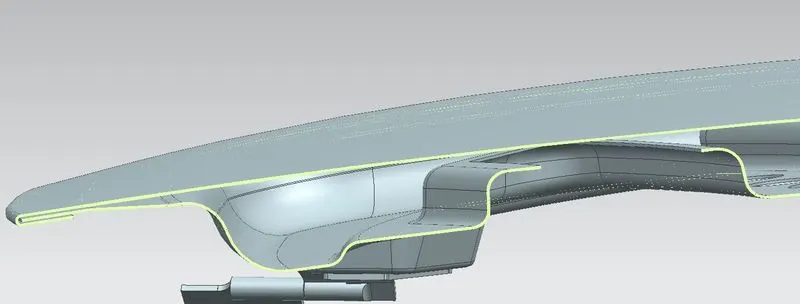
In highlighted area , they will roll the hemming.So, some clearances has given.
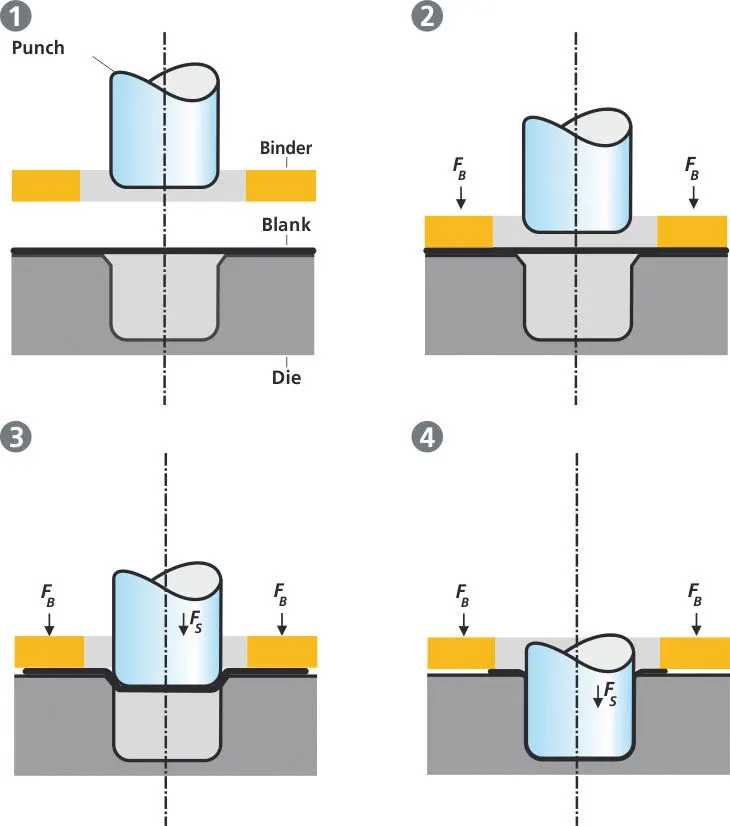
Deep drawing :
It is a sheet metal forming process in which a sheet metal blank is radially drawn into a forming die by the mechanical action of a punch. It is thus a shape transformation process with material retention. The process is considered "deep" drawing when the depth of the drawn part exceeds its diameter.
Deep drawing processes are divided into three types:
- Deep drawing with tools
- Deep drawing with active means
- Deep drawing with active energy
Hood Thickness Information
- Outer panel thickness = 0.75mm
- Inner panel thickness = 0.75mm
- Reinforcement thickness = 0.5mm
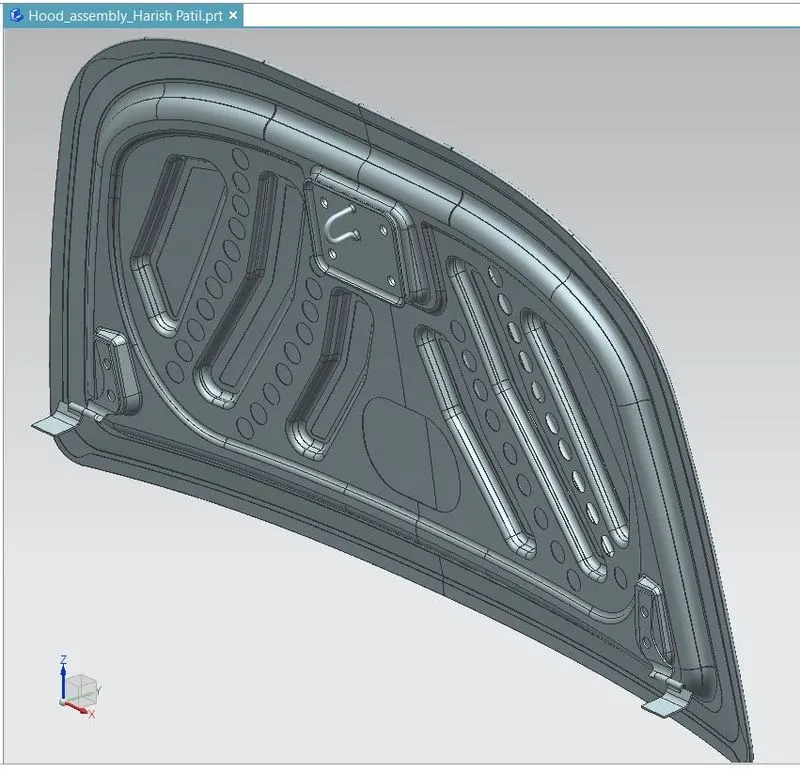
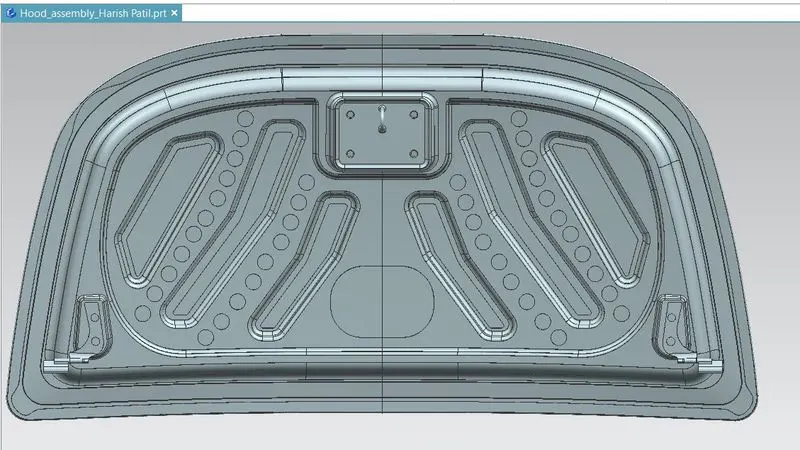
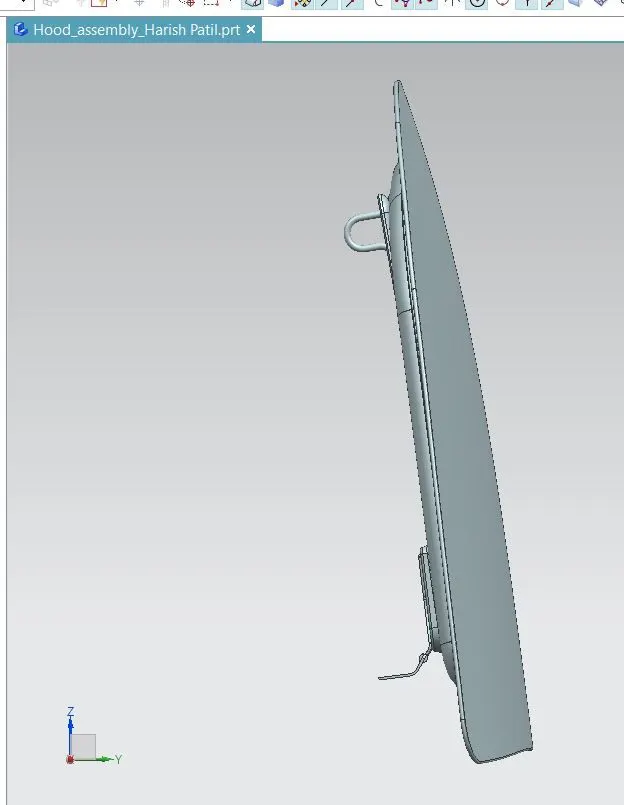
Assembly Images:
Conclusion:
Hood design is a critical one which includes the condition such as safety purpose & depends of good looking.
Over all design learnt about the hood assembly,hood inner panel, hood outer panel,hinge, striker with their reinforcements.