Section Modulus calculation and optimization
SECTION MODULUS OF AN HOOD
Section modulus is a geometric property for a given cross-section used in the design of beams or flexural members.Other geometric properties used in design include area for tension, radius of gyration for compression, and momentof inertia for stiffness. Any relationship between these properties is highly dependent on the shape in question.Equations for the section moduli of common shapes are given below. There are two types of section moduli, the elastic section modulus (S) and the plastic section modulus (Z).
- Section modulus is a direct measure of strength of any sectional area of an object about an reference axis(neutral axis).
- Strength is nothing but, capable of supporting greater loads, so higher the strength it has a high capable of supporting greater loads.
- This strength can measured directly from Section modulus formula, and defined by below formula.
- Section modulus represented with a symbol of 'S'.
S=I/Y
where 'I'moment of inertia '
Y' is the distance from the reference line(neutral axis) to one of the extreme end of an object. - Moment of inertia is nothing but offering resistance against of moment, bending or twisting, i.e if we applied any external load on the body, how much resistance its offering to tend to deform.
- So, higher the value of moment of inertia , have higher resistance to deform under certain load, hence we can say that moment of inertia directly proportional to the strength of the material , and strength of the material can be calculated with the help of section modulus.
- If we vary the neutral axis towards positive or negative side the overall strength of the body will decrease , because when nuetral axis line lies on the middle of the section only have higher strength at particular point, so, here 'Y' value was inversely proportional to section modulus.
- So Newton's first law also explains that ,if higher the mass , the force required to move the object is also high due to offering more resistance in order to move the object, This resistance we called it as a MOMENT OF INERTIA.
Existing Hood section:
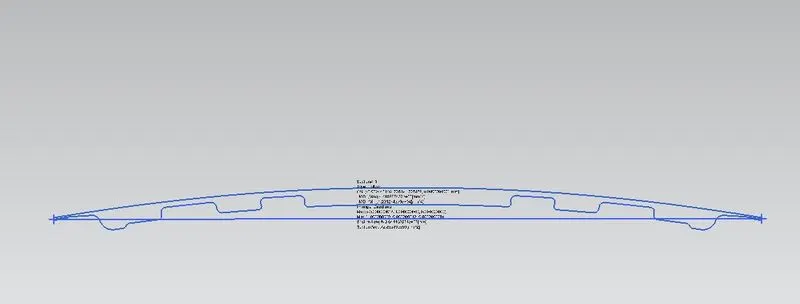
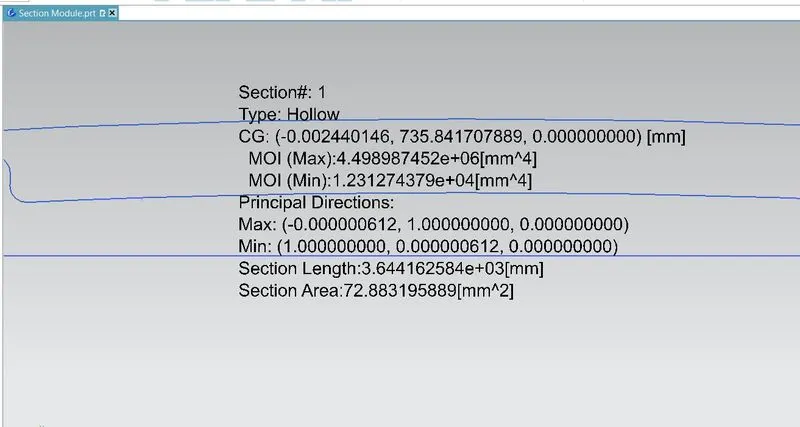
Here the moment of inertia was calculated by using the NX-software obtained values are
IMAX:- 4.498987452X10^6 mm^4
Imin:- 1.231274379x10^4 mm^4
Y=427.55mm
1)Section modulus(S):-I/Y=4.498987452X10^6mm^4/427.55mm
=10.5227X10^3 mm^3(Maximum strength).
2) Section modulus(S):-I/Y=3.18672x10^3 mm^4/244.412mm
=0.02879x10^3 mm^3(minimum strength).
Trail one ,the inner panel curve offsetting outside by 2mm i.e increasing in cross sectional area:
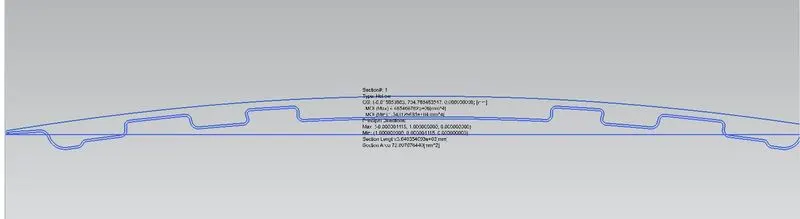
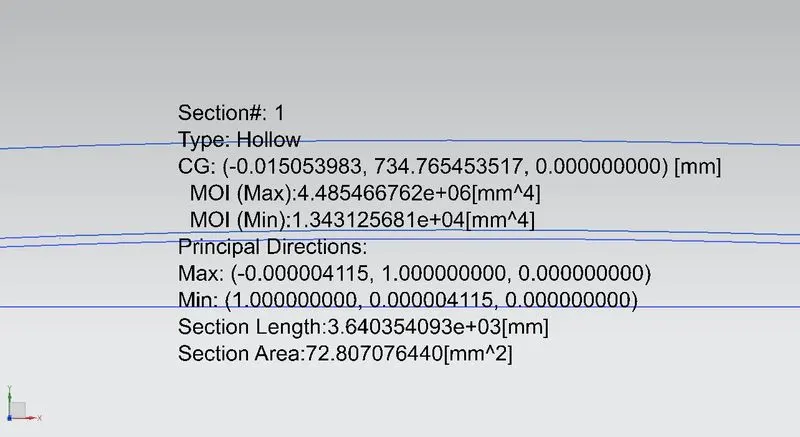
IMAX:- 4.485466762X10^6 mm^4
Imin:- 1.3434125681x10^4 mm^4
Y=427.55mm
1)Section modulus(S):-I/Y=4.485466762X10^6 mm^4/427.55mm
=10.49109X10^3 mm^3(Maximum strength).
2) Section modulus(S):-I/Y=1.3434125681x10^4 mm^4/244.412mm
=0.03141x10^3 mm^3(minimum strength).
Conculsion:
The strength of the material is directly proportional to the moment of inertia,increase in sectional area there is have increase in overall mass of an object. Hence have increase in strength.