Gear Box
AIM: To perform the four simulations in the Gearbox and then to compare the results among all the four cases.
- 20% Immersion, Fluid - Engine oil.
- 30% Immersion, Fluid- Engine oil.
- 20% Immersion,Fluid-n-heptane (c7h16).
- 30% Immersion,Fluid-n-heptane (c7h16)
Theoritical Background:
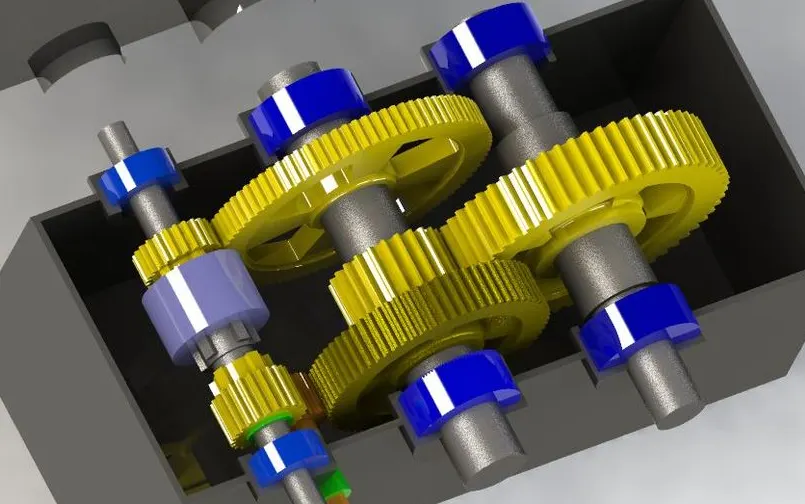
A transmission is a machine in a power transmission system, which provides controlled application of the power. Often the term 5 speed transmission refers simply to the gearbox that uses gears and gear trains to provide speed and torque conversions from a rotating power source to another device.
Gearboxes or also commonly called gear reducers or enclosed speed reducers are used on many electromechanical drive systems . Gearboxes, are essentially multiple open gear sets contained in a housing. The housing supports bearings and shafts, holds in lubricants, and protects the components from surrounding conditions. Gearboxes are available in a wide range of load capacities and speed ratios. The purpose of a gearbox is to increase or reduce speed. As a result, torque output will be the inverse of the speed function.
There are many types of gears such as spur gears, helical gears, bevel gears, worm gears, gear rack, etc. These can be broadly classified by looking at the positions of axes such as parallel shafts, intersecting shafts and non-intersecting shafts.
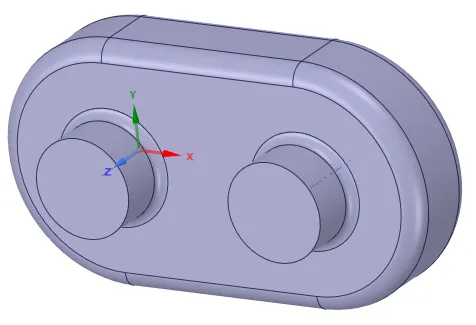
Geometry:
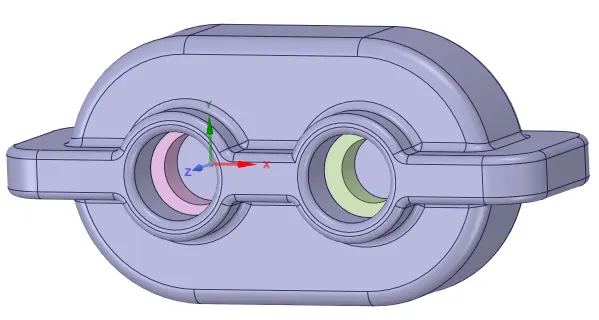
Spur Gear
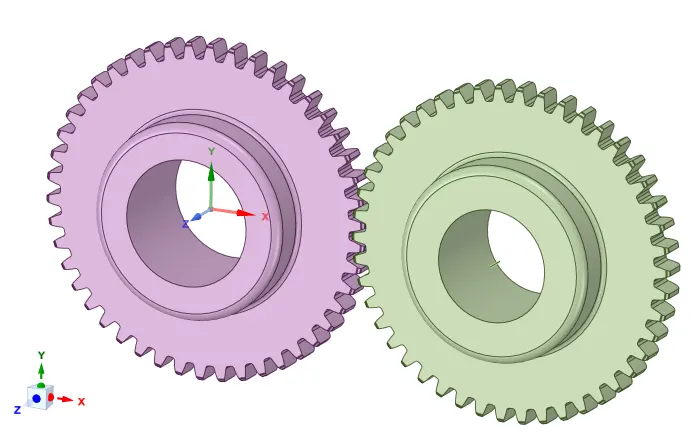
Gear Housing
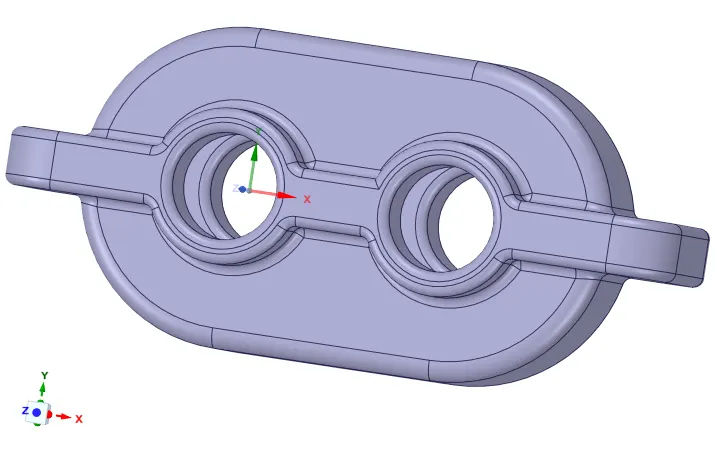
Extracted Fluid Volume
Obtaining 2D Geometry:
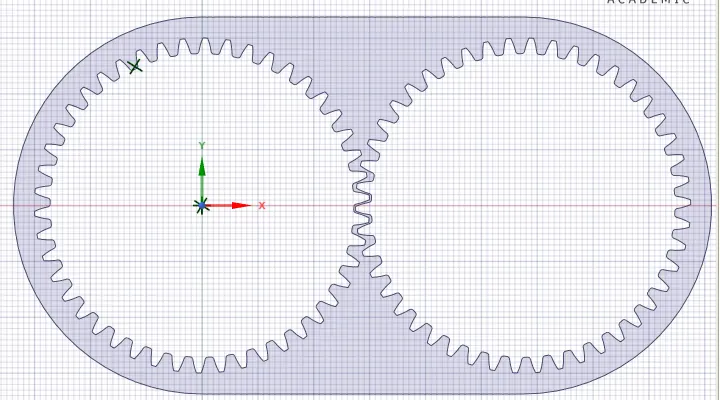
The 2D model is extracted by creating the planes along the 3 axis and splitting the body of 3D model using split body tool
Splitted body
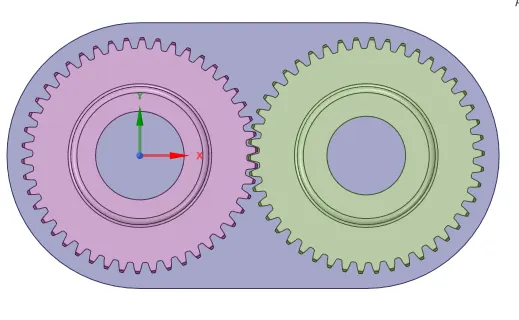
2 D Geometry
Meshing:
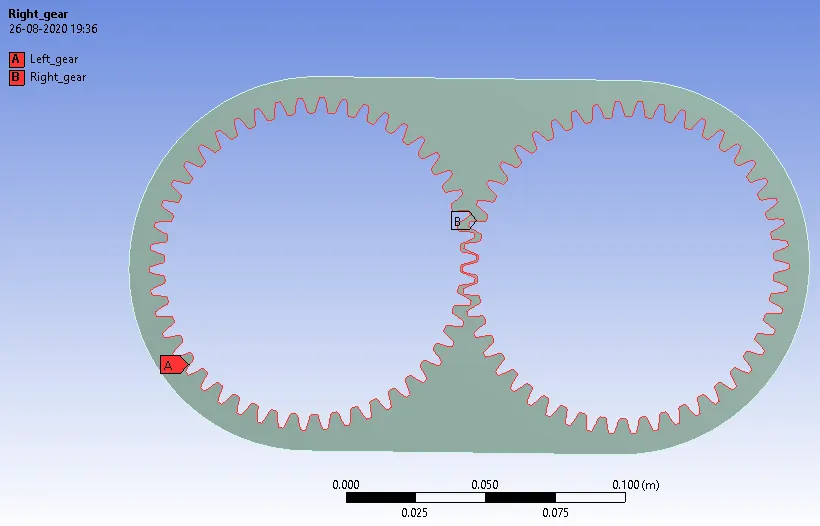
Named Selection
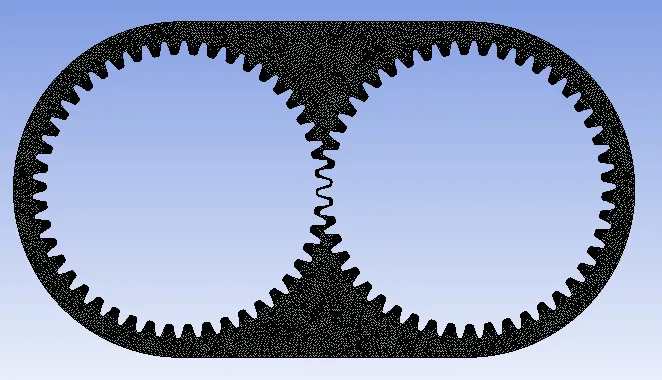
The edges of the gears are selected individually using edge selection option and are named 'left gear' and 'right gear' respectively.
Mesh
element size = 1mm
Mesh method - All triangles method
Number of Nodes - 15875
Number of Elements - 28327
Fluent Setup:
Solver: Transient state
Type: Pressure based
Model: k-epsilon Standard Wall functions model , Multiphase: Volume of Fluid and Implicit formulation used
Material: Air: Density = 1.225 kg/m3, Dynamic viscosity = 1.7894e-05 kg-m/s,
Engine Oil: Density = 889 kg/m3, Dynamic viscosity = 1.06 kg-m/s
n-heptane-liquid: Density = 684 kg/m3, Dynamic viscosity = 0.000409 kg-m/s
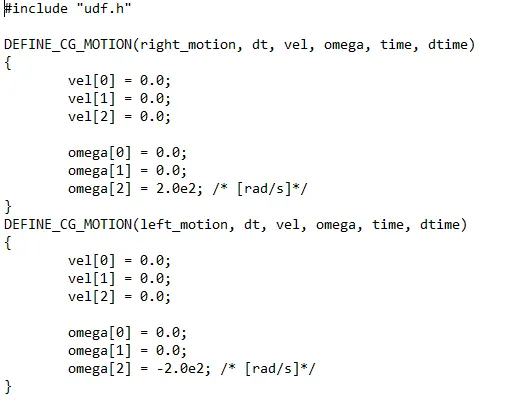
User Defined Functions(udf)
It is used in Ansys Fluent solver to enhance the Standard features ot the code. It can be added in ansys fluent functions to give motions, custom boundary condions, material properties, source terms with respect to simulation being performed.
4 Different cases
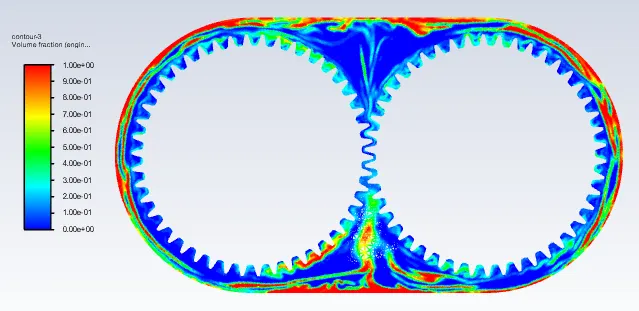
Case 1: 20% Immersion, Fluid - Engine oil.
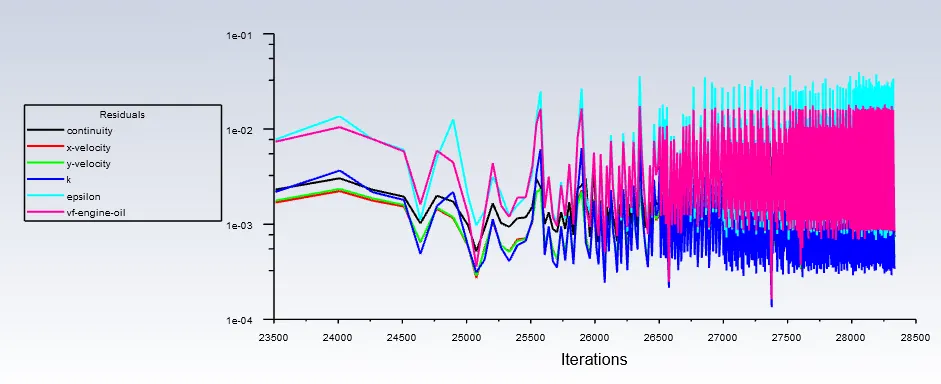
Residuals plots
Contour
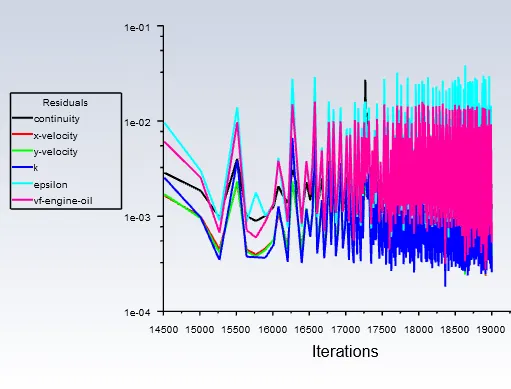
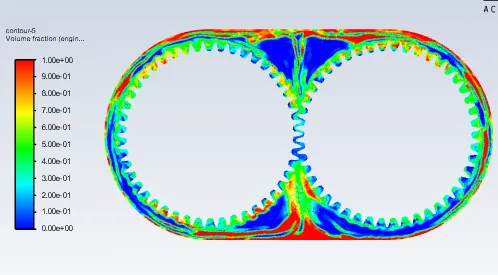
Case 2: 30% Immersion, Fluid- Engine oil.
Residual plots
Contour:
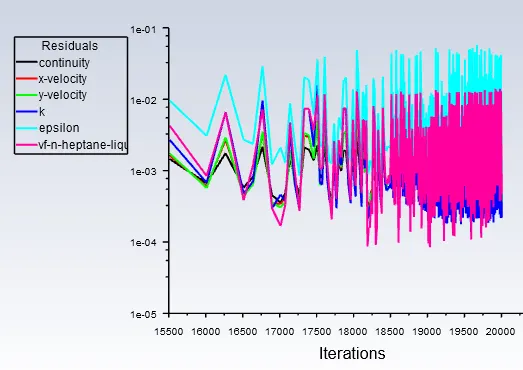
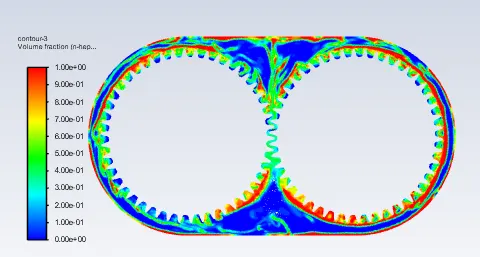
Case 3: 20% Immersion, Fluid-n-heptane (c7h16).
Residual plots
Contour:
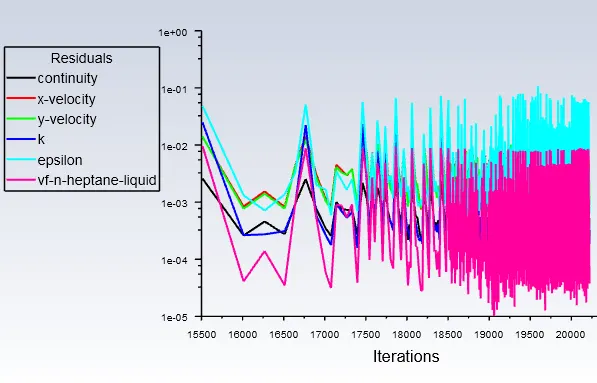
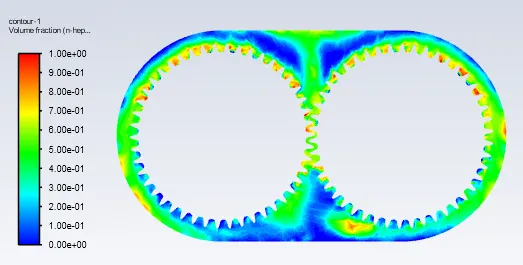
Case 4: 30% Immersion,Fluid-n-heptane (c7h16)
Residual plots
Contour:
OBSERVATIONS:
At time t = 0, all the lubricants are concentreated at the bottom of the gear box. 30% immersion has more lubricant than 20% immersion case. When the gear starts rotating there is enough gap between the gear teeth to fill the lubricaiton. In case of 30% immersion case the more gear teeths come in contact with lubricant initially so as to carry the lubricant so it is more effective compared to 20% immerison case. Splashing of the lubricant helps to spread the lubricant all over the gear box. Engine oil has more viscocity than the n-heptane-liquid. This makes the engine oil stick to the tooth surface.
1] What is Dynamic meshing? Give some other examples where dynamic meshing can be used.
Dynamic meshing refers to situations in which the computational grid changes dynamically during the run of the CFD simulation. This opens up for the possibility to simulate flows where the geometry changes with time, e.g. flows around falling objects or internal combustion in cylinders. In ANSYS Fluent the dynamic mesh capability is used to simulate problems with boundary motion, such as check valves and store separations.
Examples:
1] pistons moving inside an engine cylinder
2] A flap deflecting on an aircraft wing
3] deforming, such as the elastic wall of a balloon during inflation
4] a flexible artery wall responding to the pressure pulse from the heart.
2] What is the fluid Sloshing effect? Discuss whether the sloshing effect is good or bad? Explain.
In fluid dynamics, slosh refers to the movement of liquid inside another object (which is, typically, also undergoing motion).
The liquid must have a free surface to constitute a slosh dynamics problem, where the dynamics of the liquid can interact with the container to alter the system dynamics significantly. Important examples include propellent slosh in spacecraft tanks and rockets (especially upper stages), and the free surface effect (cargo slosh) in ships and trucks transporting liquids (for example oil and gasoline). It has become common to refer to liquid motion in a completely filled tank
3] What is the use of UDF?
UDF is programmed function that can be dynamically loaded with Ansys Fluent solver to enhance the standard features of the code. The UDF can be used to define the material properties, boundary conditions, source terms for flow regime as well as specify custom model parameters to initialize the solution.
Every UDF file must contain udf.h file inclusion directive (#include "udf.h") at the beginning of the source code file. Values that are passed to the solver by UDF or returned to the solver by UDF are specified in S.I units.
4] Discuss the common errors that occurred in the simulation. A] 'Dynamic mesh failed' error. B] 'Negative cell volume detected' error.
A] Dynamic mesh failed error.
The dynamic mesh model in ANSYS Fluent can be used to model flows where the shape of the domain is changing with time due to motion on the domain boundaries. The dynamic mesh model can be applied to single or multiphase flows (and multi-species flows). The update of the volume mesh is handled automatically by ANSYS Fluent at each time step based on the new positions of the boundaries. To use the dynamic mesh model, you need to provide a starting volume mesh and the description of the motion of any moving zones in the model. ANSYS Fluent allows you to describe the motion using either boundary profiles, user-defined functions (UDFs), or the six degrees of freedom solver.
ANSYS Fluent expects the description of the motion to be specified on either face or cell zones. If the model contains moving and non-moving regions, you need to identify these regions by grouping them into their respective face or cell zones in the starting volume mesh that you generate. Furthermore, regions that are deforming due to motion on their adjacent regions must also be grouped into separate zones in the starting volume mesh. The boundary between the various regions need not be conformal. You can use the non-conformal or sliding interface capability in ANSYS Fluent to connect the various zones in the final model.
B] Negative cell volume detected error.
When the boundary displacement is large compared to the local cell sizes, the cell quality can deteriorate or the cells can become degenerate if only mesh smoothing is used. This will invalidate the mesh resulting in negative cell volumes and consequently, will lead to convergence problems when the solution is updated to the next time step.
To circumvent this problem, ANSYS Fluent agglomerates cells that violate the skewness or size criteria and locally remeshes the agglomerated cells or faces. If the new cells or faces satisfy the skewness criterion, the mesh is locally updated with the new cells (with the solution interpolated from the old cells). Otherwise, the new cells are discarded and the old cells are retained.
Refrence:
https://skill-lync.freshdesk.com/support/solutions/articles/43000567497-mesh-models-and-applications