Frequency Analysis of a rotating shaft
Aim:- To find out the critical frequencies of the shaft
Objectives:-
- To create 3D model of rotating shaft
- To perform frequency analysis on the rotating shaft and find out the critical frequencies.
Introduction:-
For a rotating shaft there is a speed at which, for any small initial deflection, the centripetral force is equal to the elastic restoring force. At this point the deflection increases greatly and the shaft is said to "whirl". Below and above this speed this effect is very much reduced. This critical (whirling speed) is dependent on the shaft dimensions, the shaft material and the shaft loads . The critical speed is the same as the frequency of traverse vibrations.
The critical speed Ncof a shaft is simply

Where m = the mass of the shaft assumed concentrated at single point .
k is the stiffness of the shaft to traverse vibrations
For a horizontal shaft this can be expressed as

Where y = the static deflection at the location of the concentrated mass
Theory
Consider a rotating horizontal shaft with a central mass (m) which has a centre of gravity (G)slightly away from the geometric centroid(O)
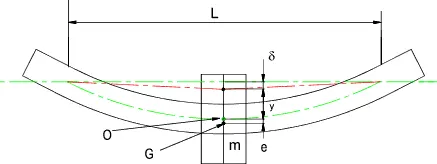
The centrifugal force on the shaft = m ω 2(y + e) and the inward pull exerted by the shaft = y (48EI / L 3).
The more general formulea for the restoring traverse force of the beam is y (K EI / L 3) where K = a constant depending on the position of the mass and the end fixing conditions.
Equating these forces...

When the denominator = 0 ,that is [ KEI / m ω 2 L 3 ] = 1 , the deflection becomes infinite and whirling takes place.
The whirling or critical speed is therefore.

For a simply supported beam with a central mass K = 48 .. See examples below
Substituting ω c 2 for KEI /mL3 in the above equation for y results in the following equation which relates the angular velocity with the deflection.
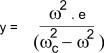
This is plotted below..
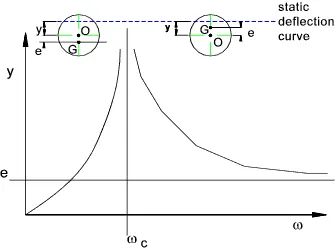
This curve shows the deflection of the shaft (from the static deflection position) at any speed ω in terms of the critical speed.
When ω < ωc the deflection y and e have the same sign that is G lies outside of O. When ω > ωc then y and e are of opposite signs and G lies between the centre of the rotating shaft and the static deflection curve. At high speed G will move such that it tends to coincide with the static deflection curve.
Procedure:-
Geometry Modelling of a Rotating shaft-
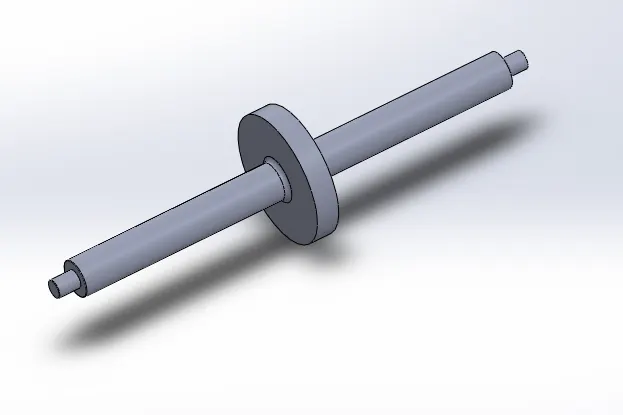
A shaft and disc were sketched and then each of the sketch was extruded as per requirement .
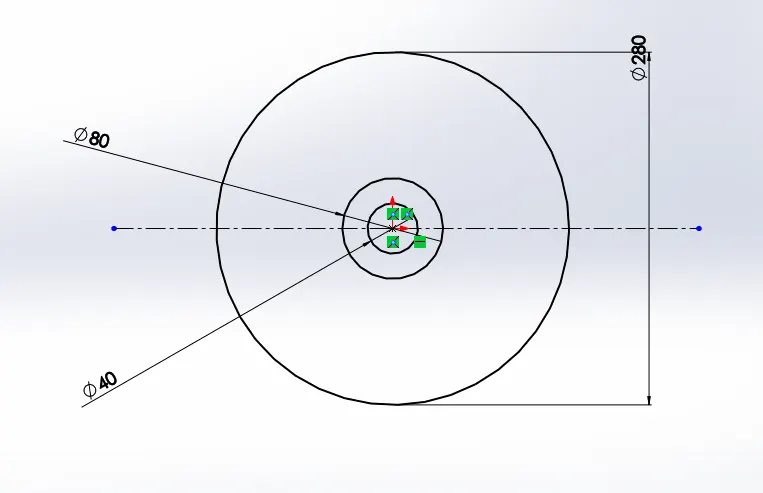
Geometry :-
After Extruding each part as per requirement
Simulation Setup:-
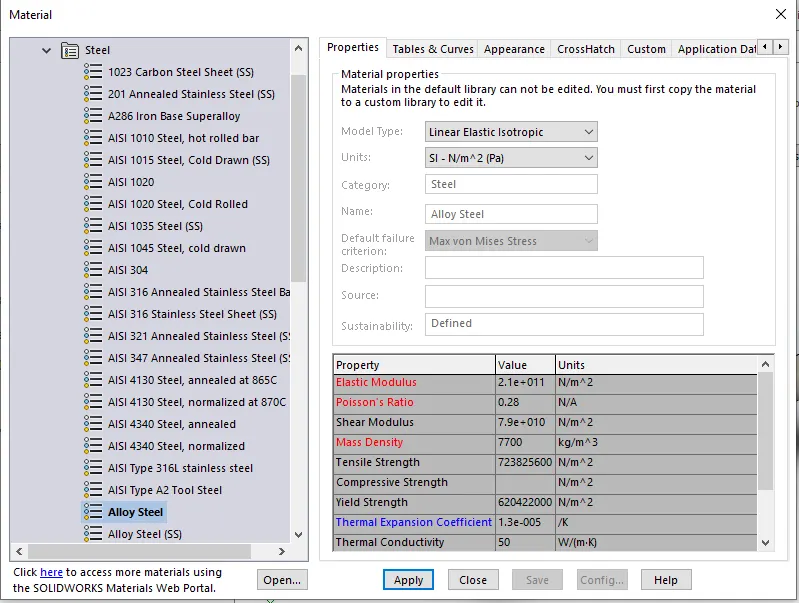
For the frequency analysis the material chosen is Alloy Steel
Fixture
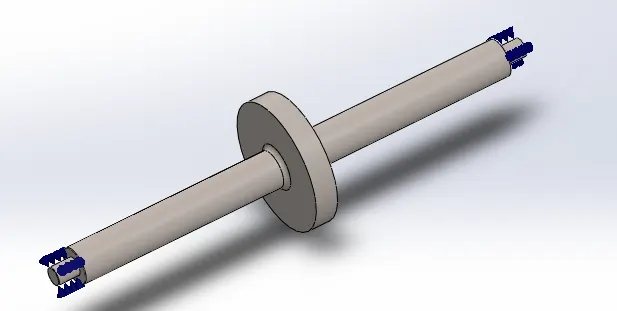
Both ends of the shaft are mounted on bearings
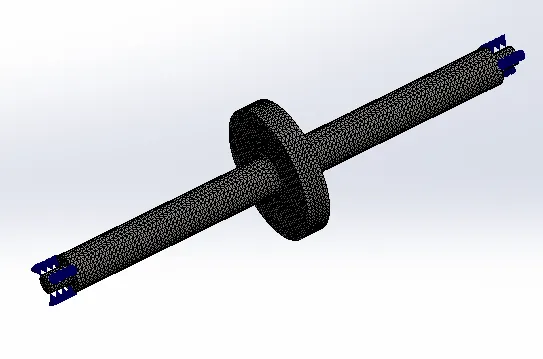
Mesh size of 9mm
Default setting of the study is kept as it is
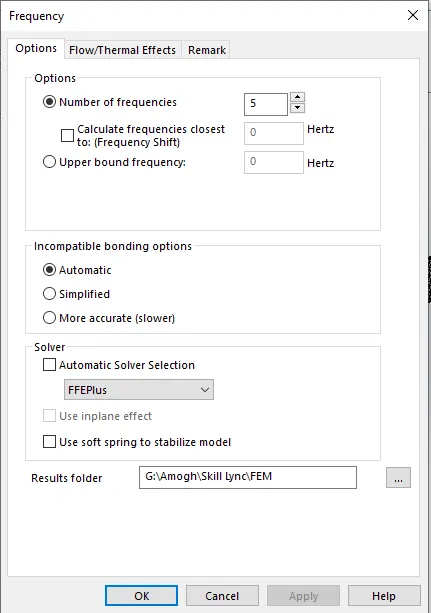
Results:-
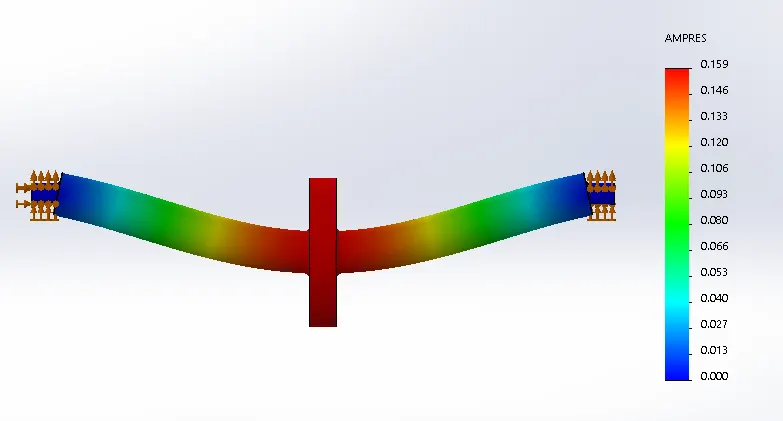
Mode Shape 1:
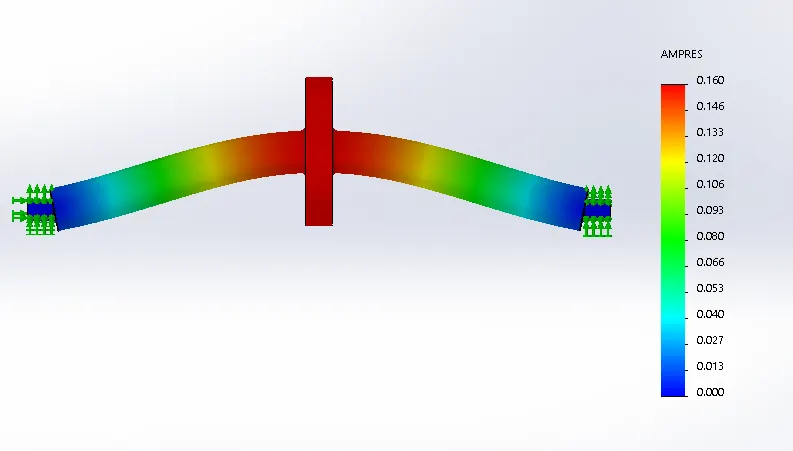
Mode Shape 2:
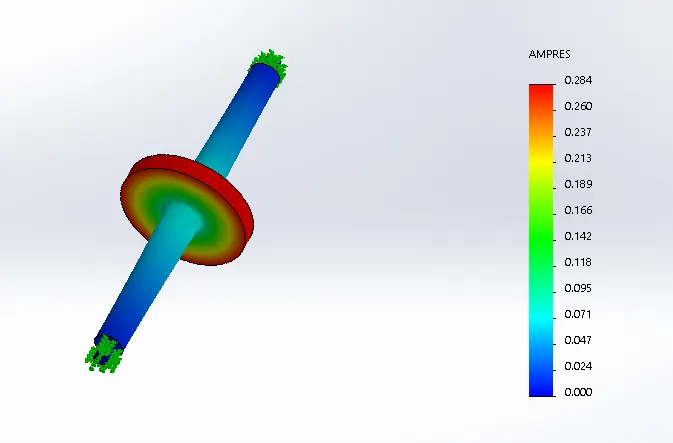
Mode Shape 3:
Mode Shape 4:
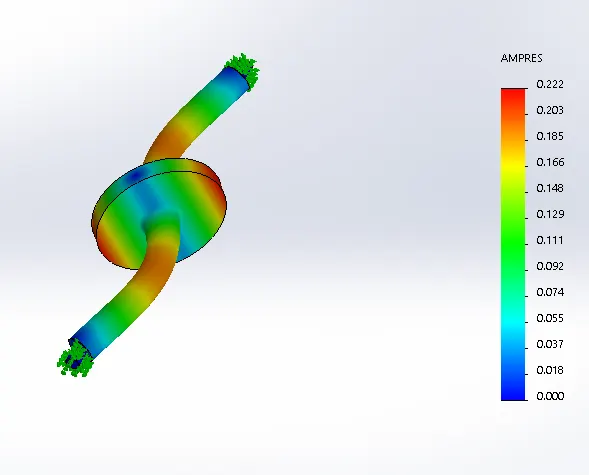
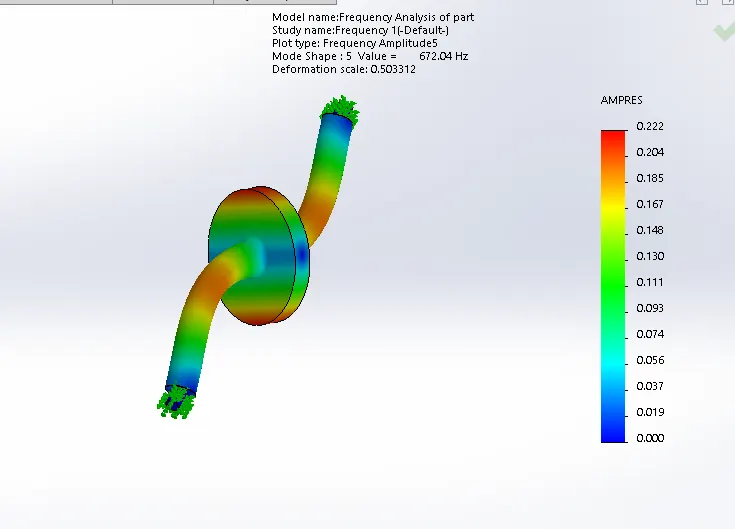
Mode Shape 5:-
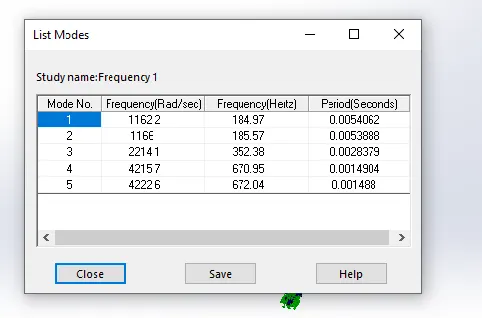
List of Resonant Frequencies:
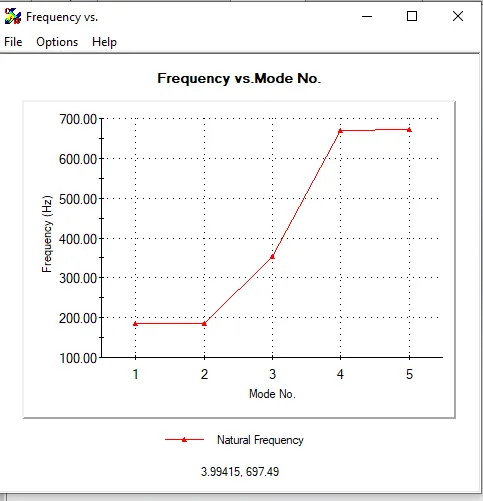
Plot of Frequency vs Mode Number
Conclusion:-
- The system has resonant frequencies at 184.97 Hz , 185.57 Hz , 352.38 Hz,670.95 Hz , 672.04 Hz . If the system is made to run near this frequencies it will cuse resonance. Whirling of shafts occurs due to roational imbalance of a shaft, even in the absence of load, which causes causes. This whirling speed of shaft is called as critical speed of shaft.
- In order to avoid effect of resonance , the system can be incorporated with spring and damper.