DUTY CYCLE
DUTY CYCLE:
OBJECTIVE:
- To explain why the power electronics circuits are efficient and the losses occur in the power electronic circuit.
- Using a suitable Matlab model show how duty cycle control signal can be generated for a simple power converter circuit.
- To Make a comparison of square wave inverter output voltage with sine modulated one.
- To explain the difference between VFD and Vector control drive and to explain whether we can use VFD method for induction motor in EV application.
1)POWER ELECTRONICS:
- Electronics applied to the conversion and control of electric power.
- Electronics signals controlling the electric power in the circuit is called Power Electronics.
- To process and control the flow of electric energy by supplying voltages and currents in a form that is optimally suited for user loads.
- The conversion is performed with the help of semiconductor switching devices such as
- The conversion is performed with semiconductor switching devices such as diodes, thyristors, and power transistors such as the power MOSFET and IGBT.
- In contrast to electronic systems concerned with the transmission and processing of signals and data, in power electronics, substantial amounts of electric energy are processed.
- The power range is typically from tens of watts to several hundred watts.
- In industry, a common application is the variable speed drive(VSD) that is used to control an induction motor.
- The power range of VSDs start from a few hundred watts and ended at tens of megawatts.
- Switching Technique is adopted from power electronics to control the voltage and current for an electric motor.
- This avoids the high amount of losses by replacing the resistor with a power module/switch.
- These power modules are operated at the high frequency where the rated battery voltage (Vbat) can be reduced to the desired voltage by on-off the modules.
- The duty cycle is varied in order to achieve the desired voltage.
- The on-off switching frequency is referred to in terms of duty ratio.
- Duty Ratio(d)=`(ON Time)/(ON+OFF Time)`
- Vavg=Vbat*d
POWER MODULES/SWITCHES:
- When it comes to EV application, the controlling of the speed of the motor mainly depends on the controlling of the voltage and current flowing to the motor.
- In order to achieve this controllers/Inverters are used to adjust the voltage in the coil and to control the magnitude of the current.
EFFICIENCY:
- Since power electronics use semiconductor devices that operate in switching mode its efficiency is higher.
- These devices don't have any mechanical moving parts and therefore, the losses are very minimal and therefore their efficiency may approach as high as 98-99%.
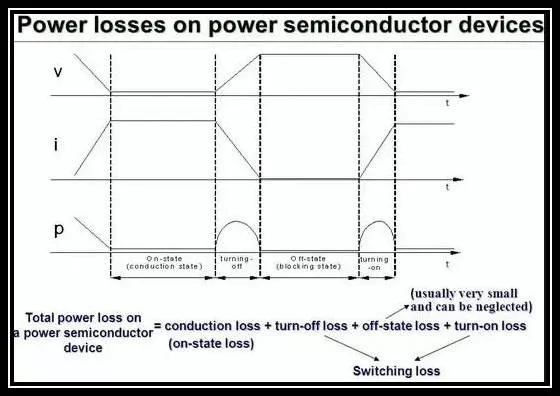
LOSSES IN POWER ELECTRONICS CIRCUIT:
There are two main losses in the power dissipation of the circuits,
- Switching loss
- Conduction loss
SWITCHING LOSS:
- Switching loss occurs when the device is transitioning from the blocking state to the conduction state and vice-versa.
- This interval is characterized by a significant voltage across its terminals and a significant current through it.
- The energy dissipated in each transition needs to be multiplied with the frequency to obtain the switching losses.
CONDUCTION LOSS:
- Conduction loss occurs when the device is in full conduction.
- The current in the device is whatever is required by the circuit and the voltage at its terminals is the voltage drop due to the device itself.
- These losses are in direct relationship with the duty cycle.
2)Duty cycle control signal:
The Buck converter model in Matlab is used to simulate the nature of the duty cycle control signal.
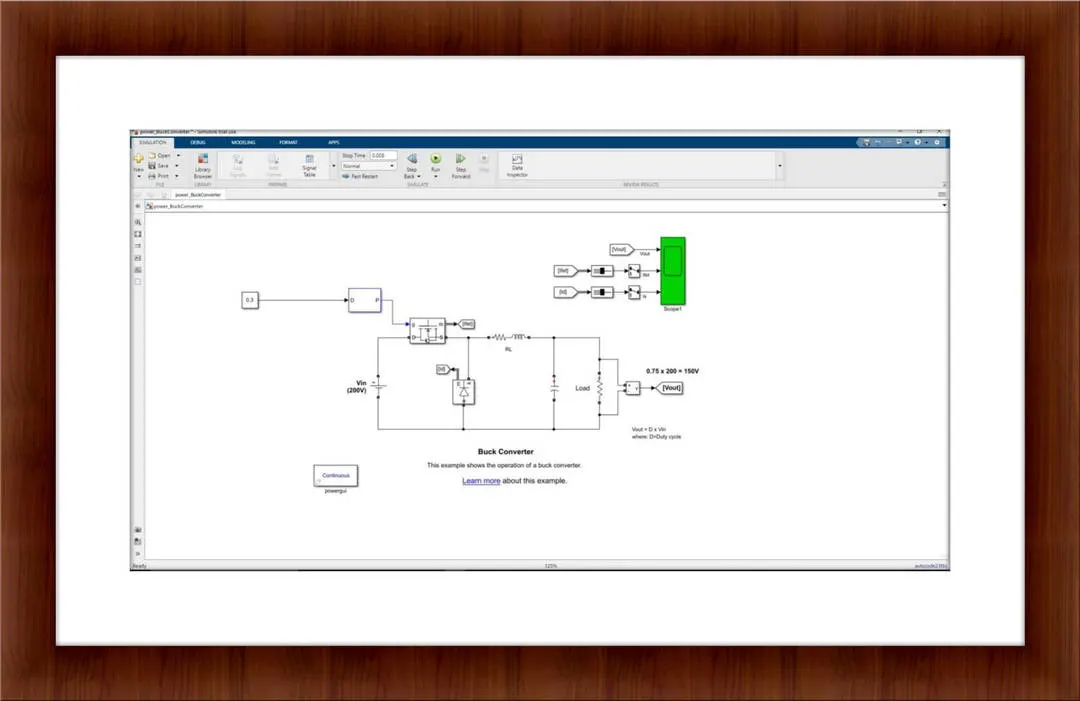
- A Buck converter is a DC/DC power converter which steps down the voltage from its input (source) to its output(Load).
- In continuous conduction mode ( Current through the inductor never falls to zero), the theoretical transfer function of the buck converter is :
d=Vout/Vin
where d is the duty cycle.
The parameters for the duty cycle as follows:
CASE-1:
d=0.3:
In the constant block, the input is given as 0.3 and the output voltage is viewed through the scope block.

CASE-2:
d=0.5:
In the constant block, the input is changed to 0.5 and the output voltage is viewed through the scope block.

CASE-3:
d=0.7:
In the constant block, the input is changed to 0.7 and the output voltage is viewed through the scope block.

RESULT:
- From the above graph, it is observed that while increasing the duty cycle the output voltage also increases correspondingly.
- This is how the duty cycle signals are generated and varied according to the required output voltage.
3)Comparison of square wave inverter output voltage with sine modulated one.
- The inverter is used to convert the DC electricity to AC electricity.
- An Inverter converts DC current to either square wave AC current or Sinewave AC current.
- Sine wave inverters are more efficient than square wave inverters when it comes to the conversion of DC to AC.
- This ensures that the power loss is minimized due to the greater efficiency.
ADVANTAGES:
- The sine wave minimises the risk of damage to your sensitive appliances compared to square wave and there is very little harmonic distortion in a sine wave, essential for expensive equipment.
- Devices that use control circuits, which sense the phase for speed/voltage control, or devices that sense instantaneous zero voltage crossing (for timing control) must have a sine wave supply.
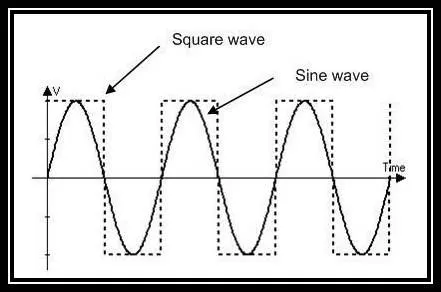
- From the figure, it is evident that the sine wave changes polarity instantaneously and smoothly when it crosses zero volts.
- The rise and fall of voltage are smooth as compared to the shape of the square wave.
- Due to this feature, the inductive loads(motors or microwaves) run quieter,cooler and faster.
- Sine wave inverters are used to support household appliances such as refrigerators, computers, laptops etc.. whereas square wave inverters are usually used to support motors alone.
- Square wave inverters are less reliable and also unsafe to use for appliances whereas sine wave inverters are highly safe to use.
- Square wave inverters produce a very loud noise when used compared to sine wave inverters which produce normal sound only.
- Practically, the square wave can also be modified further using more sophisticated inverters to produce a sine wave.
- To produce a sine wave output, high-frequency inverters are used.
- These inverters use the pulse width modification method by switching currents at high frequency, and for variable periods of time.
- Using high-frequency gradual changes in pulse width is generated.
- The pulse width modulation methods have resulted in very efficient inverters.
4)Difference between VFD and Vector control drive:
| Variable Frequency Drive(VFD) | Vector Control Drive |
| Variable Frequency Drive(VFD) control method work by optimizing the motor flux and keeping the strength of the magnetic field constant, which ensures constant torque generation. | Vector control drive controls the speed or torque of an AC motor by controlling the stator current space vectors, similar to the DC control methods by transforming a three-phase system that depends on time and speed to a two-coordinate time-invariant system |
| VFD control method varies both the voltage and frequency of power to the motor in order to maintain a fixed, constant ratio between the two, so the strength of the magnetic field is constant, regardless of motor speed. Here flux and current cannot be controlled independently. |
The stator current in an AC motor consisting of the magnetising component of the current and the torque producing component is controlled independently each with its own PI controller. |
| VFD control is typically implemented without feedback. | Vector control method uses sensors to get feedback for dynamic control. |
| Instantaneous torque control cannot be achieved by this method. | Due to the dynamic response, instantaneous torque control can be achieved. |
VFD method for induction motor in EV application:
- Speed regulation with VFD control can be achieved only 2-3% of rated motor frequency, so these methods are not suitable for applications where precise speed control is required, so the precision control in EV applications cannot be achieved.
- In VFD control, the current and flux are coupled so current variation affects the flux value.
- This method has low efficiency and thus it can reduce the vehicle efficiency and so this method is not used in induction motor in EV application.