Efficiency Analysis on Cyclone Seperator
Aim:
- To perform an analysis on a cyclone seperator model at various partice size from 1 μm to 5 μm and to identify the seperation efficiency.
- To perform the same analysis by varying the particle velocity from 1 m/sec to 5 m/sec
Emprical Models for Cyclone seperator Efficiency :
- and Leith model : This model is developed based on force balance. The model assumes that a particle carried by the vortex endures the influence of two forces: a centrifugal force, Z, and a flow resistance, W. Core length, zc, and core diameter, dc.
- Li and Wang model : This model includes particle bounce or re-entrainment and turbulent diffusion at the cyclone wall. A two-dimensional analytical expression of particle distribution in the cyclone is obtained. Li and Wang model was developed based on the following assumptions:
• The radial particle velocity and the radial concentration profile are not constant, for uncollected particles within the cyclones.
• Boundary conditions with the consideration of turbulent diffusion coefficient and particle bounce re-entrainment on the cyclone wall are:
c = c0 , at θ = 0 - Koch and Licht model : This collection theory recognized the inherently turbulent nature of cyclones and the distribution of gas residence times within the cyclone. Koch and Licht describe particle motion in the entry and collection regions with the additional following assumptions:
• The tangential velocity of a particle is equal to the tangential velocity of the gas flow, i.e. there is no slip in the tangential direction between the particle and the gas.
• The tangential velocity is related to the radius of cyclone by: uRn = constant - Lapple Model : model was developed based on force balance without considering the flow resistance. Lapple assumed that a particle entering the cyclone is evenly distributed across the inlet opening. The particle that travels from inlet half width to the wall in the cyclone is collected with 50% efficiency.
Procedure:
Space Claim:
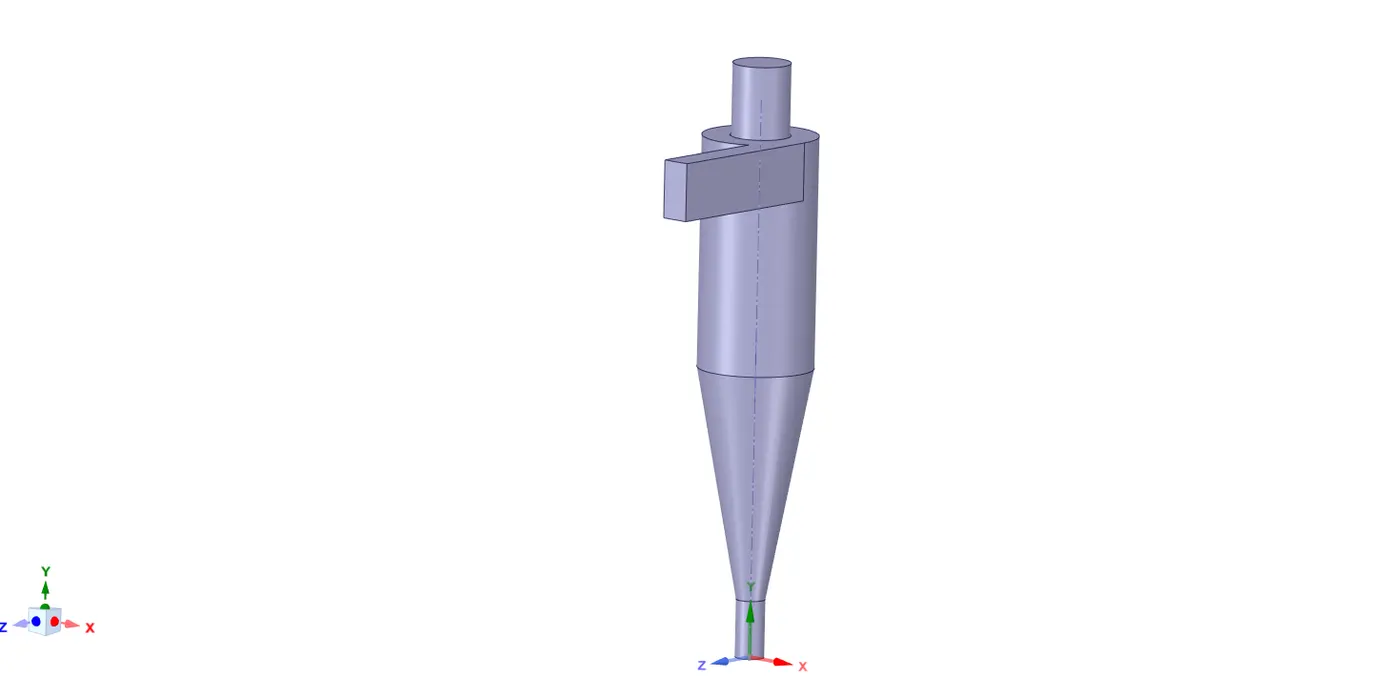
- The given geometry is imported into spaceclaim.
- The geometry is cleaned using volume extract from the prepare tool bar.
Meshing:
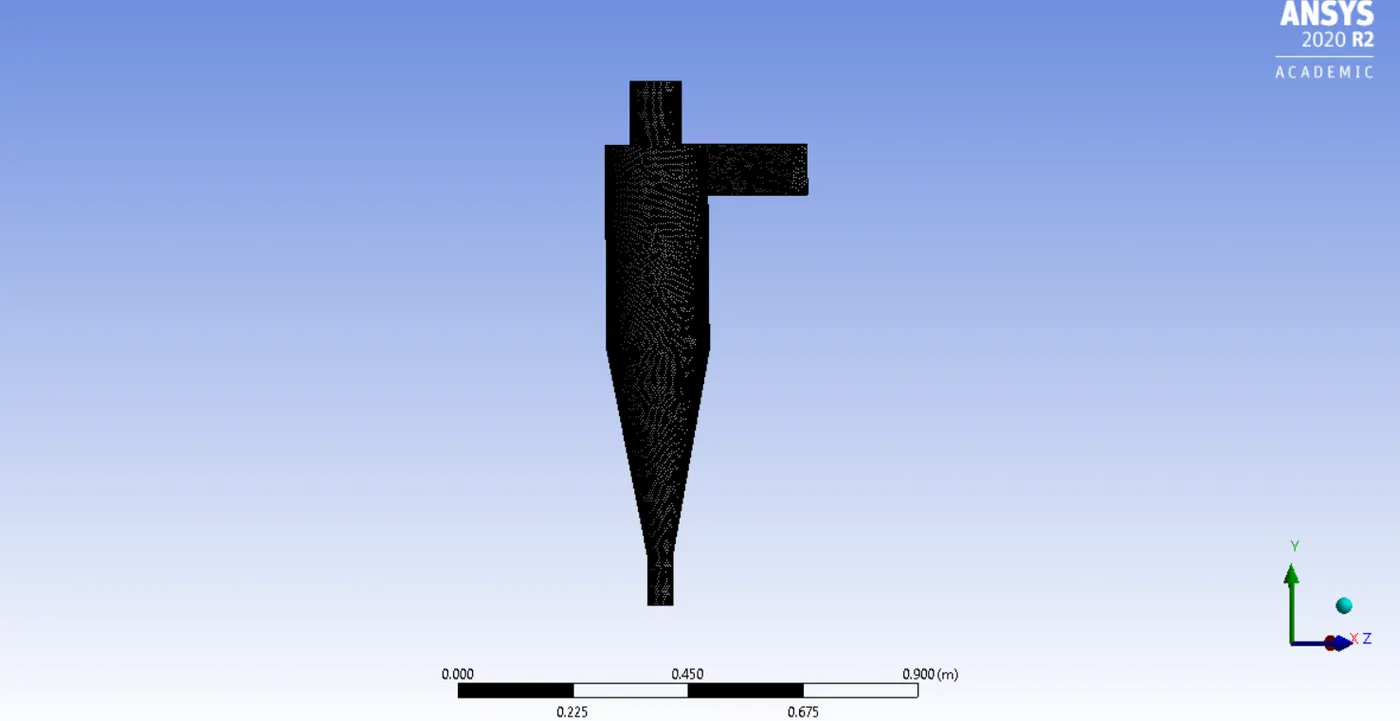
- The geometry in which the volume is extracted is then transferred to meshing window.
- First the Inlet and the two outlets are named respectively.
- Then the element size is defined as 5.7e-03m .
- The meshing type is tetrahedral mesh.

Fluent Interface :
- The meshed geometry is then transitioned into fluent interface, where the simulation type is Steady state simulation.
- The gravity is set to ON and given in the negative Y-direction, this enables the solid particles to fall down by effect of gravity.
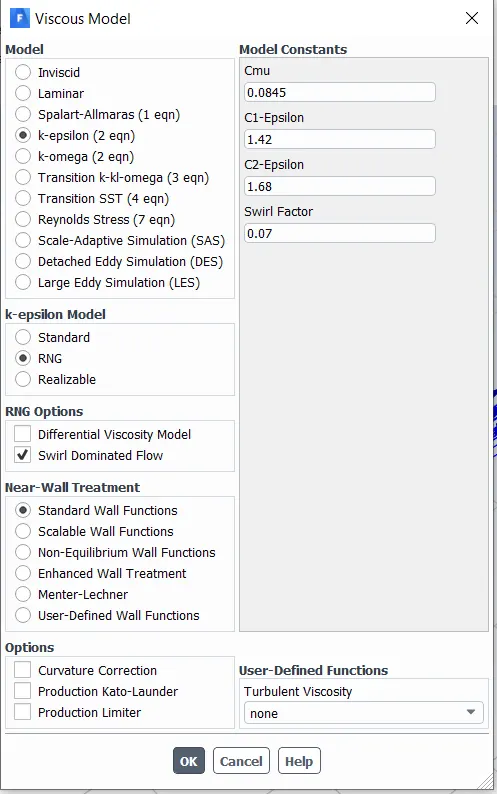
- The viscous model is K- epsilon, RNG swirl dominated flow.
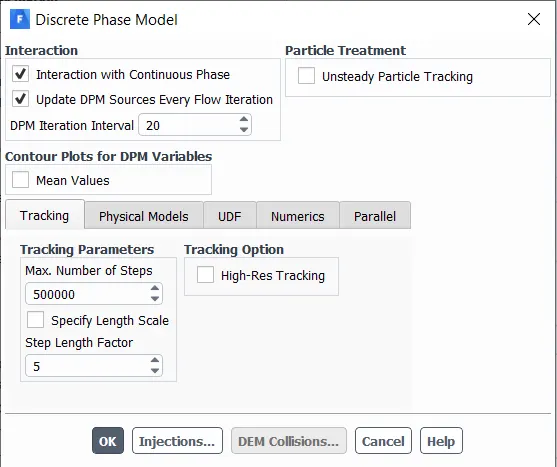
- The discrete phase modelling is selected , with interaction with continuous phase and update DPM source is turned ON.
- The Injected particle is selected , the particle injected is antracite.
- The injected surface is Inlet and face normal injection is turned on, the particle size is set to the required dimension.
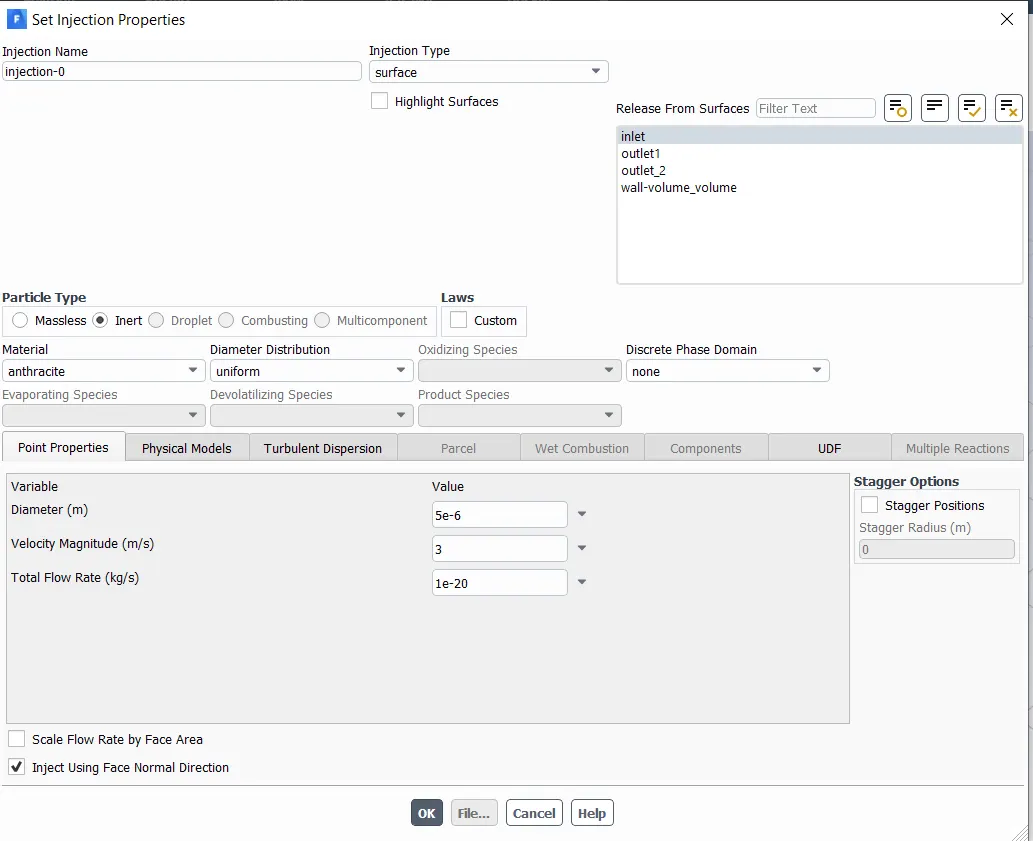
- The boundary conditions are set as follows
Inlet - Reflect , Outlet 1- Escape, Outlet 2 - Trap , Wall - Reflect 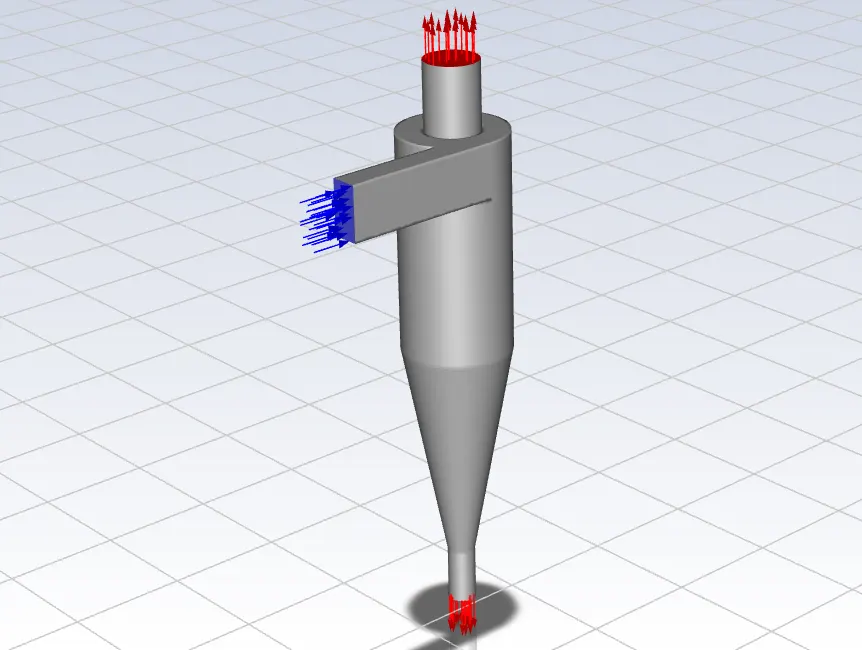
- The initialization mode is set to Standard initialization, starting from inlet.
- The momentum is set at First order Upwind
- Turbulent Kinetic energy and Dissipation rate are set to second order Upwind.
- The Setup is initialized and ran for 200 iterations.
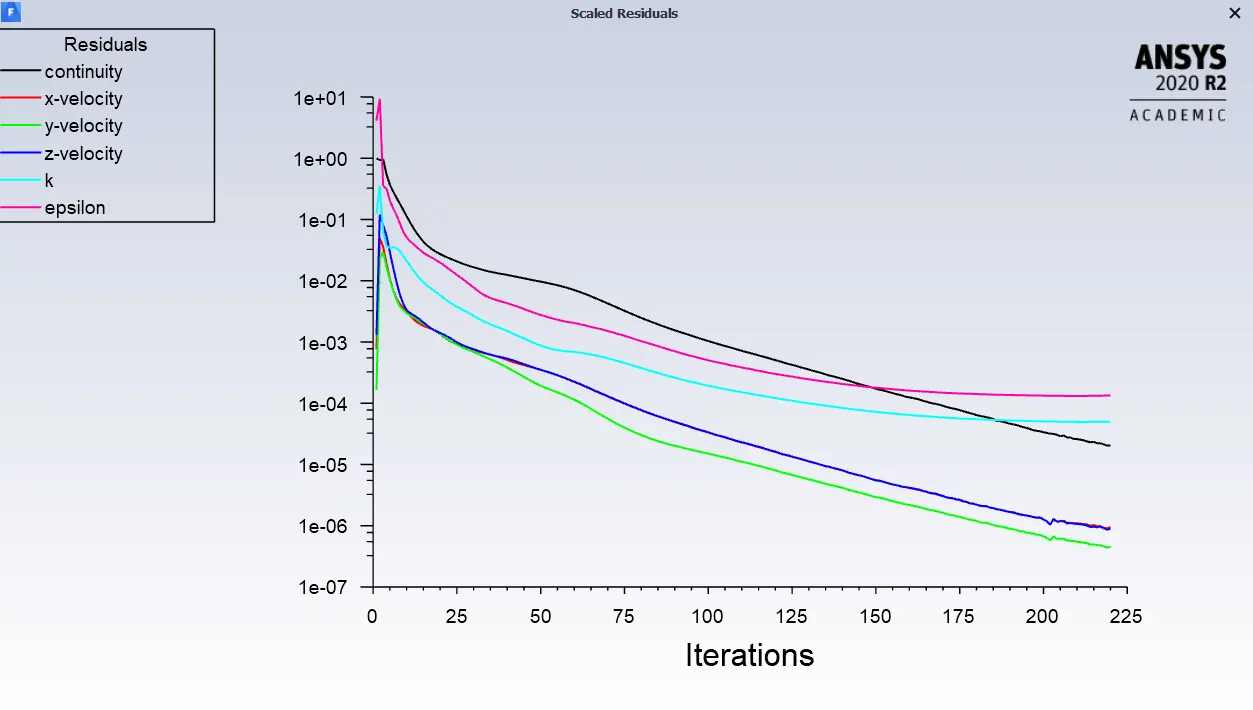
Scaled Residuals
- The DPM particle data is then exported to file location
Post Processing :
- The exported DPM particle data is now imported.
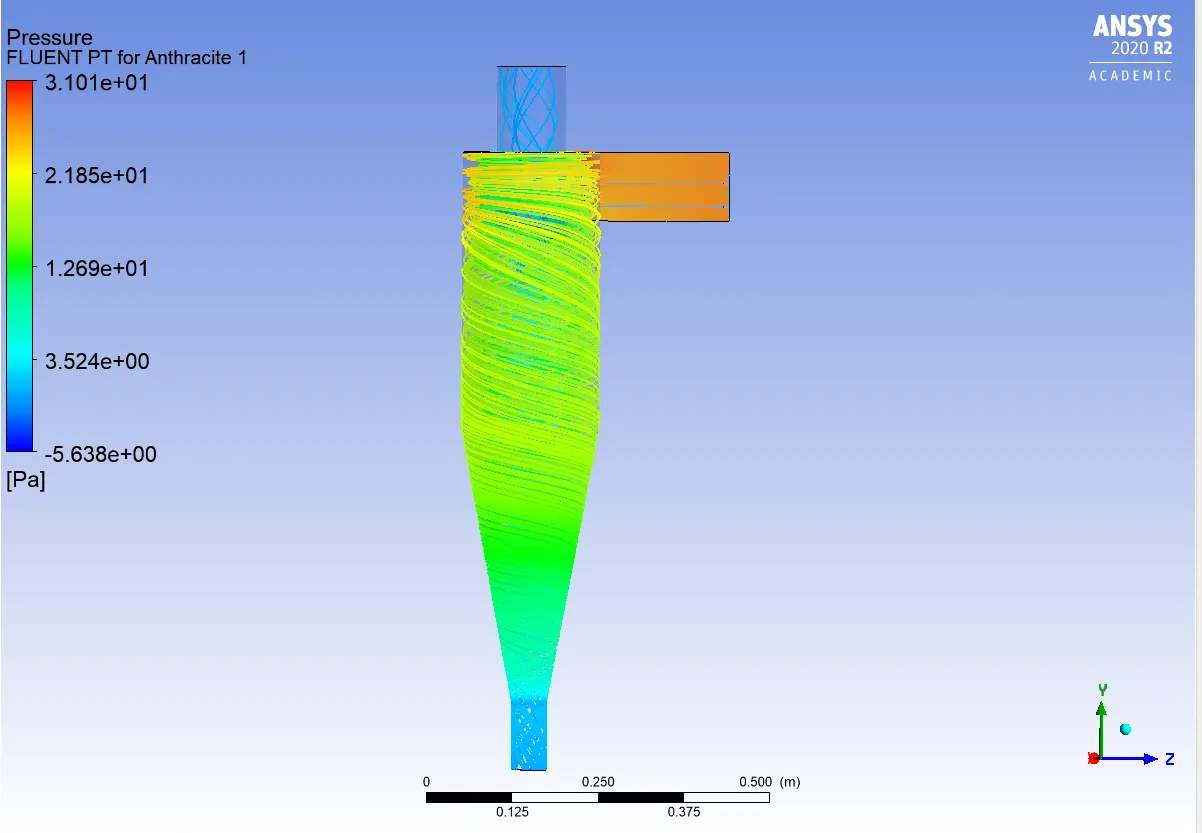
- The colour variable is chosen as DPM particle time
- A Vortex model is added and vortex intensity is set to 0.25 to visualize the vortex generated
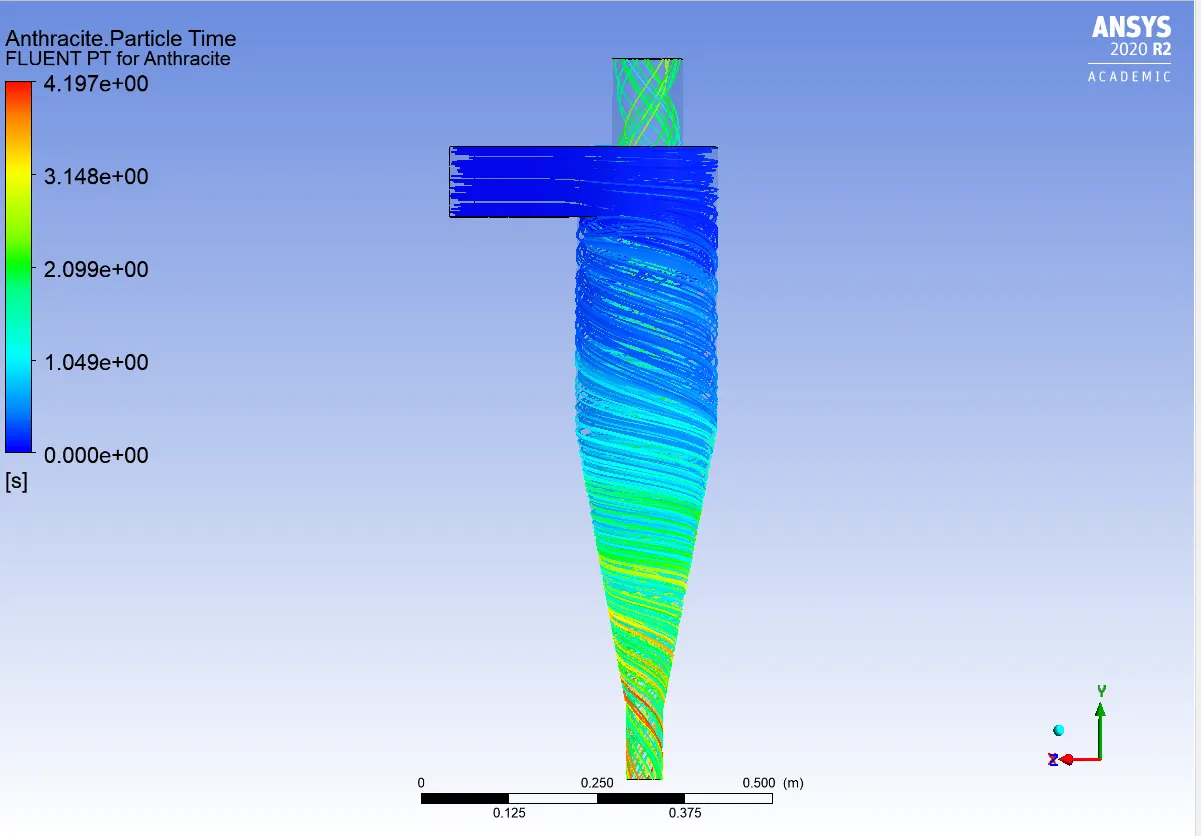
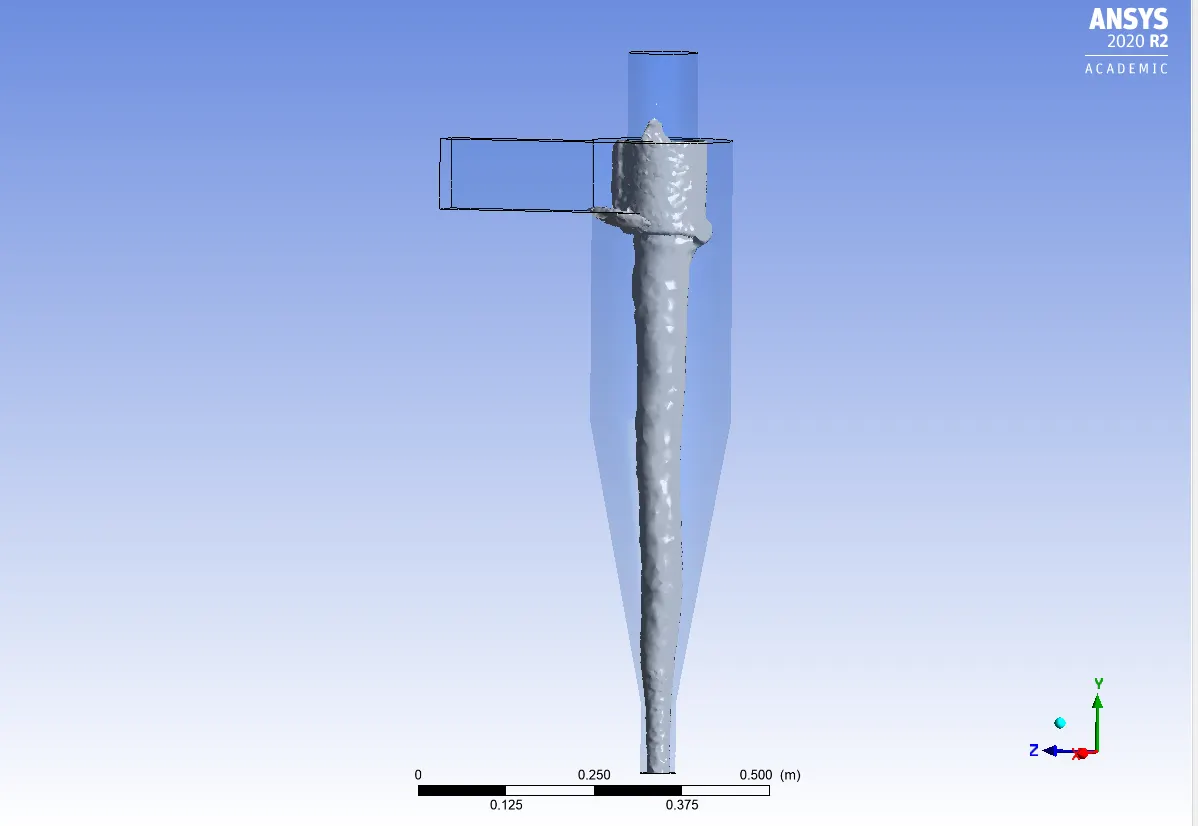
Case 1
- DPM size = 5 μm

- DPM size = 4 μm

- DPM size = 3 μm

- DPM size = 2 μm

- DPM size = 1 μm

Cyclone seperator Effeciency :
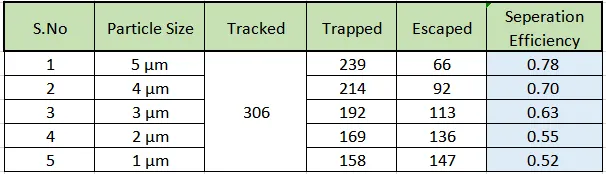
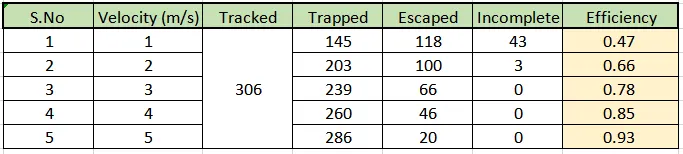
The effeciency of the cyclone seperator is the ratio if Number of particles trapped to the number of particles tracked .
Efficiency = Number of Particles Trapper / Number of Particles Tracked
Case 2 :
- 1m/s
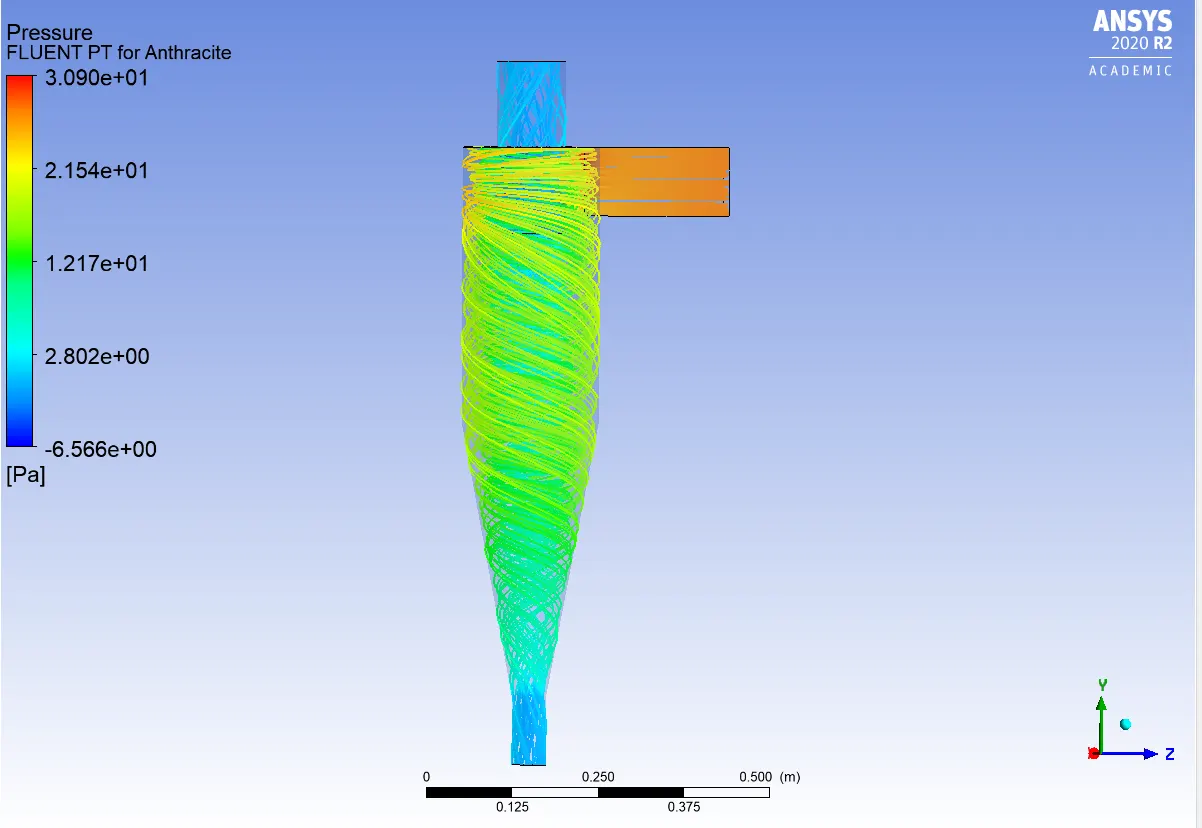
- 2m/s
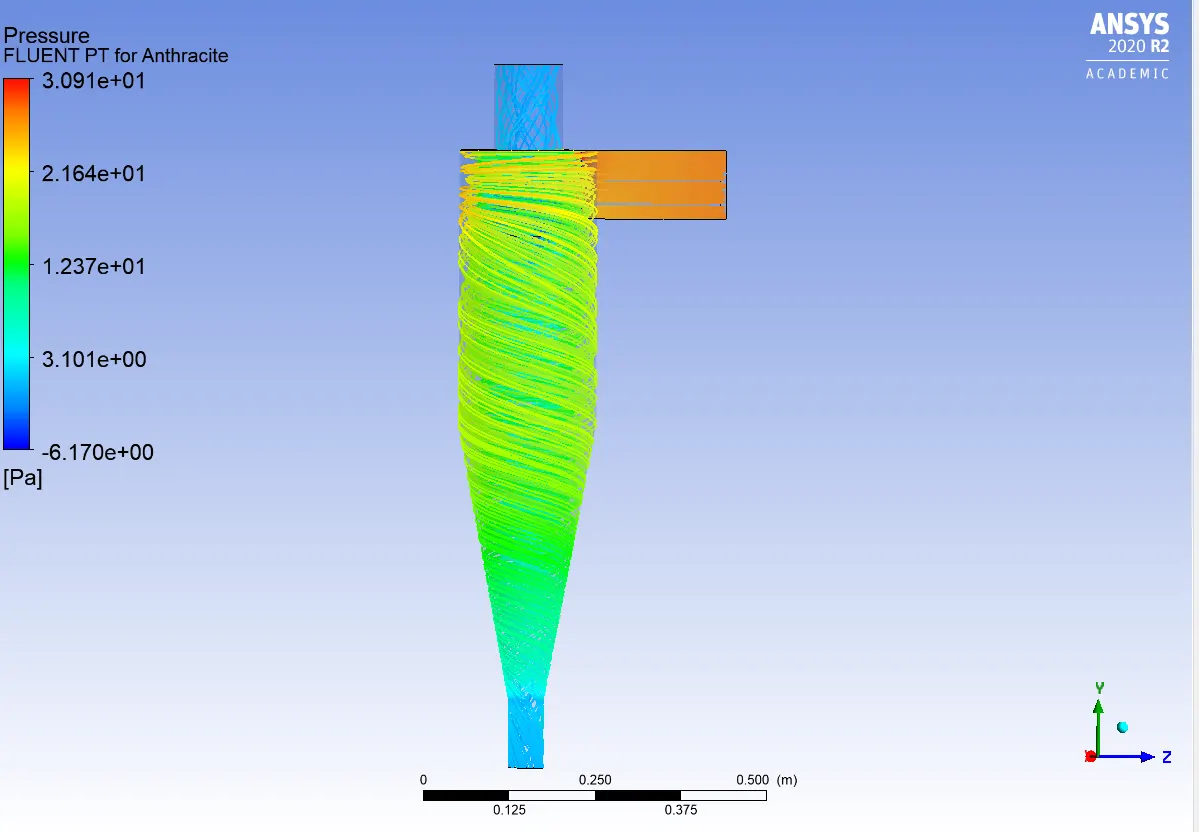
- 3m/s
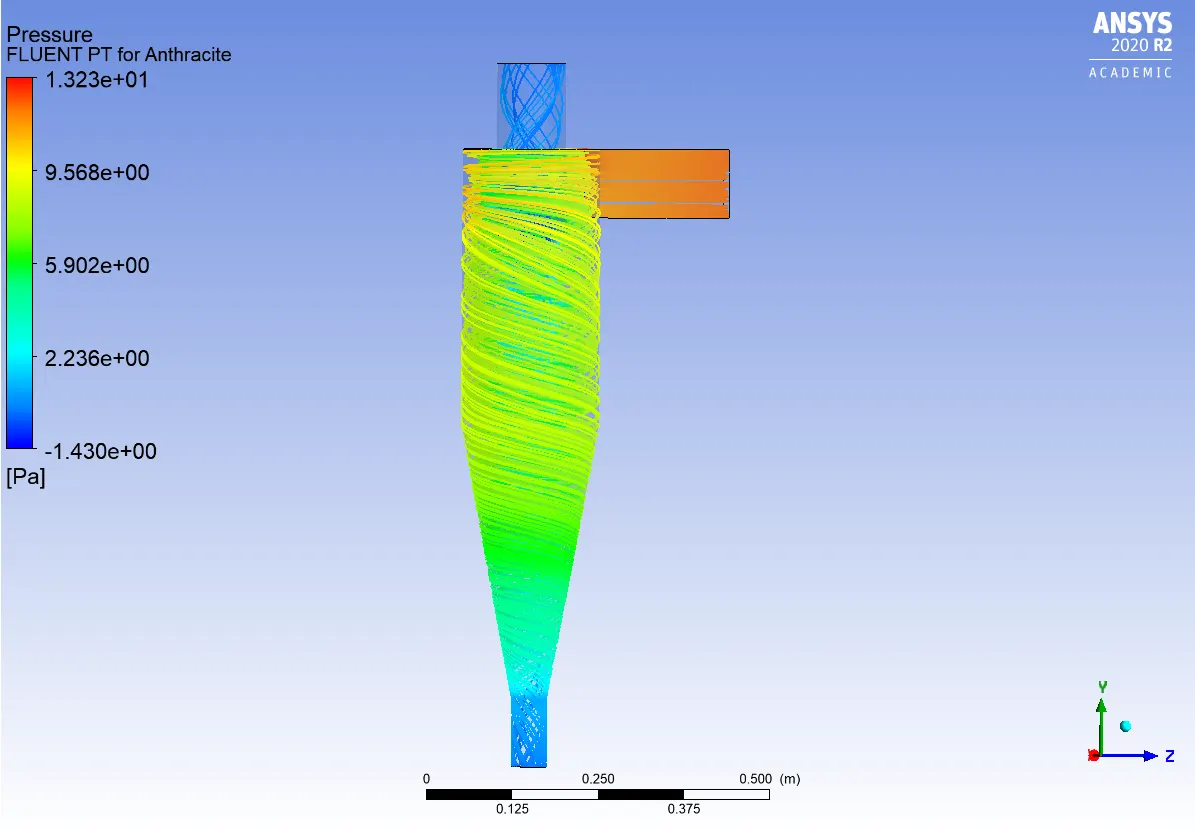
- 4m/s
Result :
- As we can see from the data, as the particle size increases, the seperation efficiency of the cyclone seperator increases.
- Similarly, as the velocity inlet particle veocity increases, the Efficiency increases