Learn theory of machines
A free, ordered path through theory of machines, from linkages and velocity analysis to gear trains, flywheels, balancing and vibrations, built from Skill-Lync's GATE solutions, calculators and articles.
- 7.3
- GATE ME marks per paper, 2022-26
- 29
- GATE questions solved
- 6
- free calculators
- 1,629
- student project reports
Updated 16 Nov 2026 · Free, no sign-up · GATE data from official ME papers 2022-2026
What is theory of machines?
Theory of machines is the study of how machine parts move and the forces that move them: linkages and cams (kinematics), gears and gear trains, flywheels, governors, balancing, brakes and vibrations (dynamics). It explains why an engine needs a flywheel, how a gearbox picks a ratio and why a shaft whirls.
Why does theory of machines matter for jobs?
Design, powertrain, vehicle dynamics and NVH engineers use it daily: sizing a gear train, checking that a linkage clears its neighbours through its full motion, or keeping a part's natural frequency away from the engine's firing frequency.
Multibody dynamics (MBD) software such as MotionView, ADAMS or SOLIDWORKS Motion is theory of machines on a computer; the vehicle dynamics and MBD courses assume the kinematics on this page.
In Skill-Lync's placement records (as of 17 Nov 2026), freshers placed in design roles were offered 3.6 LPA on average (n = 958 disclosed offers), with the middle half between 3.0 LPA and 4.2 LPA. These are starting offers from Skill-Lync placements, not a market survey: see the full salary breakdown.
How to learn theory of machines: a 6-step path
Work through these in order. Each step points to the free Skill-Lync resource that teaches it, then to a calculator, article or solved GATE question to test yourself.
- 01
Mechanisms and their mobility
Links, pairs, degrees of freedom, Grashof's law and the inversions of the four-bar and slider-crank.
- 02
Velocity and acceleration analysis
Instant centres, relative velocity, Coriolis acceleration; cams and followers.
- 03
Gears and gear trains
Tooth geometry, interference, simple, compound and epicyclic trains.
- 04
Flywheels, governors, balancing and brakes
Turning-moment diagrams, governor height-speed, balancing rotating and reciprocating masses, gyroscopic couple.
- 05
Vibrations
Free, damped and forced single-degree-of-freedom vibration, resonance and isolation.
- 06
Machines in a vehicle
Put it together: steering linkages, suspensions and multibody models.
Then test the whole subject on the 29 solved GATE questions.
Worked example: which way will this four-bar linkage move?
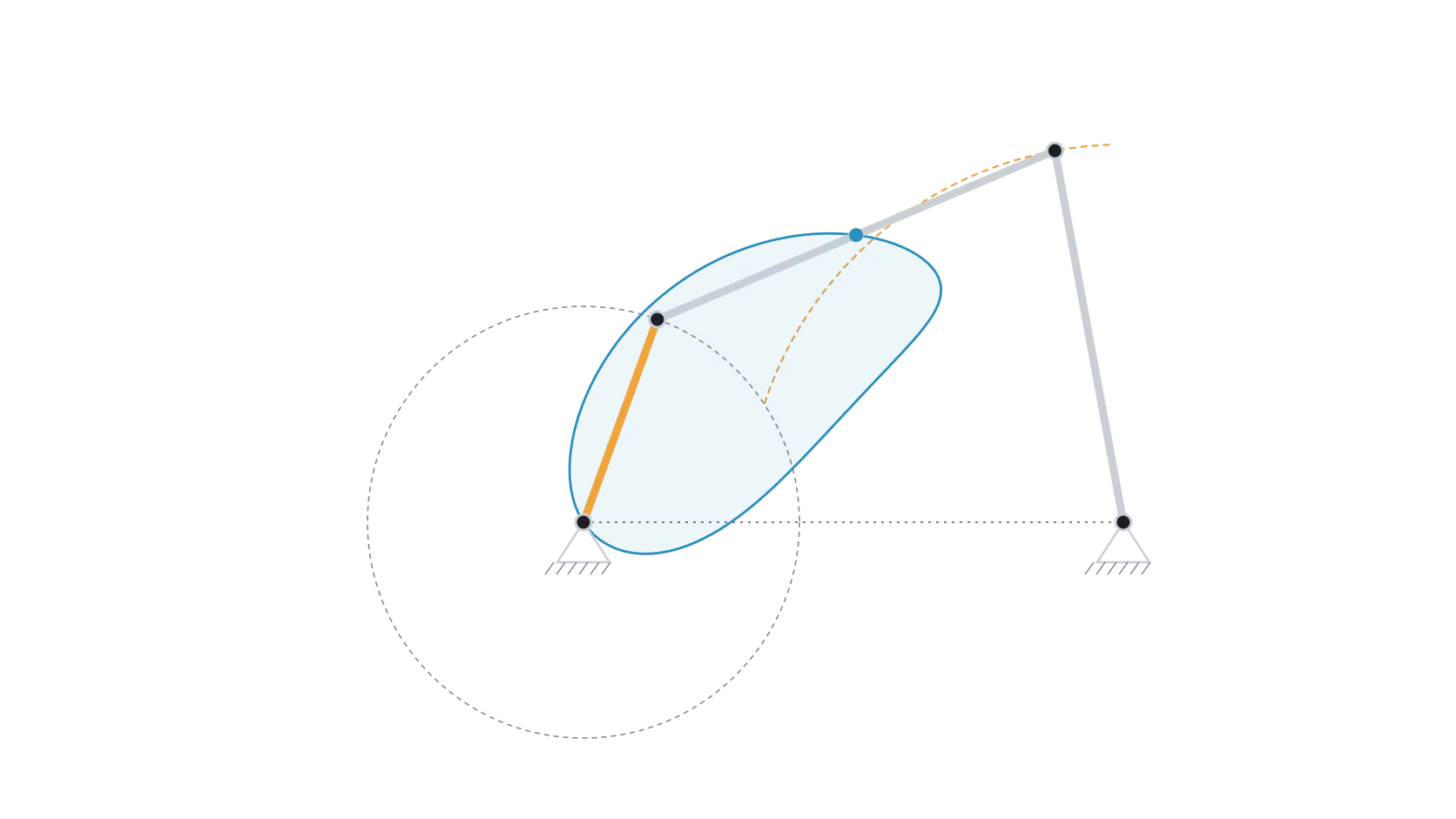
A four-bar linkage has a fixed link of 100 mm, a crank of 40 mm, a coupler of 80 mm and a rocker of 70 mm (the drawing at the top of this page).
- Grashof's condition: with the shortest link, the longest and the other two, the linkage has a link that can turn a full circle if . Here , so it is a Grashof linkage.
- The shortest link (40 mm) is next to the fixed link, so it turns fully: a crank-rocker. The 70 mm link only swings.
- Rocker limits are where crank and coupler line up: the distance from the crank pivot to the rocker pin is mm (extended) or mm (folded). The cosine rule in the triangle with the 100 mm fixed link and the 70 mm rocker gives rocker angles of 87.95° and 18.19°, a swing of about 69.8°.
- The crank turns 177.5° from the extended to the folded position and 182.5° back, so at constant crank speed the rocker takes times longer one way than the other (its time ratio).
Answer. A Grashof crank-rocker: the 40 mm crank turns fully, the rocker swings through about 69.8° and is very nearly symmetric (time ratio 1.029), so it suits a wiper-like oscillating drive rather than a quick-return.
Every number here is recomputed when the page is built and checked by an independent script (Skill-Lync, 16 Nov 2026).
Free theory of machines resources
Everything below is free to read, watch or use. Skill-Lync made all of it except the last group.
Calculators and simulators
- Planetary gear calculatorRatios and speeds of an epicyclic train, any member fixed
- Ackermann steering calculatorSteering linkage exact across the lock, turning circle
- Ride frequency calculatorSuspension natural frequency and damping
- Natural frequency calculatorSpring-mass, beams and shafts · Skill-Lync Resources
- Gear types simulatorSpur, helical, bevel and worm gears in 3D · Skill-Lync Resources
- Suspension dynamics simulatorQuarter-car model you can excite and damp · Skill-Lync Resources
Articles
- Cam and Follower Mechanism: Types, Motion Laws, Cam Profile and UsesSkill-Lync blog
- Building a Four-Bar Mechanism in MotionView for Multibody Dynamics SimulationSkill-Lync blog
- How Does a Car Manual Gearbox Work?Skill-Lync blog
- Creating a Planetary Gear System in SolidWorks: Step-by-StepSkill-Lync blog
- Types of Steering Gearbox: Rack and Pinion, Recirculating Ball and MoreSkill-Lync blog
- Mastering Multibody Dynamics using SolidWorks: Simulating a Geneva MechanismSkill-Lync blog
Beyond Skill-Lync
What Skill-Lync students built
1,629 public project reports on Skill-Lync apply theory of machines directly (counted by title on 16 Nov 2026):
| Project | What it practises | Reports |
|---|---|---|
| Internal Geneva mechanism | intermittent motion: wheel position, velocity and acceleration from a motion study | 310 |
| Planetary gear set | carrier, sun and ring speeds from an assembled gear set | 263 |
| Piston driven by a cam | follower displacement and contact forces from a cam profile | 159 |
| Simple pendulum | the pendulum equation of motion solved as an ODE and animated in MATLAB or Python | 897 |
How many marks does theory of machines carry in GATE ME?
Theory of Machines carried 7.3 marks per paper on average in the 6 GATE Mechanical papers from 2022 to 2026 (each out of 100), between 4 and 10. Skill-Lync solved all 29 of those questions and checked each one against the official answer key.
| 2022 S1 | 2022 S2 | 2023 | 2024 | 2025 | 2026 |
|---|---|---|---|---|---|
| 7 | 7 | 4 | 10 | 9 | 7 |
Marks per paper, from the solved questions on the GATE theory of machines page; the subject-wise table for every subject is on GATE ME weightage.
Is there a Skill-Lync theory of machines course?
No dedicated Skill-Lync course on theory of machines yet. The closest are Multibody Dynamics for Automotive Applications using Motionview and Motionsolve (8 h) and Multibody Dynamics using SolidWorks (3 h), which cover multibody dynamics: building joints, motions and contacts of mechanisms in MotionView/MotionSolve or SOLIDWORKS Motion and reading their kinematic and dynamic results. They use the software to analyse mechanisms; they do not teach the hand methods (instant centres, gear-train tables, governors, balancing) or exam practice.
See vehicle dynamics and MBD courses compared. If you want a full theory of machines course from Skill-Lync, leave your details and we will tell you when one launches.
Theory of Machines: questions learners ask
What is the difference between kinematics and dynamics of machines?
Kinematics of machines studies motion alone: positions, velocities and accelerations of links, cams and gears, without asking what forces cause them. Dynamics of machines adds the forces and inertia: flywheels, governors, balancing, gyroscopic couples and vibrations. Many universities teach them as two separate courses.
How many marks does theory of machines carry in GATE Mechanical?
In the six GATE ME papers from 2022 to 2026 theory of machines and vibrations carried 7.3 marks per paper on average, between 4 and 10. Skill-Lync has solved all 29 of those questions step by step, checked against the official answer keys, on the GATE theory of machines page.
What is Grashof's law?
For a four-bar linkage with shortest link s, longest link l and other links p and q, at least one link can rotate fully when s + l is less than or equal to p + q. Which link is fixed then decides the type: crank-rocker, double-crank or double-rocker, as the worked example on this page shows.
Does Skill-Lync have a theory of machines course?
Not yet. The closest are the multibody dynamics courses, which teach mechanism simulation in MotionView/MotionSolve and SOLIDWORKS Motion. Everything on this page is free, and you can ask to be told when a theory of machines course launches.