Learn machine design
A free, ordered path through machine design (design of machine elements), from factor of safety and failure theories to fatigue, bolted and welded joints, shafts, bearings, gears and fits, built from Skill-Lync's calculators, GATE solutions, lessons and student projects.
- 2.7
- GATE ME marks per paper, 2022-26
- 13
- GATE questions solved
- 8
- free calculators
- 741
- student project reports
Updated 16 Nov 2026 · Free, no sign-up · GATE data from official ME papers 2022-2026
What is machine design?
Machine design, or design of machine elements, is choosing the size, shape and material of parts such as shafts, bolts, welds, springs, bearings and gears so they carry their loads without yielding, breaking by fatigue or deflecting too much, with a stated factor of safety, and so they fit and can be made.
Why does machine design matter for jobs?
Product design and design engineer roles use it daily. A CAD model is only a shape until someone has checked that the shaft will not fail in fatigue, the bolts hold their preload and the fits assemble. Design interviews for freshers ask about factor of safety, von Mises stress, Goodman and Soderberg lines, and hole-shaft fits.
It is also where FEA earns its keep: a FEA course teaches you to compute stresses on complex parts, but deciding whether those stresses are acceptable uses the failure theories and fatigue rules on this page.
In Skill-Lync's placement records (as of 17 Nov 2026), freshers placed in design roles were offered 3.6 LPA on average (n = 958 disclosed offers), with the middle half between 3.0 LPA and 4.2 LPA. These are starting offers from Skill-Lync placements, not a market survey: see the full salary breakdown.
How to learn machine design: a 7-step path
Work through these in order. Each step points to the free Skill-Lync resource that teaches it, then to a calculator, article or solved GATE question to test yourself.
- 01
Design process, materials and factor of safety
Loads, stresses, material properties from a tensile test, and how a factor of safety is chosen.
- 02
Static failure theories
Maximum principal stress, Tresca and von Mises: which to use for brittle and ductile materials, and why they differ in shear.
- 03
Fatigue and variable loads
S-N curves, endurance limit, stress concentration, and the Goodman, Soderberg and Gerber lines for fluctuating stress.
- 04
Bolted, riveted and welded joints
Bolt preload and tightening torque, eccentrically loaded rivet groups, and fillet and butt weld sizing.
- 05
Shafts, keys and springs
Shafts under combined bending and torsion (the worked example below), critical speed, keys, couplings and helical springs.
- 06
Bearings, gears and power screws
Rolling bearing life, gear tooth forces and gear trains, and the efficiency of square-threaded screws.
- 07
Limits, fits and tolerances
ISO hole-shaft fits, tolerance stack-up and GD&T: making sure the parts you sized will assemble.
Then test the whole subject on the 13 solved GATE questions.
Worked example: how thick must this shaft be?
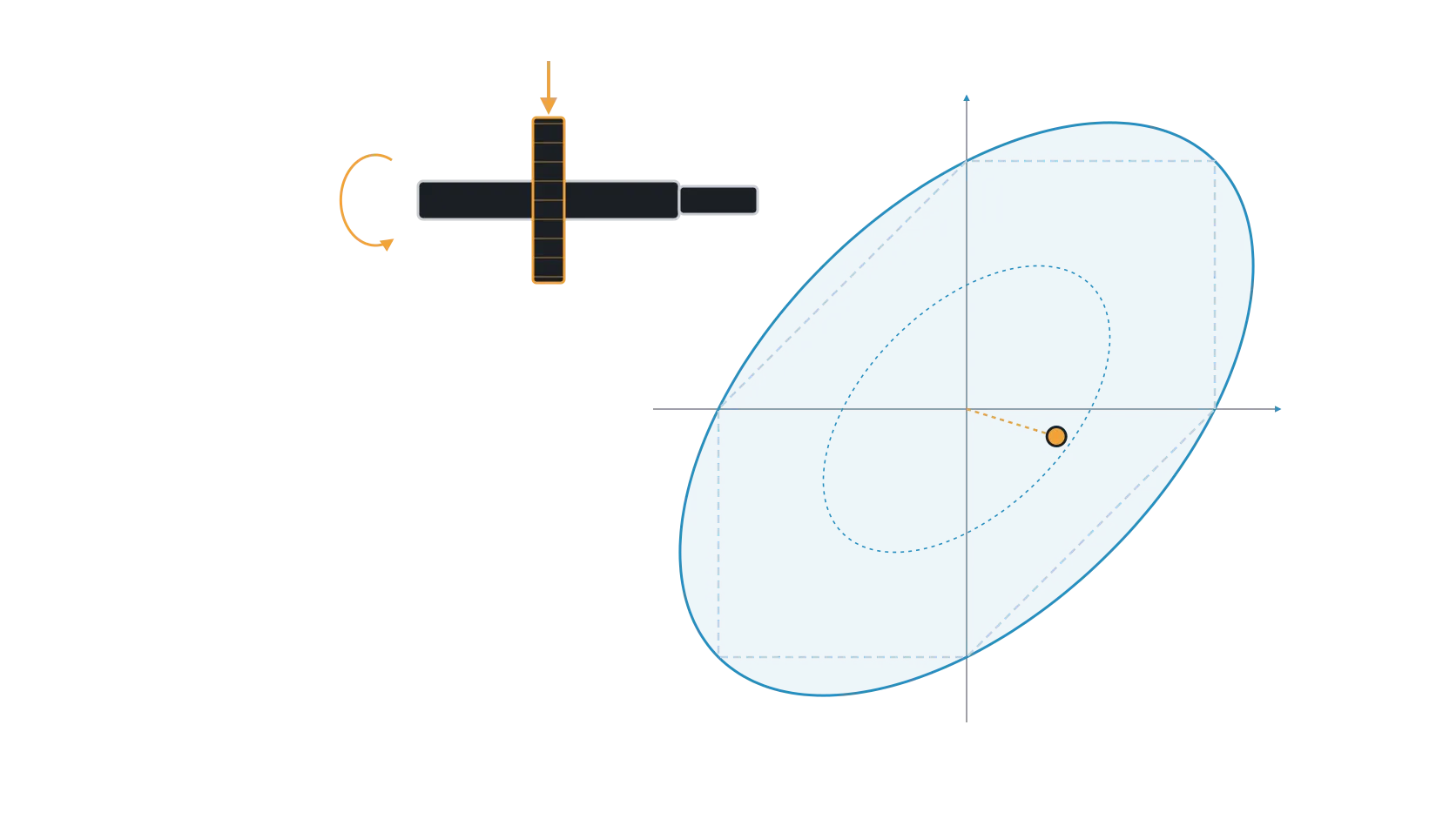
A solid steel shaft transmits kW at rpm and also carries a bending moment N·m from a gear. The steel's yield strength is MPa and the required factor of safety is . Size the shaft by the maximum shear stress (Tresca) and distortion energy (von Mises) theories.
- Torque from power: N·m.
- Tresca: the largest shear stress is and may reach MPa, so mm.
- von Mises: the equivalent stress is and may reach MPa, so mm.
- Pick the next standard size, mm. Then bending stress is 75.5 MPa, shear stress 60.0 MPa, MPa and the real factor of safety is .
Answer. A 30 mm shaft. Tresca asks for 29.4 mm and von Mises for 28.5 mm: Tresca is the more conservative theory, and both round up to the same standard size, giving a factor of safety of 2.33 on yield.
Every number here is recomputed when the page is built and checked by an independent script (Skill-Lync, 16 Nov 2026).
Free machine design resources
Everything below is free to read, watch or use. Skill-Lync made all of it except the last group.
Calculators and simulators
- Weld strength calculatorFillet and butt welds to IS 800 or AISC, eccentric loads
- Bolt torque calculatorTightening torque and preload, M3-M36, VDI 2230 · Skill-Lync Resources
- Limits and fits calculatorISO 286 hole and shaft limits, clearance or interference
- Tolerance stack-up calculatorWorst case, RSS and Monte Carlo
- Yield strength calculator0.2% offset proof stress from test data
- Von Mises stress guideYield criteria and reading FEA stress results · Skill-Lync Resources
- Spring simulatorHooke's law: force, deflection, stress and energy · Skill-Lync Resources
- Gear types simulatorSpur, helical, bevel and worm gears in 3D · Skill-Lync Resources
Free video lessons
- GD&T Benefits and Traditional Dimensioning Limits12 min · from Geometric Dimensioning and Tolerancing
- Reading Feature Control Frames and the ASME Y14.5 Standard24 min · from Geometric Dimensioning and Tolerancing
- Tolerance Stack-Up Analysis with RSS, MRSS and Worst Case21 min · from Geometric Dimensioning and Tolerancing
Articles
- How Are CAD and CAE Revolutionizing Machine Design?Skill-Lync blog
- How to Calculate Fatigue Life in Product DevelopmentSkill-Lync blog
- Fatigue Analysis of an S-Hook Using SolidWorksSkill-Lync blog
- All About Tolerance Stack-Up AnalysisSkill-Lync blog
- The Various Types of Springs and Their Everyday UsesSkill-Lync blog
- Governors & Bearings Explained Simply - Mechanical Engineering Interview QuestionsSkill-Lync blog
Beyond Skill-Lync
What Skill-Lync students built
741 public project reports on Skill-Lync apply machine design directly (counted by title on 16 Nov 2026):
| Project | What it practises | Reports |
|---|---|---|
| Spur gear stress analysis | tooth bending and contact stress of a gear pair in Ansys, compared across materials | 273 |
| Weld joint verification | weld joints checked by FEA in Ansys for different weld materials | 201 |
| Rotating shaft frequency analysis | natural frequencies and resonance of a shaft in SOLIDWORKS Simulation | 214 |
| GD&T on an assembly drawing | datums and tolerances applied to a butterfly valve and other assemblies | 53 |
How many marks does machine design carry in GATE ME?
Machine Design carried 2.7 marks per paper on average in the 6 GATE Mechanical papers from 2022 to 2026 (each out of 100), between 0 and 6. Skill-Lync solved all 13 of those questions and checked each one against the official answer key.
| 2022 S1 | 2022 S2 | 2023 | 2024 | 2025 | 2026 |
|---|---|---|---|---|---|
| 4 | 0 | 3 | 2 | 6 | 1 |
Marks per paper, from the solved questions on the GATE machine design page; the subject-wise table for every subject is on GATE ME weightage.
Is there a Skill-Lync machine design course?
No dedicated Skill-Lync course on machine design yet. The closest are FEA using SOLIDWORKS (4 h) and Geometric Dimensioning and Tolerancing (14 h), which cover two parts of machine design: checking stress, fatigue, buckling and natural frequency by simulation, and specifying tolerances with GD&T. Neither teaches the hand design of joints, shafts, bearings, gears or springs, or exam problem practice.
See every Skill-Lync FEA course compared. If you want a full machine design course from Skill-Lync, leave your details and we will tell you when one launches.
Machine Design: questions learners ask
Is machine design the same as design of machine elements?
Yes. Most Indian universities call the course Design of Machine Elements (DME) and GATE calls the subject Machine Design. Both cover the same core: failure theories, fatigue, joints, shafts, keys, springs, bearings, gears and power screws, sized with a factor of safety and checked against standard data books.
How many marks does machine design carry in GATE Mechanical?
In the six GATE ME papers from 2022 to 2026 machine design carried 2.7 marks per paper on average, between 0 and 6. Skill-Lync has solved all 13 of those questions step by step, checked against the official answer keys, on the GATE machine design page.
Which failure theory should I use, Tresca or von Mises?
For ductile metals, von Mises (distortion energy) matches test results best and is what FEA software reports. Tresca (maximum shear stress) is slightly more conservative, by up to about 15% in pure shear, and is simpler by hand. For brittle materials such as cast iron, use the maximum principal stress theory.
Does Skill-Lync have a machine design course?
Not yet. Skill-Lync has no course on machine design itself. The closest are FEA using SOLIDWORKS, which covers static, fatigue, buckling and frequency analysis, and the GD&T course for tolerancing. Everything on this page is free, and you can ask to be told when a machine design course launches.