Learn fluid mechanics
A free, ordered path through fluid mechanics, from viscosity and manometers to pipe losses, boundary layers and pumps, built from Skill-Lync's own book, GATE solutions, calculators and lessons.
- 8.5
- GATE ME marks per paper, 2022-26
- 32
- GATE questions solved
- 10
- book chapters, 15 interactives
- 2,764
- student project reports
Updated 16 Nov 2026 · Free, no sign-up · GATE data from official ME papers 2022-2026
What is fluid mechanics?
Fluid mechanics is the study of liquids and gases at rest and in motion: pressure, buoyancy, flow rate, energy losses and the forces a flow puts on a surface. Engineers use it to size pipes and pumps, predict drag on cars and aircraft, and design nozzles, turbines and cooling systems.
Why does fluid mechanics matter for jobs?
Every CFD, HVAC, pump, turbomachinery and aerodynamics job assumes it. CFD interviews for freshers open with Reynolds number, the assumptions behind Bernoulli's equation, boundary layers and pressure drop before anyone asks about software, because a simulation you cannot sanity-check by hand is worthless.
The same subject is the base for the CFD courses: the continuity and momentum equations from chapters 3 and 4 of the book are the same conservation laws a CFD solver discretises.
In Skill-Lync's placement records (as of 17 Nov 2026), freshers placed in CFD roles were offered 3.9 LPA on average (n = 150 disclosed offers), with the middle half between 2.8 LPA and 4.5 LPA. These are starting offers from Skill-Lync placements, not a market survey: see the full salary breakdown.
How to learn fluid mechanics: a 6-step path
Work through these in order. Each step points to the free Skill-Lync resource that teaches it, starting with the matching chapters of the interactive book, then to a calculator, article or solved GATE question to test yourself.
- 01
Fluid properties and statics
Viscosity, pressure, manometers and buoyancy: the vocabulary for everything after.
- 02
Kinematics, Bernoulli and momentum
Streamlines, continuity, Bernoulli with its assumptions, flow meters and jet forces.
- 03
Viscous flow and pipe losses
Laminar profiles, the Moody chart, minor losses and pipe networks: the pump-sizing chapter.
- 04
Dimensional analysis and boundary layers
Model testing, the boundary layer, drag and lift on bodies.
- 05
Compressible flow and turbomachines
Speed of sound, nozzles and shocks, then turbines and pump curves.
- 06
From hand calculation to CFD
See the same flows solved numerically: pipe flow, a cylinder's wake, turbulence models.
Then test the whole subject on the 32 solved GATE questions.
Worked example: is the flow in this pipe laminar, and what does it cost?
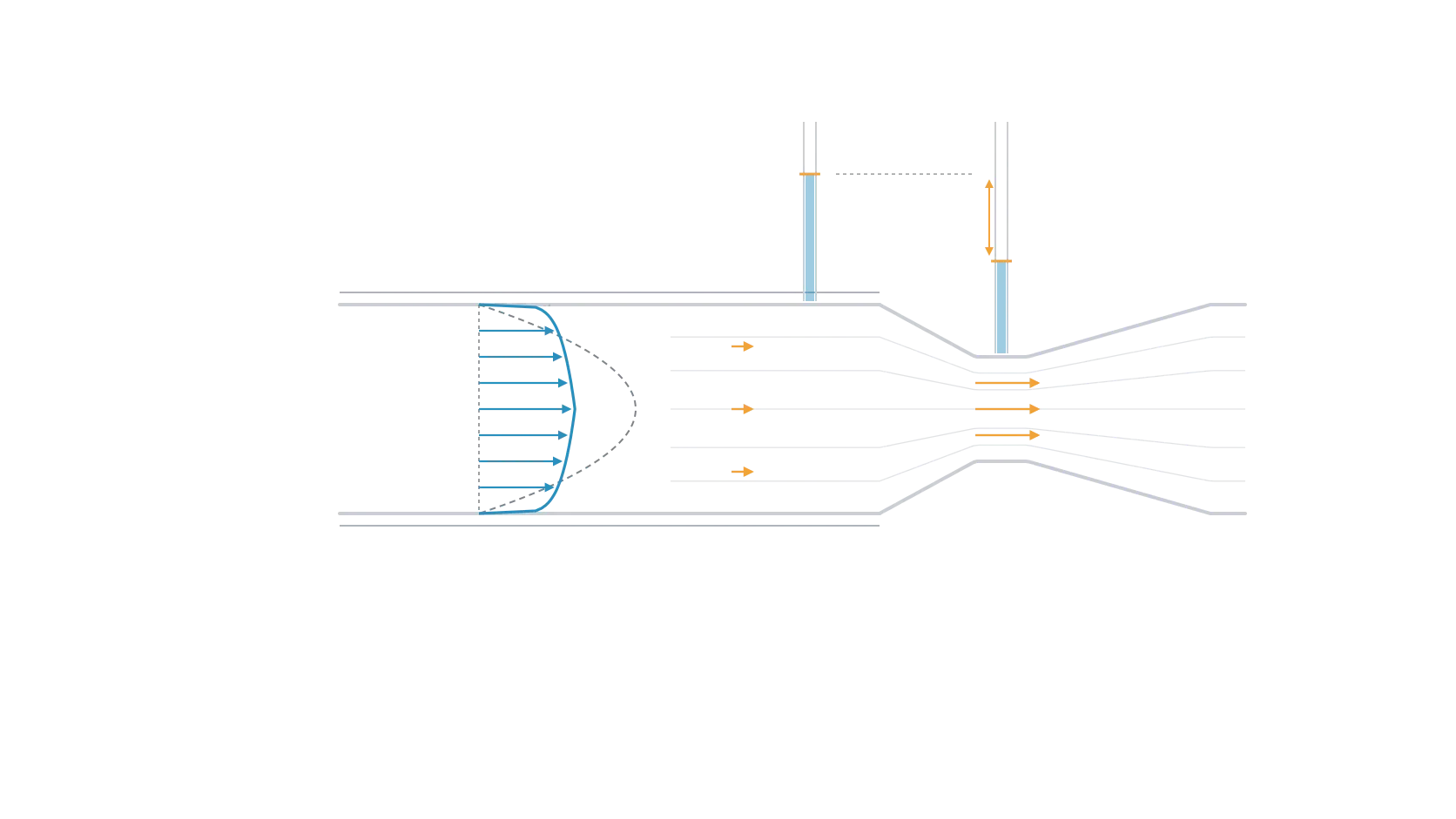
Water at 20 °C ( kg/m³, m²/s) flows at m/s through a smooth pipe of mm, m long. The pipe then passes through a venturi with a 12.5 mm throat.
- Reynolds number: . That is far above about 2,300, so the flow is turbulent, not laminar.
- Friction factor for a smooth pipe (Blasius, valid up to ): .
- Head loss over 10 m (Darcy-Weisbach): m, so the pressure drop is kPa.
- Venturi throat: continuity gives m/s, and Bernoulli gives kPa between inlet and throat.
Answer. Turbulent (Re about 29,900), 6.9 kPa lost per 10 m of pipe, and a 10.8 kPa reversible drop at the venturi throat, which is what a venturi meter reads to measure the flow rate.
Every number here is recomputed when the page is built and checked by an independent script (Skill-Lync, 16 Nov 2026).
Free fluid mechanics resources
Everything below is free to read, watch or use. Skill-Lync made all of it except the last group.
Interactive book
Calculators and simulators
Free video lessons
- Introduction to CFD, Fluid Properties and the CFD Workflow21 min · from Introduction to Aero-Thermal simulation using ANSYS Fluent
- Setting Up and Viewing a Pipe Flow Simulation40 min · from CFD Simulation using SolidWorks
- 2D Flow Over a Cylinder: Vortex Shedding, Steady vs Transient48 min · from Introduction to GUI based CFD using ANSYS Fluent
- Aerodynamics Basics: Speed of Sound, Pitot Tubes and Forces32 min · from Introduction to Aero-Thermal simulation using ANSYS Fluent
- CFD Course Roadmap and Conservation Laws Behind Navier-Stokes36 min · from Advanced CFD using OpenFOAM
Articles
- Fluid Dynamics vs. Fluid Mechanics: Understanding the Key DifferencesSkill-Lync blog
- What is CFD? Computational Fluid Dynamics Explained for EngineersSkill-Lync blog
- Setting Up a Pipe Flow Simulation with Line Probes: A Step-by-Step GuideSkill-Lync blog
- Introduction to RANS Turbulence Models: Fundamentals and ApplicationsSkill-Lync blog
- Study of Cavitation in Winkl – Hoffer NozzleSkill-Lync blog
- Simulating Flow Through a Centrifugal Pump Using SolidWorksSkill-Lync blog
Answered by Skill-Lync experts
Beyond Skill-Lync
What Skill-Lync students built
2,764 public project reports on Skill-Lync apply fluid mechanics directly (counted by title on 16 Nov 2026):
| Project | What it practises | Reports |
|---|---|---|
| Flow over a cylinder | wake, vortex shedding and drag at different Reynolds numbers | 928 |
| 1D supersonic nozzle | quasi-1D nozzle flow solved with the MacCormack method | 689 |
| Backward-facing step | separation and reattachment behind a sudden expansion | 739 |
| Centrifugal pump | pump flow, pressure rise and efficiency | 264 |
| Pipe flow | developing velocity profile and pressure drop in a pipe | 144 |
How many marks does fluid mechanics carry in GATE ME?
Fluid Mechanics carried 8.5 marks per paper on average in the 6 GATE Mechanical papers from 2022 to 2026 (each out of 100), between 7 and 10. Skill-Lync solved all 32 of those questions and checked each one against the official answer key.
| 2022 S1 | 2022 S2 | 2023 | 2024 | 2025 | 2026 |
|---|---|---|---|---|---|
| 8 | 8 | 10 | 7 | 10 | 8 |
Marks per paper, from the solved questions on the GATE fluid mechanics page; the subject-wise table for every subject is on GATE ME weightage.
Is there a Skill-Lync fluid mechanics course?
No dedicated Skill-Lync course on fluid mechanics yet. The closest is Post Graduate Program in Computational Fluid Dynamics (125 h), which cover CFD from the conservation laws up: writing your own solvers in MATLAB and Python, then CONVERGE and Ansys Fluent on industry flows. It assumes the fluid mechanics on this page and does not teach manometers, hydraulic machines or exam problem practice.
See every Skill-Lync CFD course compared. If you want a full fluid mechanics course from Skill-Lync, leave your details and we will tell you when one launches.
Fluid Mechanics: questions learners ask
What is the difference between fluid mechanics and fluid dynamics?
Fluid mechanics is the whole subject: fluids at rest (statics) and in motion. Fluid dynamics is the part about fluids in motion, the forces, momentum and energy of a flow. Computational fluid dynamics (CFD) solves those equations of motion numerically on a computer instead of by hand.
How many marks does fluid mechanics carry in GATE Mechanical?
In the six GATE ME papers from 2022 to 2026 fluid mechanics carried 8.5 marks per paper on average, between 7 and 10. Skill-Lync has solved all 32 of those questions step by step, checked against the official answer keys, on the GATE fluid mechanics page.
Is fluid mechanics hard?
It is one of the harder second-year subjects because it mixes calculus with physical intuition. Most students struggle with when Bernoulli applies and with pipe-loss problems. Learning it visually first, by changing a flow and watching the profile or pressure respond, then doing worked numbers, is faster than memorising derivations.
Does Skill-Lync have a fluid mechanics course?
Not yet. Skill-Lync has no course on fluid mechanics itself. The closest is the PG Program in CFD, which starts from the conservation laws and teaches simulation. Everything on this page is free, and you can ask to be told when a fluid mechanics course launches.