Learn strength of materials
A free, ordered path through strength of materials, from stress and strain to Mohr's circle, beams, torsion and buckling, built from Skill-Lync's own book, GATE solutions, calculators and lessons.
- 10
- GATE ME marks per paper, 2022-26
- 35
- GATE questions solved
- 9
- book chapters, 13 interactives
- 803
- student project reports
Updated 16 Nov 2026 · Free, no sign-up · GATE data from official ME papers 2022-2026
What is strength of materials?
Strength of materials (also called mechanics of materials or mechanics of solids) is the study of how loaded parts stretch, bend, twist and fail. It turns loads into stresses and deflections, so an engineer can choose a section and material that carries the load safely without wasting weight.
Why does strength of materials matter for jobs?
Design engineers use it every time they size a shaft, a bracket or a bolt, and every FEA (CAE) engineer uses it to check whether a simulation result is believable: a hand calculation of bending stress or deflection is the first sanity check on any mesh.
It is also the base for the FEA courses: the stress transformation and Mohr's circle chapter is exactly what an FEA solver reports as principal and von Mises stress.
In Skill-Lync's placement records (as of 17 Nov 2026), freshers placed in CAE (FEA) roles were offered 3.4 LPA on average (n = 285 disclosed offers), with the middle half between 2.8 LPA and 3.5 LPA. These are starting offers from Skill-Lync placements, not a market survey: see the full salary breakdown.
How to learn strength of materials: a 6-step path
Work through these in order. Each step points to the free Skill-Lync resource that teaches it, starting with the matching chapters of the interactive book, then to a calculator, article or solved GATE question to test yourself.
- 01
Stress, strain and elastic constants
Axial load, Hooke's law, the stress-strain curve and thermal stress.
- 02
Principal stresses and Mohr's circle
Stress transformation: the chapter FEA results are built on.
- 03
Shear force and bending moment diagrams
Draw SFD and BMD for any loading before you compute a single stress.
- 04
Bending, shear stress and deflection
Flexure formula, section modulus and the beam deflection formulas.
- 05
Torsion, springs and columns
Shafts in torsion, helical springs and Euler buckling.
- 06
Cylinders, strain energy and the jump to FEA
Pressure vessels and impact loads, then the same stresses computed by FEA.
Then test the whole subject on the 35 solved GATE questions.
Worked example: will this beam yield, and how far will it sag?
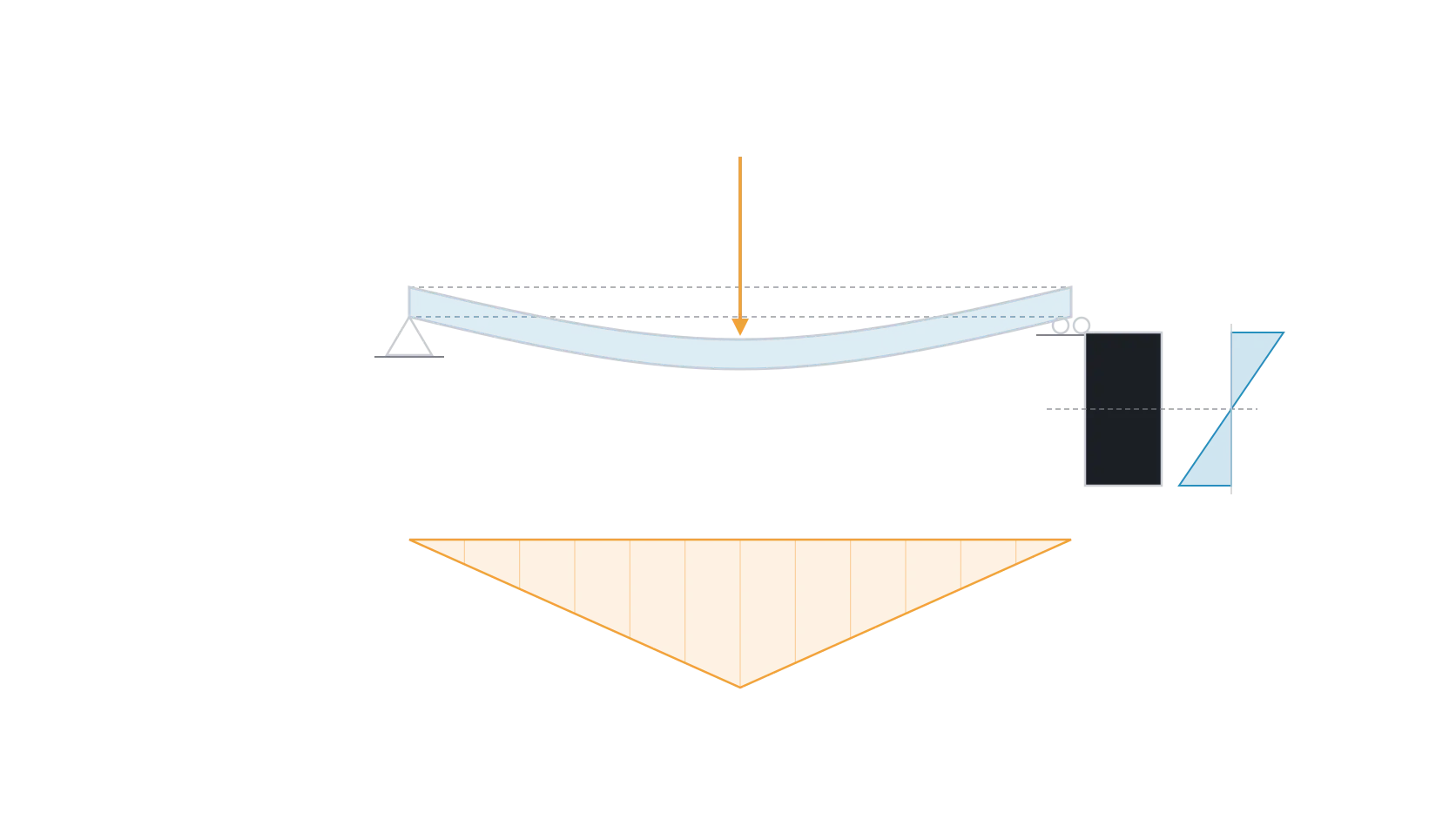
A simply supported steel beam spans m and carries kN at mid-span. Its section is a solid rectangle mm wide and mm deep. Steel: GPa, yield strength 250 MPa.
- Maximum bending moment, at mid-span: kN m.
- Second moment of area: mm⁴.
- Bending stress at the top and bottom fibres: MPa, so the factor of safety on yield is .
- Mid-span deflection: mm.
Answer. The beam does not yield (117 MPa against 250 MPa, factor of safety about 2.1) and sags about 4.9 mm, which is span/410. Turning the same bar on its side (80 wide, 40 deep) cuts I to a quarter: the deflection quadruples and the stress doubles to about 234 MPa.
Every number here is recomputed when the page is built and checked by an independent script (Skill-Lync, 16 Nov 2026).
Free strength of materials resources
Everything below is free to read, watch or use. Skill-Lync made all of it except the last group.
Interactive book
Calculators and simulators
- Yield strength calculator0.2% offset yield from your own test data
- Beam deflection calculatorDeflection and slope for standard beam cases · Skill-Lync Resources
- Section modulus calculatorZ, I and bending stress for I, T, tube and box · Skill-Lync Resources
- Stiffness calculatorAxial, bending, spring and torsional stiffness · Skill-Lync Resources
- Von Mises stress guideYield criteria with an interactive stress state · Skill-Lync Resources
Free video lessons
- Strength of Materials for FEA: Stress, Strain and Principal Stresses39 min · from Structural Analysis using Ansys Workbench
- Mohr's Circle and the Finite Element Method Explained74 min · from Structural Analysis using Ansys Workbench
- Introduction to Beams: Loads, Beam Types and Supports26 min · from Mastering Shear Force and Bending Moment Diagrams
- Stress, Strain, Hooke's Law and the Steel Stress-Strain Curve37 min · from Mastering Shear Force and Bending Moment Diagrams
- Static vs Dynamic Analysis and a Plate With a Hole in SolidWorks18 min · from CAE Simulation using SolidWorks
Articles
- 0.2% Offset Method: How to Find Yield Strength, with a Worked ExampleSkill-Lync blog
- Stress vs Pressure: Key Differences Explained with Worked ExamplesSkill-Lync blog
- Strain Gauge Principles: How They Work, Applications & TypesSkill-Lync blog
- Comparison of stress concentration on plates with different number of holesSkill-Lync blog
- How to Calculate Fatigue Life in Product DevelopmentSkill-Lync blog
- A Comprehensive Guide to Performing Buckling Analysis in SolidWorksSkill-Lync blog
Answered by Skill-Lync experts
Beyond Skill-Lync
What Skill-Lync students built
803 public project reports on Skill-Lync apply strength of materials directly (counted by title on 16 Nov 2026):
| Project | What it practises | Reports |
|---|---|---|
| Plate with a hole | stress concentration around a hole, compared with the textbook factor | 395 |
| Tension and torsion test | virtual tensile and torsion tests on a specimen | 182 |
| Beams in bending | different sections under the same load, checked against beam formulas | 122 |
| Buckling | critical loads of columns and stands | 104 |
How many marks does strength of materials carry in GATE ME?
Strength of Materials carried 10 marks per paper on average in the 6 GATE Mechanical papers from 2022 to 2026 (each out of 100), between 6 and 15. Skill-Lync solved all 35 of those questions and checked each one against the official answer key.
| 2022 S1 | 2022 S2 | 2023 | 2024 | 2025 | 2026 |
|---|---|---|---|---|---|
| 6 | 10 | 15 | 8 | 7 | 14 |
Marks per paper, from the solved questions on the GATE strength of materials page; the subject-wise table for every subject is on GATE ME weightage.
Is there a Skill-Lync strength of materials course?
No dedicated Skill-Lync course on strength of materials yet. The closest are Structural Analysis using Ansys Workbench (14 h) and Mastering Shear Force and Bending Moment Diagrams (27 h), which cover parts of it: Structural Analysis using Ansys Workbench opens with strength of materials for FEA and Mohr's circle, and Mastering Shear Force and Bending Moment Diagrams (a civil course) covers beams, supports and SFD/BMD in depth. Neither covers the whole subject (torsion, springs, columns, cylinders, strain energy) or exam practice.
See every Skill-Lync FEA course compared. If you want a full strength of materials course from Skill-Lync, leave your details and we will tell you when one launches.
Strength of Materials: questions learners ask
Is strength of materials the same as mechanics of materials?
Yes. Strength of materials, mechanics of materials, mechanics of solids and solid mechanics are names for the same second-year subject. Anna University calls it Strength of Materials, VTU Mechanics of Materials, SPPU Solid Mechanics and KTU Mechanics of Solids; the units on stress, beams, torsion and columns are the same.
How many marks does strength of materials carry in GATE Mechanical?
In the six GATE ME papers from 2022 to 2026 strength of materials carried 10 marks per paper on average, between 6 and 15. Skill-Lync has solved all 35 of those questions step by step, checked against the official answer keys, on the GATE strength of materials page.
Why do FEA engineers need strength of materials?
An FEA solver will always give a colourful answer, even when the model is wrong. A hand calculation of bending stress, deflection or buckling load tells you whether the result is in the right range. Interviewers for CAE roles test this directly, usually with a beam or a plate with a hole.
Does Skill-Lync have a strength of materials course?
Not a complete one. Structural Analysis using Ansys Workbench starts with strength of materials for FEA, and Mastering Shear Force and Bending Moment Diagrams covers beams in depth. Everything on this page is free, and you can ask to be told when a full course launches.