Learn machining and metrology
A free, ordered path through machining science, machine tools and metrology, from how a chip forms and how long a tool lasts to CNC programming, fixtures, fits, gauges and surface finish, built from Skill-Lync's interactive book, GATE solutions, calculators, lessons and student projects.
- 8.8
- GATE ME marks per paper, 2022-26
- 34
- GATE questions solved
- 13
- book chapters, 13 interactives
- 966
- student project reports
Updated 17 Nov 2026 · Free, no sign-up · GATE data from official ME papers 2022-2026
What is machining and metrology?
Machining is making a part by removing material with a cutting tool, as in turning, milling, drilling and grinding, or by spark, chemical or laser energy. Metrology is measuring the result: lengths, angles, threads and surface finish, against the limits, fits and geometric tolerances on the drawing, so that the parts assemble and work.
Why does machining and metrology matter for jobs?
Manufacturing, process and quality engineers use it on every shift: choosing cutting speeds and feeds, estimating cycle time and cost per part, writing or checking CNC programs, designing fixtures and deciding whether a measured part is inside its tolerance. Design engineers need the same knowledge to put achievable tolerances and surface finishes on a drawing.
It is also a steady block of marks in GATE Mechanical and a common interview topic for core freshers (Merchant circle, Taylor's equation, 3-2-1 locating, G-codes, hole and shaft fits). Automotive design roles add GD&T and fixture design on top of it.
In Skill-Lync's placement records (as of 19 Nov 2026), freshers placed in design roles were offered 3.6 LPA on average (n = 958 disclosed offers), with the middle half between 3.0 LPA and 4.2 LPA. These are starting offers from Skill-Lync placements, not a market survey: see the full salary breakdown.
How to learn machining and metrology: a 7-step path
Work through these in order. Each step points to the free Skill-Lync resource that teaches it, starting with the matching chapters of the interactive book, then to a calculator, article or solved GATE question to test yourself.
- 01
How a chip forms: orthogonal cutting and the Merchant circle
Rake angle, chip thickness ratio, shear angle and the force circle that relates cutting force, thrust and friction.
- 02
Tool wear, tool life and machining economics
Flank and crater wear, Taylor's equation, and the cutting speeds for minimum cost and maximum production (the worked example below).
- 03
Machine tools: lathe, milling, drilling and grinding
Turning, taper and thread cutting, milling and drilling time, indexing for gears, and grinding wheel specification.
- 04
Non-traditional machining and additive manufacturing
ECM, EDM, laser, electron beam and ultrasonic machining, and how 3D printing builds parts layer by layer from an STL file.
- 05
CNC machines, part programming, jigs and fixtures
Stepper and servo drives, G-codes and M-codes, the 3-2-1 locating principle, and process planning.
- 06
Measurement, gauge blocks and comparators
Errors and uncertainty, standards, slip gauges, sine bars, optical flats and comparators.
- 07
Limits, fits, GD&T, threads and surface finish
ISO hole and shaft fits, limit gauges, GD&T, best-size wire for threads, roughness parameters and the CMM.
Then test the whole subject on the 34 solved GATE questions.
Worked example: what cutting speed gives the cheapest part?
A carbide tool turning steel lasts min at m/min and min at m/min. The machine and operator cost Rs 10 per minute, changing the tool takes 2 min and each new cutting edge costs Rs 100. Each part is one pass along 200 mm of a 50 mm diameter bar at a feed of 0.25 mm/rev. Find the cutting speed for minimum cost per part and compare it with 100 m/min and with the speed for maximum production.
- Taylor's equation through the two tests: and m/min.
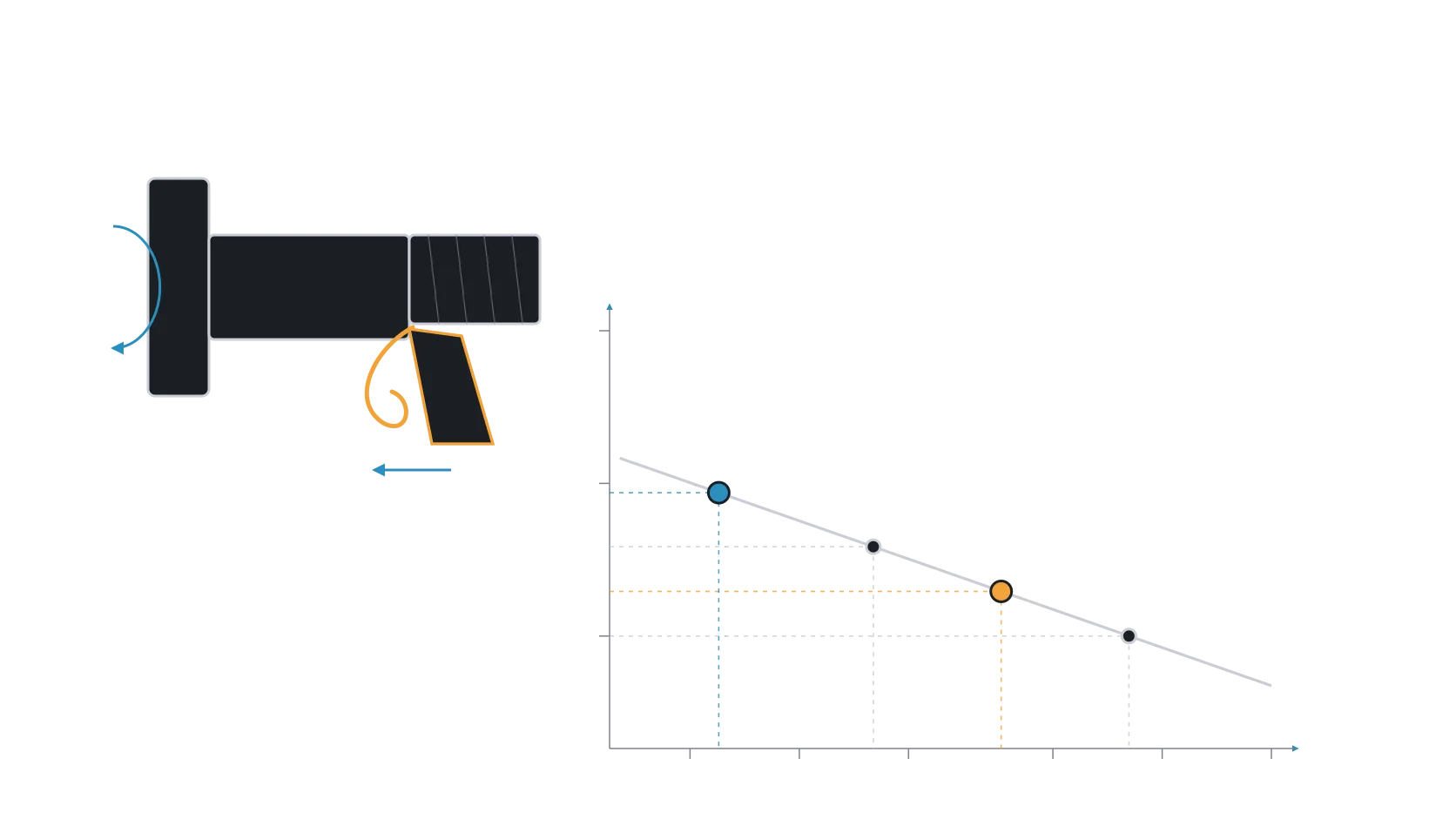
- Tool life for minimum cost: min, so m/min.
- Machining time: spindle speed rpm and min, so one edge lasts parts.
- Cost per part Rs 13.68. At 100 m/min ( min, min) it is Rs 14.43.
- Tool life for maximum production ignores the tool's price: min, m/min, min and the cost rises to Rs 19.67 per part.
Answer. About 122.5 m/min, where each edge lasts 36 minutes (35 parts) and a part costs Rs 13.68 in machine time and tooling. Running slower at 100 m/min costs Rs 14.43; running at the maximum-production speed of 191.7 m/min makes a part in 39 seconds but costs Rs 19.67, because a Rs 100 edge is used up every 9 parts.
Every number here is recomputed when the page is built and checked by an independent script (Skill-Lync, 17 Nov 2026).
Free machining and metrology resources
Everything below is free to read, watch or use. Skill-Lync made all of it except the last group.
Calculators and simulators
Free video lessons
- Reading Feature Control Frames and the ASME Y14.5 Standard24 min · from Geometric Dimensioning and Tolerancing
- Tolerance Stack-Up Analysis with RSS, MRSS and Worst Case21 min · from Geometric Dimensioning and Tolerancing
- Geo and Re-Spot Pin Tolerances, Clamps, Grippers and Terminology38 min · from Introduction to BIW Fixture Design using CATIA V5
- 3D Printing and 3D Modeling Overview with Ansys SpaceClaim7 min · from Additive manufacturing & 3D printing using Ansys SpaceClaim
Articles
- Engineering Metrology Basics Every Beginner Should KnowSkill-Lync blog
- Inspection and Measurement Techniques in GD&TSkill-Lync blog
- GD&T Applications and Interpretations Needed for MeasurementSkill-Lync blog
- GD&T Symbols Explained: Symbol Chart, Feature Control Frames, Datums and MMCSkill-Lync blog
- All About Tolerance Stack-Up AnalysisSkill-Lync blog
- The Fundamentals of Additive ManufacturingSkill-Lync blog
Beyond Skill-Lync
What Skill-Lync students built
966 public project reports on Skill-Lync apply machining and metrology directly (counted by title on 17 Nov 2026):
| Project | What it practises | Reports |
|---|---|---|
| Machining with a planer, simulated | explicit dynamics FEA of a planer tool cutting a workpiece in Ansys Workbench | 168 |
| BIW fixture design | locating, clamping and fixture layouts for car body-in-white panels | 747 |
| GD&T on an assembly drawing | datums and tolerances applied to a butterfly valve assembly | 51 |
How many marks does machining and metrology carry in GATE ME?
Machining and Metrology carried 8.8 marks per paper on average in the 6 GATE Mechanical papers from 2022 to 2026 (each out of 100), between 6 and 13. Skill-Lync solved all 34 of those questions and checked each one against the official answer key.
| 2022 S1 | 2022 S2 | 2023 | 2024 | 2025 | 2026 |
|---|---|---|---|---|---|
| 8 | 10 | 13 | 6 | 7 | 9 |
Marks per paper, from the solved questions on the GATE machining and metrology page; the subject-wise table for every subject is on GATE ME weightage.
Is there a Skill-Lync machining and metrology course?
No dedicated Skill-Lync course on machining and metrology yet. The closest are Geometric Dimensioning and Tolerancing (14 h), Manufacturing (25 h) and Additive manufacturing & 3D printing using Ansys SpaceClaim (10 h), which cover three parts of this subject: GD&T and tolerancing on drawings, a survey of manufacturing processes including metal removal and non-traditional machining, and 3D printing. None teaches machining calculations, CNC part programming or metrology instruments in depth, or exam problem practice.
See every Skill-Lync design course compared. If you want a full machining and metrology course from Skill-Lync, leave your details and we will tell you when one launches.
Machining and Metrology: questions learners ask
Is machining and metrology one subject?
GATE Mechanical lists them as neighbouring topics in its manufacturing section: machining and machine tool operations, then metrology and inspection. The 2027 syllabus also makes additive manufacturing its own topic and moves CNC programming under automation. Universities usually teach Machining Science and Metrology as separate courses, often in the same year.
How many marks do machining and metrology carry in GATE Mechanical?
In the six GATE ME papers from 2022 to 2026 machining, metrology, CNC and additive manufacturing carried 8.8 marks per paper on average, between 6 and 13. Skill-Lync has solved all 34 of those questions step by step, checked against the official answer keys, on the GATE machining page.
What is Taylor's tool life equation?
Taylor's equation, V T^n = C, links cutting speed V to tool life T. The exponent n depends mainly on the tool material and is larger for carbide than for high-speed steel, so carbide loses less life when you speed up. Two tool-life tests at different speeds give n and C, as in the worked example above.
Does Skill-Lync have a machining course?
Not a dedicated one. The closest are the GD&T course for tolerancing, the 25-hour Manufacturing course, which has modules on metal removal, non-traditional machining and 3D printing, and Additive Manufacturing using Ansys SpaceClaim. Everything on this page is free, and you can ask to be told when a machining course launches.