How Are CAD and CAE Revolutionizing Machine Design?
Discover how CAD and CAE are revolutionizing machine design, enhancing precision, efficiency, and innovation in mechanical engineering.
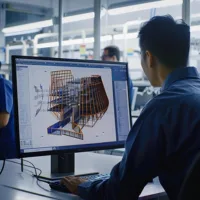
Machine design is a fundamental discipline within mechanical engineering that focuses on creating mechanical systems to perform specific functions. The advent of Computer-Aided Design (CAD) and Computer-Aided Engineering (CAE) has revolutionized this field, enabling engineers to design, analyze, and optimize mechanical systems with unprecedented precision and efficiency. This article explores the roles of CAD and CAE in machine design, highlighting their benefits, applications, and advancements.
The Role of CAD in Machine Design
CAD (Computer-Aided Design) is a technology that allows engineers to create detailed 3D models and drawings of mechanical components and systems. By using CAD software, engineers can:
- Visualize Concepts: CAD enables the visualization of complex designs, allowing engineers to see how different components fit together.
- Enhance Precision: Detailed 3D models ensure that dimensions and tolerances are accurately represented, reducing errors in the manufacturing process.
- Accelerate Design Process: CAD software offers tools for rapid prototyping and iteration, significantly speeding up the design process.
- Improve Collaboration: CAD files can be easily shared and modified, facilitating collaboration among team members and stakeholders.
Applications of CAD in Machine Design
- Automobile Engineering: CAD is extensively used in the design of automotive components such as engines, transmissions, and suspension systems.
- Aerospace Engineering: Engineers use CAD to design aircraft structures, ensuring they meet stringent safety and performance standards.
- Consumer Products: CAD is used to design everyday products, from household appliances to electronic devices.
- Robotics: CAD plays a crucial role in designing robotic systems, including manipulators and mobile robots.
The Role of CAE in Machine Design
CAE (Computer-Aided Engineering) encompasses a range of simulation and analysis tools that help engineers predict the performance of their designs under real-world conditions. Key benefits of CAE include:
- Predictive Analysis: CAE tools, such as Finite Element Analysis (FEA), enable engineers to simulate and analyze stresses, strains, and deformations in mechanical components.
- Optimized Design: CAE allows for the optimization of designs by evaluating multiple scenarios and identifying the best solutions.
- Reduced Prototyping Costs: By simulating physical tests, CAE reduces the need for costly and time-consuming physical prototypes.
- Enhanced Reliability: CAE helps identify potential failure points and allows engineers to address them before production.
Applications of CAE in Machine Design
- Structural Analysis: CAE tools are used to analyze the structural integrity of buildings, bridges, and mechanical components.
- Thermal Analysis: Engineers use CAE to study heat transfer and thermal behavior in systems such as engines and electronics.
- Fluid Dynamics: CAE tools simulate fluid flow in applications such as aerodynamics, hydraulics, and HVAC systems.
- Dynamic Analysis: CAE helps analyze the behavior of systems under dynamic loads, including vibrations and impacts.
Advancements in CAD and CAE Technologies
Recent advancements in CAD and CAE technologies have further enhanced their capabilities:
- Cloud-Based CAD and CAE: Cloud computing has enabled the development of cloud-based CAD and CAE tools, allowing for greater accessibility and collaboration.
- AI and Machine Learning: Integration of AI and machine learning algorithms in CAD and CAE software has improved design automation and predictive capabilities.
- Real-Time Simulation: Advances in computational power have made real-time simulation feasible, enabling engineers to receive instant feedback on design changes.
- Augmented Reality (AR) and Virtual Reality (VR): AR and VR technologies are being integrated into CAD and CAE tools, providing immersive design and analysis experiences.
Conclusion
CAD and CAE have become indispensable tools in the field of machine design, offering engineers the ability to create, analyze, and optimize mechanical systems with unparalleled accuracy and efficiency. As these technologies continue to evolve, they will undoubtedly drive further innovations in mechanical engineering and related fields, leading to the development of more advanced and reliable mechanical systems.
Skill-Lync offers a wide range of industry-relevant upskilling programs to get you career-ready. Click here to sign up for a FREE course demo right away, and let's launch your career together!


