What are stiffness modifiers in the ETABS tool?
A stiffness modifier is a modification factor that is generally used in the properties of cross section such as moment of inertia, torsion etc., aiding in reducing the stiffness in concrete sections to model cracked behaviour of concrete. The stiffness modifier is applied only on concrete structures as it cracks on loading.
 Navin Baskar·11 Aug 2022·2 min read

What are stiffness modifiers in the ETABS tool?
A stiffness modifier is a modification factor that is generally used in the properties of cross-sections such as the moment of inertia, torsion etc., aiding in reducing the stiffness in concrete sections to model cracked behaviour of concrete. The stiffness modifier is applied only on concrete structures as it cracks on loading.
Analysis of structures on other structural elements are generally carried out by forces that depend on the stiffness of the member. Stiffness is defined as the rigidity of the member, or the capacity to resist deformation under the action of the applied load. These loads on structures exert internal forces, resulting in compression and tension in the concrete fibres that arise due to the cracking of the member.
Significance of the stiffness modifier
In ordinary frame structures, the moment of inertia of the structural element is completely taken into account. Hence, the structural elements stiffen and tend to attract seismic forces. These forces would in turn generate cracks in the tension zone, thereby reducing the area of cross section and stiffness to the member. Subsequently, the moment of inertia would also drop more than that of the gross moment of inertia.
So, we need to assign a stiffness modifier to reduce stiffness, defining structural members as cracked sections. By applying stiffness modifiers, one can determine the capacity required in the members once cracked.
Codal recommendations for stiffness modifiers
Earlier, the concept of stiffness modifiers was not taken into account in structural analysis, when IS 1893 (Part 1) - 2002 was in application. At this time, values were derived from different international standards, based on project requirements.
Now, in the latest codal revision of IS 1893 (Part 1) - 2016, the stiffness modifier is provided in Clause 6.4.3.1.
For structural analysis, the moment of inertia shall be taken as
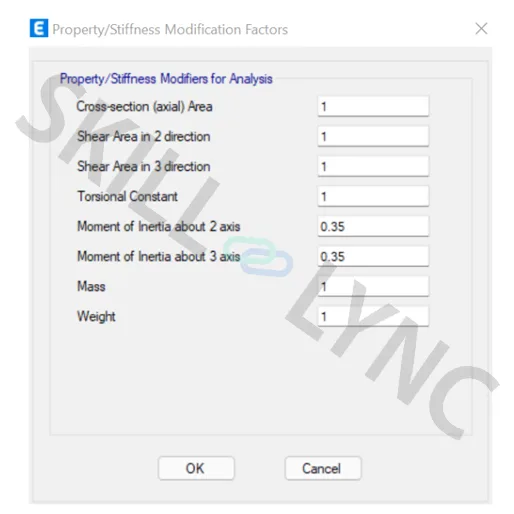
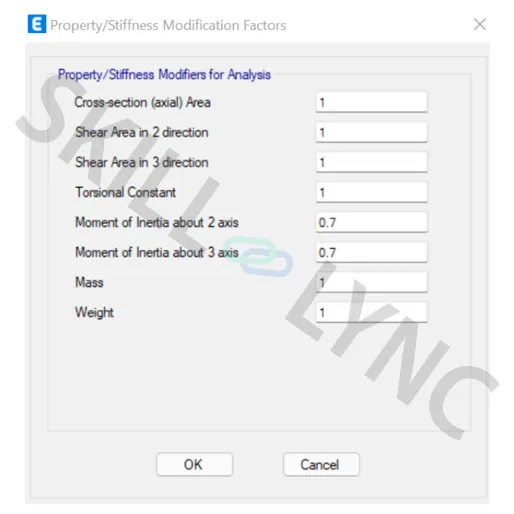
- In RC and masonry structures: 70% of I gross for columns and 35% of I gross for beams
- In steel structures: I gross is taken as 100% for beams and columns
The values suggested in the code were based on numerical experiments and taken from different international codes. The stiffness modifier of the column is higher than that of beam as the column has more axial compression than the beam. Thus, the extent of cracks is lesser in the columns as compared to the beam.
For ACI 318-14, refer to Table 6.6.3.1.1(a)
For column - 0.70 Ig
For beam - 0.35 Ig
For walls - 0.35 Ig for cracked and 0.70 for uncracked
For flat slabs and plates - 0.25 Ig
Ig - Gross moment of inertia
How to apply stiffness modifiers in ETABS?
- In ETABS, the stiffness modifier is assigned with the following steps:
- Go to “Define” → “Section properties” → “Frame Section”
- Select the member property to modify
- On property modifier click on “Modify/Show Modifier”
- Enter the Moment of Inertia for 2 axis and 3 axis as 0.35 for beam and 0.70 for column respectively