Week-7 Challenge: DC Motor Control
Objective:
1. A. Explain a MATLAB demo model named ‘Speed control of a DC motor using BJT H-bridge’.
B. Comment on the armature current shoot-up from the scope results.
C. Refer to the help section of ‘The Four-Quadrant Chopper DC Drive (DC7) block’. Compare it with the H-bridge model.
2. Develop a 2-quadrant chopper using simulink & explain the working of the same with the relevant results.
3. Explain in a brief about operation of BLDC motor.
1. A. Explain a MATLAB demo model named ‘Speed control of a DC motor using BJT H-bridge’.
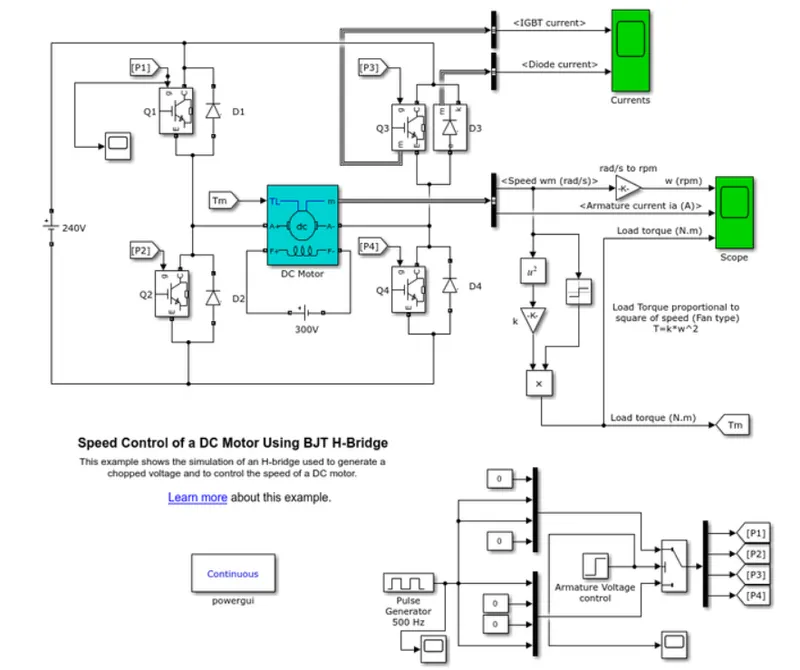
Figure:-1 Simulink model for BJT H-Bridge
Major blocks used in the above simulin model are:
Pulse Generator: It is used to create a pulse to control the gate of the transistor. Amplitude of this pulse is 1 and its period is 0.002 sec. Duty cycle of 75% is maintained.
Switch: It consists of 3 ports u1, u2, and u3. Thresold is maintained at u2=0.5. If the input is active otherwise u3 is active.
Step: THis block is used as armature voltage control. A step time of 0.5 sec is given.
Goto and From: THese blocks are used to take the signal from one place and use it in gate of the transistor.
IGBT(Q): THIS is the insulated gate bipolar transistor working in this model as a chopper.
Diodes: These are used to dissipate the inductor energy when anyone of the chopper is switched off.
DC machines: This is a DC motor of configuration, 5HP 240 V 1750RPM, input is taken as load torque.
Simulation time of 1 sec is given as, First off all for the transistors to work, control signal needs to be studied. For that we go to the pu;se generator block. Here pulse is given according to the duty cycle. Step block has a signal of 0 for 0-0.5 sed and 1 for 0.5-1 sec. Therefore switch's u1 port operates when time is more than 0.5 se=c and u3 operates from 0-0.5 sec. This means P1 and P4 operates in time period of 0-0.5 sec. Hence Q1and Q4 operates in 0-0.5 sec interval. When Q1 and Q4 are switched off, D2 and D3 starrs working. Similarly during 0.5-1 sec interval, u1 starts operating and P2 and P3 operates which means Q2 and Q3 starts operating. When these are switched off, D1 and D4 operates.
Results:
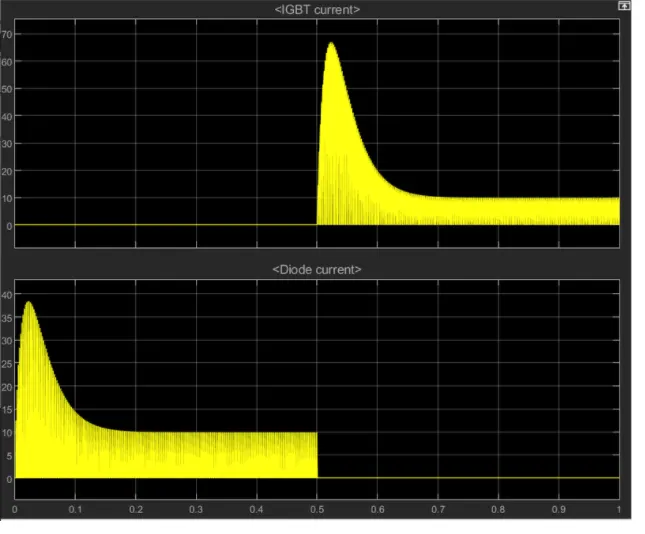
Figure 2:- current in Q3 and D3
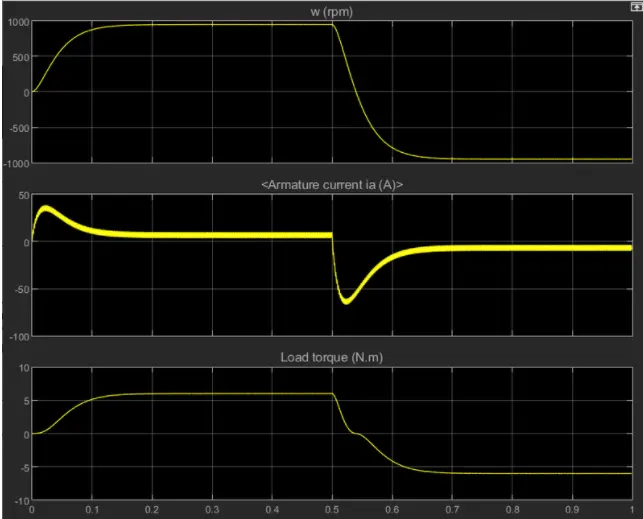
Figure 3:- RPM, Current and Load Torque in DC machine vs Time
1 B. Comment on the armature current shoot-up from the scope results.
Figure:-3 shows the armature current characteristics with respect to simulation time. During accelaration , current jumps up in the starting of the simulation and after almost 0.1 sec, it becomes stable. This means it reaches steady stable. This can be concluded using RPM and Load torque as well.Rpm suddeny increases and then becomes stable.
After 0.5 sec Q2 and Q3 starts operating , direction of the current changes and reverse motoring is observed. Therfore there is a big drop in current observed.
1 C. Refer to the help section of ‘The Four-Quadrant Chopper DC Drive (DC7) block’. Compare it with the H-bridge model.
Just like a 2 quadrant chopper, 4 quadrant chopper consists of 4 choppers and 4 diodes. It operates in 4 quadrants namely Forward Motoring , Forward braking, Reverse motoring and Reverse regenerative braking. Working is shown in the figure below.
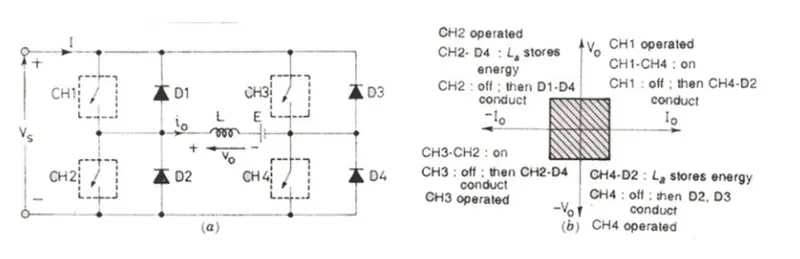
Figure4:- 4 Quadrant Chopper
Simulink Model of a 4 quadrant DC drive is shown below.
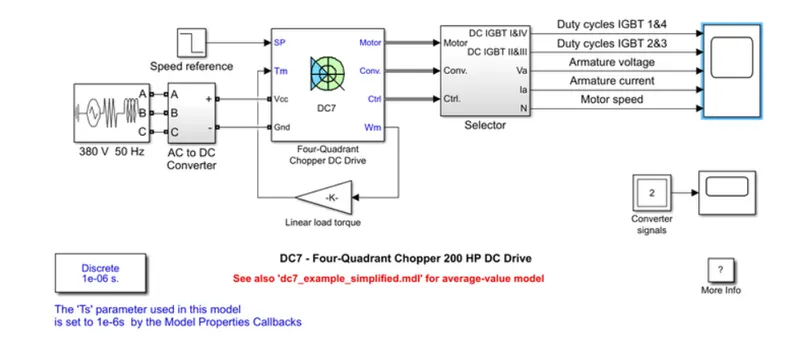
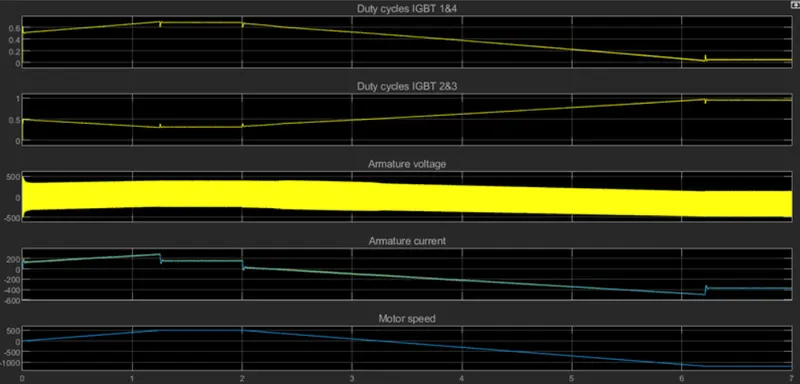
Figure-5 DC7 results
Compare it with H-Bridge Model
- DC7 model has an AC supply of voltage which is furthur converted to DC using a rectifier.Where7m][as in a H-Bridge model.DC supply is given.
- Using a PI current controller, the chopper duty cycle corresponding to the commanded armature current is derived in DC7 model, where as in H-Bridge a duty cycle of &%% is given using a pulse generator provided by us.
- From figure-7 we can see that in DC7 model low ripples in armature current are observed as compared to a armature curent in H-Bridge model as shown in figure-3.
- By default, the field current is set to its steady state value when simulation is started for DC7 model. But in H-Bridge model, current reaches steady state after some time.
- DC7 is a discrete model whereas H_Bridge is a continous model.
- Load Torque with Speed reference is given in DC7 model, whereas in H-Bridge model only Load Torque is given as an input.
2.Develop a 2-quadrant chopper using simulink & explain the working of the same with the relevant results.
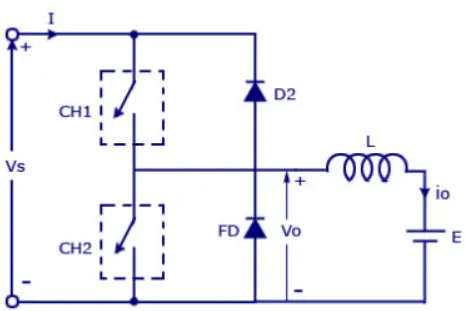
Figure6:- 2 Quadrant chopper circuit
We start with CH_1 ON< I is the amount of current which flows through it. As CH-2 is off, current follows the inductor path and goes to the load. Emf induced in the load is given below.
E=Vs
When current flows through inductor inductor, some energy is stored in the inductor, so when we switch off CH-1 current cannot flowthrough CH-1 and thus it flows through FD diode.
E=0
As soon as the inductor energy is finished or consumed by the motor, CH-2 chopperis switched ON and current follows from Load(moto)to CH-2. This current is negative current. Output voltage is 0 for this time interval.
Again as soon as the Ch-3 is turned off, D2 starts to conduct current.In this case battery ois being charged by the loademf.
VS=E
Using Simulink,
BLocks Used:
DC Voltage source: It is the source voltage of 100V.
IGBT: Insulate Gate Bipolar Trasistor is used as a chopper.
Pulse Generator: This block is used to control the gate of IGBI.
Diode: 1it is a P-N junction diode.
Ground: Grounding the circuit.
Inductor:
Voltage measurment: To measure the voltage.
PowerGUI
Prodecure:
- We follow the figure:-. First of all get all the blocks mentioned beow.
- Source voltage of 100V is used and its positive terminal is connected to collector of IGBT block.To operate CH-1, duty cycle of 50% is used. Maximum maplitude of 1 is used. For CJ-2 just a phase deay of 0.5 sec is given. Signal=0 means off state and 1 means on state.
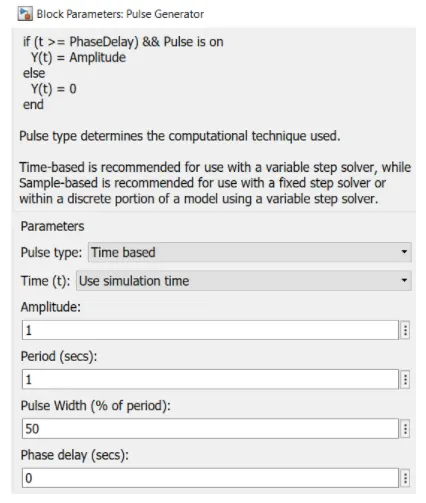
Figure-7 Pulse for CH-7
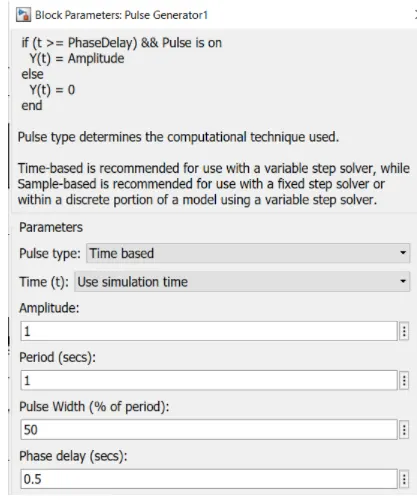
Figure-8 Pulse for CH-2
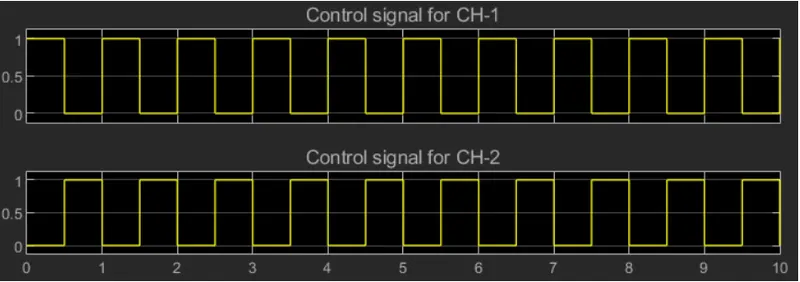
Figure-9 Control signal
- now insert diodes and connect in parallel to the choppers as shown in the circuit diagram. Connect the inductor and ground to the circuit.
- Use voltage measurment block to measure the voltage at input and output and plot all these using scope block. Add powergui block as well.'
Result:-
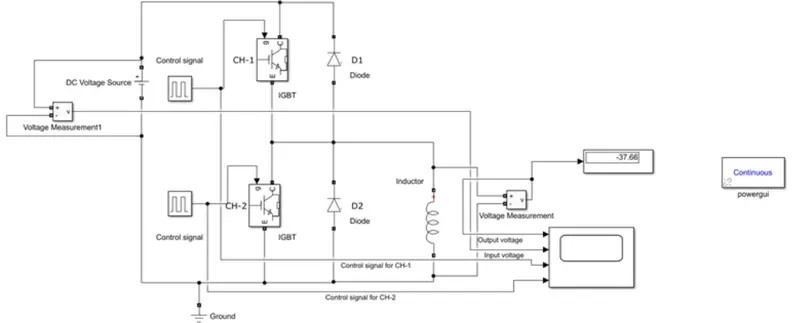
Figure-10 Final simulink model:-
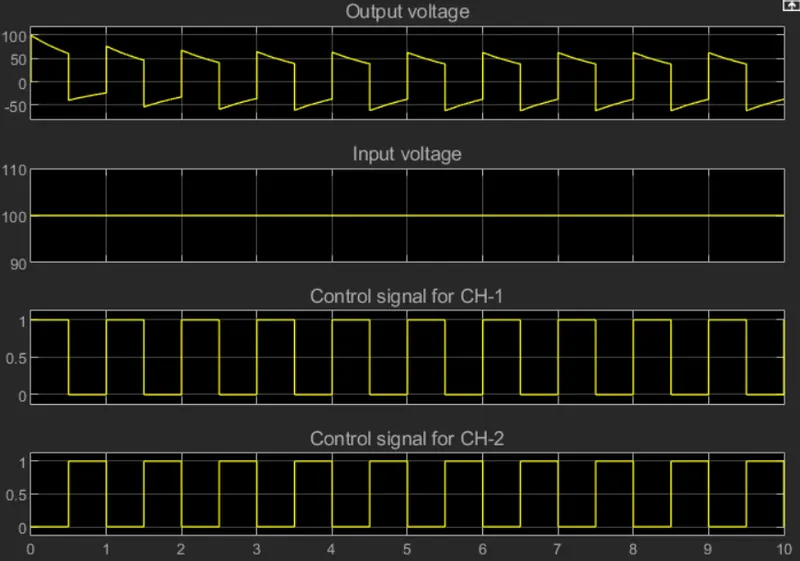
Figure11- Final results
- From the given figure-11, it can be seen that output voltage is positive during motoring and goes to nmegative during regenerative braking.
3. Explain in a brief about operation of BLDC motor.
A brushless DC moto or BLDC motor has a rotor(Permanent magnet) and a stator(coil winding). It is different than a Brushed DC motor in a way that it doesnothave brushls, so no need to worry about wear and tear of the brushes. it consists of electonic commutation.
When none of the coil is energied , rotor remains stationary. Applying voltage across two phases generated combined magnetic field, as a result of this, rotor starts rotating. For a 3-Phase motor, 6 step commutation is observed. Switching of polarity of current in the coil winding is done using a commutator. BLDC motor is controlled by a trapezoidal control.
With increase in pole pairs, Frequency of commutation increases. For proper commutation of motor at right time, with correct phase we need to know the rotor position which id usually measured using a hall sensor.
3 Phase inverter is used to control the phases for 6 step commutation. it converts DC power in 3-phase current.
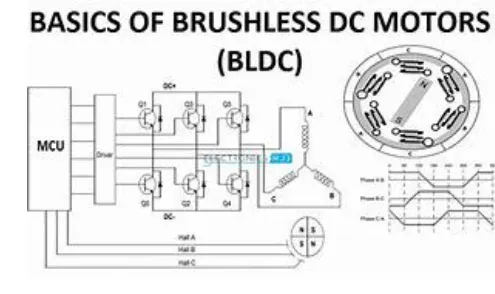
The controller adjusts the phase and amplitude of the DC current pulses to control the speed and torque of the motoe. This control system is an alternative to the mechanical commutator used in many conventional electric motord.
BLDC MOTOR:-(CONSTRUCTION)
Basically a BLDC motor can be constructed in two ways-by placing the rotor outside the core and the windings in the core and another by placing the windings outside the core. In the former arrangment, the rotor magnets act as an insulator and reduce the rate of heat dissipation from the motoe and operate at low current. It is typically used in fans. In the later arrangment, the motor dissipates more heat, thus causing an increase in torque. It is used in hard disk drives.
4 Pole 2 Phase Motor Operation
The brushless DC Motor is driven by an electronic dive that switches the supply voltage between the stator windings as the rotor runs.The rotor position is monitered by transducer which supplies information to the electronic controller and based on this position, the stator winding to be energized is determined. This electronic drive consists of transistors which are operated via a micro processor.
The magnetic field generated by the permanent msgnets interacted with the fiels induced by the current in the stator windings,creating a mechanical torque. The electronic switching circuit or the drive switches the supply current to the stator so as to maintain a constant angle agrees between the interacting fieds. Hall sensors are mostly mounted on the ststor or on the rotor. When the rotor passes through the hall sensor,based on the north or south pole, it generates a high or low signal. Based on the combination of these signals, the windings to engerzied is defined. In order to keep the motoe running,the magnetic field produced by the windings should shift position, as the rotor moves to catch up with the stator field.
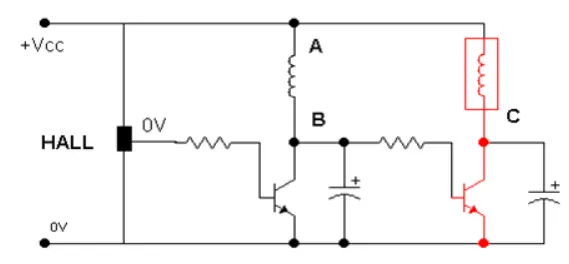
Circuit
In 4 pole,2 Phase brushless DC motor, a single hall sensor is used. Which is embedded on the stator. As the rotor rotates, the hall sensor senses the position and develops a high or low signal, depending on the pole of the magnet. The hall sensor is connected viaba resistor to the transistors. When a high voltage signal occurs at the output of the sensor, the transistor connected to a coil A starts conducting, providing the path for the current to flow and thus energizing coil A. The capacitor starts charging to the full supply voltage. When the hall sensor dxetescts a change in polarity of the rotor, it develops a low voltage signal as its output and since the transistpr 1 doesn't get any supply.It is in cutoff condition. The voltage developed around the capacitor is Vcc, which is the supply voltage to the 2nd transistor and coil B is now energized, as a current passes through it.
BLDC motors, have fixed permanent magnets, which rotates and a fixed armature, eliminating the problems of connecting current to the moving armature. And posibbily more poles on the rotor than the stator or reluctance motors.The latter may be without permanent magnets. just poles that are innduced on the rotor then pilled into an arrangment by timed stator windings. An electric controller replaces the brush assembly of the brushed DC motor, which continously switches the phase to the windings to keep the motor turning. The controller performs comparative timed power distribution by using a solid state circuit instead of the brush system.
Advantages:-
1. Brushless motors are more efficient as its velocity is determined by the frequency at which current is supplied, not the voltage.
2. As brushes are absent, the mechanical energy loss due to friction i sless which ench==hanced efficiency
3. BLDC motor can operate at high speed under any condition.
4.There is no sparking and much less noise during operation.
5. More electro magnets can be usedon the stator for more precise control.
6.BLDC motors accelerate and deaccelerate easily as they are having low motor inertia.
7.It has high performance motor that provides large torque per cubic inch over a vast speed range.
Disadvantages:-
1. BLDC motor cost more than a brushed a DC motor.
2. The limited high power could be supplied to BLDC motor, otherwise, too much heat weakens the magnet and the insulation of windings may get damaged.
3. Not much availabity of many integrated electronic control solutions.
4.Requires complex drive circuitary.