Week-6 Challenge: EV Drivetrain
- which types of power converter circuits are employed in an electric and hybrid electric vehicle?
The control inputs given by the vehicle brake and accelerate pedals are received by the electronic controllers produces control signals to the power source system through power devices. These power devices together form a circuit called a power converter which functions to regulate power flow between the electric motor and energy source.
The power electronic converter is made of solid-state devices which take care of more amount of power from the source and supply the required amount of power to the motor input terminals.
Power converters are made up of high-power fast-acting semiconductor devices, such as bipolar junction transistor (BJT), metal oxide semiconductor field-effect transistor (MOSFET), insulated gate bipolar transistor (IGBT), silicon-controlled rectifier or thyristor (SCR), gate turn-off SCR (GTO), and MOS-controlled thyristor (MCT). These solid-state devices are connected in a form of a circuit topology network that contributes to its function as an on-off electronic switch to convert the fixed supply voltage into a variable voltage and variable frequency supply. There are control input gates or bases to each of the devices which can be turned on or off depending on the demand of supply voltage by the command generated by the controller.
The power converters are responsible to deliver high quality of power based on vehicle demands like highly reliable, flexible, and fault-tolerant electrical power processing system
In the applications of power electronics in EV and HEV vehicles, converters and inverters play a very important role. As we know the devices that convert power from one form to another are known as converters and also helps to step up and step down the system voltage level.
Converters are classified as
- AC to DC Converter(also called Rectifier)
- DC to AC Converter(also called Inverter)
- Ac to AC Converter(also called AC voltage regulator)
- DC to DC Converter (also called Chopper).
The battery charger is composed of AC/DC and or DC/DC converters. Combination of converters or individually used to serve the purpose of power supply.
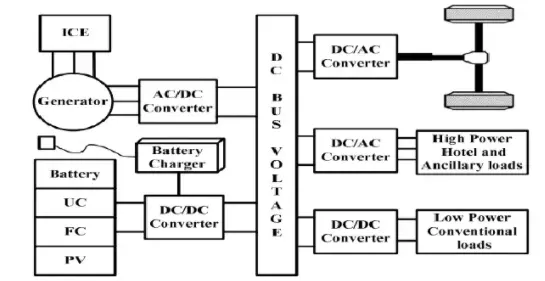
Role of PEC in the modern architecture of electrical power system
for vehicular application
DC/DC Converters:
A DC-DC Converter in its basic form converts unregulated DC input voltage at a certain level to a regulated DC output voltage at a different level with very high conversion efficiency(>90%). Transistors such as MOSFETS and IGBTS are used as switches. MOSFETs are preferred to use in high frequency, low, and medium power applications whereas the IGBTs transistor is used for low frequency and high power applications. The size of the components such as inductors, transformers, and capacitors is reduced at high-frequency operation. Since there is a constant rise in vehicular power requirement due to the replacement of traditionally driven mechanical and pneumatic, and hydraulic systems by the electrically driven systems, DC/DC Converters need to supply high voltage levels (42V, 300V,..) to all the auxiliary loads of the vehicle in order to perform high efficiency.
In EV and HEV, high voltage battery packs are required to supply low voltage electrical loads (12V) for headlights, microprocessors. Switched-mode DC/DC converters are used to such low loads which can operate with high power densities and efficiencies. Since not all types of converters, components, materials, and packing technologies are suitable for the power converters of EV and HEV, different types of converters are available with characteristics for different functions.
PWM DC/DC Converters: The converter operates by repetitively switching between two topologies. When the switch is ON, the converter elements are connected in one topology, and when the diode is ON, elements are connected in different topologies. This switching action converts the input Dc voltage into a pulsating voltage which is filtered through a low-pass filter to get DC voltage at the output. The output voltage can be controlled by controlling the duty ratio.
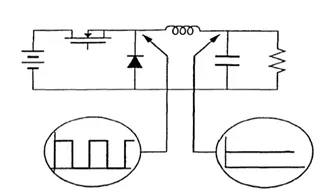
Circuit of Buck Converter
Quasi-Resonant Converters:
To minimize the switching losses when either the voltages or current of these devices are zero, we can prefer a Quasi-resonant Converter. There two types are-
- Zero current switched quasi-resonant converters(ZCS QRC)
- Zero-voltage-switched quasi-resonant Converters(ZVS QRC)
The energy stored in the switch as a result of the parasitic output capacitance is dissipated in the switch each time the switch is on can be minimized by using capacitance.
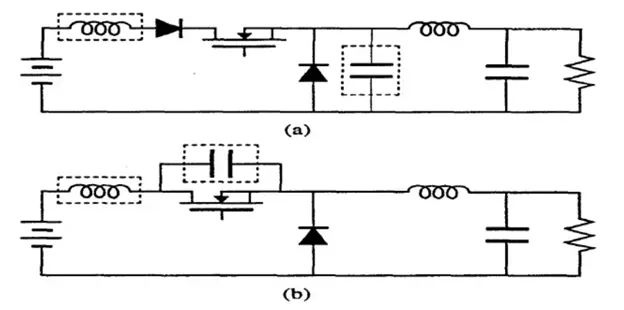
(a)Half-wave Zero-current-switched quasi-resonant buck converter.
(b)Half-wave Zero-voltage-switched quasi-resonant buck converter.
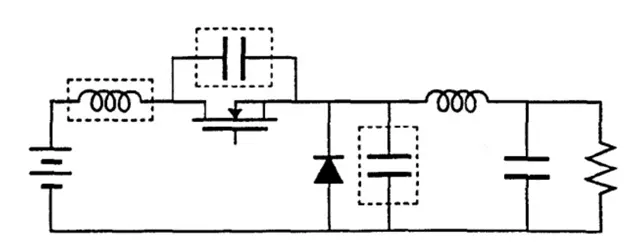
Zero-voltage-switched multi-resonant buck converter
Constant-frequency Quasi-Resonant and Multi-Resonant Converters
Non-Linear Resonant Switch Converters
Resonant Converters:
- Series Resonant Converter
- Parallel Resonant Converter
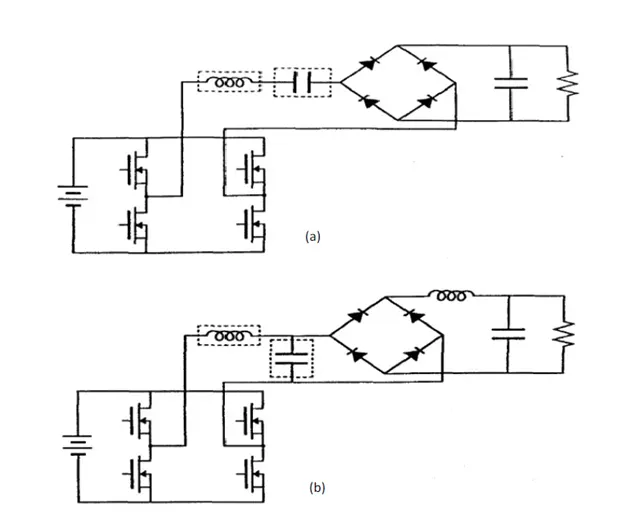
- Series Resonant Converter
- Parallel Resonant Converter
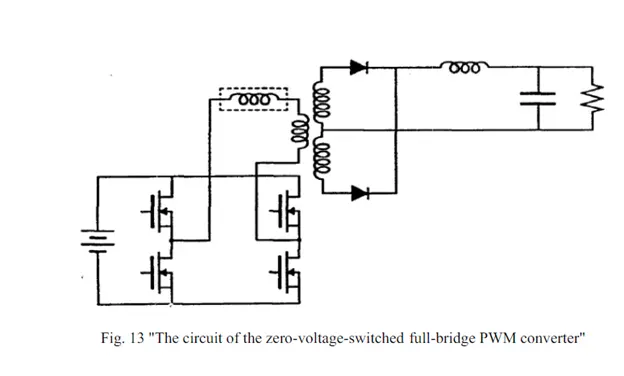
Soft-switched PWM Converters:
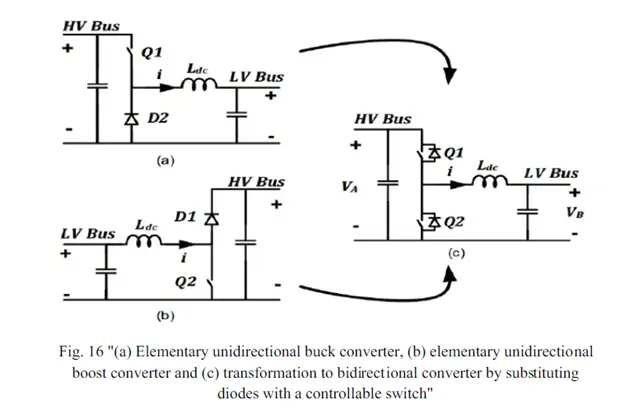
Non-isolated Bidirectional Half-Bridge DC/DC converter:
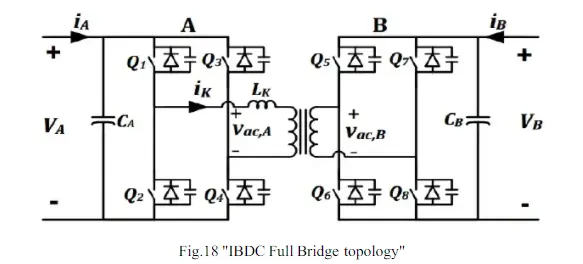
Isolated Bidirectional Full Bridge Dc/DC Converter(IBDC):
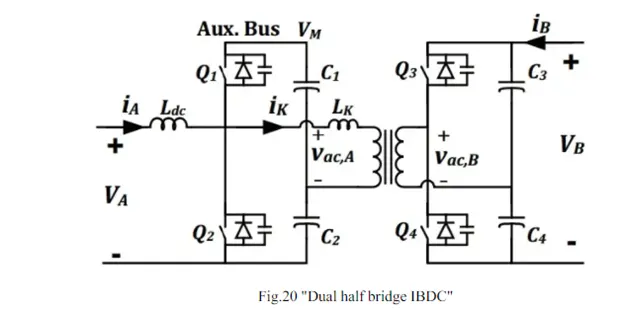
Isolated Bidirectional Dual Half-Bridge DC/DC Converter:
DC/AC Converters:
DC/AC inverter takes DC power from the batteries to drive the electric traction motor which is then transmitted to the wheels through power train. It also recharges the battery during regenerative braking in HEVs. Inverters are of two types-Voltage fed and Current-fed. Since large series inductance is in demand for increasing current source, current fed inverters are used in EV propulsion.
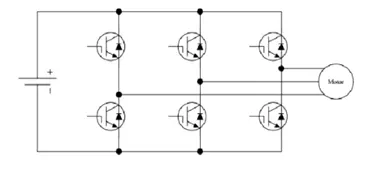
Three-Phase full-bridge Voltage-fed Inverter(VSI)
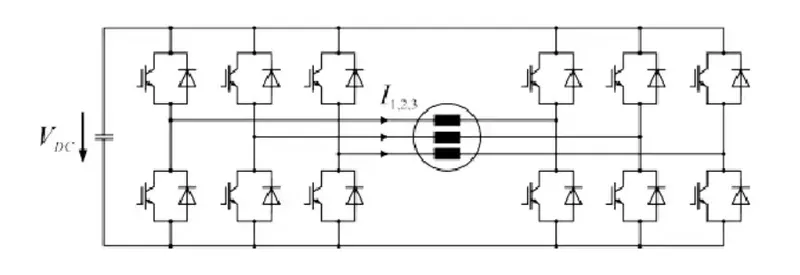
H-Bridge Topology with single DC link:
Soft-Switching Inverters:
- Resonant Dc link Inverter
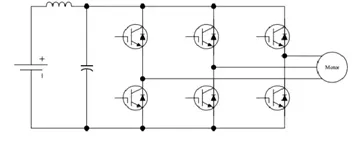
2. Auxiliary Resonant Commutated Pole Inverter.
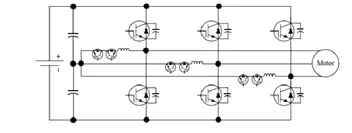
AC/DC converter:
Battery charges in EV are classified as on-board and off-board with unidirectional or bidirectional power flow. Unidirectional charging has some issues with hardware requirements, interconnection issues which leads to reduce battery degradation. A bidirectional charging system supports charge from the grid, battery energy rejection back to the grid, and power stabilization with adequate power conversion. Due to limitations with high power needs an electric drive like AC/DC for power transmissions.
Ev's unidirectional chargers use a diode bridge in conjunction with a filter and DC/DC Converter.
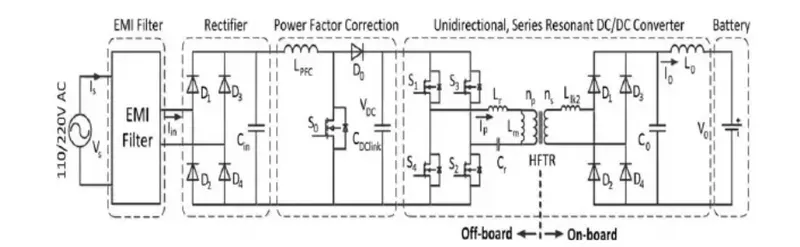
Onboard unidirectional full-bridge series resonant charger
A bidirectional charger has two stages an active grid connected bidirectional AC/DC converter that enforces power factor and a bidirectional DC/DC converter to regulate battery current. This circuit provides high power density and fast control
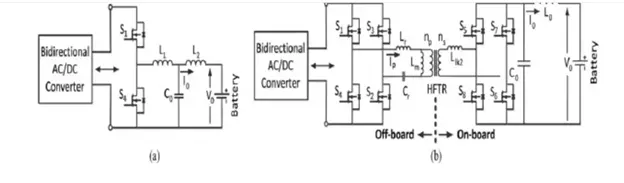
(a) Non-isolated bidirectional two-quadrant charger
(b)Isolated bidirectional dual active bridge charger
Q2. An Electric Vehicles powertrain with a 72V battery pack is shown in the diagram below. The duty ratio for acceleration operation is ‘d1’ and for the braking operation the duty ratio is ‘d2’.
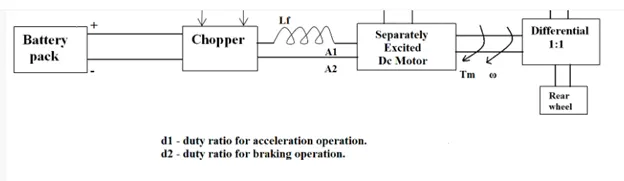
The other parameters of the electric vehicle is given below
Motor and Controller Parameters
Rated armature voltage=72V
Rated armature current=400A
Ra=0.5 KФ=0.7 Volt second
Chopper switching frequency=400Hz
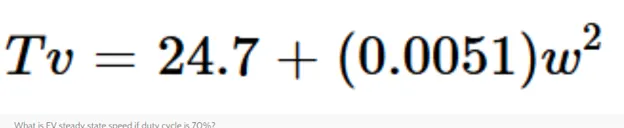
The vehicle speed-torque characteristics are given by the below equation
What is EV steady state speed if duty cycle is 70%?
A)
Duty ratio increases by 70%,
Output Voltage from Chopper, Vv= 72* 70/100=50.4
Motor Constant, Kphi=0.7Vs
Vehicle Torque-speed Characteristic is, Tv = (Vv-wKphi)*Kphi/Ra
Tv = (50.4-w*0.7)*0.7/0.5
Tv = 70.56-0.98w-------1
Given Motor Torque speed characteristic ,Tv=24.7+(0.0051)w^2--------2
Solving equation 1 and 2, 70.56-0.98w=24.7+(0.0051)w^2
W=38.86 rad/s
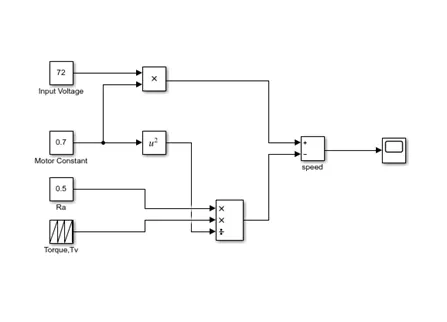
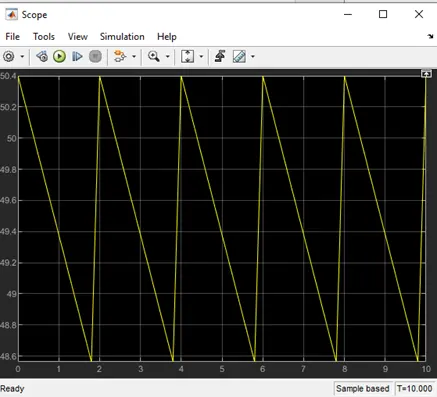
Q3. Develop a mathematical model of a DC Motor for the below equation using Simulink.
ꙍ=V KФ-Ra/ KФ^2.T
A) Simulink Model:
Q4. Refer to the blog on the below topic
Induction versus DC brushless motors by Wally Rippel, Tesla
Explain in brief the author’s perspective.
According to the author's perspective, after Wally Ripple’s and Tesla’s invention both the Brushless Dc motor and 3-phase induction motors are considered as the most efficient drives to date. But still, they have their own drawbacks and at the same time better performance characteristics. Let us see how the Induction motor and brushless DC motors have failed to give the highest efficiency levels. Both of them are two different technologies even though they have the same sets of stators and three-phase modulating inverters but different rotors.
In brushless DC Machines, the rotor will have two or more permanent magnets that generated Dc magnetic field which passes over the current-carrying stator windings and produces the electromagnetic force. With this emf, the rotor rotates produces torque to the shaft. It has become necessary to maintain the magnitude and polarity of the stator currents to be continuously varied in order to maintain the constant torque of the rotor. There comes the importance of a converter to control the voltage variations from DC to AC, which is called an Inverter. When maximum torque is needed at low speeds, the inverter shall adjust by increasing the magnetic field strength with semi-conductor devices. Similarly, when the lower torque is required at the wheel, the inverter should control the field strength. This method of changing field strength with permanent magnets has become difficult. The author expects more ways of improvements should be done with control systems like inverter topology to overcome such issues.
In the Induction motors, there are no magnets but contains stator windings through which the current passes, produces a rotating magnetic field thereby enters the rotor. With this force rotor rotates. Since these motors cannot run from the DC source which forces the use of the inverter here. The Inverter maintains the phase in step with the angular position of the rotor. We can power up from a battery or DC source so that variable speed can be adjusted with inverter frequency. This way of adding inverter also produces low torques compared to DC brushless machines which again thinks about improvisation of the inverter to attain desired torque levels.
So according to the author, the importance of converters is realized, and need to do research on better topologies to attain the highest efficiency overcoming temperature and current loss issues. It is because the only difference between brushless and induction motors are the rotors and the inventor control. And with digital controllers, the only difference is with control code. As there are very few points of percentage difference in their efficiencies, the author says that the development of both DC Brushless motors and Induction motors are more likely to happen in the future expecting more electrical in hybrid vehicles.