MATLAB Scripting of steady and unsteady 2D heat conduction equation
Objective
Write a MATLAB Script to solver 2D Heat Diffusion Equation for Steady-state & Transient State using Jacobi, Gauss-seidel & Successive over-relaxation iterative method for Steady-state & Implicit and Explicit schemes for Transient state.
Input
2D, Plate with negligible thickness
Length of Plate = 1 meter, Width of Plate = 1 meter.
Convegence Criteria is 1e-4.
Boundary Condition:-
Top Boundary = 600 K, Bottom Boundary = 900 K, Left Boundary = 400 K, Right Boundary = 800 K
Uniform grid spacing along x & y direction with 10 nodes.
Thermal Diffusivity - 1.4 m2/s
Over-relaxation factor - 1.1
Timestep - 1000 (for transient simulation)
Discretization of 2D Diffusion Equation (Steady Form)
`(d^2T)/dx^2 + (d^2T)/dy^2 = 0`
Discretization scheme for diffusion term: Central Difference Scheme
`(T_(i+1,j) - 2T_(i,j) + T_(i-1,j))/(deltax)^2 + (T_(i,j+1) - 2T_(i,j) + T_(i,j-1))/(deltay)^2`
Iterarive method such as Jacobi, Gauss-seidel & Successive over-relaxation can be used to solve the above equation to obtain the steady state temperature field.
Jacobi Method - Calculates the temperature of nodes at the current iteration using temperature values of the previous iteration.
`T_(i,j) = (1/k)((Told_(i+1,j) + Told_(i-1,j))/(deltax)^2 + (Told_(i,j+1) + Told_(i,j-1))/(deltay)^2)`
T - Temperature of the current iteration
Told - Temperature of the previous iteration
`K = 2((deltax^2 + deltay^2)/(deltax^2deltay^2))`
Gauss-Seidel Method - Calculates the temperature of nodes at current iteration using temperature values of the latest updated iteration during the iterative procedures.
`T_(i,j) = (1/k)((Told_(i+1,j) + T_(i-1,j))/(deltax)^2 + (Told_(i,j+1) + T_(i,j-1))/(deltay)^2)`
T - Temperature of the current iteration
Told - Temperature of the previous iteration
`K = 2((deltax^2 + deltay^2)/(deltax^2deltay^2))`
Successive over-relaxation Method - Calculates the temperature of nodes at current iteration using temperature values of the previous iteration + Rate of change of temperature with respect to iteration multiplied with an over-relaxation factor.
`T_(i,j) = Told_(i,j) + alpha((dT)/(di))`
where `((dT)/(di)) = (T_(GS) - T_(old))/((n+1) - n)`
`alpha` - over-relaxation factor
n+1 - current iteration
n - old iteration
`T_(i,j)` - Temperature at current iteration
`Told_(i,j)` - Temperature at old iteration
`T_(GS)` - Temperature calculated at current iteration using Gauss-Seidel Method
Finally substituting `(dT)/(di)` in main formula and doing some re-arrangement, The final form we will get as follow
`T_(i,j) = Told_(i,j)(1 -alpha ) + alphaT_(GS)`
Discretization of 2D Diffusion Equation (Transient Form)
`(dT)/(dt) = alpha((d^2T)/dx^2 + (d^2T)/dy^2)`
`alpha` - Thermal Diffusivity
Explicit Method - Temperature of nodes at current time step is calculated based on previous time step nodes temperature.
`((T_(i,j) )^(n+1)-(T_(i,j) )^n)/(deltat)=alpha(((T_(i+1,j))^n - 2(T_(i,j) )^n+ (T_(i-1,j))^n)/(deltax)^2 + ((T_(i,j+1))^n - 2(T_(i,j))^n + (T_(i,j-1))^n)/(deltay)^2)`
Right hand side, all values are known so it can be directly solved for next timestep using time marching approach.
Using Jacobi Method for space marching, the final discretized equation is as follow:-
`(T_(i,j) )^(n+1)=(T_(i,j) )^n + (alphadeltat)/(deltax)^2((T_(i+1,j))^n - 2(T_(i,j) )^n+ (T_(i-1,j))^n) + (alphadeltat)/(deltay)^2((T_(i,j+1))^n - 2(T_(i,j))^n + (T_(i,j-1))^n)`
`(T_(i,j) )^n` - Temperature at previous time step
`(T_(i,j) )^(n+1)` - Temperature at current time step
Stability criteria:-
`(alphadeltat)/(deltax)^2+(alphadeltat)/(deltay)^2 <= 0.5` OR `(CFL_x + CFL_y <= 0.5)`
Implicit Method - Temperature of nodes at the current time step is calculated based on the current time step nodes temperature itself. This leads to a system of linear algebirc equations.
`((T_(i,j) )^(n+1)-(T_(i,j) )^n)/(deltat)=alpha(((T_(i+1,j))^(n+1) - 2(T_(i,j) )^(n+1)+ (T_(i-1,j))^(n+1))/(deltax)^2 + ((T_(i,j+1))^(n+1) - 2(T_(i,j))^(n+1) + (T_(i,j-1))^(n+1))/(deltay)^2)`
Right hand side all values are unknown, Hence Iterative technique such as Jacobi, Gauss-seidel & Successive over-relaxation has to be used followed by time marching.
Using different iterative methods(Jacobi, Gauss-Seidel, SOR), Solution will end up with a different number of iterations to reach specified solution time(0.5 seconds in this case) due to the iterative process nature.
Jacobi Method
`(T_(i,j) )^(n+1)=(T_(i,j) )^n + (alphadeltat)/(deltax)^2((T_(i+1,j))^(n+1) - 2(T_(i,j) )^(n+1)+ (T_(i-1,j))^(n+1)) + (alphadeltat)/(deltay)^2((T_(i,j+1))^(n+1) - 2(T_(i,j))^(n+1) + (T_(i,j-1))^(n+1))`
`(alphadeltat)/(deltax)^2 - CFL_x`
`(alphadeltat)/(deltay)^2 - CFL_y`
`(T_(i,j) )^(n+1)=(T_(i,j) )^n + CFL_x((T_(i+1,j))^(n+1) - 2(T_(i,j) )^(n+1)+ (T_(i-1,j))^(n+1)) + CFL_y((T_(i,j+1))^(n+1) - 2(T_(i,j))^(n+1) + (T_(i,j-1))^(n+1))`
`(T_(i,j) )^(n+1) (1 + 2CFL_x + 2CFL_y) = (T_(i,j) )^n + CFL_x((T_(i+1,j))^(n+1)+ (T_(i-1,j))^(n+1)) + CFL_y((T_(i,j+1))^(n+1) + (T_(i,j-1))^(n+1))`
`(T_(i,j) )^(n+1) = 1/((1 + 2CFL_x + 2CFL_y))((T_(i,j) )^n + CFL_x((T_(i+1,j))^(n+1)+ (T_(i-1,j))^(n+1)) + CFL_y((T_(i,j+1))^(n+1) + (T_(i,j-1))^(n+1)))`
`1/((1 + 2CFL_x + 2CFL_y)) - term_1`
`CFL_x*term_1 - term_2`
`CFL_y*term_1 - term_3`
We can write final equation for jacobi method as:-
`(T_(i,j) )^(n+1) = term_1(Tprev_(i,j) )^n + term_2((Told_(i+1,j))^(n+1)+ (Told_(i-1,j))^(n+1)) + term_3((Told_(i,j+1))^(n+1) + (Told_(i,j-1))^(n+1)))`
`(T_(i,j) )^(n+1)` - Temperature at current time step
`(Tprev_(i,j) )^n` - Temperature at previous time step(This will remain constant with in an iterative loop and will be updated for next time loop)
`(Told_(i,j))^(n+1)` - Temperature at previous iteration(This will change with in an iterative loop)
For the Gauss-Seidel method above equation can be used but with the latest updated temperature values as shown below
`(T_(i,j) )^(n+1) = term_1(Tprev_(i,j) )^n + term_2((Told_(i+1,j))^(n+1)+ (T_(i-1,j))^(n+1)) + term_3((Told_(i,j+1))^(n+1) + (T_(i,j-1))^(n+1)))`
For the SOR method, We will use equation as follow:-
`T_(i,j) = Told_(i,j)(1 -alpha ) + alphaT_(GS)`
`T_(GS) -`Temperature calculated at current iteration using Gauss-Seidel Method
`alpha` - over-relaxation factor
MATLAB Script
I have written separate code for different type of simulations i.e. Steady simulation with Jacobi Method, Steady simulation with Gauss-Seidal Method, Steady simulation with SOR Method, Transient simulation using Explicit Method, Transient simulation using Implicit Method.
I have written a main code where I have defined all the inputs and I have scripted user defined input to select the type of simulation steady or unsteady, type of solver Jacobi, Gauss-Seidal, SOR, Explicit or Implicit.
Main Code
clc
clear all
close all

L = 1;    %length of plate
W = 1;    %width of plate

nx = 10;  %mesh points along x direction
ny = 10;  %mesh points along y direction

nt = 500;  %number of time step for transient simulation
dt = 0.001; %time step size

%generating the grid

x = linspace(0,L,nx);
y = linspace(0,W,ny);

dx = x(2) - x(1);
dy = y(2) - y(1);

error = 5e9;                    %initial error
convergence_criteria = 1e-4;    %convergence criteria

T = 300*ones(nx,ny);            %initializing the temeperature field

%defining boundary condition

T_top = 600;
T_bottom = 900;
T_right = 800;
T_left = 400;

T(:,1) = T_left;
T(:,end) = T_right;
T(1,:) = T_top;
T(end,:) = T_bottom;

%corner nodes temperature

T(1,1) = (T_top + T_left)/2;
T(end,1) = (T_bottom + T_left)/2;
T(1,end) = (T_top + T_right)/2;
T(end,end) = (T_bottom + T_right)/2;


%Selectthe solver

type = sprintf("Steady Simulation - 1 nTransient Simulation - 2n");
disp(type)

simulation_type = input("Select the simulation type: 1 or 2: ");

if simulation_type == 1       %steady

    solver = sprintf("nJacobi Solver - 1 nGauss-Seidel Solver - 2nSOR Solver - 3n");
    disp(solver)

    solver_type = input("Select the solver: 1 or 2 or 3: ");

    if solver_type == 1        %steady jacobi
        jacobi_steady_solver(T,nx,ny,dx,dy,error,convergence_criteria,x,y)
    elseif solver_type == 2    %steady gauss-seidel
        gauss_seidel_steady_solver(T,nx,ny,dx,dy,error,convergence_criteria,x,y)
    elseif solver_type == 3    %steady SOR
        SOR_steady_solver(T,nx,ny,dx,dy,error,convergence_criteria,x,y)
    end

elseif simulation_type == 2    %transient

    solver = sprintf("nExplicit Solver - 1 nImplicit Solver - 2n");
    disp(solver)

    solver_type = input("Select the solver: 1 or 2: ");

    if solver_type == 1        %explicit method
        jacobi_unsteady_explicit_solver(T,nx,ny,dx,dy,dt,nt,x,y,convergence_criteria)
    elseif solver_type == 2      %implicit method

        sub_solver = sprintf("nJacobi Solver - 1 nGauss-Seidel Solver - 2nSOR Solver - 3n");
        disp(sub_solver)

        sub_solver_type = input("Select the sub solver: 1 or 2 or 3: ");

        if sub_solver_type == 1      %implicit jacobi method
            jacobi_unsteady_implicit_solver(T,nx,ny,dx,dy,dt,nt,x,y,convergence_criteria,error)
        elseif sub_solver_type == 2  %implicit gauss-seidel method
            gauss_seidel_unsteady_implicit_solver(T,nx,ny,dx,dy,dt,nt,x,y,convergence_criteria,error)
        elseif sub_solver_type == 3  %implicit SOR method
            SOR_unsteady_implicit_solver(T,nx,ny,dx,dy,dt,nt,x,y,convergence_criteria,error)
        end
    end
end
Code for Steady-State Jacobi Method
function out = jacobi_steady_solver(T,nx,ny,dx,dy,error,convergence_criteria,x,y)

    T_old = T;                 %temperature of previous iteration

    jacobi_iteration = 1;      %initial iteration

    k = (2*(dx^2+dy^2))/((dx^2)*(dy^2));

    %solving

    while (max(error)>convergence_criteria)

        for i = 2:nx-1          %march along x direction
            for  j = 2:ny-1     %march along y direction
                T(i,j) = (1/k)*((T_old(i+1,j)+T_old(i-1,j))/(dx^2) + (T_old(i,j+1)+T_old(i,j-1))/(dy^2));
            end
        end

        error = (max(abs(T_old - T)));      %calculating the error
        T_old = T;                          %updating temperature field
        jacobi_iteration = jacobi_iteration + 1;     %updating the iteration no.

    end

    %Ploting temperature contour

    figure(1);
    contourf(x,y,T);
    clabel(contourf(x,y,T));
    colorbar;
    colormap(jet);
    xlabel('X-Axis');
    ylabel('Y-Axis');

    title_text = sprintf('2D Steady Heat Diffusion, Jacobi Solver, Iterations = %d',jacobi_iteration);
    title(title_text);

    iter = sprintf("Number of Iterations to converge: %d",jacobi_iteration);
    disp(iter)

    set(gca,'ydir','reverse')
end
Code for Steady-State Gauss-Seidel Method
function out = gauss_seidel_steady_solver(T,nx,ny,dx,dy,error,convergence_criteria,x,y)

    T_old = T;          %temperature of previous iteration

    gauss_seidel_iteration = 1;      %initial iteration

    k = (2*(dx^2+dy^2))/((dx^2)*(dy^2));

    %solving

    while (max(error)>convergence_criteria)

        for i = 2:nx-1                 %march along x direction
            for  j = 2:ny-1            %march along y direction
                T(i,j) = (1/k)*((T_old(i+1,j)+T(i-1,j))/(dx^2) + (T_old(i,j+1)+T(i,j-1))/(dy^2));
            end
        end

        error = (max(abs(T_old - T)));         %calculating the error
        T_old = T;                             %updating temperature field
        gauss_seidel_iteration = gauss_seidel_iteration + 1;     %updating the iteration no.
    end

    %Ploting temperature contour

    figure(1);
    contourf(x,y,T);
    clabel(contourf(x,y,T));
    colorbar;
    colormap(jet);
    xlabel('X-Axis');
    ylabel('Y-Axis');

    title_text = sprintf('2D Steady Heat Diffusion, Gauss-Seidel Solver, Iterations = %d',gauss_seidel_iteration);
    title(title_text);

    iter = sprintf("Number of Iterations to converge: %d",gauss_seidel_iteration);
    disp(iter)

    set(gca,'ydir','reverse')
end
Code for Steady-State SOR Method
function out = SOR_steady_solver(T,nx,ny,dx,dy,error,convergence_criteria,x,y)

    T_old = T;          %temperature of previous iteration

    SOR_iteration = 1;    %initial iteration

    k = (2*(dx^2+dy^2))/((dx^2)*(dy^2));

    alpha = 1.6;     %Over-relaxation factor

    %solving

    while (max(error)>convergence_criteria)

        for i = 2:nx-1             %march along x direction
            for  j = 2:ny-1        %march along y direction
                T(i,j) = T(i,j)*(1-alpha) + (alpha*((1/k)*((T_old(i+1,j)+T(i-1,j))/(dx^2) + (T_old(i,j+1)+T(i,j-1))/(dy^2))));
            end
        end

        error = (max(abs(T_old - T)));      %calculating the error
        T_old = T;                          %updating temperature field
        SOR_iteration = SOR_iteration + 1;  %updating iteration no.

    end

    %Ploting temperature contour

    figure(1);
    contourf(x,y,T);
    clabel(contourf(x,y,T));
    colorbar;
    colormap(jet);
    xlabel('X-Axis');
    ylabel('Y-Axis');

    title_text = sprintf('2D Steady Heat Diffusion, SOR Solver, Iterations = %d',SOR_iteration);
    title(title_text);

    iter = sprintf("Number of Iterations to converge: %d",SOR_iteration);
    disp(iter)

    set(gca,'ydir','reverse')
end
Code for Transient Explicit Method
function out = jacobi_unsteady_explicit_solver(T,nx,ny,dx,dy,dt,nt,x,y,convergence_criteria)

    T_old = T;      %temperature of previous time step

    alpha = 1.4;    %thermal diffusivity

    CFL_x = ((2*alpha*dt)/dx^2);    %CFL along x
    CFL_y = ((2*alpha*dt)/dy^2);    %CFL along y

    solution_time = dt;             %tracking the solution time

    for k = 1:nt                    %time marching

            for i = 2:nx-1          %space marching along x
                for  j = 2:ny-1     %space marching along y
                    T(i,j) = T_old(i,j) + CFL_x*(T_old(i+1,j)-2*T_old(i,j)+T_old(i-1,j)) + CFL_y*(T_old(i,j+1)-2*T_old(i,j)+T_old(i,j-1));
                end
            end

    error = max(max(abs(T_old - T)));      %calculating the error
    T_old = T;                             %updating the temperature

    %ploting temperature contour

    figure(1);
    contourf(x,y,T);
    clabel(contourf(x,y,T));
    colorbar;
    colormap(jet);
    xlabel('X-Axis');
    ylabel('Y-Axis');

    solution_time = dt + solution_time;

    title_text = sprintf('2D Explicit Unsteady Heat Diffusion, Jacobi, Solution Time: %.3f s',solution_time);
    title(title_text);

    set(gca,'ydir','reverse')

    if (error < convergence_criteria);
        disp("Simulation has reached steady state!")
        break

    end
end
Code for Transient Implicit Jacobi Method
function out = jacobi_unsteady_implicit_solver(T,nx,ny,dx,dy,dt,nt,x,y,convergence_criteria,error)

    T_old  = T;  %previous iteration temperature
    T_prev = T;  %previous time step temperature

    alpha = 1.4; %thermal diffusivity

    CFL_x = ((2*alpha*dt)/dx^2); %CFL along x
    CFL_y = ((2*alpha*dt)/dy^2); %CFL along y

    term_1 = (1 + 2*CFL_x + 2*CFL_y)^(-1);
    term_2 = term_1*CFL_x;
    term_3 = term_1*CFL_y;

    solution_time = dt;    %tracking the solution time

    jacobi_iteration = 1;

    for k = 1:nt    %time marching

        while (error > convergence_criteria)    %Jacobi Iterative Method

            for i = 2:nx-1             %space marching along x
                for  j = 2:ny-1        %space marching along y

                    H = (T_old(i+1,j) + T_old(i-1,j));
                    V = (T_old(i,j+1) + T_old(i,j-1));
                    T(i,j) = ((T_prev(i,j)*term_1) + (term_2*H) + (term_3*V));
                end
            end

            error = max(max(abs(T_old - T))); %calculating the error
            T_old = T;                        %updating the temperature for next iteration
            jacobi_iteration = 1 + jacobi_iteration;
        end

    error = 1;           %re-assigning the error

    T_prev = T;          %updating the temperature for the next time step

    %ploting temperature contour

    figure(1);
    contourf(x,y,T);
    clabel(contourf(x,y,T));
    colorbar;
    colormap(jet);
    xlabel('X-Axis');
    ylabel('Y-Axis');

    solution_time = dt + solution_time;

    title_text = sprintf('2D Implicit Unsteady Heat Diffusion, Jacobi, Solution Time: %.3f s',solution_time);
    title(title_text);

    set(gca,'ydir','reverse')

    end

end
Code for Transient Implicit Gauss-Seidel Method
function out = gauss_seidel_unsteady_implicit_solver(T,nx,ny,dx,dy,dt,nt,x,y,convergence_criteria,error)

    T_old  = T; %previous iteration temperature
    T_prev = T; %previous time step temperature

    alpha = 1.4;       %thermal diffusivity

    CFL_x = ((2*alpha*dt)/dx^2); %CFL along x
    CFL_y = ((2*alpha*dt)/dy^2); %CFL along y

    term_1 = (1 + 2*CFL_x + 2*CFL_y)^(-1);
    term_2 = term_1*CFL_x;
    term_3 = term_1*CFL_y;

    solution_time = dt;         %tracking the solution time

    gauss_seidel_iteration = 1;

    for k = 1:nt         %time marching

        while (error > convergence_criteria)    %Gauss-Seidel Iterative Method

            for i = 2:nx-1           %space marching along x
                for  j = 2:ny-1      %space marching along y

                    H = (T_old(i+1,j) + T(i-1,j));
                    V = (T_old(i,j+1) + T(i,j-1));
                    T(i,j) = ((T_prev(i,j)*term_1) + (term_2*H) + (term_3*V));
                end
            end

            error = max(max(abs(T_old - T)));     %calculating the error
            T_old = T;                            %updating the temperature for next iteration
            gauss_seidel_iteration = 1 + gauss_seidel_iteration;
        end

    error = 1;          %re-assigning the error

    T_prev = T;         %updating the temperature for the next time step

    %ploting temperature contour

    figure(1);
    contourf(x,y,T);
    clabel(contourf(x,y,T));
    colorbar;
    colormap(jet);
    xlabel('X-Axis');
    ylabel('Y-Axis');

    solution_time = dt + solution_time;

    title_text = sprintf('2D Implicit Unsteady Heat Diffusion, Gauss-Seidel, Solution Time: %.3f s',solution_time);
    title(title_text);

    set(gca,'ydir','reverse')

    end

end
Code for Transient Implicit SOR Method
function out = SOR_unsteady_implicit_solver(T,nx,ny,dx,dy,dt,nt,x,y,convergence_criteria,error)

    T_old  = T; %previous iteration temperature
    T_prev = T; %previous time step temperature value

    alpha = 1.4;    %thermal diffusivity

    omega = 1.1;    %over-relaxation factor

    CFL_x = ((2*alpha*dt)/dx^2);  %CFL along x
    CFL_y = ((2*alpha*dt)/dy^2);  %CFL along y

    term_1 = (1 + 2*CFL_x + 2*CFL_y)^(-1);
    term_2 = term_1*CFL_x;
    term_3 = term_1*CFL_y;

    solution_time = dt;        %tracking the solution time

    SOR_iteration = 1;

    for k = 1:nt          %time marching

        while (error > convergence_criteria)         %SOR Iterative Method

            for i = 2:nx-1      %space marching along x
                for  j = 2:ny-1 %space marching along y

                    H = (T_old(i+1,j) + T(i-1,j));
                    V = (T_old(i,j+1) + T(i,j-1));

                    T_gauss_seidel = ((T_prev(i,j)*term_1) + (term_2*H) + (term_3*V));

                    T(i,j) = T_old(i,j)*(1-omega) + (T_gauss_seidel*omega);
                end
            end

            error = max(max(abs(T_old - T)));       %calculating the error
            T_old = T;                              %updating the temperature for next iteration
            SOR_iteration = 1 + SOR_iteration;
        end

    error = 1;        %re-assigning the error

    T_prev = T;       %updating the temperature for the next time step

    %ploting temperature contour

    figure(1);
    contourf(x,y,T);
    clabel(contourf(x,y,T));
    colorbar;
    colormap(jet);
    xlabel('X-Axis');
    ylabel('Y-Axis');

    solution_time = dt + solution_time;

    title_text = sprintf('2D Implicit Unsteady Heat Diffusion, SOR, Solution Time: %.3f s',solution_time);
    title(title_text);

    set(gca,'ydir','reverse')

    end

end
Results for Steady Cases
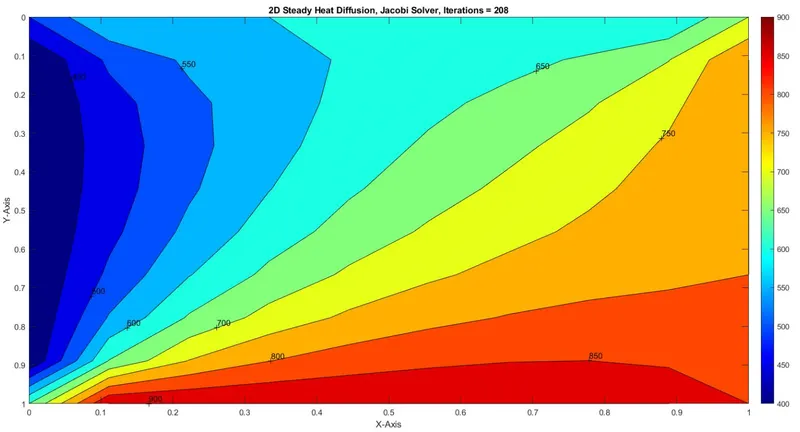
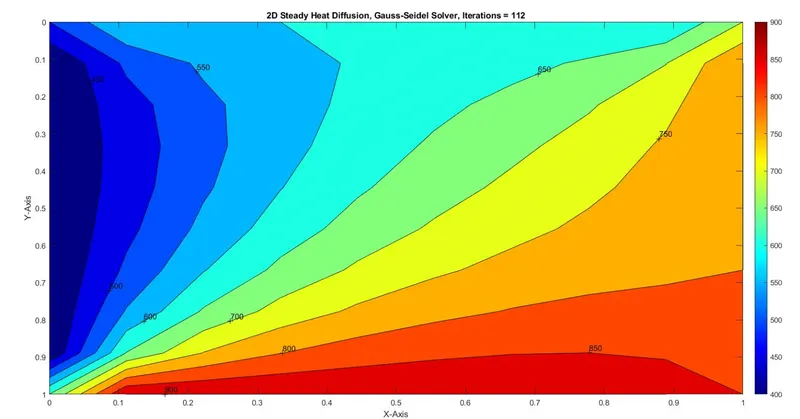
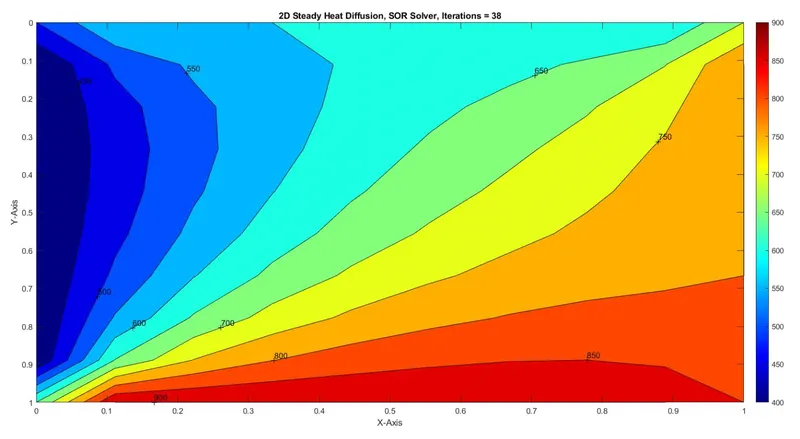
| Solver Type | Number of iterations to reach convergence |
| Jacobi | 208 |
| Gauss-Seidel | 112 |
| SOR (over relexation factor = 1.1) | 38 |
SOR takes the least iterations to reach a steady-state solution whereas Jacobi takes the maximum number of iterations.
Results for Transient Cases
Explicit Scheme with Jacobi Solver
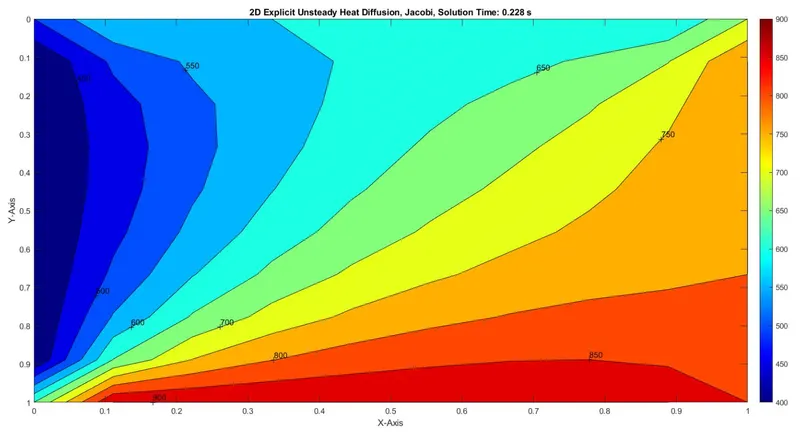
The temperature field reaches a steady-state in 0.228 seconds.
Implicit Scheme with Jacobi, Gauss-Seidel & SOR Solver
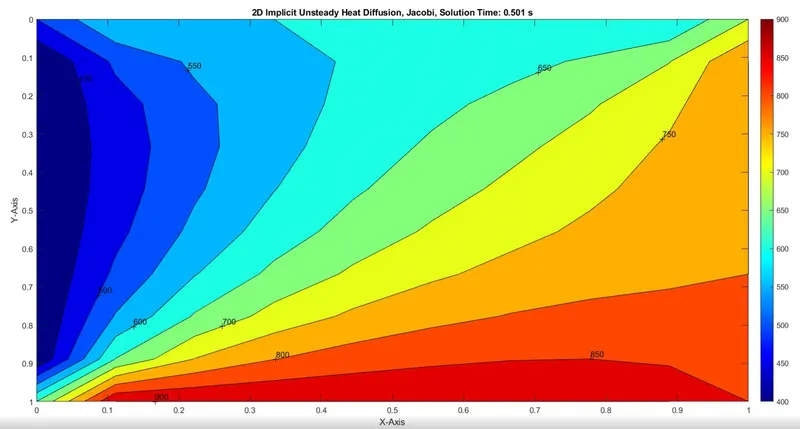
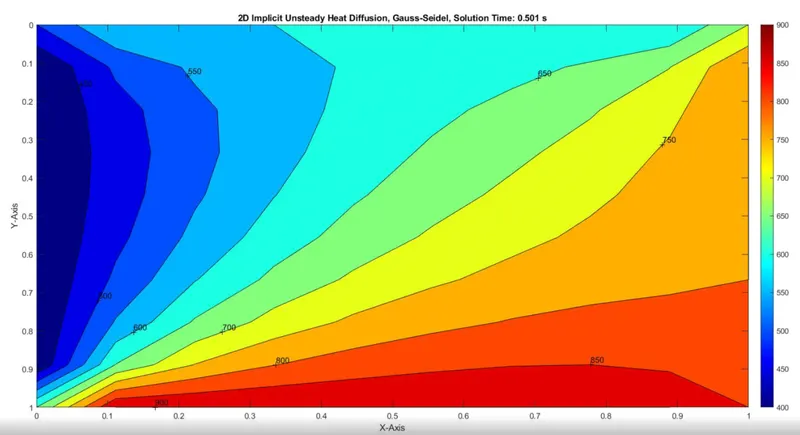
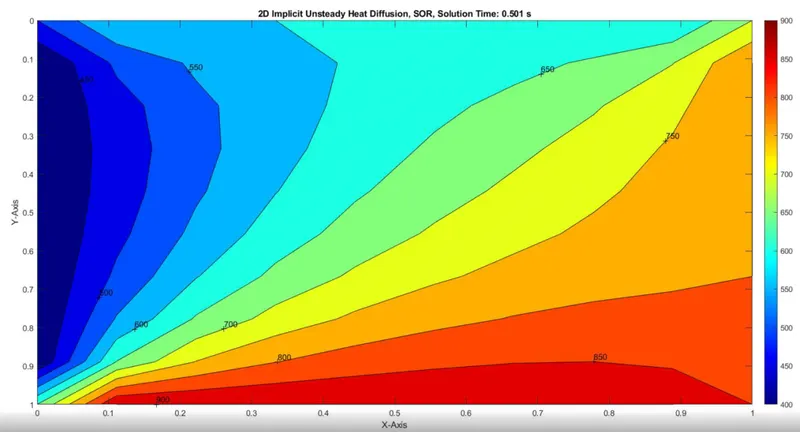
For the implicit method, the solution time is 0.5 seconds.
The temperature field has reached its steady state.
Jacobi method takes a maximum of 2318 iterations to reach 0.5 seconds of solution time.
Gauss-Seidel method takes 1790 iterations to reach 0.5 seconds of solution time.
SOR method takes a minimum of 1548 iterations to reach 0.5 seconds of solution time.